White Label AI SDR: How Agencies Resell Outbound Under Their Own Brand (2026)
A white label AI SDR lets an agency run LinkedIn-first outbound under its own brand instead of reselling a vendor's tool. This 2026 guide defines the term, compares refer vs white-label vs build, lays out a step-by-step launch, names the BRAND stack to check, and covers the real safety tax at scale with sourced rules from LinkedIn and Google.
Connect & share


- A white-label AI SDR is outbound software you run under your own brand, not a tool you refer clients to.
- Three models exist: refer, white-label, or build. Most agencies should white-label.
- Safety is the real job at scale: LinkedIn bans bulk automation, and email has a hard spam line.
- Win on delivery, data ownership and clear reporting, never on promises of "unlimited" volume.
An agency owner adds "AI outbound" to the menu. The demos look slick, the first client signs, and the booked meetings start to land. Then month three arrives and the client asks a quiet question: why does the dashboard still show someone else's name, and whose leads are these anyway?
That one question decides whether white-label is a real business or just a resale coupon. This guide shows what a white-label AI SDR actually gives you, what it does not, and how to deliver it safely across many clients. We answer the client's question — whose brand, whose data, whose risk — at the end.
Let us start with the term itself, because most pages use it loosely.
What is a white label AI SDR?
A white label AI SDR is outbound software you run under your own brand. It does the work of a sales development rep. It finds prospects, sends first messages, follows up, and passes replies to a human.
"White label" means your logo, domain and client sit on top. Another company runs the platform underneath.
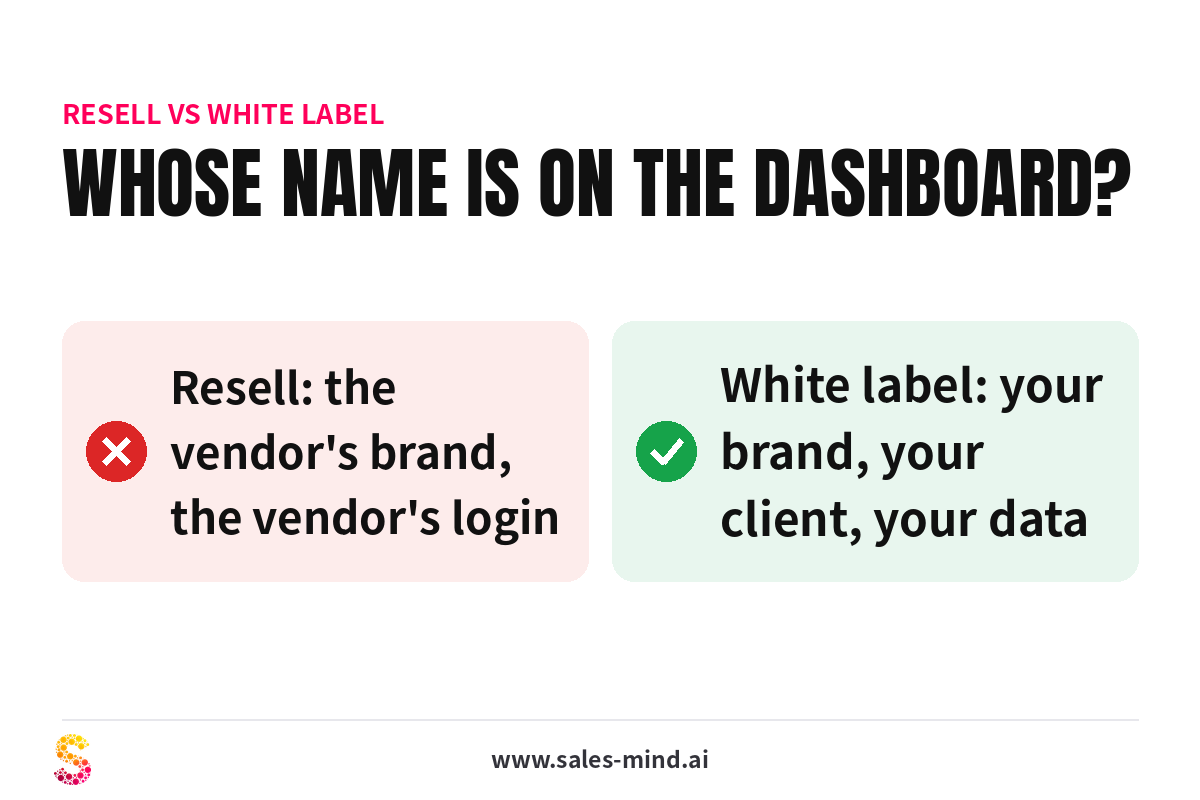
It is not the same as reselling a tool. Reselling sends your client to log in to a vendor's dashboard, with the vendor's name on the screen. White-label keeps the client inside your brand. SalesMind is one example of this model: a LinkedIn-first AI SDR that agencies can run under their own name for each client.
Think of it like a coffee brand. You can hand someone a competitor's cup, or you can serve the same coffee in your own cup, with your own service around it. Same beans, very different business.
White label vs reselling vs building: which model fits your agency?
Pick the model by where your value comes from. If it is client service and delivery, white-label fits best. If it is pure referral, resell. If it is proprietary technology, build. Here is the trade-off in one view.
| Model | Who the client sees | What you control | Best when |
|---|---|---|---|
| Refer / resell | The vendor | Little: a margin, maybe a discount code | You only want a referral fee |
| White-label | You | Brand, pricing, client data, service and reporting | Delivery and client service are your edge |
| Build from scratch | You | Everything, including the code and the upkeep | Your product itself is the business |
Most agencies sit in the middle. You do not want to send clients to a competitor's login, and you do not want to hire engineers to rebuild outreach, deliverability and a LinkedIn integration from zero. White-label gives you the brand and the service without the code.
Why reselling leaks value
When the client logs in to the vendor, three things leak: your brand, your pricing power, and the relationship. The next renewal, the client wonders why they pay you and not the vendor directly. White-label closes that leak by keeping every touch inside your name.
Why building rarely pays
Building your own AI SDR means owning spam filters, warm-up, LinkedIn safety and a support queue forever. That is a product company, not an agency. Choose it only when the software itself is what you sell.
How to launch a white label AI SDR under your brand
Launching is a short, ordered process. Do it in this sequence and your first client campaign can be live in days, not months.
- Pick one niche. Choose a vertical you already understand, so your messaging and targeting are sharp from day one.
- Set up the brand layer. Your logo, your domain, your dashboard. The client should never see the underlying vendor.
- Give each client a separate workspace. One isolated account per client keeps data, limits and reporting clean as you add more.
- Agree the rules of engagement. Human-paced sending, real personalization, and limits that respect each platform. Write them down before the first message.
- Connect the channels. LinkedIn first for trust, email as backup for reach. Authenticate your sending domains before any email goes out.
- Define the handoff. Decide who answers a positive reply and how fast. A booked meeting is the product; the inbox cannot sit idle.
- Report weekly. Send a simple, branded summary: messages sent, replies, meetings booked. Clear reporting is what renews contracts.
Notice that most of these steps are service decisions, not technical ones. That is the point of white-label: the platform handles the plumbing so you can run the relationship.
The BRAND stack: five layers to check
Before you resell anything, make sure the platform gives you all five layers below. We call it the BRAND stack, and we use the same name across our LinkedIn posts and videos so it is easy to remember.
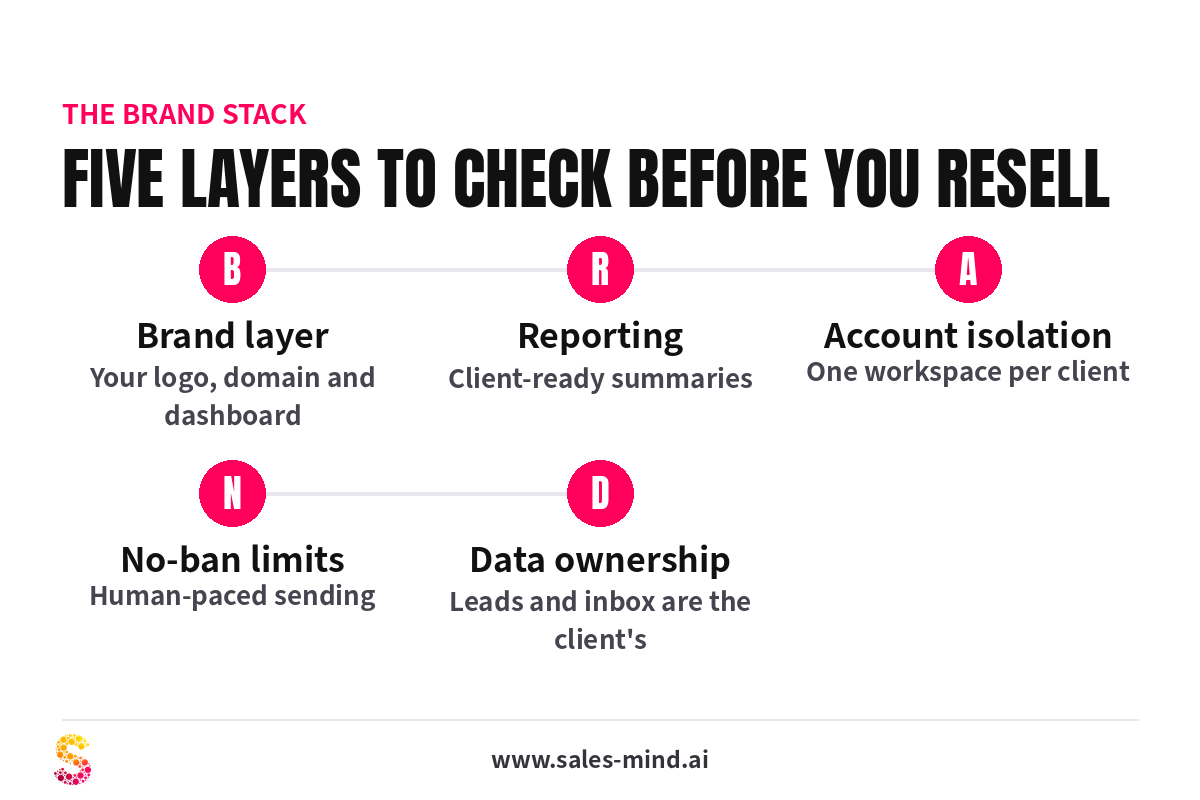
- B — Brand layer: your logo, your domain, your dashboard on every screen.
- R — Reporting: client-facing summaries you can send without editing.
- A — Account isolation: one separate workspace per client, no shared data.
- N — No-ban limits: human-paced sending that respects each platform's rules.
- D — Data ownership: the leads, replies and inbox belong to the client.
What goes wrong at scale: the safety tax
At one client, safety is easy. Across ten, it is the whole job. Both LinkedIn and email charge a safety tax, and ignoring it is the fastest way to lose a client's account or domain.
Does LinkedIn allow automation?
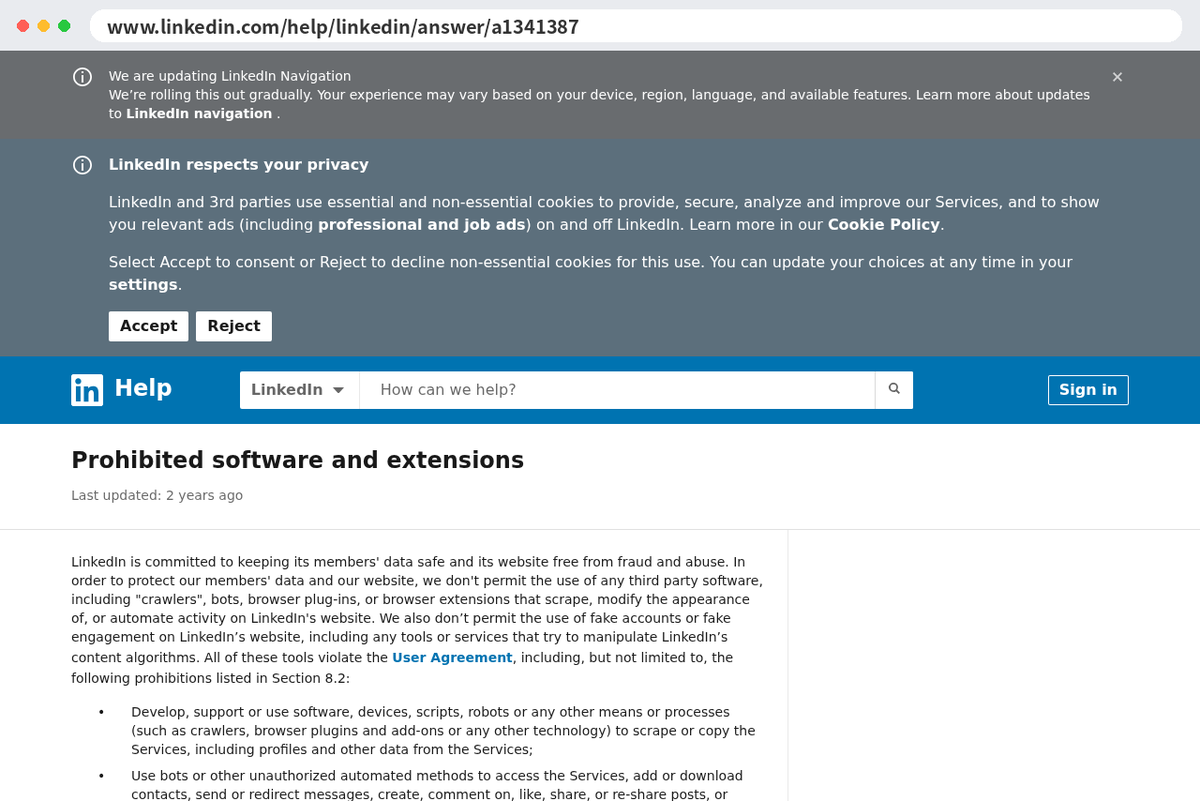
No — not bulk or bot automation. LinkedIn's Help Center page on prohibited software and extensions is clear. It does not allow third-party tools that scrape or automate activity on the site. Members who use them risk a restricted or closed account (as of November 2026).
But buyers are still there. LinkedIn says it has more than 1 billion members. So the goal is simple: human-paced, personal messages, one account at a time. Never a bot blasting invites.
For a white-label agency, this is the make-or-break layer. One workspace per client, conservative sending limits, and real personalization keep accounts safe. Promising a client "unlimited LinkedIn automation" is how you lose their account and the contract.
Can cold email hurt my clients' domains?
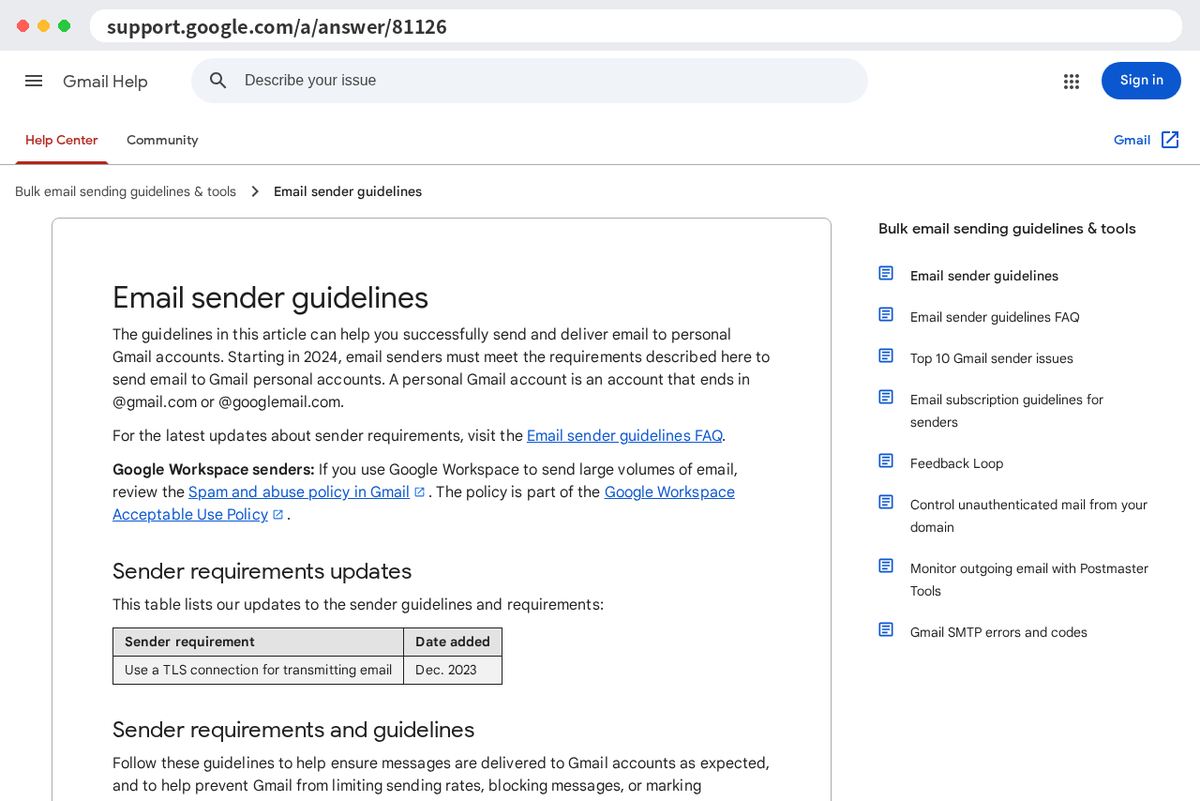
Yes, and fast. Google's Email sender guidelines set a hard line. Senders to Gmail must keep spam complaints below 0.3% (as of November 2026). Bulk senders — 5,000 or more emails a day — must also set up SPF, DKIM and DMARC and a one-click unsubscribe.
Cross that line and even clean emails hit junk. That hurts the domain your client's business runs on.
So at scale, the platform's safety features are not a nice-to-have. They are the product. Pick one that enforces limits for you, not one that lets you pour fuel on the fire.
What to look for in a white label AI SDR platform
Use this checklist when you compare platforms. Score each one against the BRAND stack and the safety tax, not against a long feature list.
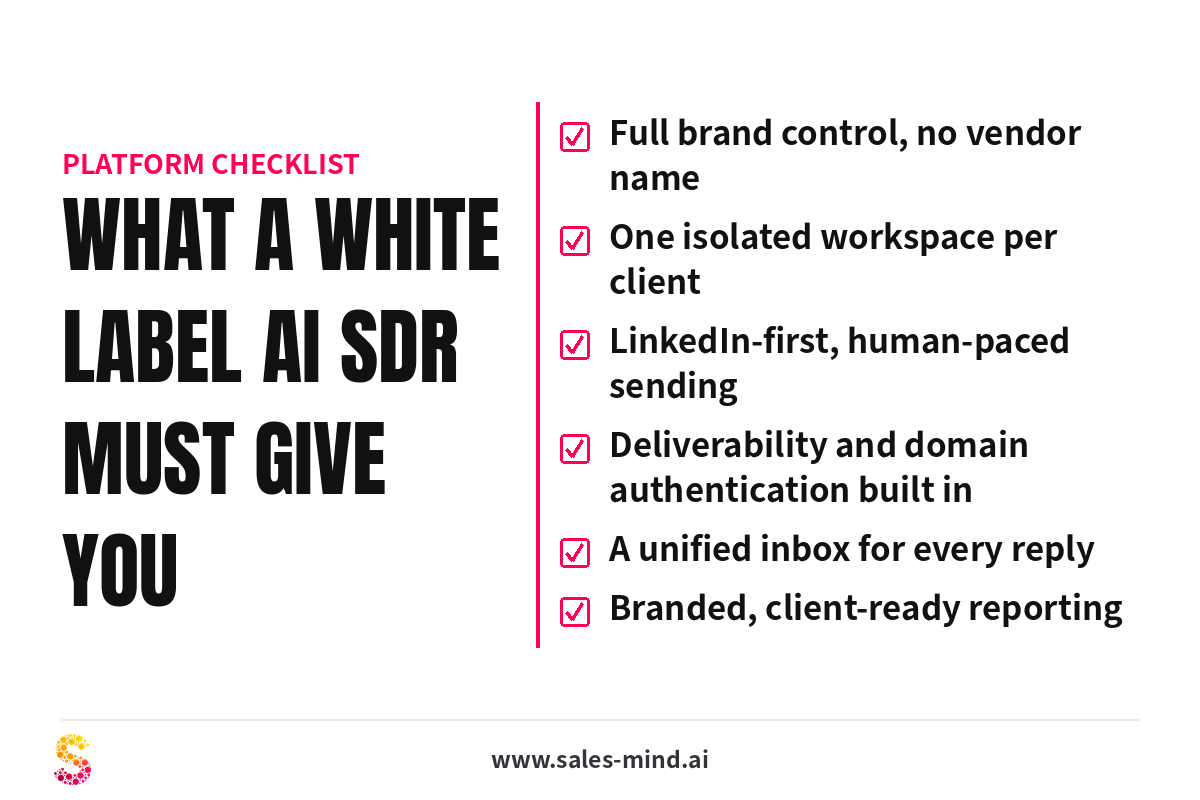
- Full brand control: your logo, domain and dashboard, with no vendor name in front of clients.
- Per-client isolation: separate workspaces so data, limits and reports never mix.
- LinkedIn-first by design: personalization and human-paced sending, not mass automation.
- Deliverability built in: domain authentication and sending controls, so a weak list cannot sink a client.
- A unified inbox: every reply in one place, so no booked meeting is missed.
- Client-ready reporting: branded summaries you can send as they are.
Email is useful as a backup channel, and some platforms add a waterfall email finder that checks several data sources for a work address. Treat it as a supporting feature: no finder returns every email, and hidden addresses stay hidden.
For a wider view of how agencies run safe outreach, our guides on LinkedIn outreach and automating LinkedIn messages without getting banned go deeper on the rules.
Mistakes agencies make with white label AI SDRs
Most white-label launches fail for the same few reasons. Avoid these and you keep clients longer.
Selling volume instead of outcomes
Clients do not buy 10,000 messages. They buy meetings. Promise booked conversations and real replies, not a send count. A high volume of weak messages hurts reply rates and reputation.
Sharing one account across clients
Mixing clients in one workspace blurs data, breaks reporting, and spreads any safety problem to everyone. Keep one isolated workspace per client from the first day.
Skipping the human in the loop
An AI SDR earns the reply. A person still closes. If no one owns the positive replies, the meetings you worked for slip away. Define the handoff before you launch.
Avoid those three, run the BRAND stack, respect the safety tax, and white-label becomes a durable service — not a resale coupon. SalesMind runs this model LinkedIn-first, under your brand, with the inbox and reporting your clients see. If you want help setting it up, book a strategy call and we will map it to your niche.
Frequently Asked Questions
It is outbound sales software you run under your own brand that acts like a sales development rep: it finds prospects, sends first messages, follows up, and routes replies to a human. Your logo and client relationship sit on top; another company maintains the platform underneath.
No. Reselling sends your client to the vendor's dashboard with the vendor's name on it. White-label keeps the brand, pricing, data and reporting inside your agency, so the client experiences the service as yours.
Yes, with limits. LinkedIn's Help Center prohibits bots and bulk automation and can restrict accounts that use them. Safe scale means one workspace per client, human-paced sending, and real personalization — not mass automation across shared accounts.
You need verified sending domains. Google's sender guidelines ask bulk senders for SPF, DKIM and DMARC, plus a spam rate below 0.3%. A good white-label platform sets this up and caps your sending. A weak list should not be able to hurt a client's domain.
Price on the outcome and the service you wrap around the platform — meetings booked, niche expertise, reporting and support — rather than on message volume. Because the client sees only your brand, you set the price, not the vendor.
The data. The leads, replies and inbox belong to the client, and the relationship belongs to your agency. That ownership is what separates a real white-label service from a referral link.
Get AI Sales Insights Weekly

