AI Sales Systems: How to Build One That Actually Books Meetings
An AI sales system connects six layers - data, targeting, signals, outreach, follow-up, and a feedback loop - into one engine that books more meetings over time.
Share this article
- Automating a broken process. AI makes a bad workflow faster, not better. Fix the flow first.
- Chasing volume over fit. Reaching more of the wrong people just burns your reputation.
- Ignoring the feedback loop. Without learning, your system is just a fancy mail merge.
- Skipping human judgment. The best systems keep a person on the message and the relationship; AI handles the busywork.
AI sales systems are quickly becoming the difference between teams that grow pipeline every quarter and teams that stall. But most companies get the idea wrong. They buy a shiny AI tool, bolt it onto a messy process, and wonder why nothing changes. A real AI sales system is not one app — it is a connected set of layers that work together to find the right buyers, reach them at the right moment, and learn from every reply. This guide shows you how to build one that actually books meetings.
Think of it less like buying a robot and more like building an engine. Each part matters, and the parts have to fit. Let's walk through what that engine looks like and how to assemble it without a giant team.
What an AI sales system really is
An AI sales system is the full workflow that turns raw market data into booked conversations, with AI doing the heavy lifting at each step. It is different from a single feature like an email writer. A feature helps one task. A system connects targeting, outreach, follow-up, and learning so the whole thing gets smarter over time.
The goal is simple: help your team spend their hours on the conversations most likely to close, and let AI handle the research, sorting, and timing that used to eat the day. When you use AI for sales this way, your reps stop guessing and start talking to ready buyers.
The 6 building blocks of an AI sales system
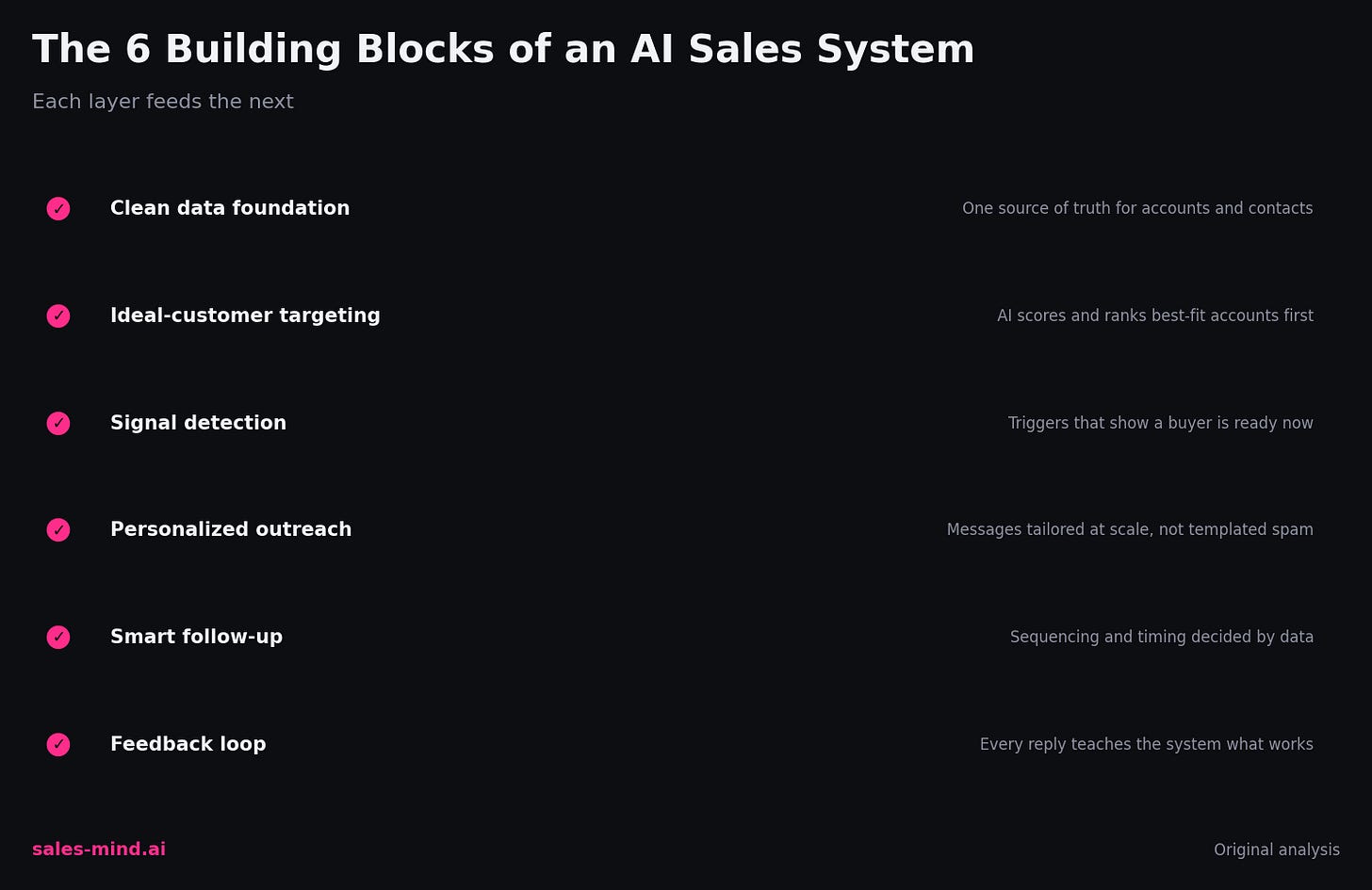
1. A clean data foundation
Everything starts here. If your account and contact data is scattered across spreadsheets and stale lists, AI will only speed up the mess. Bring your data into one source of truth so every layer above it can trust what it reads. Good data in means good decisions out.
2. Ideal-customer targeting
Next, let AI score and rank your market by fit. Instead of a rep eyeballing a list, the system ranks best-fit accounts first based on the traits your best customers share. This is where prospect intelligence earns its keep — it turns a giant market into a short, ordered list of who to reach today.
3. Signal detection
A great list still needs timing. Signal detection watches for the triggers that show a buyer is ready now: a new role, a funding round, active hiring, or a change in the tools they use. When your system reaches people at the moment their need spikes, your message feels helpful instead of random.
4. Personalized outreach at scale
This is where most "AI" fails, because templated spam is easy to spot. A strong system tailors each message to the person and the signal, not just a merge field. An AI sales agent can draft outreach that references a real reason to talk, so you get the reach of automation without sounding like a bot.
5. Smart follow-up
Most replies come after the first touch, so follow-up is not optional. The system decides sequencing and timing from data — when to send, on which channel, and when to stop. This keeps your team consistent without anyone babysitting a spreadsheet of reminders. A well-tuned funnel here is what separates busy teams from productive ones; we broke that down in our guide to the AI sales funnel.
6. A feedback loop
The final block is what makes it a system and not just automation. Every reply, open, and booked meeting teaches the model what is working. Over weeks, targeting sharpens, messaging improves, and timing tightens. The engine compounds. This is why AI lead generation done as a system beats one-off campaigns every time.
How to start building your AI sales system
You do not need to build all six blocks at once. Start where you leak the most. If your data is messy, fix the foundation first. If your reps are busy but talking to the wrong people, start with targeting and signals. If you have great targeting but weak reply rates, focus on outreach and follow-up. Add one layer, measure the lift, then add the next.
The teams that win treat this as a build, not a purchase. They connect the layers, review the numbers weekly, and let the feedback loop do its slow, compounding work. Within a quarter, the system that felt like extra effort becomes the thing that quietly fills the calendar.
A real-world example
Picture a team selling workflow software to mid-market operations leaders. Before, two reps split a list of 3,000 accounts and worked it top to bottom, sending near-identical emails. Reply rates were thin and both reps felt busy but stuck.
They rebuilt it as a system. First, they cleaned their data into one source of truth. Then AI ranked those 3,000 accounts by fit and surfaced the 200 that looked most like their happiest customers. Signal detection flagged which of those had just hired a new head of operations — a clear moment of need. Outreach referenced that exact change, follow-up ran on a data-set schedule, and every reply fed back into the model.
The reps did not work more hours. They worked the right accounts at the right time, and the calendar filled. That is the shift a system creates: same team, far better use of their attention. Nothing about it required a huge budget — just the discipline to connect the layers and trust the data.
Common mistakes to avoid
- Automating a broken process. AI makes a bad workflow faster, not better. Fix the flow first.
- Chasing volume over fit. Reaching more of the wrong people just burns your reputation.
- Ignoring the feedback loop. Without learning, your system is just a fancy mail merge.
- Skipping human judgment. The best systems keep a person on the message and the relationship; AI handles the busywork.
Frequently asked questions
Do I need a big team to run an AI sales system?
No. The whole point is leverage. A small team with a connected system can cover a market that used to need many reps, because AI handles the research, sorting, and timing.
How is an AI sales system different from a CRM?
A CRM stores what happened. An AI sales system decides what to do next — who to reach, when, and how — and then learns from the result. The two work best together, with the CRM as part of the data foundation.
How long before an AI sales system shows results?
Teams usually see better reply rates within a few weeks as targeting and timing improve. The bigger gains come over a quarter, as the feedback loop compounds.
Where should I begin?
Begin with the layer that leaks the most today, then add the next. If you want a second set of eyes on where to start, our team can map it with you.
Build a system, not a stack of tools
The companies pulling ahead are not the ones with the most AI apps. They are the ones who connected targeting, signals, outreach, follow-up, and learning into a single engine that improves on its own. That is what an AI sales system is, and it is very buildable. Book a strategy call and we'll help you design the version that fits your market.
This article was written with AI assistance and reviewed by the SalesMind team.
Get AI Sales Insights Weekly
