The AI-Assisted Sales Discovery Call: A Question Framework That Qualifies Faster
The sales discovery call is where deals are won or lost. Here is a 5-phase framework, the questions that work, and how AI helps reps prepare, listen, and follow up.
Share this article
- Before the call: AI builds a one-screen brief on the account and the person, so your questions are informed and specific from the first minute. Our prospect intelligence layer surfaces the context and signals that make discovery sharper.
- During the call: live transcription and prompts help a rep catch a buying signal or an unspoken objection they might otherwise miss, without staring at notes instead of the person.
- After the call: AI writes the summary, tags the pain and impact you uncovered, and drafts a follow-up that reflects the prospect's own words. An AI sales agent keeps the momentum going so a great call does not die in a busy inbox.
The AI-Assisted Sales Discovery Call: A Question Framework That Qualifies Faster
The sales discovery call is where most deals are quietly won or lost. It is the first real conversation, the moment you learn whether a prospect has a problem worth solving and whether you are the team to solve it. Do it well and the rest of the deal flows. Do it poorly and you spend weeks chasing someone who was never going to buy. This guide gives you a clear question framework for discovery calls in 2026, plus how AI now helps reps prepare, listen, and follow up so no signal gets missed.
We wrote this with AI assistance and grounded every step in how strong sales teams run discovery today. Let's get into it.
What a sales discovery call is really for
A discovery call is not a demo and it is not a pitch. Its only job is to understand the prospect: their situation, their problem, what that problem costs them, and what happens if they do nothing. When you understand those four things, you can tell whether there is a fit, and you can frame everything that follows around what the buyer actually cares about.
The most common mistake is talking too much. Weak discovery calls are dominated by the rep pitching, while strong ones flip that so the prospect does most of the talking. Your goal is to ask good questions and then listen, because the prospect's own words are the most persuasive material you will ever get. A well-run discovery call feels like a helpful conversation, not an interrogation.
The 5-phase discovery call framework
Run your call in five phases. Each one builds on the last, moving from rapport to a clear next step.
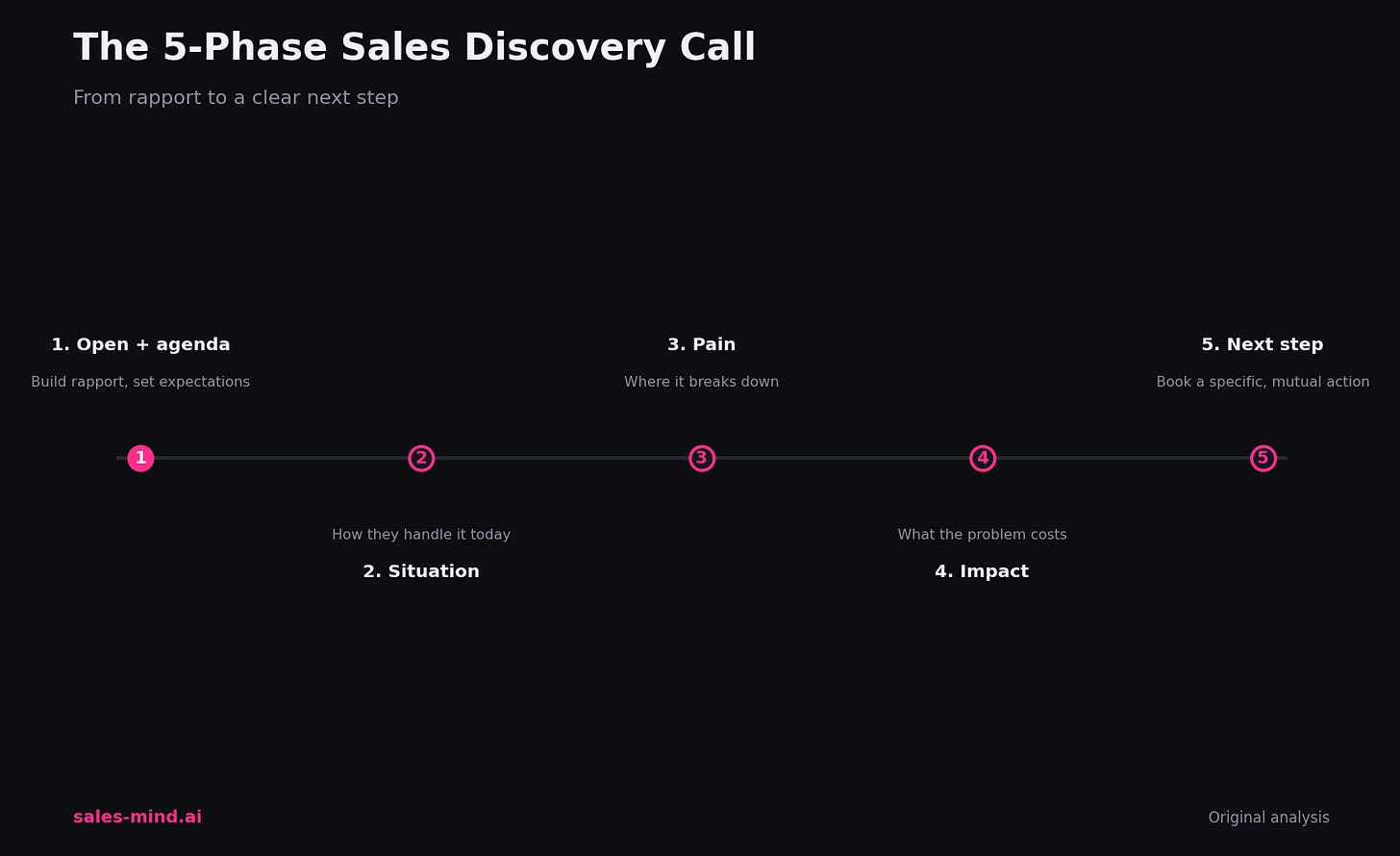
1. Open and set the agenda
Spend the first two minutes building a little rapport and then set expectations: "I'd love to understand your situation, share how we might help, and we can both decide if a next step makes sense." This gives the prospect permission to be open and signals that you are not there to hard-sell.
2. Understand the current situation
Ask how they handle the relevant work today. What tools, what process, who is involved. You are mapping their world before you suggest changing it. Good questions here sound like "Walk me through how your team does this now" and "What made you take this call?"
3. Dig into the pain
Now find the problem underneath the situation. Where does the current approach break down? What have they already tried? The best discovery questions are open and specific: "What is the hardest part of that process?" and "What happens when it goes wrong?" Let silence do some work; do not rush to fill it.
4. Quantify the impact
A problem with no cost is a problem no one pays to fix. Help the prospect put a number or a consequence on the pain: time lost, deals missed, team frustration. "If this stays the same for another year, what does that cost you?" Impact is what turns a nice-to-have into a priority.
5. Agree on a clear next step
End with a specific, mutual next step, not a vague "I'll follow up." Book the next meeting on the call. If there is no fit, say so kindly; a fast no protects everyone's time.
The prospect should talk more than you do. Discovery is not the place to prove you are smart. It is the place to prove you understand.
Where AI helps on a discovery call
AI does not replace the conversation. It removes the friction around it so the rep can be fully present. Here is where it earns its place:
- Before the call: AI builds a one-screen brief on the account and the person, so your questions are informed and specific from the first minute. Our prospect intelligence layer surfaces the context and signals that make discovery sharper.
- During the call: live transcription and prompts help a rep catch a buying signal or an unspoken objection they might otherwise miss, without staring at notes instead of the person.
- After the call: AI writes the summary, tags the pain and impact you uncovered, and drafts a follow-up that reflects the prospect's own words. An AI sales agent keeps the momentum going so a great call does not die in a busy inbox.
Discovery call questions that consistently work
Keep a short list of go-to questions you can adapt to any call:
- "What made you agree to this conversation today?"
- "Walk me through how you handle this right now."
- "What is the most frustrating part of that?"
- "What have you already tried, and how did it go?"
- "If nothing changes, what does that cost you over the next year?"
- "Who else would need to be involved in a decision like this?"
- "What would a great outcome look like six months from now?"
Common discovery call mistakes to avoid
Even experienced reps slip into a few traps. Watch for these:
- Pitching too early. The moment you start selling, the prospect stops sharing. Hold your solution until you fully understand the problem.
- Asking closed questions. "Do you struggle with this?" gets a yes or no. "How does this play out on a bad week?" gets a story you can use.
- Skipping impact. If you never quantify what the problem costs, the deal stalls later because no urgency was ever established.
- Ending vaguely. "I'll send some info" is where momentum dies. Always leave with a booked next step.
- Ignoring the buying group. If you never ask who else decides, you can run a perfect call with someone who cannot say yes.
Avoiding these five is often the difference between a pipeline full of real opportunities and one full of polite maybes that never close.
Frequently asked questions
How long should a sales discovery call be?
Most run 25 to 40 minutes. Long enough to understand the situation, pain, and impact; short enough to respect a busy calendar. If you are past 45 minutes and still gathering basics, the call likely lost focus early. A clear agenda keeps it on track.
What is the difference between a discovery call and a demo?
Discovery is about understanding the buyer; a demo is about showing a solution. Doing them in the right order matters. A demo before discovery is a guess. A demo after discovery is tailored to the exact problems the prospect just described, which is far more convincing.
Can AI run the discovery call for me?
No, and it should not. The human connection is the point of discovery. AI is best used to prepare you, support you in the moment, and handle the notes and follow-up. The questions, the listening, and the judgment stay with the rep.
The bottom line
A great sales discovery call follows a simple arc: open, understand the situation, dig into the pain, quantify the impact, and agree on a clear next step. Ask more than you tell, and let the prospect's own words guide the deal. AI makes this easier by preparing your brief, supporting you live, and handling the follow-up, so you can focus on the conversation. If you want to build a discovery process your whole team can run, book a strategy call and we will map it with you.
Get AI Sales Insights Weekly