AI Prompts for Lead Generation: 9 That Actually Fill Your Pipeline
Nine practical AI prompts that turn a blank chat box into a repeatable lead generation workflow, from defining your ICP to writing follow-ups.
Share this article
- AI prompts for lead generation are the exact instructions you give an AI tool to do the slow parts of finding buyers: building a target list, researching accounts, scoring leads, and drafting outreach.
- A good prompt turns a blank chat box into a repeatable step in your pipeline.
- A vague one just gives you generic filler you have to rewrite.
- Most teams already have access to AI.
AI prompts for lead generation are the exact instructions you give an AI tool to do the slow parts of finding buyers: building a target list, researching accounts, scoring leads, and drafting outreach. A good prompt turns a blank chat box into a repeatable step in your pipeline. A vague one just gives you generic filler you have to rewrite.
Most teams already have access to AI. What they lack is a set of prompts that produce useful output every time. Below are nine prompts we use to run lead generation, grouped by the job they do, plus the small rules that make each one work. Copy them, swap in your details, and make them yours.
Why the prompt matters more than the tool
Every AI tool answers the question you actually asked, not the one you meant. Ask "give me leads" and you get a bland list. Ask "list 20 companies that match this profile, ranked by fit, with one reason each" and you get something you can act on. The prompt is the difference between a toy and a system.
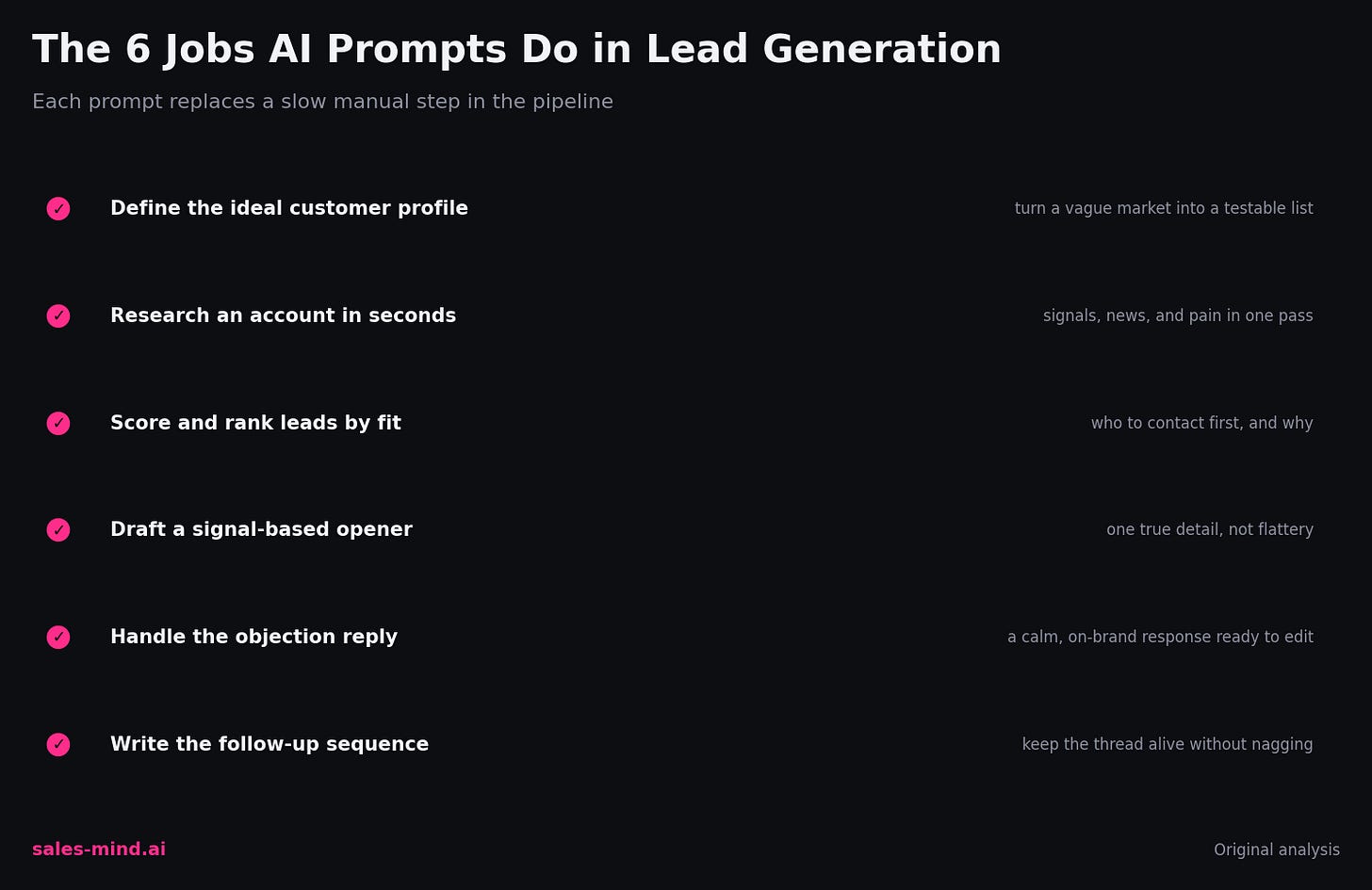
The six jobs these prompts cover map directly to the stages of a real pipeline. Skip one and the next stage suffers. The graphic below shows how each prompt slots into the flow.
Prompts for building your target list
1. Define the ideal customer profile
"Act as a B2B sales strategist. Based on this description of our best three customers [paste details], write a one-paragraph ideal customer profile, then list the five firmographic and three behavioral signals I should filter for."
This forces clarity before you build anything. A sharp profile makes every later prompt better because the AI now knows exactly who you are chasing.
2. Expand a seed list into look-alikes
"Here are 10 companies that fit us perfectly [list]. Suggest 20 more that share the same profile, and for each, name the single trait that makes it a match."
Look-alike expansion is where AI saves the most hours. You bring the judgment about what "good" looks like; the AI does the tedious hunting.
Prompts for researching accounts
3. Summarize an account in one pass
"Summarize this company for a sales rep in six bullets: what they do, their likely goals this quarter, recent news, tech they use, one probable pain point, and one reason they might need help with sales outreach."
This replaces the twelve-tab research ritual. Feed it a company page or a few notes and you get a briefing you can read in thirty seconds.
4. Find the buying signal
"From this information [paste], identify the strongest reason to reach out to this company right now, and explain why it makes them likely to care about improving lead generation."
A message tied to a real signal lands. A message with no reason is noise. This prompt makes sure every outreach has a "why now."
Prompts for scoring and prioritizing
5. Rank leads by fit
"Score each of these accounts from 1 to 10 on fit with our ideal customer profile [paste profile], and sort them highest to lowest with a one-line reason for each score."
Ranking tells you where to spend your first hour. Most reps treat every lead as equal and waste their best energy on bad-fit accounts. This fixes the order.
The best AI prompt is not the one that writes the most. It is the one that makes a clear decision you can act on in the next five minutes.
Prompts for outreach and follow-up
6. Draft a signal-based opener
"Write a two-sentence opening line for a cold email to [role] at [company], based on this signal [paste]. No flattery, no 'I hope this finds you well,' just a specific, relevant hook."
Use the AI for the hook, then write the ask yourself. That mix reads as human because most of it is.
7. Handle a common objection
"A prospect replied 'we already have a tool for this.' Write three short, non-pushy responses that keep the conversation open and focus on outcomes, not features."
Objection replies are where deals stall. Having calm, ready-to-edit responses keeps momentum without sounding scripted.
8. Build a follow-up sequence
"Write a three-touch follow-up sequence for a prospect who opened my email but did not reply. Each message under 60 words, adding a new angle, never guilt-tripping."
Most deals live in the second and third touch. This prompt keeps the thread alive so you stop losing the near-misses.
9. Turn a call into next steps
"Here are my rough notes from a discovery call [paste]. Write a short recap email with three clear next steps and one question that moves the deal forward."
The fastest way to lose momentum after a good call is a slow, vague follow-up. This makes the next step obvious for both sides.
The rule that makes every prompt work
Notice the pattern across all nine: each prompt asks for a specific format and a decision, not just "help." You give the AI a role, real context, and a tight output shape. That is the whole craft. The teams that win with AI in lead generation are not the ones with the fanciest tool — they are the ones who learned to ask precisely.
Prompts get you speed. They do not get you strategy. Deciding which market to own, what your offer really is, and how to run the human conversation is still yours to lead. AI clears the busywork so you have the time and focus to do that well.
Frequently asked questions
Do I need a special AI tool to use these prompts?
No. These prompts work in most general AI assistants. The gain comes from a purpose-built system that connects the prompts to your real data and pipeline, so research, scoring, and outreach flow together instead of living in a chat window.
Will AI-written outreach sound generic?
Only if you let AI write the whole message. Use it for research and the opening hook drawn from a real signal, then finish the ask in your own voice. The blend reads as human because most of it is.
How many prompts should I actually use?
Start with three: define your profile, research an account, and draft a signal-based opener. Those cover the highest-leverage stages. Add the others once the first three are part of your routine.
What is the most common prompting mistake?
Being vague. "Write me a cold email" produces filler. Give the role, the context, the signal, and the exact output format, and the quality jumps immediately.
Make these prompts part of a real system
Prompts are the starting point. The compounding value comes when research, lead scoring, and outreach run as one connected process instead of nine separate copy-paste steps. That is what turns AI from a helper into an engine for lead generation.
Want to see how a connected AI system handles this end to end for your team? Book a strategy call and we will map it to your pipeline. You can also explore how our AI lead generation platform and prospect intelligence turn these prompts into a repeatable workflow.
Get AI Sales Insights Weekly
