What Is an MQL? A Sales Leader's Guide to Marketing Qualified Leads
An MQL is defined by fit plus engagement, not form-fills alone. Here is how to define, score, and modernize marketing qualified leads so the MQL-to-SQL handoff finally works.
Share this article
- Lead — any contact in your database. No qualification implied.
- MQL (marketing qualified lead) — engaged and fits your ICP; ready for a qualifying touch, not a hard pitch.
- SQL (sales qualified lead) — a rep has vetted the MQL, confirmed budget/need/timing, and accepted it into the pipeline.
- PQL (product qualified lead) — has used your product (a trial or freemium account) and hit a value milestone. Common in product-led motions.
MQL? A Sales Leader's Guide" width="1200" height="630" >
Ask ten sales leaders what an MQL is and you will get ten different answers. That is the whole problem. When marketing and sales cannot agree on what a marketing qualified lead actually means, the pipeline turns into a blame game: marketing celebrates volume, sales complains about quality, and revenue stalls in the gap between them. Getting the MQL definition right is one of the highest-leverage alignment moves a revenue team can make.
This guide breaks down what an MQL is, how it differs from the other lead stages, how to score one without over-engineering it, and how modern AI-driven qualification is quietly rewriting the rules. It is written for revenue leaders who want their funnel to actually predict revenue.
What is an MQL?
An MQL — marketing qualified lead — is a prospect who has shown enough interest and fit to be worth a closer look from sales, but who is not yet ready for a direct sales conversation. They have raised their hand: downloaded a resource, attended a webinar, requested a demo, or repeatedly visited high-intent pages. Crucially, an MQL is defined by behavior plus fit, not by behavior alone.
An MQL is not "anyone who filled out a form." It is a prospect whose actions and profile together suggest they could become a customer — and who is worth a human's time to qualify further.
That last distinction is where most funnels break. A student downloading your ebook for a class project can trigger the same form-fill as a VP of Sales evaluating your platform. One is an MQL; the other is noise. Fit is what separates them.
MQL vs SQL vs PQL: the stages that matter
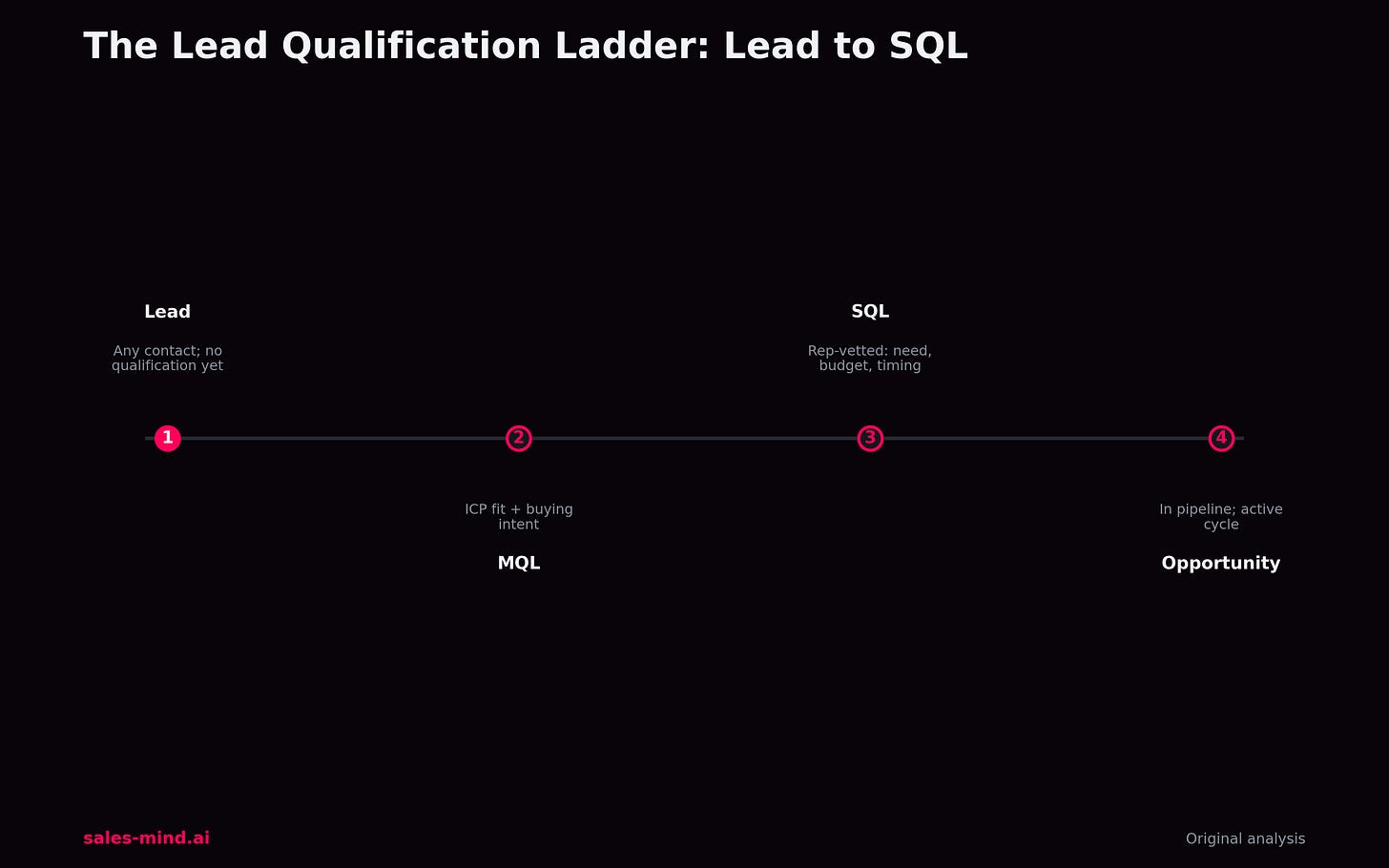
MQLs live inside a broader progression. Understanding the neighbors makes the definition sharper:
- Lead — any contact in your database. No qualification implied.
- MQL (marketing qualified lead) — engaged and fits your ICP; ready for a qualifying touch, not a hard pitch.
- SQL (sales qualified lead) — a rep has vetted the MQL, confirmed budget/need/timing, and accepted it into the pipeline.
- PQL (product qualified lead) — has used your product (a trial or freemium account) and hit a value milestone. Common in product-led motions.
The handoff from MQL to SQL is the moment marketing and sales either align or collide. A clean definition of "MQL" is what makes that handoff smooth.
 lead qualification ladder from lead to SQL" width="1456" >
How to define an MQL for your team
There is no universal MQL threshold — the right one is specific to your business. Build it from two axes:
- Fit (who they are): Does the contact match your ideal customer profile? Right industry, company size, role, and geography. A perfect-fit account with modest engagement often outranks a poor-fit account that clicked everything.
- Engagement (what they did): Which actions signal real buying intent versus idle curiosity? A pricing-page visit and a demo request weigh far more than a single blog read.
Write the definition down as a shared agreement between marketing and sales — a lightweight SLA. When both teams sign off on exactly what qualifies, the "these leads are garbage" arguments largely disappear because the standard was set together.
Lead scoring without over-engineering it
Lead scoring is how you operationalize the MQL definition. Assign points for fit attributes and engagement actions; when a contact crosses a threshold, they become an MQL. The temptation is to build a 40-variable model that no one understands. Resist it. Start with a handful of signals that clearly correlate with closed-won deals, watch how they perform, and refine.
The failure mode to avoid: scoring on volume of activity instead of quality of intent. Ten low-value clicks should not outscore one high-intent demo request. If your model is minting MQLs that sales keeps rejecting, your weights are rewarding the wrong behavior — recalibrate against actual conversion data, not gut feel.
How AI is changing MQL qualification
Traditional lead scoring is static: a human guesses the point values and rarely updates them. AI-driven qualification flips that. Instead of fixed rules, models learn from your historical pipeline which combinations of fit and behavior actually predict a closed deal — and they adjust continuously as new data arrives. The result is fewer false-positive MQLs and a handoff sales trusts.
This is where the MQL concept is quietly evolving. When qualification is continuously learned rather than manually configured, the line between "marketing qualified" and "sales qualified" blurs into a single, always-current readiness score. Teams that adopt this stop arguing about definitions and start acting on a shared, data-backed signal. If you are rethinking how your funnel qualifies leads, it is worth booking a strategy call to map where AI can tighten your MQL-to-SQL handoff, or exploring how AI lead generation reshapes the top of the funnel.
The one metric that proves your MQL definition works
You can argue about MQL definitions forever, or you can let one number settle it: MQL-to-SQL conversion rate. If a healthy share of your MQLs get accepted by sales, your definition is predictive and your funnel is honest. If most get rejected, your MQLs are inflated and the whole stage is misleading everyone upstream of it.
Track this rate every month and segment it by source. You will often find one channel producing MQLs that convert beautifully and another flooding the funnel with form-fills that go nowhere. That insight lets marketing double down on what actually creates pipeline instead of optimizing for raw lead count. It also gives sales a reason to trust the handoff again — the fastest way to end the "these leads are garbage" standoff is to show, with data, that the leads are not.
Pair that conversion rate with velocity — how long an MQL takes to become an SQL — and you have an early read on funnel health that surfaces problems weeks before they show up in closed revenue. A rising MQL count with a falling conversion rate is not growth; it is a warning.
Frequently asked questions
What does MQL stand for?
MQL stands for marketing qualified lead — a prospect whose engagement and profile fit suggest they are worth a qualifying touch from sales, but who is not yet ready for a hard sales pitch.
What is the difference between an MQL and an SQL?
An MQL has been qualified by marketing based on fit and engagement. An SQL is an MQL that a sales rep has vetted and accepted into the pipeline after confirming need, budget, and timing. MQL is the invitation; SQL is the acceptance.
How do you calculate whether a lead is an MQL?
Combine a fit score (how well the contact matches your ICP) with an engagement score (which high-intent actions they took). When the combined score crosses an agreed threshold, the lead becomes an MQL. Keep the model simple and calibrate it against real conversion data.
Should MQLs be measured on volume or quality?
Quality. A high MQL count that sales rejects is a vanity metric. The number that matters is MQL-to-SQL conversion rate — it tells you whether your definition actually predicts revenue.
Turn MQLs into a signal your team trusts
An MQL is only as useful as the shared definition behind it. Anchor it in fit plus engagement, agree the threshold across marketing and sales, score for intent rather than activity, and let data — increasingly, AI — keep the model honest. Do that and the MQL stops being a source of friction and becomes what it was always meant to be: an early, reliable signal of who is about to buy. To pressure-test your own qualification model, book a strategy call with our team.
Get AI Sales Insights Weekly