Sales Qualified Lead: Criteria, Scoring, and How to Book More Meetings
A sales qualified lead is a prospect sales has agreed is ready for a real conversation. This guide defines the four criteria that qualify a lead, gives a simple scoring model, and shows the fast, context-rich handoff that turns qualified leads into booked meetings.
Share this article
- Marketing qualified lead (MQL): someone who has shown interest — opened emails, visited pricing pages, downloaded a resource. Interest, not intent.
- Sales qualified lead (SQL): a lead your sales team has reviewed and accepted as a fit worth pursuing now. Intent plus fit plus timing.
Sales Qualified Lead: Criteria, Scoring, and How to Book More Meetings
A sales qualified lead is a prospect your sales team has agreed is ready for a real conversation, not just someone who downloaded a guide. Get the definition right and your pipeline fills with people who actually want to talk. Get it wrong and your reps burn hours on curiosity clicks while genuine buyers slip away. This guide gives you a clear definition, the criteria that separate a sales qualified lead from noise, a simple scoring model, and the handoff that turns qualified leads into booked meetings.
What a sales qualified lead really means
Marketing and sales often use the same words to mean different things, and that gap is where good leads die. Two terms matter most:
- Marketing qualified lead (MQL): someone who has shown interest — opened emails, visited pricing pages, downloaded a resource. Interest, not intent.
- Sales qualified lead (SQL): a lead your sales team has reviewed and accepted as a fit worth pursuing now. Intent plus fit plus timing.
The jump from MQL to SQL is the most important step in your funnel because it is where subjective "they seem interested" becomes an objective "yes, we should call them." When that step has clear rules, reps trust the leads they get. When it does not, reps ignore the queue and go build their own pipeline — and your marketing spend leaks out the bottom.
The four criteria that qualify a lead
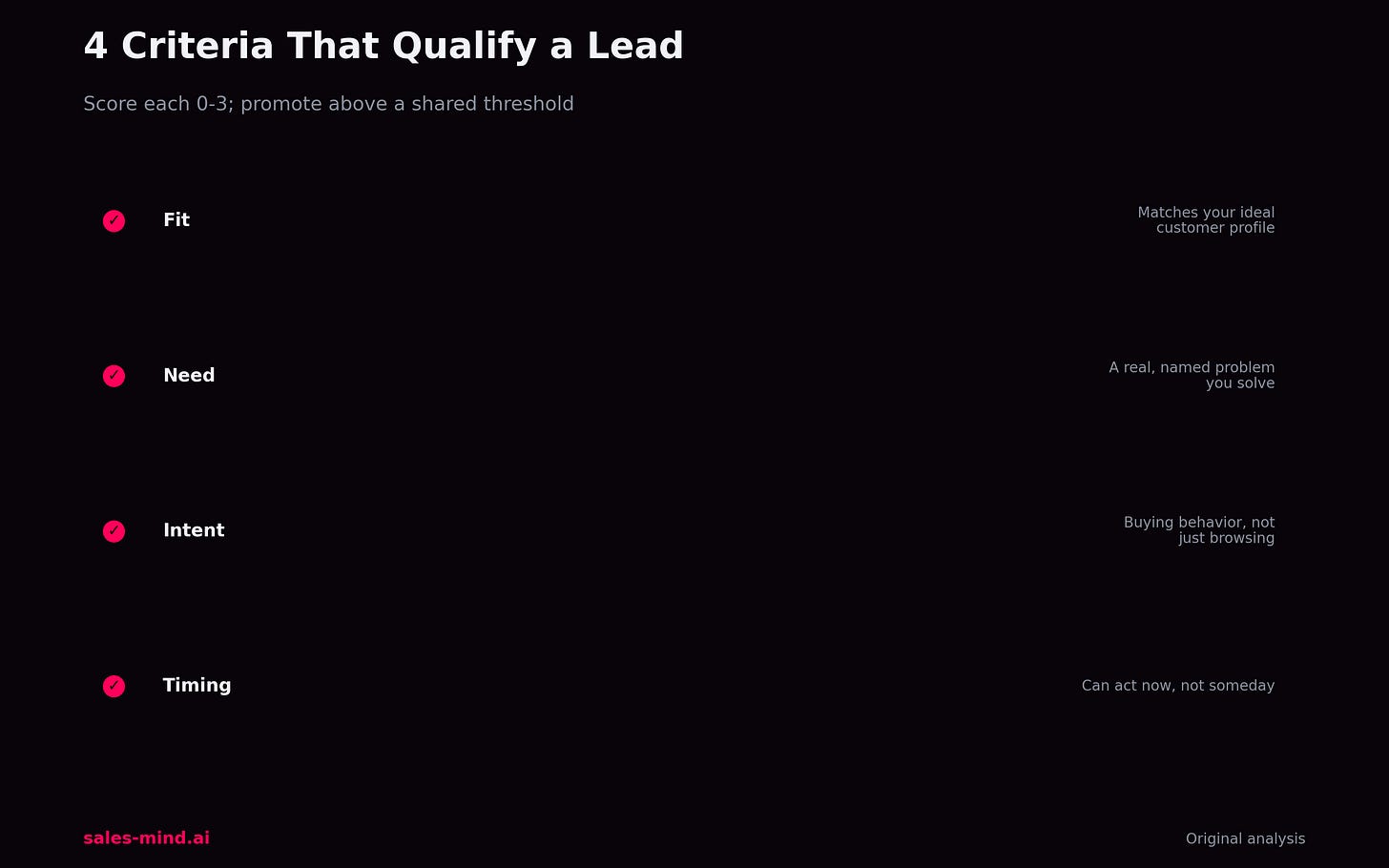
You do not need a 30-field checklist. Most teams can qualify well with four dimensions. Score each one and you have a shared language between marketing and sales.
1. Fit
Does this lead match your ideal customer profile? Industry, company size, region, and role all matter. A director at a 200-person B2B software company might be a perfect fit, while a student researching a class project is not, even if they clicked everything. Fit is the filter that stops your reps chasing traffic that will never buy.
2. Need
Is there a real problem you solve? A lead who is actively struggling with slow prospecting or a thin pipeline has a need you can name. Need is often visible in behavior: they read your comparison pages, they ask about a specific workflow, they reply with a question rather than a "thanks."
3. Intent
Are they showing buying behavior, not just browsing? Requesting a demo, replying to outreach, or returning to high-value pages several times signals intent. A single blog visit does not. Intent is the difference between "aware" and "in-market."
4. Timing
Can they act soon, or is this a "someday" project? A lead with budget cycles opening this quarter is worth a fast follow. A lead who says "revisit in a year" belongs in nurture, not on a rep's call list today. Timing decides the order of your queue.
A simple scoring model you can run this week
Turn those four criteria into points. Keep it light so your team actually uses it. Here is a model that works for most B2B teams:
- Fit (0-3): 3 for a clear ICP match, 0 for out of profile.
- Need (0-3): 3 for a named, active problem you solve, 0 for none visible.
- Intent (0-3): 3 for a demo request or reply, 1 for repeat high-value visits, 0 for passive browsing.
- Timing (0-3): 3 for "ready now," 1 for "this quarter," 0 for "someday."
Set a threshold — say, a total of 8 or more with no zeros in Fit or Intent — to promote a lead to SQL. Everything below the line goes to nurture, not to a rep. The exact numbers matter less than the agreement: marketing and sales sign off on the model together, so a "qualified" lead means the same thing to both teams. That single act of alignment removes most of the friction in a B2B funnel.
Where scoring goes wrong
Three mistakes quietly break most qualification systems:
Scoring interest as intent. Email opens and page views feel like signals, but they measure curiosity. If your model rewards clicks, your SQL queue fills with readers, not buyers. Weight replies, demo requests, and specific questions far higher than passive activity.
No feedback loop. If reps cannot mark a lead "not actually qualified" and have that reshape the model, the same bad leads keep coming. Qualification is a living system. Review disqualified SQLs every couple of weeks and adjust the criteria.
Slow handoffs. A lead's intent has a short shelf life. When a prospect raises their hand, the clock starts. A qualified lead that waits days for a follow-up cools into a missed opportunity. Speed is a qualification factor in its own right.
The handoff: from qualified to booked
Qualifying a lead is only half the job. The meeting is the goal. A strong handoff has three parts:
- Context travels with the lead. The rep should see why the lead qualified — the pages viewed, the reply that triggered it, the ICP match — so the first message is relevant, not generic.
- The first touch is fast and specific. Reference the exact signal. "You were comparing prospecting tools for a lean team" beats "Thanks for your interest." Relevance is what earns the reply.
- The channel matches the buyer. For B2B, the first touch often works best on LinkedIn, where the relationship feels human, with email as follow-up. A qualified lead reached on the right channel with the right context books at a far higher rate than a cold, templated blast.
This is where signal-driven selling pays off: when your system watches for the behaviors that define intent and routes those leads to a rep with full context, qualification and outreach stop being separate steps. If you want to see how a signal-driven prospect intelligence layer feeds your team qualified conversations, our prospect intelligence platform is built for exactly that motion.
Bringing it together
A sales qualified lead is not a metric to inflate — it is a promise between marketing and sales that a rep's time is well spent. Define it with four criteria, score it simply, keep a feedback loop, and hand it off fast with context. Do that, and the number of meetings your team books climbs without you adding a single new lead source. The pipeline you already have starts converting.
Want help designing a qualification model and outreach motion that fits your market? Book a strategy call and we will map it with you. You can also explore how an AI lead generation layer keeps your qualified pipeline full.
Frequently asked questions
What is the difference between an MQL and an SQL?
An MQL has shown interest, such as downloading a resource or visiting key pages. An SQL is a lead that sales has reviewed and accepted as a fit worth pursuing now — it combines fit, need, intent, and timing, not just interest.
What are the main sales qualified lead criteria?
Fit (does the lead match your ideal customer profile), need (is there a real problem you solve), intent (are they showing buying behavior), and timing (can they act soon). Score each and set a promotion threshold both teams agree on.
How do you score a sales qualified lead?
Rate fit, need, intent, and timing on a small scale — for example 0 to 3 each — and promote leads above a shared threshold with no zeros in fit or intent. Keep the model light so reps actually use it, and adjust it with feedback.
Why do qualified leads still not convert?
Usually because interest was scored as intent, the handoff was slow, or the first touch was generic. Weight real buying signals, follow up fast, and lead with the specific reason the prospect qualified.
Get AI Sales Insights Weekly
