Machine Learning Sales Forecasting: How AI Predicts Which Deals Will Close
Share this article
- Start with clean stage data. The model learns from your history, so consistent stages and close dates matter more than volume.
- Feed it engagement signals. Connect email, calendar, and activity data so the model can see how deals really move.
- Score the open pipeline. Let the system rank current deals by real close probability, not rep sentiment.
- Act on the outliers. Focus coaching on deals the model and the rep disagree about — that gap is where quarters are won or lost.
Machine learning sales forecasting is changing how revenue leaders answer the hardest question in the business: which deals will actually close this quarter? For years, that answer came from gut feel and a rep dragging a slider in the CRM. Sales prediction using machine learning replaces the guesswork with patterns learned from thousands of past deals, so your forecast reflects reality instead of optimism. This guide explains how it works, what signals the model reads, and how to roll it out without a data-science degree.
The promise is simple: a forecast you can trust, early enough to do something about it. Let's break down how machine learning gets there.
What machine learning sales forecasting actually does
Traditional forecasting looks backward. A rep marks a deal "very likely," a manager adjusts it, and everyone hopes. Machine learning sales forecasting looks at how similar deals behaved in the past and scores the ones in front of you today. Instead of one person's opinion, the model weighs dozens of factors at once and updates every time something changes in the deal.
The result is a probability grounded in evidence: not "I feel good about this one," but "deals that looked like this rarely closed, and here is why."
The signals a model reads to predict a close
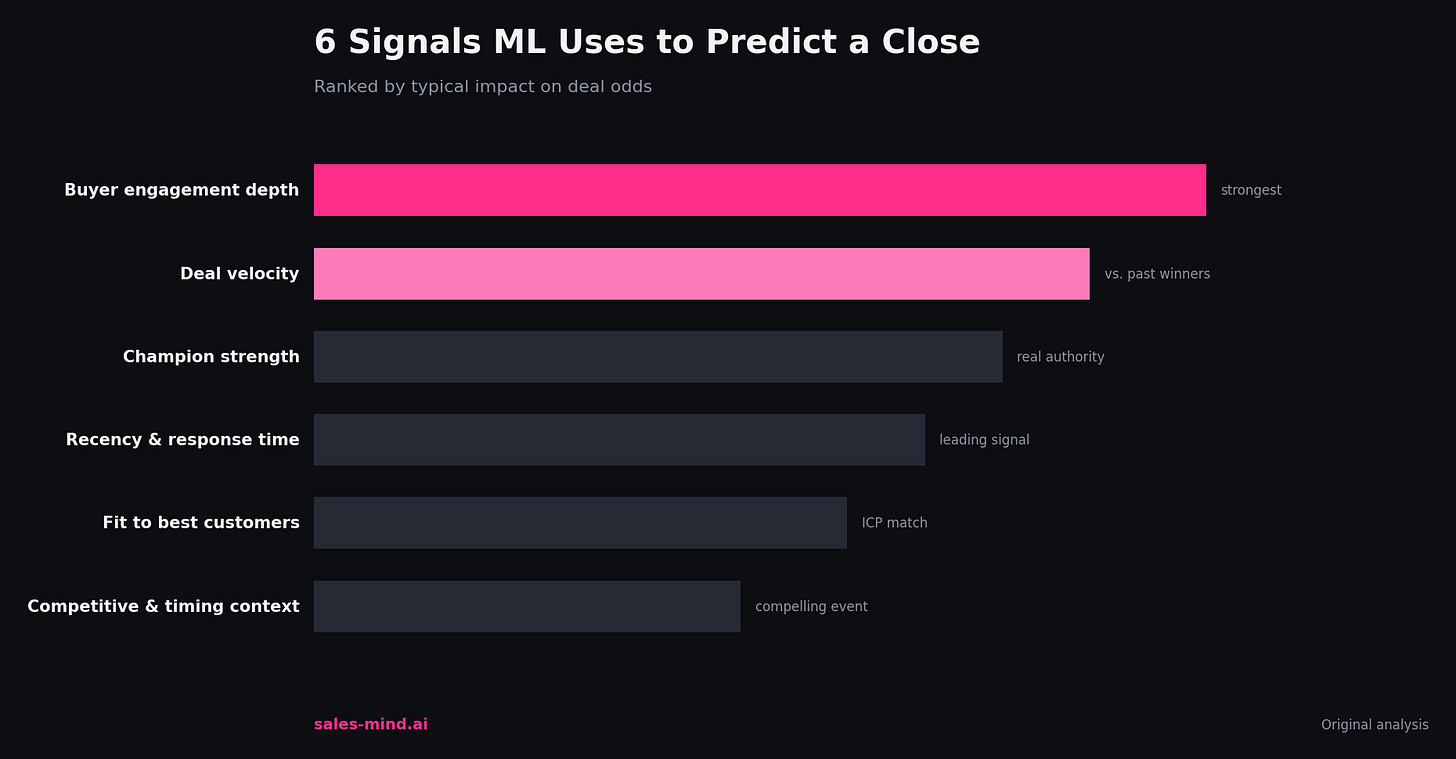
Sales prediction using machine learning is only as good as the signals it learns from. The strongest models blend behavioral, relationship, and timing data. Here are the six signals that matter most, ranked by how much they typically shift a deal's odds.
1. Buyer engagement depth
How many people from the buying side are involved, and how actively? A deal with five engaged stakeholders behaves very differently from one with a single champion who goes quiet. Engagement depth is often the single strongest predictor of a real close.
2. Deal velocity
How fast the deal moves through stages compared to deals that closed before. A deal stuck twice as long as your average winner is waving a red flag the model can see weeks before a human would.
3. Champion strength
Whether your main contact has the influence and budget to actually get it done. The model learns to tell a title from real authority by looking at who else joins the conversation.
4. Recency and response time
How recently the buyer replied, and how quickly. Slowing responses are a quiet leading indicator of a deal cooling off.
5. Fit to your best customers
How closely the account matches the profile of accounts that became happy, long-term customers. Strong fit raises the odds; poor fit lowers them, no matter how excited a rep feels.
6. Competitive and timing context
Whether a compelling event, budget cycle, or competitor is in play. These context signals often decide close timing more than anything in the pitch.
Why this beats the old "gut-feel" forecast
A rep forecast is one opinion, shaped by hope and the pressure of quota. A machine learning forecast is thousands of opinions from past deals, with no ego attached. It is not that reps are wrong — it is that no human can hold dozens of weighted signals across an entire pipeline in their head. The model does exactly that, and it does it the same way every time.
The goal is not to replace the rep's judgment. It is to give leaders an honest second opinion early enough to coach, reprioritize, and hit the number.
How to roll out ML forecasting without a data team
You do not need to build models from scratch. Modern sales intelligence platforms handle the machine learning for you. The practical path looks like this:
- Start with clean stage data. The model learns from your history, so consistent stages and close dates matter more than volume.
- Feed it engagement signals. Connect email, calendar, and activity data so the model can see how deals really move.
- Score the open pipeline. Let the system rank current deals by real close probability, not rep sentiment.
- Act on the outliers. Focus coaching on deals the model and the rep disagree about — that gap is where quarters are won or lost.
Our prospect intelligence platform turns your pipeline and engagement data into clear close probabilities, so leaders forecast with evidence instead of hope. Pair it with AI lead generation and the model gets even sharper, because better-fit deals enter the pipeline in the first place.
Common mistakes when adopting ML forecasting
Machine learning sales forecasting works best when you avoid a few traps that quietly break trust in the numbers:
- Messy stage definitions. If "proposal sent" means five different things across your team, the model learns noise. Agree on what each stage means before you turn anything on.
- Treating the score as gospel. A probability is a guide, not a verdict. The value is in the conversation it starts between a manager and a rep, not in blindly killing every low-scoring deal.
- Ignoring the disagreements. The most useful moments are when the rep is confident and the model is not. That gap is a coaching goldmine, and skipping it wastes the whole system.
- Forgetting to feed it fresh data. A model cut off from live engagement signals slowly drifts out of date. Keep your activity, email, and calendar data flowing so predictions stay current.
Handle those four, and the forecast quickly becomes the most trusted number in the room instead of the most argued-about one.
What good looks like after a quarter
Teams that adopt machine learning sales forecasting usually see three changes fast: forecasts stop swinging wildly at quarter-end, managers spend coaching time on the deals that matter, and slipped deals get caught weeks earlier. The forecast becomes a planning tool leaders can actually build on, not a number everyone quietly distrusts. Over a few quarters, that trust compounds: hiring plans, territory decisions, and board updates all get steadier because they rest on a prediction the whole team believes in.
Frequently asked questions
What is machine learning sales forecasting?
It is a way of predicting which deals will close, and when, by having a model learn patterns from your past deals and score your current pipeline. It replaces gut-feel percentages with evidence-based probabilities.
How is sales prediction using machine learning different from CRM forecasting?
Standard CRM forecasting relies on reps setting a stage or a percentage by hand. Machine learning reads dozens of behavioral and timing signals automatically and updates the prediction as the deal changes, so it is both more objective and more current.
Do I need a data scientist to use it?
No. Modern sales intelligence platforms build and maintain the models for you. Your job is to keep pipeline data consistent and connect your engagement sources.
How much history does the model need?
More is better, but even a few hundred past deals with clean stage and outcome data are enough to start producing useful predictions that improve over time.
Want a forecast your leadership can actually trust? Book a strategy call and we'll show you how machine learning sales forecasting turns your pipeline data into decisions you can make with confidence.
This article was written with AI assistance and reviewed by the SalesMind team.
Get AI Sales Insights Weekly