Intent Data for Sales: Turn Buying Signals Into Meetings
Intent data for sales is the set of behavioral signals that show which accounts are actively researching a solution now. This guide explains the three signal types, a four-step signal-to-conversation framework, and a 30-day plan to turn intent into booked meetings.
Share this article
- First-party intent: activity on your own properties—repeat website visits, demo requests, pricing views, opened sequences, replies. This is the strongest signal because it is about your solution specifically.
- Second-party intent: activity on review sites and communities where a buyer compares options in your category. It shows category interest with real purchase context.
- Third-party intent: aggregated research behavior across the web, matched to an account. It is the broadest and earliest signal, useful for spotting accounts before they reach you.
Intent data for sales is the set of signals that show which accounts are actively researching a problem you solve—right now, before they raise their hand. Most teams still work from static lists and wonder why reply rates keep sliding. The teams pulling ahead have learned to read intent and reach out at the exact moment a buyer is paying attention. This guide explains what intent data is, the three types that matter, and how to turn signals into booked conversations without adding headcount.
What intent data for sales actually means
Intent data is behavioral evidence that a company is in a buying window. It answers a question a contact list never can: not just "who fits our ideal customer," but "who is likely thinking about this today." A perfect-fit account that is not researching is a cold lead. A slightly imperfect account that just viewed your product page three times is a warm one. Intent flips the order of your outreach so your best hours go to the accounts most ready to talk.
Used well, intent data connects sales intelligence to timing. It does not replace your judgment about fit—it sharpens where you spend it.
The three types of intent signals
Buying signals are not all created equal. It helps to sort them into three groups, from strongest to broadest.
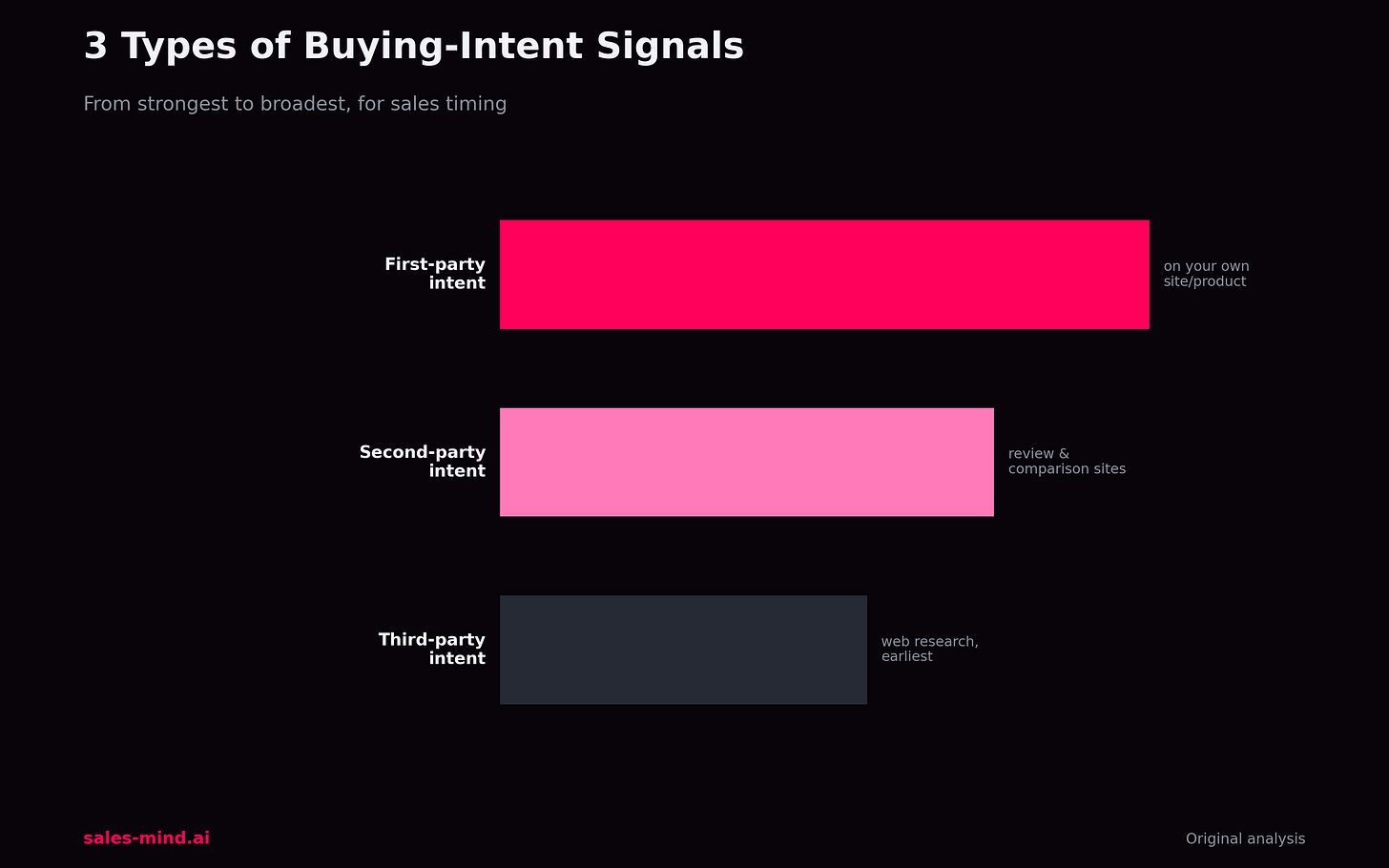
- First-party intent: activity on your own properties—repeat website visits, demo requests, pricing views, opened sequences, replies. This is the strongest signal because it is about your solution specifically.
- Second-party intent: activity on review sites and communities where a buyer compares options in your category. It shows category interest with real purchase context.
- Third-party intent: aggregated research behavior across the web, matched to an account. It is the broadest and earliest signal, useful for spotting accounts before they reach you.
The strongest programs layer all three. First-party tells you who is close; third-party tells you who is entering the funnel; second-party confirms they are actively comparing.
The signal-to-conversation framework
Collecting signals is easy. Acting on them is where most teams stall. A simple four-step framework keeps intent data from becoming another dashboard nobody opens.
- Score: combine fit and intent into one priority number. A high-fit account with fresh intent goes to the top of the queue today.
- Route: send the highest-scoring accounts to the right rep automatically, with the signal attached so the rep knows why.
- Reach: open with the context, not a generic pitch. Reference the problem the buyer is clearly researching, then offer a specific next step.
- Review: track which signals turn into meetings and which do not. Retire weak signals; double down on the ones that convert.
This is the difference between "we have intent data" and "our intent data books meetings." The framework, not the feed, is the advantage.
How to write outreach that uses intent
The fastest way to waste a strong signal is to open with a template. When an account is researching a topic, your first line should show that you noticed the context and can help. Lead with the buyer's likely problem, name a specific outcome, and keep the ask small—a short conversation, not a hard sell. Because the timing is right, a relevant, human message lands far better than volume ever will.
Be careful with privacy and tone. Never quote the exact page someone visited; that feels like surveillance. Instead, speak to the broader problem the signal points to. Intent guides your timing and topic; it should never make a prospect feel watched.
Where intent data fits in your sales motion
Intent should change what your team does on a Monday morning, not just what a report shows at quarter end. In a healthy motion, the account with the freshest, strongest signal is the first call a rep makes that day. Marketing warms those same accounts with relevant content, and leadership watches which signal types actually turn into pipeline. When intent is wired into the daily rhythm, prospecting stops being a numbers game and becomes a timing game—and timing is where smaller, sharper teams beat bigger, louder ones.
This is also where sales intelligence earns its keep. A signal on its own is a hint. Attached to firmographics, past conversations, and the right contact, it becomes a reason to reach out that a buyer will actually welcome. The goal is not more activity; it is better-timed, better-informed activity that respects the buyer's attention.
A 30-day plan to put intent to work
You do not need a massive program to start. A focused month proves the model:
- Week 1: instrument first-party signals—key page views, repeat visits, and product activity—so you can see who is already close.
- Week 2: add one external source of category intent and match it to target accounts, then build a simple combined fit-and-intent score.
- Week 3: route the top-scoring accounts to reps with the signal attached, and coach reps to open with context, not a pitch.
- Week 4: review which signals produced meetings. Keep the winners, cut the noise, and set your ongoing scoring rules.
By the end of the month you will have a working, evidence-based system rather than a pile of unused data—and a clear view of which signals deserve a rep's time.
Common mistakes with intent data
Three patterns waste good signals. First, treating every signal as urgent—third-party research is a nudge, not a fire alarm, and blasting those accounts burns goodwill. Second, ignoring fit; intent without fit fills your calendar with meetings that never close. Third, hoarding signals in a tool no rep checks. Intent data only works when it flows into the daily workflow reps already live in and drives a clear next action.
Frequently asked questions
What is the difference between intent data and lead scoring? Lead scoring rates how well a contact fits your ideal customer. Intent data adds the timing layer—how actively that account is researching now. The best models combine both into a single priority.
Where does intent data come from? From three sources: your own site and product activity, review and comparison sites, and third-party research networks matched back to an account. Strong programs blend all three.
Do small sales teams benefit from intent data? Yes—arguably more. A small team cannot chase every account, so spending limited hours on the accounts showing real intent is exactly where a lean team wins.
How do I combine intent with account fit? Keep two separate scores and add them. Fit answers whether an account is worth winning; intent answers whether now is the moment. A high-fit, high-intent account is your best call of the day, while a high-intent, low-fit account is usually a polite pass. Weighting both stops your team from chasing busy signals that never become revenue.
How often should intent scores refresh? Signals decay quickly, so treat intent as a daily input, not a monthly one. A signal that mattered last week may be cold today, and a fresh one can move an account to the top of the queue overnight.
Turn signals into a real pipeline
Intent data for sales rewards teams that act on timing instead of guessing. If you want help building a scoring and outreach model that turns buying signals into booked meetings, book a strategy call with our team. You can also explore how prospect intelligence surfaces the right accounts and how our AI lead generation approach puts those signals to work.
Get AI Sales Insights Weekly
