AI for Sales Objection Handling: How Reps Answer Faster and Close More in 2026
AI for sales objection handling helps reps prepare tailored answers, respond calmly under pressure, and turn every objection into shared team learning, while staying fully human where it counts.
Share this article
- Pause. Do not rush to defend. A short silence shows respect.
- Clarify. Ask, "Can you tell me more about that?" You often find the stated objection hides a deeper one.
- Acknowledge. Repeat the concern back so the buyer feels heard.
- Answer with proof. Use a specific example, a result, or a peer story, not a slogan.
AI for Sales Objection Handling: How Reps Answer Faster and Close More in 2026
Sales objection handling is the moment a deal is won or lost. A buyer says "it is too expensive" or "we already use someone," and the next ten seconds decide everything. In 2026, the best teams are using AI for sales objection handling to prepare better answers, respond calmly in the moment, and learn from every call. This guide shows how AI helps reps handle objections with confidence, and where a human still leads.
This was written with AI assistance and reviewed by our sales team, because objection handling is a craft, not a script.
Why objections are a good sign, not a wall
New reps hear an objection and freeze. Experienced reps hear an objection and lean in. Why? Because an objection means the buyer is engaged enough to push back. Silence is the real killer. When someone raises a concern, they are telling you exactly what stands between them and yes.
The job is not to "overcome" the person. It is to understand the worry underneath the words, and to answer it so clearly that the worry disappears. That is where AI earns its place: it helps you hear the real objection and respond to it well.
The five objections that stall most deals
Across thousands of B2B conversations, the same handful of objections show up again and again. Knowing them in advance means you are never caught flat-footed.
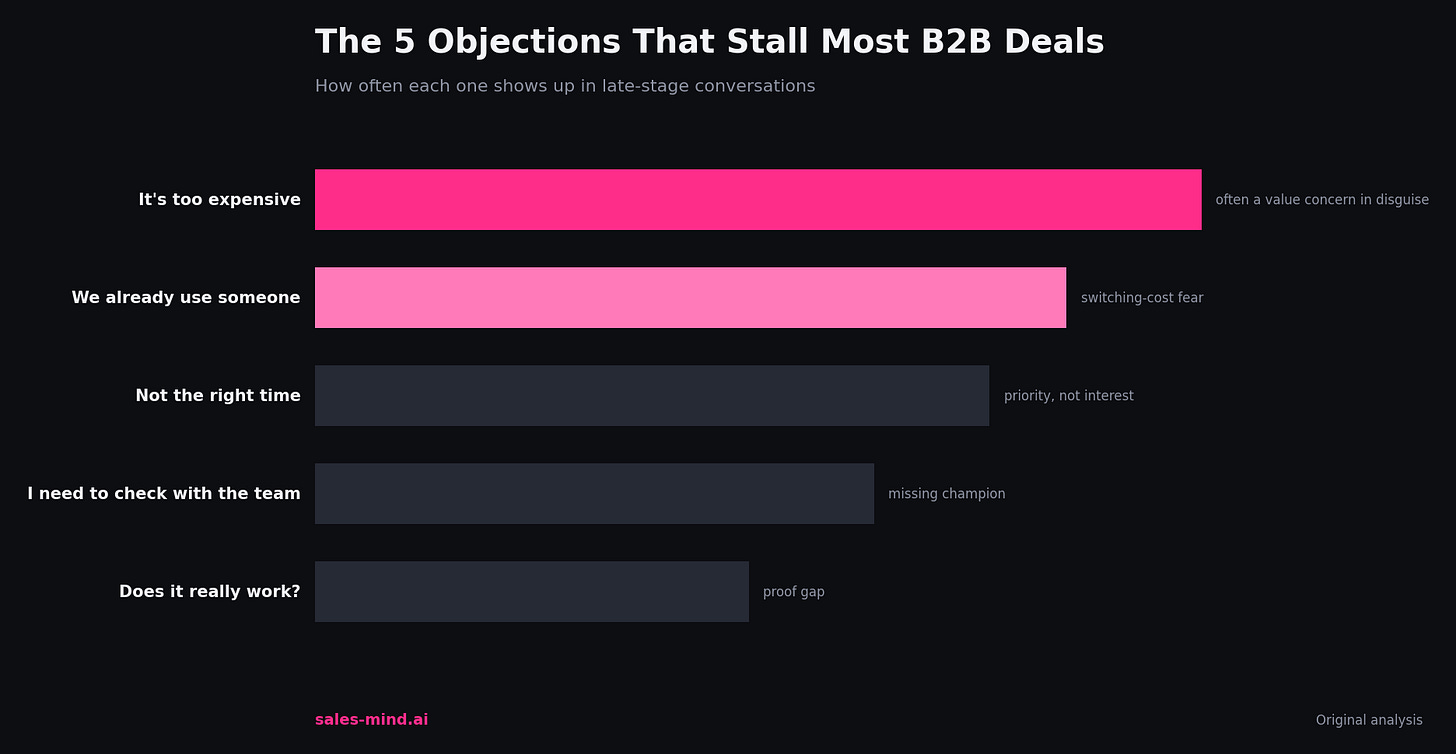
Notice that only one of these is truly about money. The rest are about trust, timing, and proof. When you treat every objection as a price problem, you discount deals that never needed a discount. AI helps you spot which objection you are actually facing.
How AI helps you handle objections in real time
Modern sales tools do more than store notes. They listen, learn, and prepare. Here is how AI sales tools support a rep before, during, and after the conversation.
Before the call: prepared, not scripted
AI reviews the account, past emails, and the buyer's role, then surfaces the two or three objections this specific person is most likely to raise. Instead of a generic script, you walk in with tailored talking points. Our AI sales agent can draft these prep notes from your own pipeline so no rep starts a call cold.
During the call: a calm second brain
When a tough objection lands, AI can suggest a proven response framework in the moment. It does not talk for you. It reminds you to slow down, ask a clarifying question, and confirm the real concern before you answer. That pause is what separates a pushy rep from a trusted advisor.
After the call: learning that compounds
Every objection you hear is data. AI groups them, shows which ones cost you the most deals, and highlights the responses that actually moved buyers forward. Over a quarter, your whole team gets sharper because the lessons are shared, not locked in one rep's head.
You do not close by winning the argument. You close by making the buyer feel understood, then removing the risk they are worried about.
A simple framework AI can guide you through
Great objection handling follows a rhythm. AI can prompt each step so it becomes second nature:
- Pause. Do not rush to defend. A short silence shows respect.
- Clarify. Ask, "Can you tell me more about that?" You often find the stated objection hides a deeper one.
- Acknowledge. Repeat the concern back so the buyer feels heard.
- Answer with proof. Use a specific example, a result, or a peer story, not a slogan.
- Confirm. Ask, "Does that address your concern?" so you know it landed.
AI keeps this loop visible on screen so even a nervous rep stays on track. The framework does the heavy lifting; the human brings the warmth.
Where the human still leads
AI is a coach, not a closer. It cannot read a hesitant tone the way you can, and it cannot build the genuine rapport that makes a buyer trust you. The winning setup pairs AI's speed and memory with human judgment and empathy. Teams that automate the prep and the learning, then keep the human fully present in the conversation, see the biggest lift. If you want help designing that setup, our team can walk you through it on a strategy call.
Putting it to work this week
You do not need a huge project to start. Pick your top three objections, write one strong response for each, and let AI prep them before every call. Then review what you hear each week and refine. Within a month, objections stop feeling like ambushes and start feeling like the last step before yes. Pairing this habit with smarter outreach means more of the right conversations reach this stage in the first place.
Three mistakes that turn an objection into a lost deal
Even strong reps trip over the same habits. AI helps catch them, but knowing them matters more.
Mistake one: answering too fast. The second a buyer says "too expensive," a nervous rep starts justifying the number. That signals defensiveness. A calm clarifying question signals confidence and buys you the real story. AI can literally prompt you to pause, which sounds small but changes the tone of the whole call.
Mistake two: treating every concern as a price problem. As the chart above shows, most objections are about trust, timing, or proof. Discounting to solve a proof problem trains buyers to squeeze you and still leaves the real worry untouched. Match your answer to the actual objection.
Mistake three: never capturing what you heard. If objections live only in a rep's memory, the team relearns the same lessons every quarter. When AI logs and groups objections automatically, one rep's hard-won answer becomes everyone's playbook. That shared memory is where a team's win rate quietly climbs, deal after deal.
Frequently asked questions
Can AI actually handle objections for me on a call?
No, and it should not try. AI prepares you, prompts a framework, and captures the outcome. The buyer still wants to talk to a person who understands them.
What is the most common sales objection?
"It is too expensive" is the loudest, but it is often a stand-in for "I am not sure this is worth it." Clarifying usually reveals a value or trust concern, not a budget one.
How does AI know which objection a buyer will raise?
It looks at the account, the buyer's role, past messages, and patterns from similar deals, then predicts the likely concerns so you can prepare specific answers.
Will AI make my reps sound robotic?
Only if you let it script them. Used well, AI removes the busywork so reps can be more present and human, not less.
The bottom line
Objections are not the enemy. They are the buyer showing you the path to close. With AI for sales objection handling, your reps prepare better, stay calm under pressure, and learn from every conversation, while staying fully human where it counts. The teams that treat objections as signal, not noise, are the ones that keep winning. To map this to your team's real deals, book a strategy call and we will help you build it step by step.
Get AI Sales Insights Weekly
