The AI Sales Manager: What It Can (and Can't) Do for Your Team
An AI sales manager is a layer of intelligence across your pipeline. Here is an honest map of the four manager jobs and how much AI can own each one today.
Share this article
- Start with pipeline hygiene, not scoring people. Let AI clean the pipeline and surface risks first; earn trust before it touches coaching.
- Keep humans in the decision loop. AI recommends; managers decide. Reps need to know a person still owns the call.
- Make the data serve the rep. If the insights help a rep close more, they will adopt it. If it only feeds a manager's dashboard, they will game it.
- Protect the coaching relationship. Use AI to prepare better one-on-ones, not to replace them.
Ask ten revenue leaders what an AI sales manager is and you will get ten answers, from a glorified dashboard to a robot that runs your team. The truth sits in between, and it matters, because the wrong mental model leads to wasted budget and frustrated reps. This article breaks the sales manager's role into its real jobs and looks honestly at which ones an AI sales manager can own today, which it can only assist, and which still belong to a human leader. The goal is a clear-eyed map you can use to decide where AI actually helps your sales organization.
What we mean by an "AI sales manager"
An AI sales manager is not a single product. It is a layer of intelligence that sits across your pipeline, your conversations, and your reps' daily activity, and it does the things a good manager does with data: it watches every deal, spots where attention is needed, and prompts the right action at the right time. Where a human manager can review a handful of deals a week in depth, this layer reviews all of them continuously. That difference in coverage, not raw cleverness, is where its value comes from.
Set expectations correctly and it becomes a force multiplier for your existing leaders. Set them wrong, expecting it to replace judgment, coaching, and accountability, and it disappoints. So let us separate the role into its four core jobs and grade each one.
The four jobs of a sales manager, and where AI fits
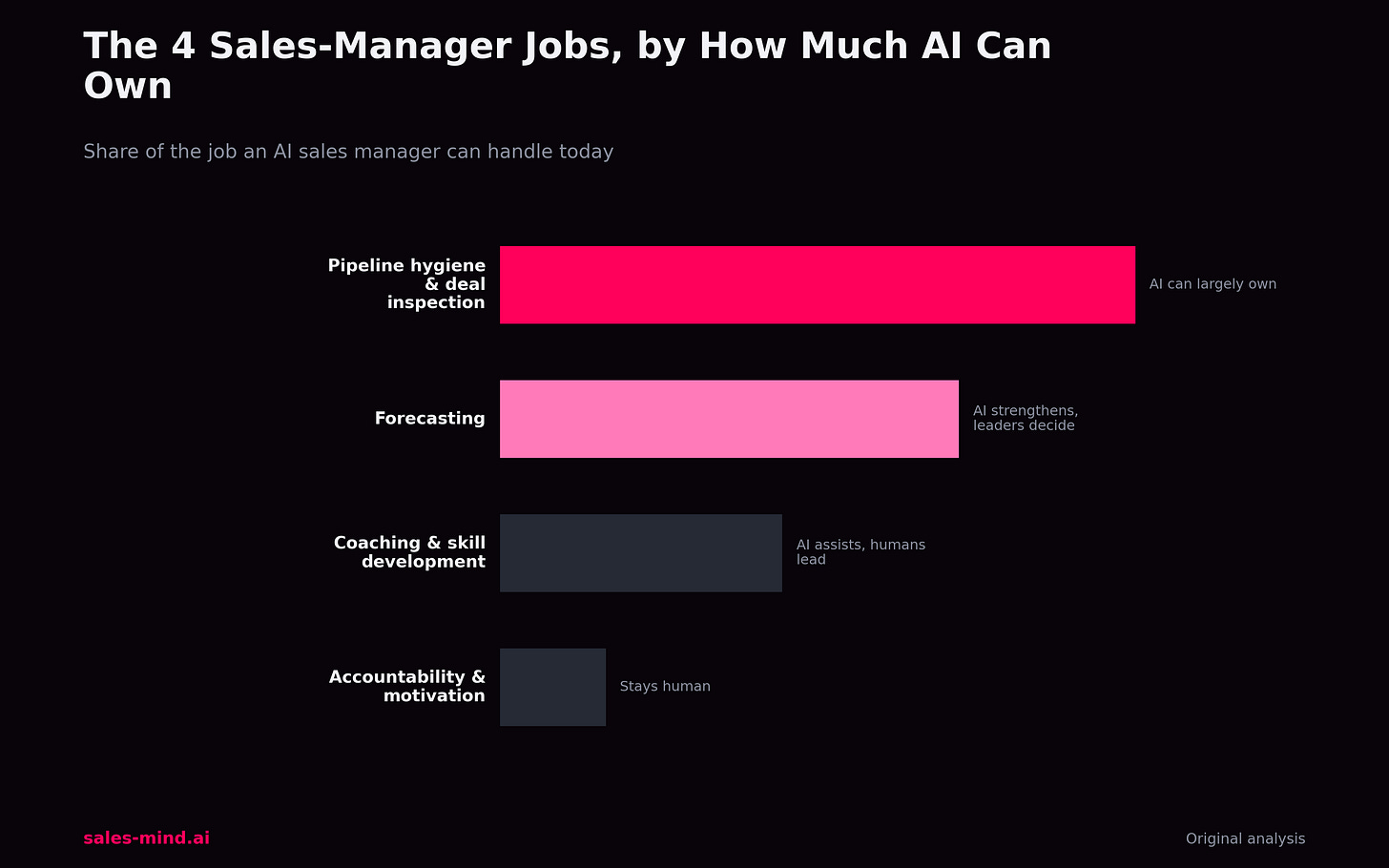
Every sales manager does four things: they keep the pipeline honest, they coach reps, they forecast, and they hold the team accountable. An AI sales manager can take on very different shares of each.
Job 1: Pipeline hygiene and deal inspection (AI can largely own this)
This is the job AI handles best. Keeping a pipeline clean, flagging stalled deals, catching opportunities with no next step, and surfacing the deals most likely to slip, is pattern work at scale. A human manager doing this by hand can only sample the pipeline; the intelligence layer inspects every deal, every day, without fatigue or favoritism. It notices the quiet deal that has not moved in three weeks and the loud deal that reps are over-forecasting. Given clean activity data, this is where AI delivers the most, the fastest.
Job 2: Coaching and skill development (AI assists, humans lead)
AI can transcribe calls, score them against a framework, and highlight patterns: talk-to-listen ratios, missed discovery questions, weak next steps. That is genuinely useful, and it gives managers evidence instead of impressions. But coaching is a relationship. A rep improves because a leader they trust tells them the hard truth, models the behavior, and follows up. AI supplies the raw material and frees the manager's time; the human still does the coaching that actually changes behavior.
Job 3: Forecasting (AI strengthens, leadership owns the call)
Forecasting is where AI and human judgment work best together. An AI sales manager can weigh deal signals, historical conversion by stage, and rep-level patterns to produce a data-driven forecast that is harder to fool than gut feel. Yet the final number is a leadership commitment to the business, shaped by context the model does not see: a delayed launch, a champion who just left, a strategic bet. Use the AI forecast as the honest baseline, then let leaders adjust with reasons, not optimism.
Job 4: Accountability and motivation (this stays human)
The last job barely moves. Holding a team to its commitments, handling a rep who is struggling, celebrating a hard-won deal, and setting the emotional tone of a sales floor are human acts. An AI sales manager can make accountability easier by making performance visible and objective, so conversations start from facts rather than debate. But the conversation itself, and the trust behind it, cannot be delegated to software.
How to introduce an AI sales manager without losing your team
The fastest way to make reps resent AI is to frame it as surveillance. Position it instead as the thing that removes busywork and makes their good work visible. A few principles keep the rollout healthy:
- Start with pipeline hygiene, not scoring people. Let AI clean the pipeline and surface risks first; earn trust before it touches coaching.
- Keep humans in the decision loop. AI recommends; managers decide. Reps need to know a person still owns the call.
- Make the data serve the rep. If the insights help a rep close more, they will adopt it. If it only feeds a manager's dashboard, they will game it.
- Protect the coaching relationship. Use AI to prepare better one-on-ones, not to replace them.
One practical signal tells you the rollout is working: your managers start spending less time hunting for what to look at and more time acting on it. Before the intelligence layer, a manager's week is eaten by exporting reports, chasing reps for updates, and guessing which deals deserve attention. After, that scavenger-hunt time collapses, and the same hours go into deal strategy and coaching. If you track only one thing during the first quarter, track where your managers' time actually goes, because that shift, from finding problems to solving them, is the whole point of an AI sales manager and the clearest proof it is earning its place.
The real payoff: leverage, not replacement
The organizations getting the most from an AI sales manager are not trying to remove their managers. They are giving each manager the reach of a much larger team: complete pipeline coverage, evidence-based coaching prep, and forecasts grounded in behavior instead of hope. That leverage lets your best leaders spend their scarce hours on the parts of the job only humans can do, the judgment, the relationships, the tough conversations, while the intelligence layer handles the tireless watching underneath.
Deciding where an AI sales manager fits your team is a strategy question as much as a tooling one, and it is worth thinking through with someone who has mapped it across many sales organizations. If you want a clear plan for where this layer would compound in your pipeline, book a strategy call and we will walk through it with you.
Frequently asked questions
Can an AI sales manager replace a human sales manager?
No. It can own repetitive, data-heavy jobs like pipeline inspection and strengthen forecasting, but coaching, accountability, and team motivation depend on human trust and judgment. Think leverage for your managers, not replacement.
What does an AI sales manager do day to day?
It continuously reviews every deal, flags stalled or at-risk opportunities, prompts next steps, scores recorded calls against a coaching framework, and produces a data-driven forecast, so your managers start each day with a prioritized, evidence-based view instead of guesswork.
Where should we start with an AI sales manager?
Begin with pipeline hygiene and deal inspection. It delivers value quickly, needs only your existing activity data, and builds trust with reps before AI is applied to more sensitive areas like call scoring and coaching.
Will my reps resist it?
They resist AI that feels like surveillance. Framed as a tool that removes busywork and makes their strong work visible, and paired with managers who still own decisions, adoption tends to be strong.
Want to map where an AI sales manager fits your pipeline? Book a strategy call with the SalesMind team.
Get AI Sales Insights Weekly