How to Build an AI Sales Funnel That Books Meetings
An AI sales funnel adds intelligence to each stage of your buyer journey so fewer good-fit buyers leak out. Here are the five stages, what to automate, and what to keep human.
Share this article
- An AI sales funnel is the same buyer journey your team already runs, with intelligence added at each stage so fewer good-fit buyers slip through the cracks.
- It is not a robot that replaces your reps.
- It is a system that gives them sharper targeting at the top, faster follow-up in the middle, and cleaner signals at the bottom, so the whole funnel leaks less.
- Most funnels fail in the gaps: a lead that never gets a second touch, a warm account nobody noticed, a reply that sat unread for two days.
An AI sales funnel is the same buyer journey your team already runs, with intelligence added at each stage so fewer good-fit buyers slip through the cracks. It is not a robot that replaces your reps. It is a system that gives them sharper targeting at the top, faster follow-up in the middle, and cleaner signals at the bottom, so the whole funnel leaks less.
Most funnels fail in the gaps: a lead that never gets a second touch, a warm account nobody noticed, a reply that sat unread for two days. AI is strong exactly where humans get stretched thin. This guide breaks the AI sales funnel into five stages and shows what to automate, what to keep human, and how to tell whether it is actually working.
Why funnels leak, and where AI plugs the holes
Picture your funnel as a series of buckets stacked with small holes between them. Water (your buyers) pours in at the top and drips out the sides on the way down. More water at the top does not fix the holes. It just wastes more water. The real win is sealing the gaps between stages.
Those gaps are usually attention problems, not effort problems. A rep cannot watch every account, read every signal, and reply within minutes at scale. AI can watch, score, and prompt, then hand the human a short, ranked list of what deserves a person's time. That division of labor is the whole idea.
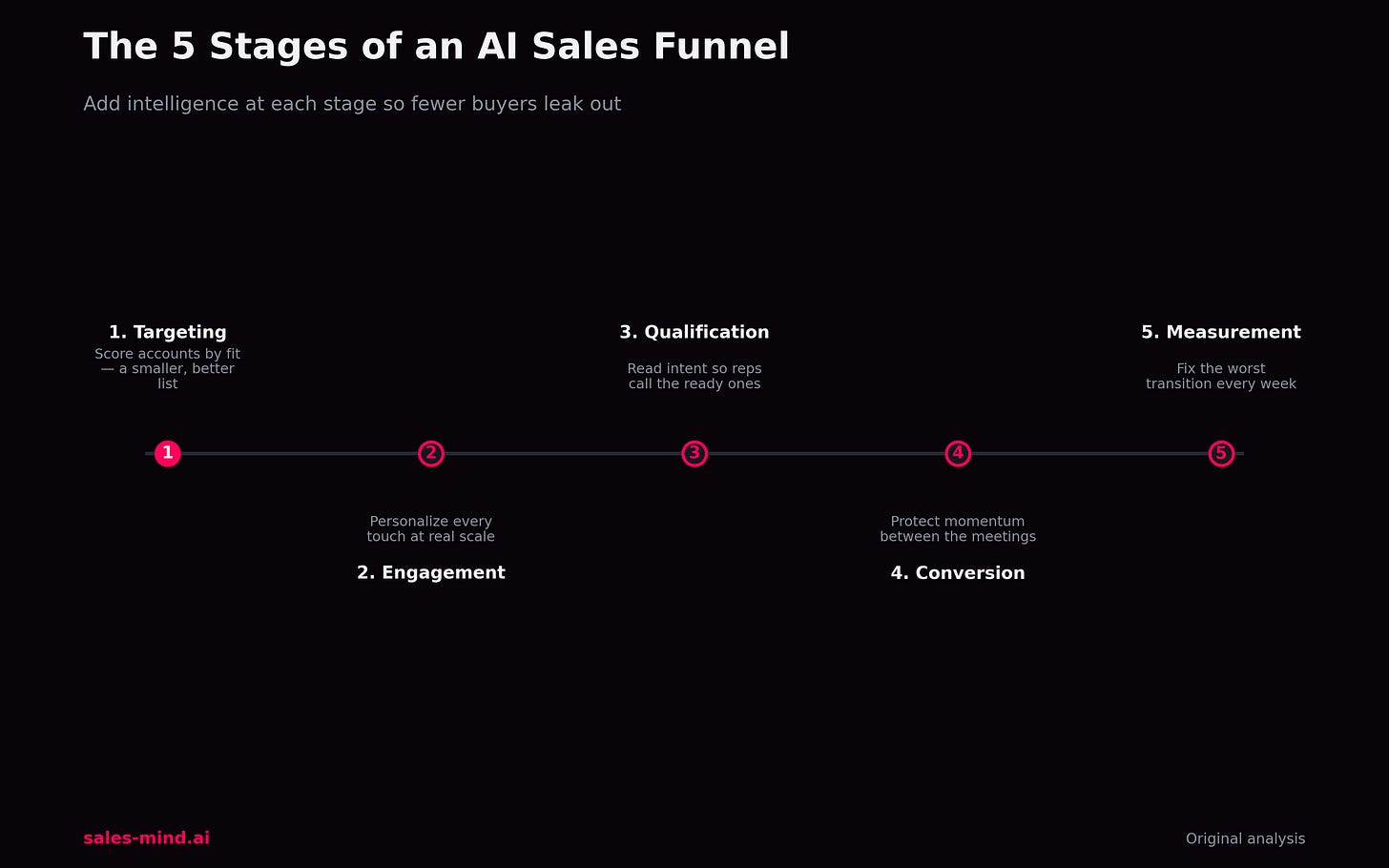
The five stages of an AI sales funnel
Stage 1 — Targeting: find the right accounts, not more accounts
The top of the funnel decides everything below it. Feed it a loose definition of your buyer and you pour in noise. AI helps here by scoring accounts against real fit signals: the tools they use, the roles they are hiring for, recent moves that suggest the problem you solve is live right now.
The goal is a smaller, better list. When your prospect intelligence ranks accounts by likelihood to buy, your reps stop spraying and start choosing. Keep a human in the loop to approve the definition and sanity-check the edge cases, but let the machine do the heavy sorting.
Stage 2 — Engagement: personalize at a scale humans cannot match by hand
Personalization used to mean choosing between quality and volume. AI removes that trade-off. It can draft a first message grounded in a real signal about each account, so every touch reads like it was written for one person, because in a sense it was.
This is where outreach automation earns its place: it handles the drafting, sequencing, and timing, while your reps review, adjust the ones that matter, and add the human warmth a template cannot. The rule that keeps this healthy is simple: automation writes the first draft, a person owns the relationship.
Stage 3 — Qualification: score intent so reps talk to the ready ones
Not every reply is a buying signal, and not every quiet account is cold. AI qualification reads behavior across the funnel: what they opened, what they clicked, which page they returned to, how a reply is phrased. It turns that into an intent score your reps can trust.
A good AI sales agent surfaces the accounts warming up so a human calls them while interest is high, and quietly nurtures the rest until their signals change. Your reps spend their best hours on the conversations most likely to become pipeline.
Stage 4 — Conversion: keep momentum between the meetings
Deals do not stall in meetings. They stall between them, in the silent days when a follow-up should have gone out and did not. This is the quietest leak in most funnels and the easiest for AI to seal. It can remind, draft the next step, and flag a deal going cold before it flatlines.
Keep the human firmly in charge of the actual selling, the negotiation, and the judgment calls. Let AI own the logistics that protect momentum: the timely nudge, the recap, the "here is what we agreed" note that keeps everyone moving.
Stage 5 — Measurement: learn from the funnel every week
An AI sales funnel should get smarter as it runs. Every stage produces data: which triggers predicted real meetings, which messages earned replies, where deals died. Reviewed weekly, that feedback loop tells you which holes to seal next, so the funnel improves instead of drifting.
Measure the transitions, not just the totals. The rate at which accounts move from one stage to the next is where you find the leak. Fix the worst transition, watch it, then move to the next. That discipline is what separates a funnel that compounds from one that just collects leads.
What to automate, and what to protect
The teams that win with an AI sales funnel are strict about the line between the two. Automate the repeatable, attention-heavy work: research, scoring, drafting, sequencing, reminders, and reporting. Protect the human work: the strategy, the first real conversation, the objection you did not see coming, and the trust that closes a deal.
Cross that line the wrong way and the funnel feels robotic and buyers disengage. Respect it and AI becomes a force multiplier: your reps do more of what only humans can do, and less of the busywork that used to eat their calendars. If you want a second opinion on where that line sits for your team, book a strategy call and we will map it to your funnel.
A simple way to start without a big rebuild
You do not need to reinvent your funnel to add intelligence. Pick the single worst leak you already know about, the stage where good accounts most often go quiet, and add AI to that one transition first. Prove it moves the number, then extend to the next stage. Small, measured steps beat a full rip-and-replace that stalls for a quarter.
Frequently asked questions
Is an AI sales funnel just marketing automation with a new name?
No. Marketing automation mostly triggers actions from rules you set. An AI sales funnel adds scoring and prediction across the whole journey, so it ranks accounts and surfaces intent rather than only firing pre-set steps. The two work well together, but they are not the same thing.
Will AI replace my sales reps?
It replaces tasks, not people. AI takes the research, drafting, and follow-up logistics off your reps' plates so they spend more time on live conversations and judgment. The relationship, the negotiation, and the close stay firmly human.
How do I know if my AI sales funnel is working?
Watch the stage-to-stage conversion rates, not just the number of leads. If accounts move from targeting to engagement to qualified conversation faster and in greater proportion than before, the funnel is doing its job. If a specific transition still leaks, that is your next project.
Where should a team start?
Start at the leak you can already name. Add intelligence to that one stage, measure the change for a few weeks, and expand from there. A focused first step is easier to prove and easier to trust than a full overhaul.
Seal the leaks, keep the human
An AI sales funnel is not about doing sales without people. It is about giving your people a funnel that stops wasting their time and their pipeline. Sharpen the targeting, personalize the engagement, score the intent, protect the momentum, and learn every week. Do that and the funnel compounds. Book a strategy call to design yours around the stage that is leaking most.
This article was written with AI assistance and reviewed by the SalesMind team.
Get AI Sales Insights Weekly
