AI Sales Forecasting: How to Predict Revenue From Real Pipeline Signals
Manual forecasts miss by a wide margin because they run on rep optimism and stale CRM fields. AI sales forecasting scores every deal against your own closed-deal history and live behavior, catching slipping deals weeks early. This guide covers the 5 signals it weighs most, a 90-day rollout, and the 3 mistakes that turn it into shelfware.
Share this article
- Engagement velocity. Not just “did they reply,” but how fast, how often, and whether the thread is speeding up or cooling. A deal where replies slow from hours to days is quietly dying, and the model sees it.
- Buying-committee coverage. Single-threaded deals close far less often. AI tracks how many stakeholders are engaged and flags when a deal rests on one champion — the single biggest hidden risk in B2B.
- Historical win-pattern match. The model scores each deal against your own closed-won and closed-lost history, so it learns your sales motion, not a generic benchmark.
- Stage-time drift. How long a deal has sat in its current stage versus how long winning deals normally sit there. Stalls are the earliest reliable warning sign.
AI sales forecasting uses machine learning to predict how much revenue your team will close, and when. Instead of asking reps to guess a percentage on every deal, an AI sales forecasting model reads the real signals inside your pipeline — email replies, meeting cadence, buying-committee size, past win patterns — and turns them into a number you can actually plan around. For most B2B teams, that shift is the difference between a forecast that’s a hopeful spreadsheet and one that holds up in the board meeting.
The hard truth: most manual forecasts miss by a wide margin every quarter, because they’re built on rep optimism and stale CRM fields. This guide breaks down how AI forecasting works, the five signals it reads that a spreadsheet can’t, and how to roll it out without turning your team into data-entry clerks.
Why manual forecasts break
A traditional forecast is a stack of judgment calls. A rep marks a deal “highly likely,” a manager sandbags it to hedge, and a VP adds a gut-feel haircut on top. Every layer adds noise, not accuracy. Worse, the underlying CRM data is usually days or weeks out of date — a “committed” deal where the champion quietly went dark three weeks ago still shows green.
AI sales forecasting removes the guesswork by scoring deals on what actually happened, not what someone hopes will happen. It compares every open deal against thousands of closed ones and asks a simple question: how did deals that looked exactly like this one actually end? That single reframing is why AI forecasts tend to catch slipping deals weeks before a human notices.
The 5 signals AI forecasting reads that a spreadsheet can't
The power of AI sales forecasting isn’t magic — it’s the breadth of signal it can weigh at once. These are the five that move the number most.
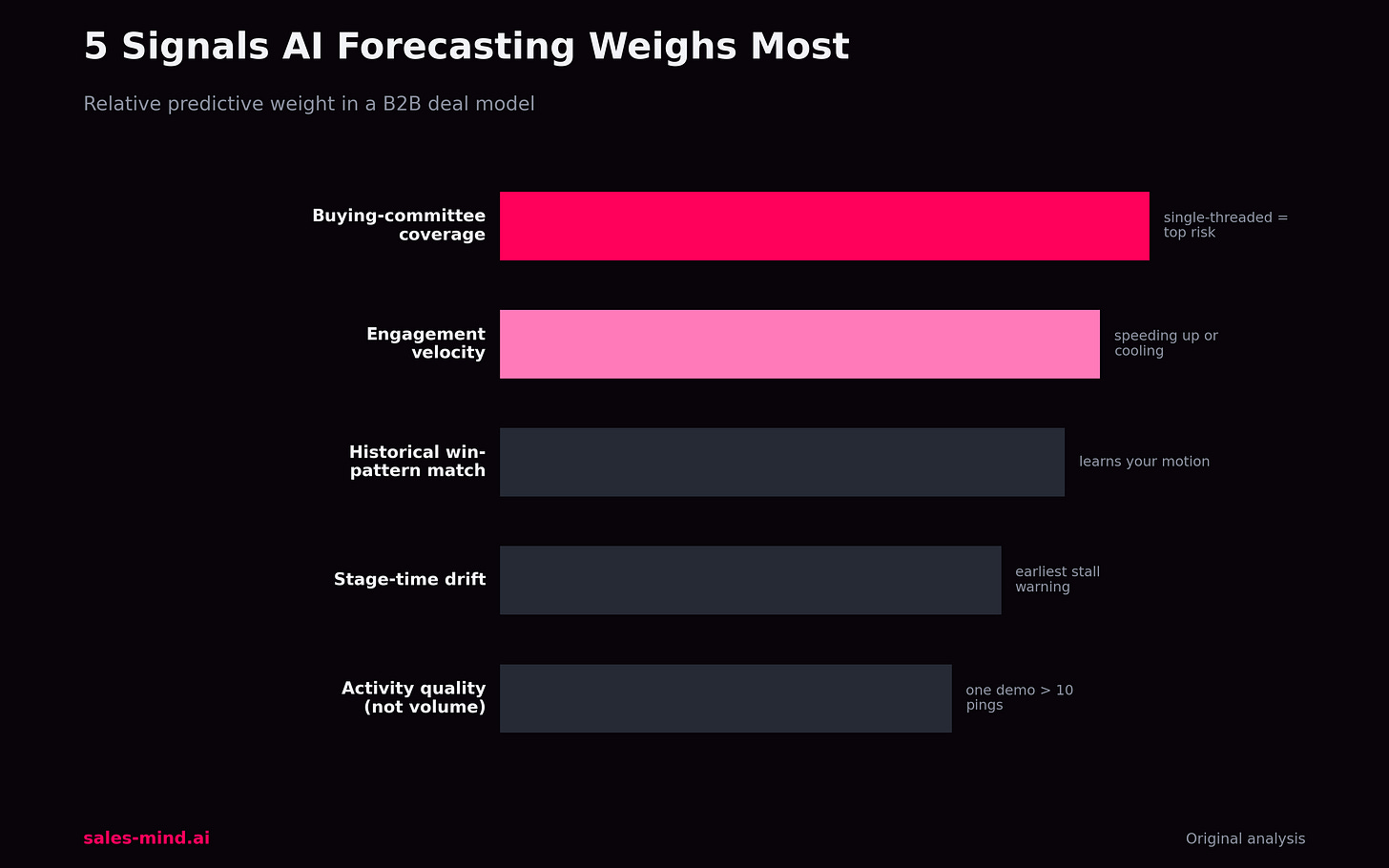
- Engagement velocity. Not just “did they reply,” but how fast, how often, and whether the thread is speeding up or cooling. A deal where replies slow from hours to days is quietly dying, and the model sees it.
- Buying-committee coverage. Single-threaded deals close far less often. AI tracks how many stakeholders are engaged and flags when a deal rests on one champion — the single biggest hidden risk in B2B.
- Historical win-pattern match. The model scores each deal against your own closed-won and closed-lost history, so it learns your sales motion, not a generic benchmark.
- Stage-time drift. How long a deal has sat in its current stage versus how long winning deals normally sit there. Stalls are the earliest reliable warning sign.
- Activity quality, not volume. Ten low-value touches don’t equal one executive meeting. AI weighs the type of interaction, so a single stakeholder demo counts more than a week of email pings.
How to roll out AI forecasting without a data-entry revolt
The number one reason forecasting projects fail is that they demand perfect CRM hygiene up front. Reps won’t log 40 fields per deal, so the model starves. The fix is to choose a system that reads signals automatically — from email, calendar, and conversation data — instead of asking humans to type them in.
Start with a 90-day rollout in three moves:
- Feed it history first. Point the model at your last 12–24 months of closed deals so it learns your real win patterns before it scores a single open deal.
- Run it in shadow mode. For the first month, compare the AI forecast against your manual one every week. Don’t replace the human call yet — build trust by watching where each one was right.
- Coach on the gaps. When the model flags a “committed” deal as at-risk, that’s a coaching conversation, not an argument. The forecast becomes a pipeline-review tool, not just a number.
Done right, AI forecasting stops being a reporting exercise and becomes an early-warning system. Managers spend pipeline reviews on the three deals that actually need help, instead of reading a spreadsheet aloud. That’s where the real return shows up: not in a prettier chart, but in deals saved before they slip.
The best AI forecast doesn’t just predict the quarter — it tells you which deals to fight for while you still can.
Where forecasting meets the rest of your sales motion
A forecast is only as good as the pipeline feeding it. If your team is working thin, single-threaded deals, no model will save the quarter. That’s why forecasting works best alongside an AI sales agent that keeps deals multi-threaded and an prospect intelligence layer that surfaces buying signals early. The forecast reads the signals; the rest of the motion creates them.
Three mistakes that wreck an AI forecast
Even a strong model fails when the process around it is broken. These are the three traps that turn a promising forecasting rollout into shelfware.
- Treating the score as a verdict, not a conversation. When the model flags a deal as at-risk, the wrong reaction is to argue with it or quietly override it. The right one is to ask why — which signal dropped? A forecast that reps fight instead of interrogate never earns trust, and a tool nobody trusts gets ignored by the next quarter.
- Starving it of history. Teams that switch it on with a clean, empty CRM get noise, because the model has nothing to compare against. Feed it your real closed-won and closed-lost record first. The more of your own outcomes it has seen, the sharper — and more specific to your motion — its calls become.
- Chasing perfect data entry instead of automatic signal capture. If your forecast depends on reps hand-logging every touch, it will always lag reality. Pick a system that reads email, calendar, and conversation data on its own, so the forecast reflects what actually happened this week, not what someone remembered to type last week.
Avoid these three and the forecast becomes a habit your team leans on, not a report they tolerate. That habit — weekly pipeline reviews driven by live risk instead of stale percentages — is where forecasting quietly compounds into a better quarter.
Frequently asked questions
Is AI sales forecasting accurate for small pipelines? It needs enough closed-deal history to learn from — usually a few hundred deals. With less, it still helps flag risk, but treat the exact number as directional until the data set grows.
Will it replace my sales managers? No. It replaces the guesswork, not the judgment. Managers still run the deals; the model just tells them where to look first.
How is this different from a CRM probability field? A CRM probability is a static number a human typed. An AI forecast is recalculated continuously from live behavior, so it updates the moment a deal’s signals change.
What data does it actually need? The strongest models read email, calendar, and conversation signals automatically, plus your historical deal outcomes. The less manual entry it requires, the more reliable it stays.
The takeaway
AI sales forecasting turns your pipeline from a hopeful spreadsheet into a live risk model that catches slipping deals weeks early. The teams that win with it don’t chase perfect data entry — they pick a system that reads the signals on its own and use the forecast to coach, not just to report.
If your current forecast surprises you at the end of every quarter, that’s a signal problem, not a spreadsheet problem. Book a strategy call and we’ll map which signals your pipeline is already generating — and which ones you’re flying blind on.
Get AI Sales Insights Weekly