AI Sales CRM: What It Actually Automates and How to Choose One
An AI sales CRM does the busywork reps hate: capturing activity, scoring leads on live signals, and drafting the next step. This guide explains what it actually automates, the five capabilities that separate a real AI sales CRM from a labeled one, and a four-question test to choose the right platform.
Share this article
- Data capture. It logs calls, emails, and meetings automatically, so the record stays current without anyone typing notes at 6pm.
- Enrichment and matching. It fills in missing company and role data, deduplicates contacts, and connects a person to the right account.
- Prioritization. It scores leads and deals on fit and intent, then tells a rep who to call first instead of leaving them to guess.
- Next-step drafting. It suggests or writes the follow-up, flags a stalled deal, and reminds you before a relationship goes quiet.
An AI sales CRM promises to do the busywork your reps hate: log activity, score leads, draft follow-ups, and tell you which deals are slipping. But the phrase gets stuck on every vendor's homepage, so it is hard to tell what is real automation and what is a chatbot bolted onto an old contact database. This guide cuts through it: what an AI sales CRM actually automates, the five capabilities that matter, and a simple way to choose one that fits how your team sells.
The short version: a CRM stores what happened. An AI sales CRM decides what should happen next and does part of it for you. That difference is where sales teams win back hours and stop letting warm conversations go cold.
What an AI sales CRM actually automates
Strip away the marketing and a genuine AI sales CRM works on four jobs your reps do by hand today:
- Data capture. It logs calls, emails, and meetings automatically, so the record stays current without anyone typing notes at 6pm.
- Enrichment and matching. It fills in missing company and role data, deduplicates contacts, and connects a person to the right account.
- Prioritization. It scores leads and deals on fit and intent, then tells a rep who to call first instead of leaving them to guess.
- Next-step drafting. It suggests or writes the follow-up, flags a stalled deal, and reminds you before a relationship goes quiet.
Notice what is missing: it does not replace the conversation. The human still runs the meeting and closes the deal. The AI removes the friction around that conversation so more of them happen.
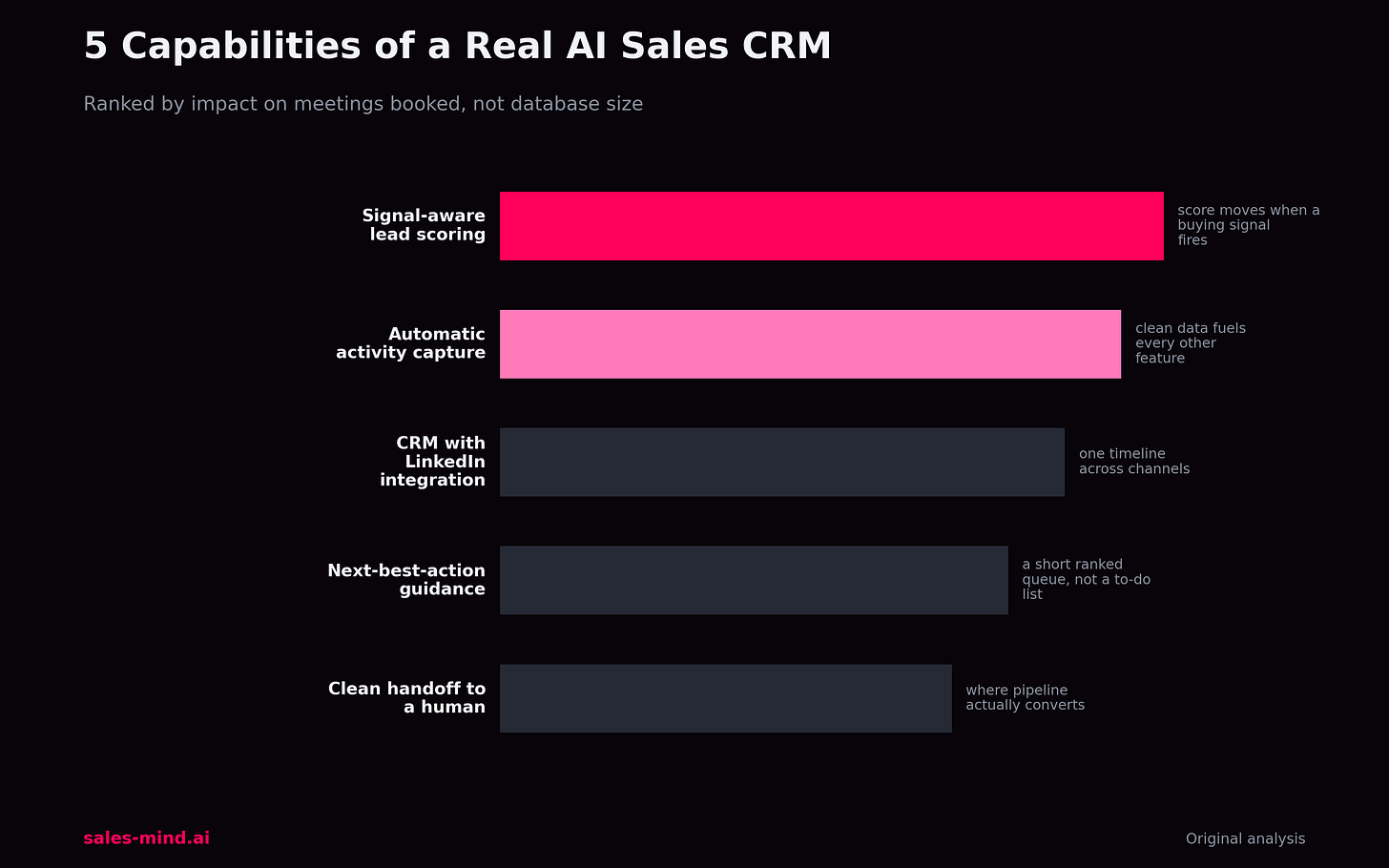
The 5 capabilities that separate a real AI sales CRM from a labeled one
1. Signal-aware lead scoring
Old CRMs score leads on static rules: title, company size, a form fill. A real AI sales CRM watches behavior and timing — a role change, a website visit, an opened proposal — and moves the hottest leads to the top on their own. Ask any vendor to show you how a score changes when a buying signal fires. If the score never moves, it is a spreadsheet with a nicer skin.
2. Automatic activity capture
The biggest reason CRMs hold stale data is manual entry. The capability to check for is silent capture: emails and calls logged to the right record without a rep lifting a finger. Clean data is the fuel for every other AI feature, so this one is not optional.
3. CRM with LinkedIn integration
Most B2B relationships start or live on LinkedIn, yet many CRMs treat it as a separate world. A CRM with LinkedIn integration syncs those touches into the same timeline as email and calls, so a rep sees the full relationship in one place and outreach stays coordinated across channels instead of duplicated. This is where a modern platform pulls ahead of a legacy database.
4. Next-best-action guidance
Scoring tells you who; guidance tells you what to do about it. The strongest AI sales CRMs surface a specific next step — send this follow-up, re-engage this quiet account, book this meeting — and can draft the message for review. It turns a long to-do list into a short, ranked queue.
5. A clean handoff to a human
Automation should hand a warm, well-briefed conversation to a person, not fire a bot at a prospect forever. Look for a CRM that packages the context — why this lead, what they care about, what was said — so the rep walks into the call ready. Pipeline converts at the handoff, and this is where an AI system either helps or gets in the way.
Where an AI sales CRM saves the most time
The payoff is not evenly spread. In practice, the hours come back in three places. First, admin: reps stop rebuilding the record and spend that time selling. Second, prioritization: leaders stop guessing which deals are real because the system flags fit, intent, and momentum. Third, follow-up discipline: fewer warm leads slip because the CRM reminds and drafts before a relationship goes cold. If you can only measure one thing after rollout, measure how many qualified conversations each rep has per week — that number should rise.
There is a second, quieter payoff: forecast accuracy. When activity is captured automatically and scores update on real signals, the pipeline reflects reality instead of wishful notes from a rep who forgot to update a stage. Leaders spend less time interrogating the CRM in deal reviews and more time coaching the deals that can actually move this quarter. That trust in the numbers is often what convinces a skeptical team to keep using the system after the launch buzz fades.
How to choose an AI sales CRM in four questions
Vendor demos all look great. These four questions separate them fast:
- Does the lead score actually move on a signal? Ask for a live example. Static scoring is not AI.
- Is activity captured automatically? If reps still log calls by hand, the data will rot and the AI will be wrong.
- Does it treat LinkedIn as a first-class channel? For B2B, a CRM with LinkedIn integration is the difference between a partial and a full picture.
- Does it hand a human a briefed conversation? The goal is more real meetings, not more automated messages.
If a platform answers yes to all four, it is doing the work of an AI sales CRM rather than wearing the label. To see how signal-based scoring, automatic capture, and coordinated outreach fit together, explore AI lead generation and prospect intelligence, then connect the sending side with outreach automation.
A note on rollout
Buying the tool is the easy part. Teams that get value fast start narrow: one segment, clean data, and a single automated play — usually re-engaging warm-but-quiet accounts. They watch reply and meeting rates for two weeks, then expand. Trying to automate everything on day one is how good tools get blamed for bad results. Start where the signal is strongest and let the wins fund the next step.
Frequently asked questions
What is the difference between a CRM and an AI sales CRM?
A traditional CRM records what happened. An AI sales CRM adds intelligence on top: it scores leads on live signals, captures activity automatically, and suggests or drafts the next step, so your team spends less time on admin and more time in real conversations.
Does an AI sales CRM replace salespeople?
No. It removes the busywork around selling — data entry, prioritization, follow-up reminders — and hands a briefed, warm conversation to a human who runs the meeting and closes the deal.
Why does LinkedIn integration matter in a CRM?
In B2B, many relationships start and develop on LinkedIn. A CRM with LinkedIn integration puts those touches in the same timeline as email and calls, so outreach stays coordinated and no context is lost across channels.
How long before an AI sales CRM shows results?
Teams that start narrow with clean data often see prioritization and follow-up gains within a few weeks. Broad, everything-at-once rollouts take longer and are harder to measure.
Want a system that scores on real signals, captures activity automatically, and briefs your reps for the conversations that convert? Book a strategy call to map an AI sales CRM to your pipeline.
Written with AI assistance and reviewed by the SalesMind team.
Get AI Sales Insights Weekly
