AI Sales Assistant: What It Does and How to Deploy One
An AI sales assistant removes the busywork around selling. Learn the 6 core jobs it handles and a simple way to deploy one without the chaos.
Share this article
- Research and account briefs. It reads company signals, recent news, and role details, then hands your rep a tight brief in minutes instead of an hour of tab-hopping.
- Personalized outreach drafts. It writes first drafts that reference the buyer's world, so reps edit and send instead of staring at a blank page.
- Meeting notes and follow-ups. It captures what was said, drafts the recap, and queues the next step, so nothing slips between calls.
- CRM updates. It logs activity and cleans records automatically, ending the "did you update the CRM" tax.
AI Sales Assistant: What It Does and How to Deploy One
An AI sales assistant is software that works alongside your reps, handling the slow, repetitive parts of selling so your team can spend its hours where deals are actually won: real conversations. Think of it less as a chatbot and more as a tireless teammate that researches accounts, drafts outreach, takes notes, and keeps your CRM clean without being asked. In this guide you will learn exactly what an AI sales assistant does, where it helps most, and how to roll one out without disrupting your team.
Sales leaders do not need convincing that reps are stretched thin. The real question is where the time goes and how to get it back. That is the lens we use here.
What does an AI sales assistant actually do?
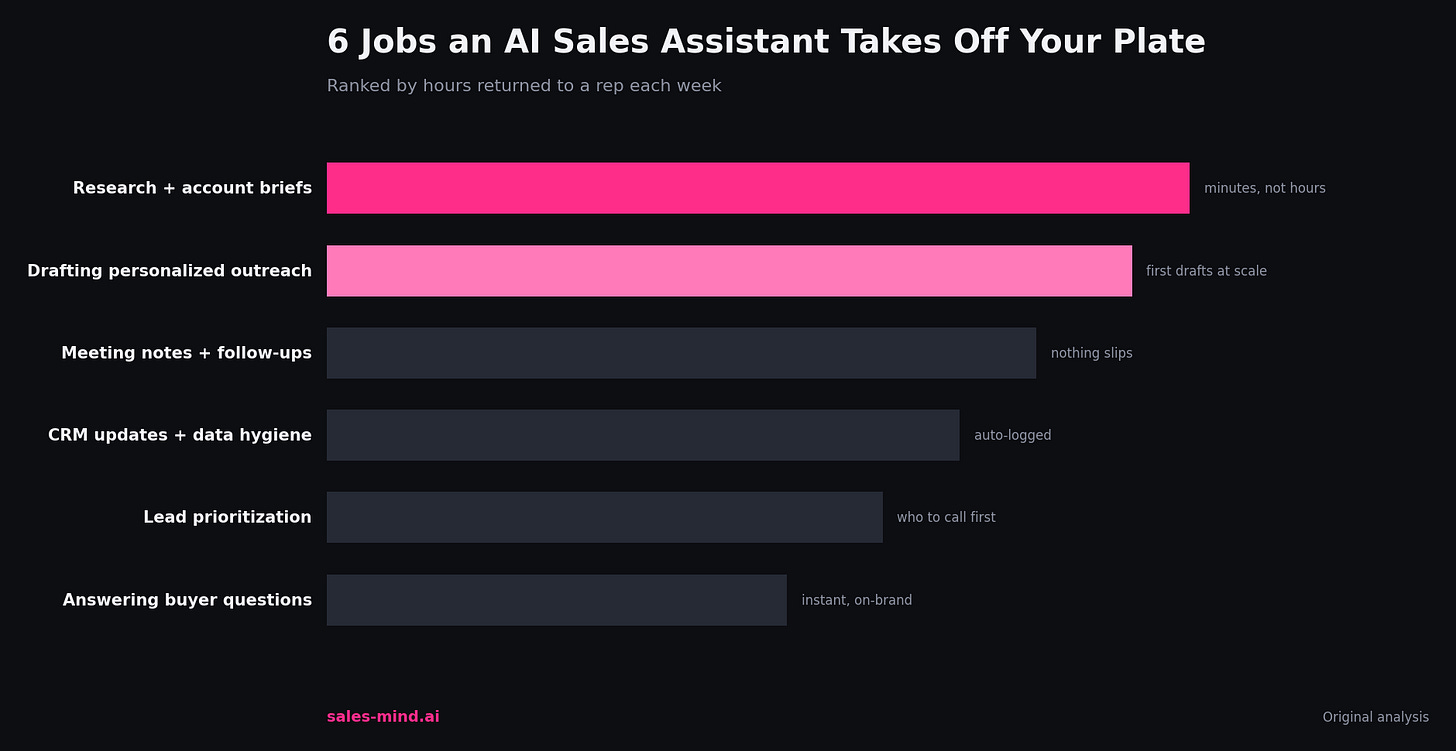
The strongest tools do not try to replace the seller. They remove the busywork that surrounds selling. A capable AI sales assistant covers six core jobs.
- Research and account briefs. It reads company signals, recent news, and role details, then hands your rep a tight brief in minutes instead of an hour of tab-hopping.
- Personalized outreach drafts. It writes first drafts that reference the buyer's world, so reps edit and send instead of staring at a blank page.
- Meeting notes and follow-ups. It captures what was said, drafts the recap, and queues the next step, so nothing slips between calls.
- CRM updates. It logs activity and cleans records automatically, ending the "did you update the CRM" tax.
- Lead prioritization. It ranks who to contact first based on fit and intent, so reps work the warmest accounts.
- Instant buyer answers. It surfaces on-brand answers to common questions so reps respond fast and stay consistent.
Why it matters now
Study after study finds that sellers spend most of their week on tasks that are not selling. Research, data entry, and admin quietly eat the calendar. An AI sales assistant hands those hours back. The gain is not just speed. When reps stop context-switching, their conversations get sharper, their follow-up gets faster, and buyers feel the difference.
There is a quality effect too. A good assistant applies your best playbook to every account, not just the ones your top rep touches. That raises the floor across the whole team.
AI sales assistant vs. AI sales agent: what is the difference?
People use these terms loosely, so it helps to be precise. An AI sales assistant supports a human who stays in control: it drafts, suggests, and organizes, and the rep decides. An AI sales agent takes on a defined task end to end, acting within guardrails you set. Most teams start with the assistant model to build trust, then hand specific, well-scoped tasks to an agent once the workflow is proven. If you want to see the agent side, explore our AI sales agent and how it fits alongside human reps.
Where an AI sales assistant helps most across the funnel
The value shows up at every stage, but it looks different at each one. Early in the funnel, an AI sales assistant shines at research and prioritization. It reads the signals that a rep would take an hour to gather, then tells them which accounts are worth the first call today. That alone reshapes a rep's morning.
In the middle, when conversations are live, the assistant keeps the momentum. It drafts the follow-up while the call is still fresh, suggests the next best step, and makes sure no promise made on a call quietly disappears. Deals stall in the gaps between touches, and this is exactly where the assistant closes those gaps.
Later, as deals mature, it protects your data and your forecast. Clean, current records mean your pipeline reflects reality, so leaders can coach and plan from facts instead of guesses. None of this replaces judgment. It gives your team more time to apply it, and better information to apply it to.
What to look for when choosing one
Not every tool that claims the label earns it. As you evaluate options, hold each one to a short standard. It should learn your context, not force a generic script on your team. It should keep a human in control, especially early. It should connect to the systems you already use, so it adds to your workflow instead of becoming another tab no one opens. And it should be honest about what it does well and what still needs a person. A tool that promises to do everything usually does most of it poorly.
Above all, judge it by outcomes. If it returns hours to your reps and lifts the quality of their conversations, it belongs in your stack. If it only adds activity, it is noise.
How to deploy an AI sales assistant without the chaos
The teams that succeed treat this as a rollout, not a switch you flip. A simple path works well.
- Start with one painful task. Pick the job reps complain about most, often research or follow-up, and let the assistant own it for two weeks.
- Feed it your context. Give it your ideal customer profile, your messaging, and your best examples so its output sounds like your team.
- Keep a human in the loop. Reps review and approve early on. Trust grows as accuracy proves out.
- Measure the right thing. Track hours returned and reply quality, not just volume. More activity is not the goal; more won conversations is.
- Expand deliberately. Add the next task only once the first is humming.
Underneath all of this sits your data. An assistant is only as sharp as the signals it reads, which is why strong prospect intelligence and clean AI lead generation make such a difference to what it can do.
Frequently asked questions
Will an AI sales assistant replace sales reps?
No. It removes the busywork around selling so reps can do more of what only humans do well: build trust, read the room, and close. The best results come from pairing the two, not swapping one for the other.
Is an AI sales assistant hard to set up?
It should not be. Start with one task, feed it your context, and expand once it proves out. The rollout, not the software, is where teams either win or stall.
How do I know it is working?
Watch two numbers: hours returned to reps each week, and the quality of replies and meetings. If both climb, the assistant is earning its place. Ask your reps too. The people doing the work will tell you fast whether a tool is helping or just adding friction to their day.
What data does an AI sales assistant need?
At a minimum, it needs your ideal customer profile, your messaging, and access to the signals that show buyer intent. The richer and cleaner that input, the sharper its research, drafts, and prioritization become. Data quality is the quiet factor that decides how good the output feels.
See what an AI sales assistant could do for your team
The fastest way to know whether an AI sales assistant fits your motion is to map it to your real workflow, not a generic demo. Book a strategy call and we will walk through where your reps lose the most time and how an assistant would give it back. You can also see how it connects to outreach automation across your team.
Get AI Sales Insights Weekly
