AI Funnel Builder: How to Build a Sales Funnel That Fills Itself
An AI funnel builder is the system that runs your sales funnel end to end, so every stage passes the right prospects to the next automatically. Here is how to build one, stage by stage.
Share this article
- Automating a broken process. If your funnel logic is wrong, AI just makes the wrong thing happen faster. Fix the stage definitions first, then automate.
- Optimizing for volume. A funnel that sends more but converts less is a step backward. Judge each stage by how many good prospects it passes forward, not by activity counts.
- Removing the human at the wrong stage. Let AI run sourcing, scoring, and timing. Keep humans on the closing conversation. Teams that flip this get worse results and burned prospects.
- No feedback loop. The scoring model should learn from which prospects actually closed. A funnel that never updates its definition of "warm" slowly drifts out of tune.
sales funnel that fills itself" style="width:100%;border-radius:12px;" >
Most teams do not have a lead problem. They have a funnel problem. Leads come in, sit in a spreadsheet, and go cold while a busy rep tries to remember who to follow up with. An AI funnel builder fixes the part humans are worst at: doing the right next step, for every prospect, every day, without forgetting anyone.
This is a build guide, not a theory piece. It walks through how to construct a sales funnel that fills and moves itself, stage by stage, using AI to carry the repetitive load so your team spends its time on the conversations that close.
What an AI funnel builder actually is
An AI funnel builder is not a landing-page tool. It is the system that runs your sales funnel end to end: it finds the right prospects, starts the conversation, scores who is warm, times the follow-ups, and hands a rep the ones ready to talk. Think of it as an operating layer that sits on top of your existing outreach and CRM, making sure no stage leaks.
The old way built a funnel out of manual tasks: a rep pulls a list, writes messages, sets reminders, updates the CRM. Every one of those steps is a place where things fall through. The AI-built funnel replaces each manual handoff with a rule the system runs on its own, so the funnel keeps moving whether or not anyone remembers to push it.
The five stages every AI-built funnel needs
Before the how-to, here is the shape you are building toward. A funnel that fills itself has five working stages, each with a clear job and a clear signal that moves a prospect to the next one.
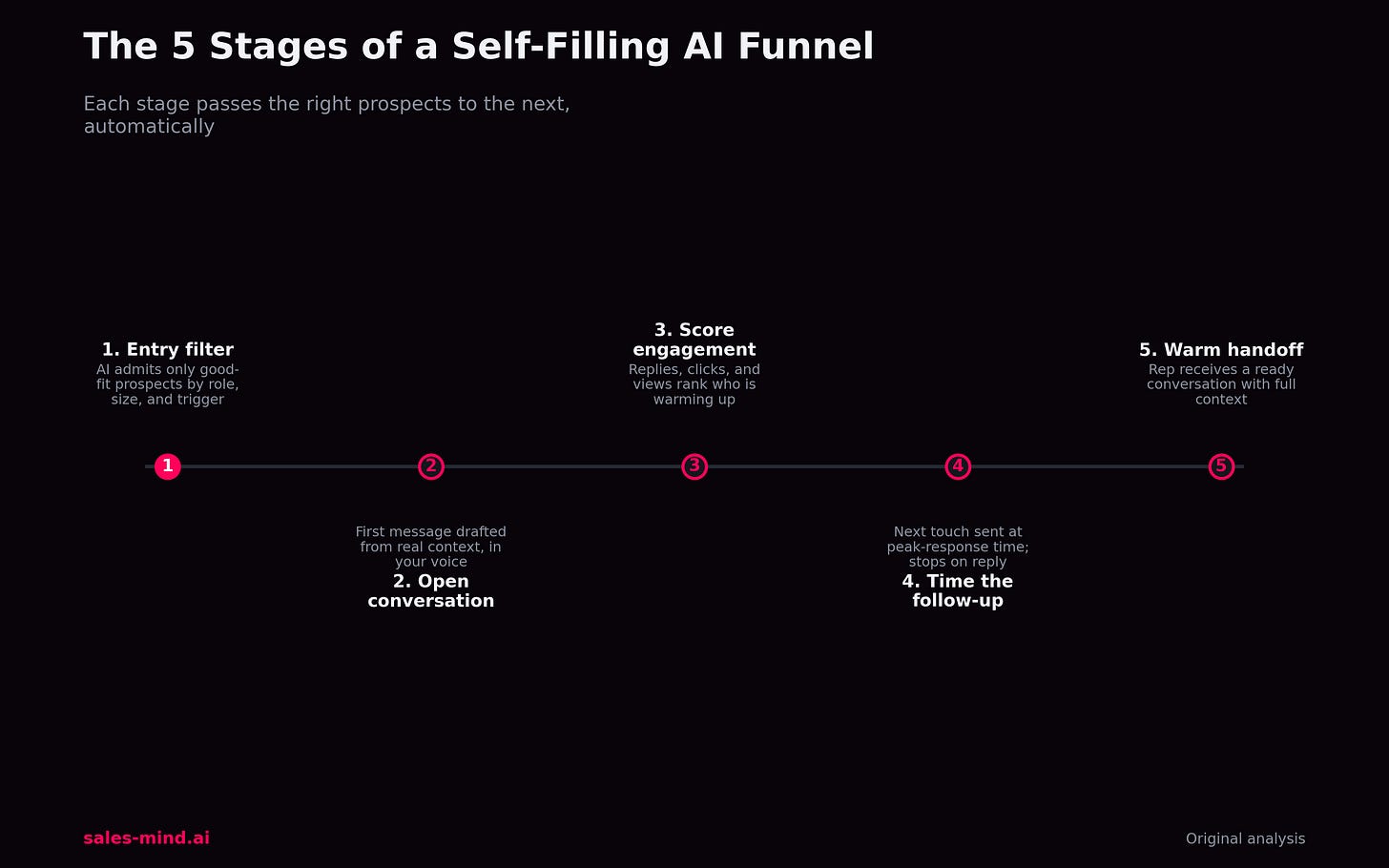
Keep this map in front of you. The goal of the build is simple: make each stage pass the right people to the next stage automatically, so nothing stalls in between.
How to build it, stage by stage
Stage 1 — Define the prospect the funnel is allowed to accept
A self-filling funnel is only as good as its entry filter. Before any automation, write down the exact profile of a good-fit prospect: the roles, company size, industry, and trigger events that make someone worth your team's time. This becomes the rule the AI uses to source and admit leads, so the top of the funnel stays clean instead of flooding with names that will never convert.
Skip this and you build a fast machine that pours the wrong people into your pipeline. Precision at the entrance saves hours at every later stage.
Stage 2 — Let AI start the conversation in your voice
Once the entry rule is set, the funnel opens conversations at a scale no rep could match by hand. A good AI funnel builder drafts the first message from the prospect's real context — their role, their company, a recent signal — not a generic mail-merge. Your job shifts from writing every message to approving the voice and setting the guardrails.
The measure of success here is not volume of messages sent. It is the reply rate. If the openers do not sound human and relevant, tighten the context the AI is allowed to use before you send more.
Stage 3 — Score engagement so warm beats loud
This is the stage most manual funnels skip, and it is where AI earns its place. As prospects reply, open, click, or view your profile, the system scores intent and ranks who is actually warming up. Instead of a rep guessing, the funnel surfaces the ten people most likely to say yes today. Predictive scoring turns a noisy inbox into a ranked to-do list.
The build rule: every engagement signal should raise or lower a prospect's score automatically, and the highest scores should rise to the top of a rep's queue without anyone sorting by hand.
Stage 4 — Automate follow-up timing, not just follow-up sending
Deals die in the gaps between touches. The AI-built funnel sends the next follow-up when the prospect is most likely to respond — and, just as important, it stops the sequence the instant someone replies so no one gets a robotic "just checking in" after they already answered. Timing, done consistently, beats clever copy sent at the wrong moment.
Stage 5 — Hand the rep a ready conversation, with context
The final stage is the handoff. When a prospect crosses the warm threshold, the funnel routes them to a human with the full history attached: what was said, what they engaged with, and why they scored high. The rep walks in warm instead of cold. This is the whole point — AI does the sorting and the patience; the human does the closing.
An AI funnel builder does not replace your salespeople. It deletes the busywork that was keeping them away from the only thing they are uniquely good at: the conversation that ends in yes.
Common mistakes when building an AI funnel
- Automating a broken process. If your funnel logic is wrong, AI just makes the wrong thing happen faster. Fix the stage definitions first, then automate.
- Optimizing for volume. A funnel that sends more but converts less is a step backward. Judge each stage by how many good prospects it passes forward, not by activity counts.
- Removing the human at the wrong stage. Let AI run sourcing, scoring, and timing. Keep humans on the closing conversation. Teams that flip this get worse results and burned prospects.
- No feedback loop. The scoring model should learn from which prospects actually closed. A funnel that never updates its definition of "warm" slowly drifts out of tune.
Where this fits in your stack
You do not need to rip anything out to build an AI-driven funnel. The sourcing and outreach layer connects to the tools your team already uses, and the scoring sits on top of your existing pipeline. If you want to see how each stage maps to a working platform, explore how an AI sales agent runs the funnel, how outreach automation opens conversations at scale, and how prospect intelligence decides who is warm.
Building this well is a strategy decision as much as a tooling one. If you want a second set of eyes on where your funnel leaks and how AI would plug it, book a strategy call and we will map it with you.
FAQ
Is an AI funnel builder the same as a landing page builder? No. A landing page builder creates web pages. An AI funnel builder runs your sales process — sourcing, outreach, scoring, follow-up, and handoff — across your existing channels.
Will AI replace my sales reps? No. It removes the repetitive work — list building, scoring, follow-up timing — and hands reps warm, well-documented conversations. Humans still do the closing.
How long does it take to build? The first working version is fast once your prospect definition and stage rules are clear. Most of the effort is defining the funnel well; connecting the automation is the quick part.
What is the single most important stage? The entry filter. A precise definition of a good-fit prospect protects every stage that follows. Get the top of the funnel right and the rest gets easier.
This article was written with AI assistance and reviewed by the SalesMind team.
Get AI Sales Insights Weekly
