AI CRM for Sales Teams: What It Actually Does (and How to Roll It Out)
An AI CRM predicts deals, automates admin, and recommends the next move so reps sell more. Here is what it does and a 5-step rollout plan.
Share this article
- Prediction. It scores which deals are likely to close and which are quietly dying, so reps spend time where it counts.
- Automation of the boring parts. It writes the follow-up draft, updates the record after a call, and schedules the next touch — the admin work that eats a rep's afternoon.
- Guidance in the moment. It surfaces the next best action for each account instead of leaving reps to guess.
AI CRM for Sales Teams: What It Actually Does (and How to Roll It Out)
An AI CRM for sales teams is a customer relationship manager that does more than store data — it reads your pipeline, predicts what happens next, and tells reps who to call and what to say. Instead of a shared filing cabinet, you get a system that thinks alongside your team.
The phrase gets thrown around a lot, so this guide keeps it concrete: what an AI CRM really does, where the value shows up, and a calm, step-by-step way to roll one out without disrupting the team. We wrote this with AI assistance and grounded every point in how sales teams actually work.
What makes a CRM an "AI CRM"?
A regular CRM records what already happened: calls logged, deals moved, notes typed. An AI CRM adds a layer on top that turns that history into guidance. Three capabilities separate the two:
- Prediction. It scores which deals are likely to close and which are quietly dying, so reps spend time where it counts.
- Automation of the boring parts. It writes the follow-up draft, updates the record after a call, and schedules the next touch — the admin work that eats a rep's afternoon.
- Guidance in the moment. It surfaces the next best action for each account instead of leaving reps to guess.
Put simply: a CRM tells you what happened; an AI CRM helps you decide what to do about it.
Why sales teams are moving to an AI CRM
Reps do not leave a CRM because they hate the software. They leave because the software makes them work for it — endless data entry, stale records, and no help deciding what matters. An AI CRM flips that relationship. Here is where the change shows up day to day:
1. Less admin, more selling
Studies of sales roles keep finding the same thing: reps spend only a fraction of their week actually talking to buyers. Logging activity, updating fields, and writing recap emails swallow the rest. An AI CRM captures call notes automatically, drafts the follow-up, and updates the record so the human can get back to the conversation.
2. Cleaner data without the nagging
A pipeline is only as trustworthy as the data behind it. When updates happen automatically, records stay current, and forecasts stop being fiction. Leaders can look at the board and believe what they see.
3. Smarter prioritisation
Not every open deal deserves equal attention. AI scoring reads engagement, timing, and past patterns to flag the accounts most likely to move — and the ones going cold. Reps start their day with a ranked list instead of a hunch.
4. Signals you would have missed
A champion changes jobs. A target account visits your pricing page three times. A deal goes quiet after weeks of momentum. An AI CRM watches for these buying and risk signals across the whole book and nudges the rep at the right moment.
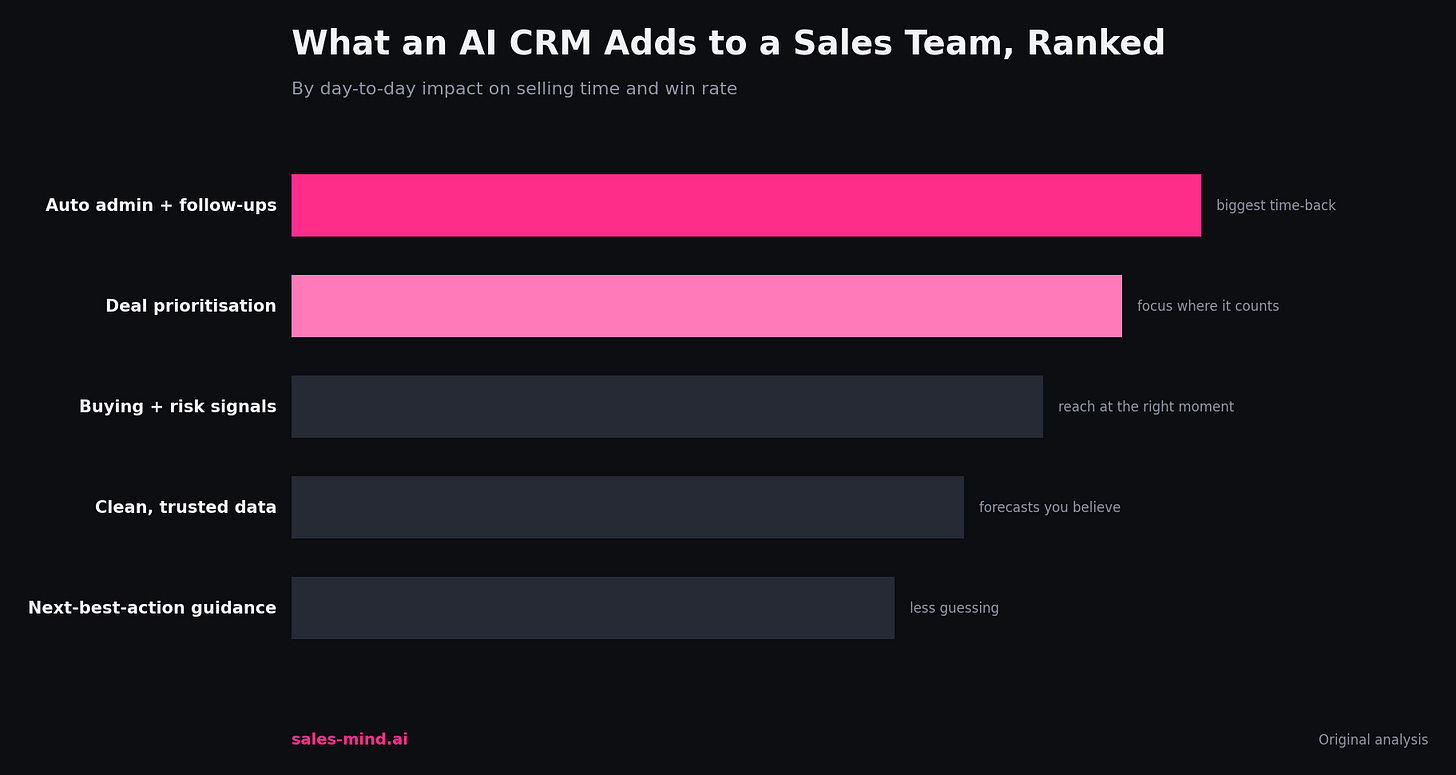
None of these wins come from a flashy dashboard. They come from the CRM quietly doing the work reps used to do by hand, then handing back a clear recommendation. When that happens, adoption stops being a fight — reps use the tool because it obviously makes their day easier and their number more reachable.
How to roll out an AI CRM in 5 steps
The teams that succeed treat this as a change-management project, not a software install. This sequence keeps adoption high and disruption low:
- Step 1 — Fix the foundation first. AI is only as good as the data it reads. Clean up duplicate records, agree on your stages, and define what a "qualified" deal means before you switch anything on.
- Step 2 — Pick one painful workflow. Do not boil the ocean. Choose the single process that hurts most — say, follow-up after demos — and let the AI prove itself there first.
- Step 3 — Keep a human in the loop. Let the AI draft, score, and suggest; let the rep approve. Trust grows when people see the suggestions are good, not when they are forced to obey them.
- Step 4 — Train on real deals. Run a short session using the team's own live pipeline, not a demo dataset. Reps adopt what obviously helps them hit quota.
- Step 5 — Measure and expand. Track time saved and win-rate on the first workflow. When the numbers are real, roll the same pattern out to the next process.
What to look for in an AI CRM
Not every "AI" badge means the same thing. As you evaluate options, weigh these:
- Does it act, or just report? Dashboards are nice, but the value is in drafted emails, auto-updates, and next-best-actions the rep can use immediately.
- Does it explain itself? A good score comes with a reason. Reps trust guidance they understand.
- Does it fit your motion? An AI CRM built for high-volume inbound will feel wrong for a complex, relationship-led enterprise sale. Match the tool to how your team actually sells.
- Will reps actually use it? The most advanced system is worthless if it adds clicks. Adoption beats features.
Where AI CRM fits in a modern sales stack
An AI CRM is most powerful when it connects to the rest of your motion — the prospecting, the outreach, and the intelligence that tells you who to reach and when. That is the whole idea behind an AI sales agent: the CRM stops being a passive record and becomes an active teammate that finds signals, drafts the next move, and keeps the pipeline honest. Pairing it with prospect intelligence means the system does not just manage the deals you have — it helps surface the ones you should be working next.
If you are weighing how an AI CRM could reshape your team's day, the fastest way to get clarity is a conversation about your specific pipeline and goals. Book a strategy call and we will map what a rollout would look like for your team.
Frequently asked questions
What is an AI CRM for sales teams?
It is a customer relationship manager with a layer of artificial intelligence that predicts deal outcomes, automates admin like data entry and follow-ups, and recommends the next best action for each account — so reps spend more time selling and less time managing the tool.
Is an AI CRM different from CRM automation?
Yes. Basic automation follows fixed rules ("if a deal reaches stage 3, send this email"). AI goes further: it learns from your data to score deals, spot signals, and adapt its suggestions as your pipeline changes.
Will an AI CRM replace sales reps?
No. It removes the busywork and sharpens decisions, but the relationship, the judgement, and the close stay human. Think of it as a co-pilot that hands reps back their time.
How long does it take to see value?
Teams that start with one focused workflow often see time savings within the first few weeks. Full pipeline impact — cleaner forecasts and better win rates — builds over a quarter as the data and habits mature.
Written with AI assistance and reviewed by the SalesMind team.
Get AI Sales Insights Weekly
