AI B2B Lead Finder: How Modern Sales Teams Fill the Pipeline in 2026
An AI B2B lead finder turns your ideal customer profile into a scored, verified list of accounts and contacts. Here is what works in 2026 and a 30-day plan to start.
Share this article
- Understands intent, not just keywords. It reads your ideal customer profile in plain language and matches on the meaning, so "mid-market SaaS teams scaling outbound" returns the right firms, not a keyword soup.
- Enriches every record. Role, seniority, company size, and verified contact details are filled in, so you are not stitching data from three tools.
- Scores and ranks. The best-fit leads rise to the top, so reps spend their hours on the accounts most likely to reply.
- Refreshes automatically. People change jobs and companies grow. A good finder keeps the list current instead of going stale the day you export it.
An AI B2B lead finder does the part of prospecting most reps quietly dread: it finds the right companies and people, then hands you a clean, ready-to-contact list. Instead of digging through directories and guessing at job titles, you describe your ideal customer and the AI builds the list for you. In 2026, this is how lean B2B teams keep the pipeline full without hiring an army of researchers.
But not every tool that claims "AI" actually helps. This guide explains what an AI B2B lead finder really does, what separates a useful one from a noisy one, and how to fold it into your sales motion without a painful rebuild.
What an AI B2B lead finder actually does
At its core, an AI lead finder turns a description of your best customer into a list of matching accounts and contacts. The strong ones go further than a basic filter:
- Understands intent, not just keywords. It reads your ideal customer profile in plain language and matches on the meaning, so "mid-market SaaS teams scaling outbound" returns the right firms, not a keyword soup.
- Enriches every record. Role, seniority, company size, and verified contact details are filled in, so you are not stitching data from three tools.
- Scores and ranks. The best-fit leads rise to the top, so reps spend their hours on the accounts most likely to reply.
- Refreshes automatically. People change jobs and companies grow. A good finder keeps the list current instead of going stale the day you export it.
Done well, this replaces hours of manual research with minutes of review. That time goes back into conversations, which is where deals are actually won.
What separates a great AI lead finder from a noisy one
Most tools can produce a big list. Volume is easy; relevance is hard. When we look at what actually moves reply rates, six signals matter most. We ranked them by how much they change results for a B2B team.
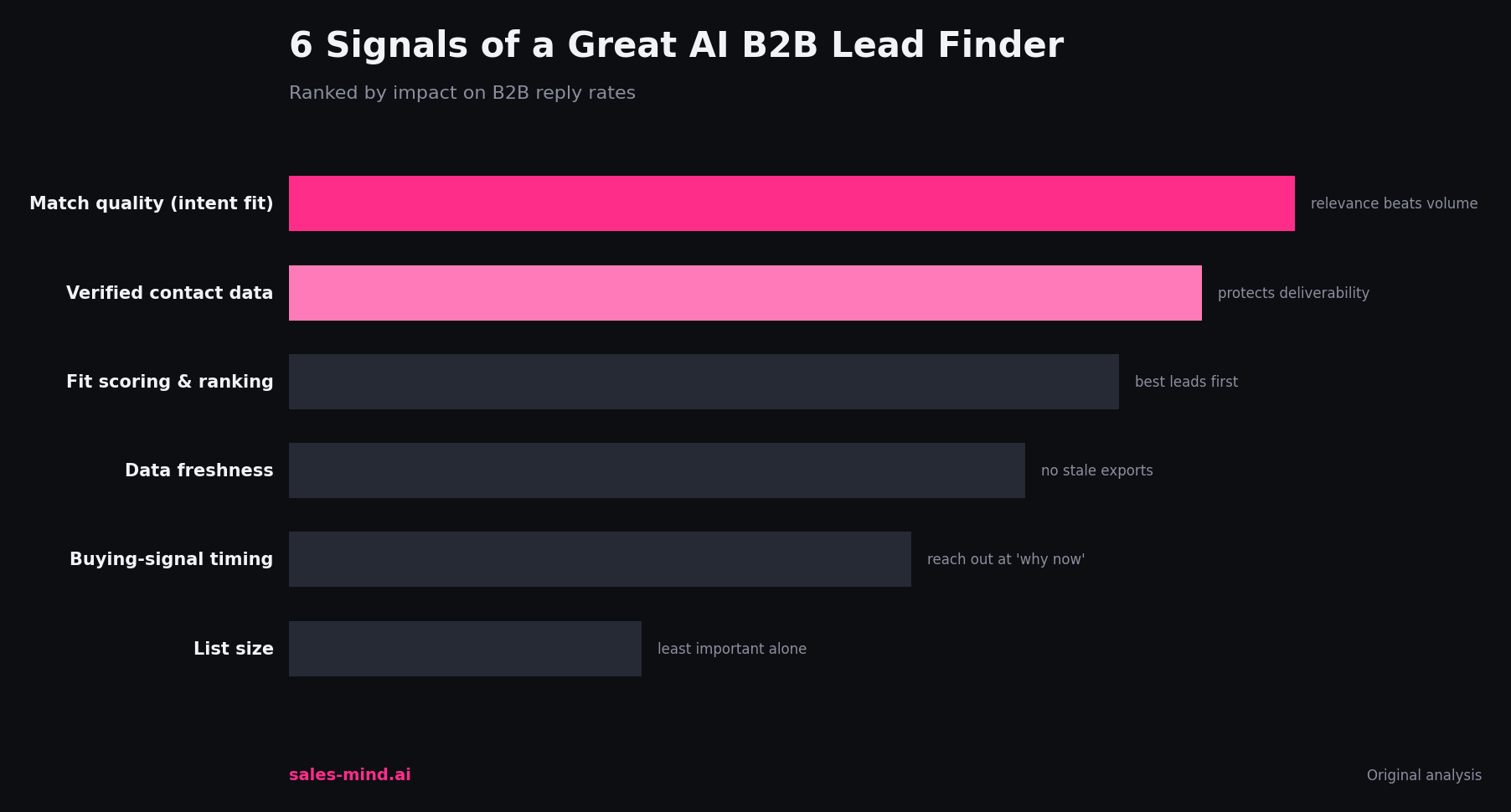
The lesson: a smaller list of well-matched, verified, freshly-scored contacts beats a giant export of stale records every time. If a tool brags about list size but stays quiet about data freshness and match quality, treat that as a warning.
How sales teams use AI lead finding day to day
The teams getting the most value do not treat the finder as a one-time list dump. They build it into a repeatable rhythm:
- Define the ideal customer once. Write it in plain language: who they are, what triggers a need, and why you win. The AI uses this as its compass.
- Let it build and score the list. Review the top-ranked matches, remove anything off-target, and approve the rest.
- Pair it with real prospect intelligence. Knowing who to contact is step one; knowing why now is what earns the reply. Signals like a new role or a growth push tell you when to reach out.
- Feed it back. Mark which leads converted. The system learns your real winners and sharpens the next list.
This is where a platform beats a point tool. When lead finding, prospect intelligence, and outreach live together, the handoffs disappear and the whole motion speeds up.
Where AI lead finding still needs a human
AI is a force multiplier, not a replacement for judgment. Keep people in the loop on three things:
- Final fit checks. The AI ranks, but a rep who knows the market can spot a mismatch the model missed.
- The message. AI can draft, but the insight that makes a prospect stop scrolling comes from understanding their world.
- Compliance and tone. Someone should own how you contact people so outreach stays respectful and on-brand.
The goal is not to remove the human. It is to remove the busywork so the human spends time where it counts.
How to start without a rebuild
You do not need to tear down your stack to get value. A simple 30-day path works well:
- Week 1: Write one sharp ideal customer profile and generate a first scored list for a single segment.
- Week 2: Run outreach to the top matches and track reply quality, not just volume.
- Weeks 3-4: Compare the AI-built list against your old method. Keep what wins and expand to a second segment.
If you want help mapping this to your team's targets, explore AI lead generation and see how it connects finding, scoring, and outreach in one flow.
FAQ
What is an AI B2B lead finder?
It is a tool that turns a description of your ideal customer into a scored, verified list of matching companies and contacts, so you spend less time researching and more time selling.
How is it different from a contact database?
A database is a static list you search. An AI lead finder understands your target in plain language, ranks the best-fit leads, and keeps the data fresh so you act on current information.
Will an AI lead finder replace SDRs?
No. It removes the manual research so reps focus on messaging and conversations. The judgment, the relationship, and the close still belong to people.
How fast can a small team see results?
Most teams get a usable scored list in the first week and can compare reply quality within a month. Start with one segment, prove it, then expand.
AI lead finder vs buying a list
Many teams still buy a bulk contact list and hope for the best. On the surface it looks faster, but the hidden costs pile up. A purchased list is a snapshot: it is out of date the moment it lands, it is often shared with dozens of other buyers, and it rarely explains why any contact is a fit. You end up paying to email people who have heard the same pitch ten times.
An AI B2B lead finder works differently. It builds the list from your own definition of a good customer, verifies the details, and keeps them fresh. Because it scores fit, you know which leads deserve a personal note and which do not. The result is a shorter list you actually trust, instead of a huge file you have to clean. Over a quarter, that difference shows up as higher reply rates and fewer wasted sends.
Common mistakes to avoid
Even with a great tool, a few habits quietly hurt results:
- Chasing volume. A list of 10,000 names feels productive but usually means more noise and lower reply rates. Trust the scoring and work the top of the list first.
- Skipping the "why now." Fit tells you who to contact; timing tells you when. Ignoring buying signals means great-fit leads still get a cold, generic message.
- Never updating the profile. Your best customers evolve. Revisit your ideal customer definition every quarter so the AI keeps aiming at the right target.
- Treating it as set-and-forget. Feed conversions back in. The system only learns your real winners if you tell it which leads closed.
Avoid these and the finder compounds: every cycle it gets a little sharper, and your reps spend more time with the accounts most likely to buy.
The bottom line
An AI B2B lead finder gives lean teams the reach of a research department without the headcount. It finds the right accounts, verifies the details, and ranks who to contact first, so your reps spend their time on real conversations. Want to see how AI lead finding, prospect intelligence, and outreach fit your pipeline? Book a strategy call and we will map it to your goals.
Get AI Sales Insights Weekly
