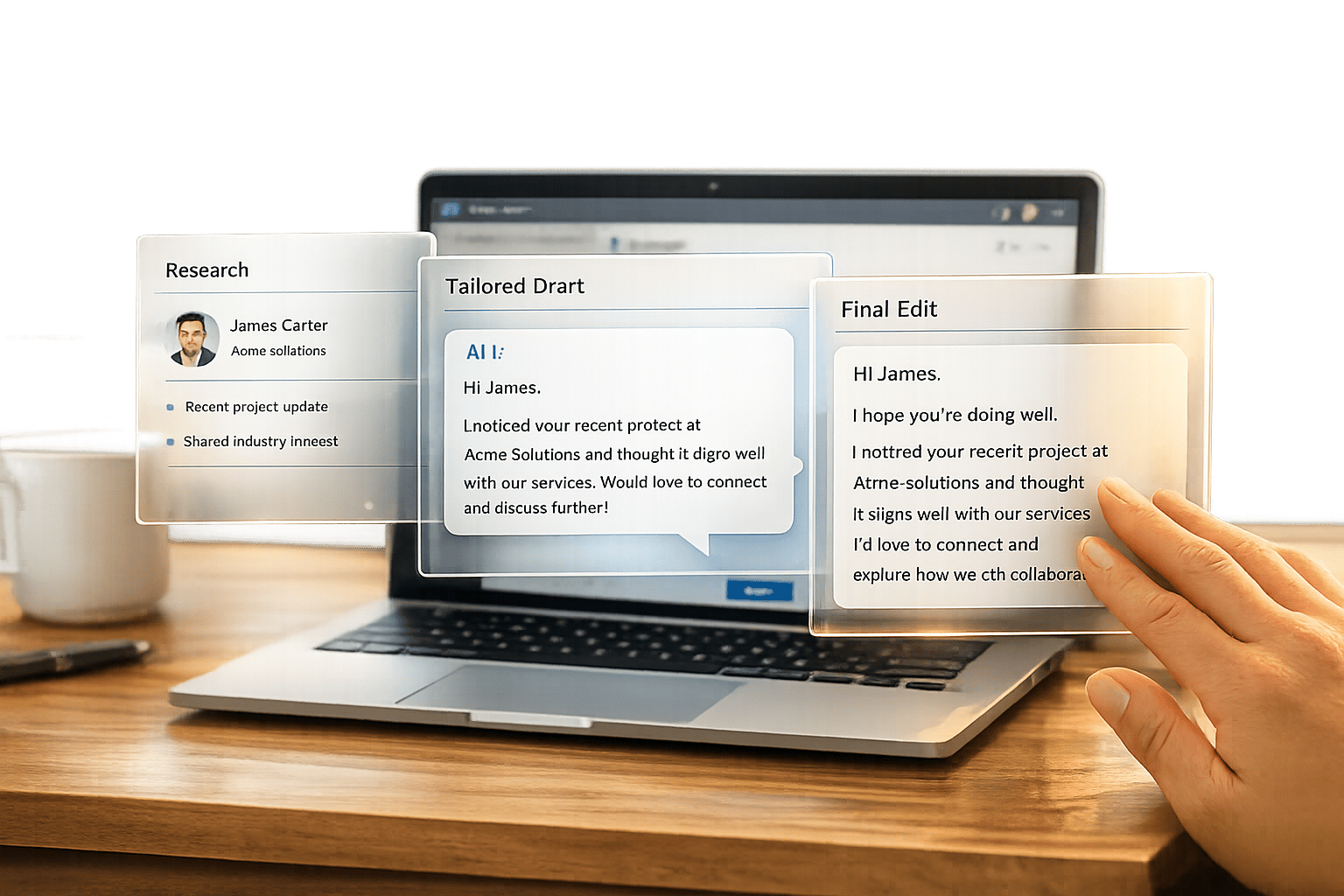
AI vs. Manual LinkedIn Relationship Management
Compare AI, manual, and hybrid LinkedIn outreach—scale with automation and use manual touch for high-value, trust-based deals.

AI vs. Manual LinkedIn Relationship Management
Managing LinkedIn relationships boils down to two approaches: AI-driven automation and manual outreach. Here's the key takeaway: AI excels at scaling outreach and saving time, while manual methods are better for building trust with high-value prospects. Combining both can lead to stronger results.
Key Insights:
-
AI Advantages:
- Automates outreach to thousands of leads daily.
- Cuts time spent per prospect to under 30 seconds.
- Boosts reply rates to 8–12% (vs. 4–7% for manual).
- Reduces cost per qualified lead to $5–20.
-
Manual Strengths:
- Ideal for high-value deals over $100,000.
- Achieves response rates of 30–40% for top-tier prospects.
- Builds deeper trust through personalized, human interaction.
-
Hybrid Approach:
- Use AI-powered LinkedIn messaging for initial outreach and follow-ups.
- Reserve manual efforts for warm leads and key accounts.
- Balance: 70% AI-driven, 30% manual for most teams.
Quick Comparison:
| Aspect | AI Outreach | Manual Outreach | Hybrid Approach |
|---|---|---|---|
| Response Rate | 8–12% | 4–7% (30–40% for key deals) | 15–22% (AI + manual follow-up) |
| Time Per Prospect | <30 seconds | 15–20 minutes | Varies by stage |
| Cost Per Lead | $5–20 | $50–150 | $20–50 |
| Best Use Case | High-volume outreach | High-value prospects | Balanced prospecting |
AI is perfect for scaling, while manual outreach is critical for trust-building. A hybrid strategy blends the best of both worlds, ensuring efficiency without sacrificing quality.
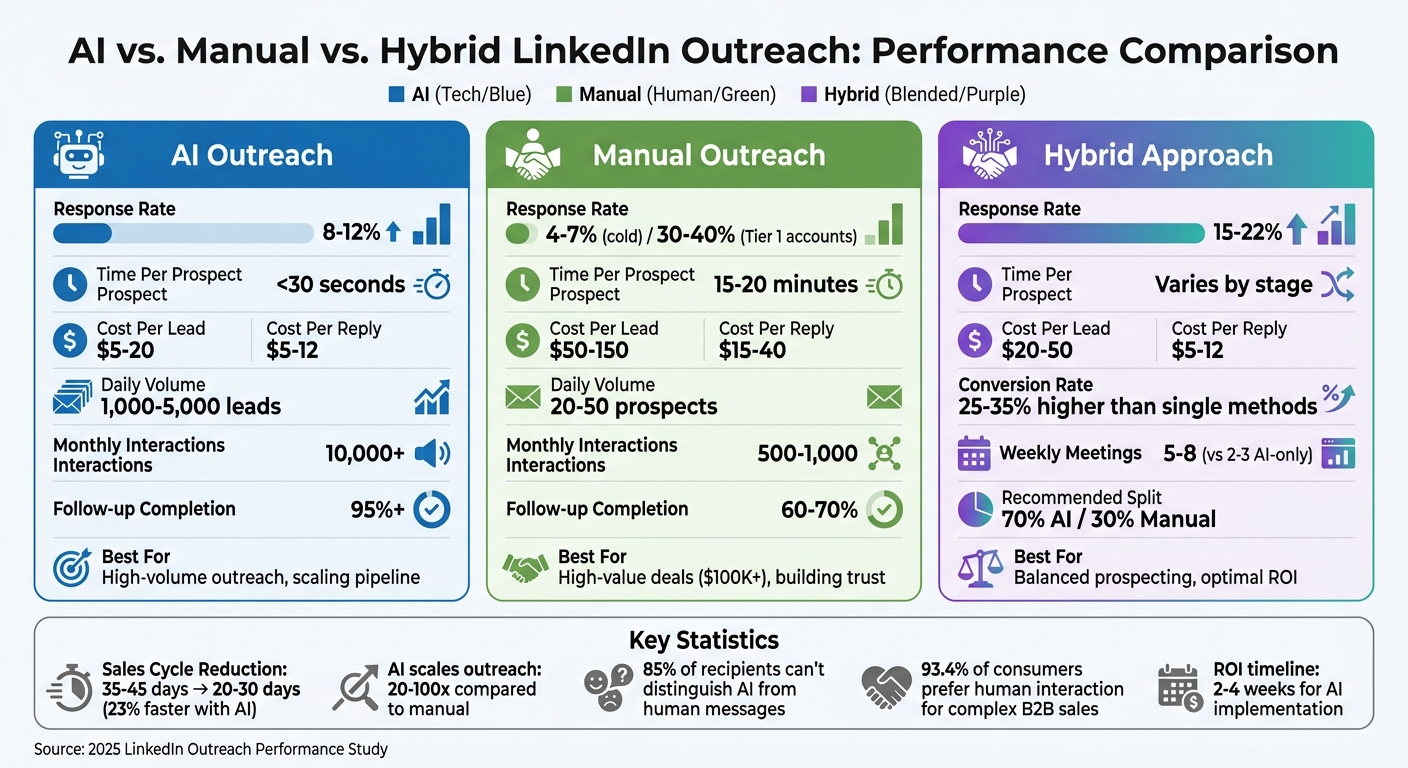
AI vs Manual vs Hybrid LinkedIn Outreach: Performance Metrics Comparison
Efficiency and Scalability Comparison
AI for High-Volume Outreach
Managing LinkedIn outreach manually is like trying to fill a lake with a teaspoon - it’s slow and limiting. Most sales professionals can handle only 20-50 personalized connections and messages per day, which caps their monthly interactions at about 500-1,000. Why? The time spent researching profiles, crafting unique messages, and tracking responses eats into their productivity [3].
AI flips this limitation on its head. Tools like SalesMind AI can process 1,000-5,000 leads daily, scaling outreach efforts by an incredible 20-100x without compromising quality [3]. These platforms automate everything: filtering prospects through LinkedIn, creating personalized icebreakers based on profile data, scheduling multi-message sequences over two weeks, and sending follow-ups triggered by user actions like views or responses [4].
The results speak volumes. AI-driven tools achieve 40-60% open rates and 15-25% reply rates, enabling users to handle 10,000+ monthly interactions seamlessly. Teams working with 100+ leads daily report 5x pipeline growth by leveraging AI-powered lead scoring to focus on high-intent prospects [5]. With 30-50% acceptance rates on connection requests and the ability to send 500+ daily invitations while staying within LinkedIn’s compliance rules, SalesMind AI users cut costs to just $8 per lead at scale [4][6].
Beyond just boosting numbers, AI also transforms the time investment required for these tasks.
Time Savings with Automation
Automation doesn’t just scale outreach - it frees up time for meaningful engagement. Without automation, managing 100-200 leads manually can take 20-40 hours per week, as each lead requires 30-60 minutes for personalization and follow-up tracking. AI slashes this workload to under 5 hours, saving teams 15-35 hours weekly by automating repetitive tasks [6].
For example, B2B SaaS companies using SalesMind AI have reduced their outreach time from 25 hours to just 3 hours weekly. Others report saving 20 hours per week, which, combined with automated follow-ups, has boosted conversions by 3x [6][7]. Cost-wise, manual outreach often runs $50-150 per qualified lead due to labor expenses, while AI cuts this to $5-20 per lead. With ROI materializing in just 2-4 weeks, thanks to a 4x faster pipeline velocity, teams can shift their focus to nurturing high-value prospects, improving relationship quality and overall results [6].
sbb-itb-817c6a5
Personalization and Response Rates
AI's Data-Driven Personalization
AI doesn’t just help scale outreach - it takes personalization to a whole new level. Platforms like SalesMind AI analyze an impressive 40–75+ data points per prospect. These include details like job titles, company updates, mutual connections, recent engagement with content, and even the technologies they use. The result? Messages that feel genuinely tailored to the recipient [2]. And it works: AI-powered personalization achieves response rates of 8–12%, compared to just 4–7% for traditional manual cold outreach [2].
A study conducted in 2025 revealed that 85% of recipients couldn’t tell the difference between an AI-crafted message and one written by hand [2]. Add in authority-led automation - where the system interacts with a prospect’s content before following up - and response rates can reach an impressive 15–22%. Even better, deals close 23% faster compared to manual methods [2].
The secret lies in variable-driven personalization. Instead of relying on generic templates like "Hi [First Name]", which typically result in reply rates as low as 0.3–4% [9], AI leverages specific, timely details such as recent achievements, funding announcements, or hiring updates. This level of personalization, which used to take 15–20 minutes of manual research per prospect, is now delivered at scale in seconds [2].
While AI ensures consistent, high-quality outreach at scale, manual methods often fall short of these efficiencies.
Manual Execution Limitations
Manual outreach might seem like a more personal option, but it often struggles to keep pace with the demands of real-world prospecting. The limited volume of daily outreach makes it hard to maintain consistent engagement, and as time goes on, burnout can cause the quality of outreach to decline [2]. In fact, response rates for manual outreach can drop by as much as 50% within just three months - falling from 2–3% to just 1–1.5% [8].
What’s more, the idea of true "manual personalization" is often misleading. Many teams rely on templates with only minor adjustments, spending 15–20 minutes per prospect trying to create unique messages that rarely scale [2]. Follow-up rates also suffer, with only 60–70% of sequences being completed due to time constraints and shifting priorities [1]. And when it comes to costs, manual outreach is far from efficient, with labor expenses averaging $15–40 per reply compared to just $5–12 for automated methods [1].
The differences in performance highlight how AI-driven personalization significantly improves both efficiency and results.
| Outreach Method | Response Rate | Time per Prospect | Cost per Reply |
|---|---|---|---|
| Generic Templates | 0.3–4% | <1 Minute | $5–12 |
| Manual Cold Outreach | 4–7% | 15–20 Minutes | $15–40 |
| AI-Powered Personalization | 8–12% | <30 Seconds | $5–12 |
| Authority-Led AI | 15–22% | <1 Minute (Setup required) | $5–12 |
Manual outreach does have its strengths, especially in warm, qualified situations where response rates can soar to 35–45% [1]. However, for large-scale cold prospecting, AI’s ability to consistently deliver personalized, data-driven messages gives it a clear advantage. Balancing the strengths of both AI and manual efforts can lead to the best overall results.
Relationship Quality and Business Outcomes
Building Trust Through Manual Approaches
For high-value B2B sales, manual outreach plays a key role in building trust. When deals exceed $100,000 or involve multiple decision-makers, authenticity becomes non-negotiable [1][10]. This means taking the time to research a prospect's profile, their recent posts, and company news to create connections that feel personal and human - not like a generic, automated message [10]. When done right, manual personalization can deliver impressive results, with response rates reaching 30–40% for Tier 1 accounts - those top 10–20 dream clients worth the extra effort. Spending 15–30 minutes researching each prospect is worth it when the stakes are this high [10]. This approach works particularly well for relationship-first selling and even for mending strained relationships, where a robotic tone could cause more harm than good [1].
But there’s a downside: manual outreach isn’t cheap. Each message costs about $29, making it practical for only 20–30 high-potential prospects daily [10]. Plus, the effort can wear down sales reps, with follow-up completion rates dropping to 60–70% after just three weeks [1].
While manual methods are ideal for premium, complex deals, they can’t compete with the speed and scalability LinkedIn automation tools offer.
Scaling Conversions with AI
When volume and cost are priorities, AI-powered outreach shines. By automating repetitive tasks, AI boosts efficiency and delivers better results at scale. Sales teams using AI report 25–35% higher lead-to-meeting conversion rates compared to manual teams. One reason? AI ensures follow-up completion rates soar past 95%, while manual efforts often stall at 60–70% [1]. Automation also speeds up the sales cycle, cutting it down from 35–45 days to just 20–30 days - a 23% improvement [2].
Cost is another area where AI excels. While manual outreach costs $29 per message, AI personalization costs only about $0.20. Similarly, the cost per qualified lead drops dramatically - from around $1,500 manually to just $14 with AI [10][2]. AI also slashes the cost per reply by 60–75%, all while keeping response rates steady or even improving them [1].
The smartest strategies combine both approaches. Automating initial outreach while reserving manual efforts for high-value prospects creates a powerful balance. The ideal mix? About 70% of outreach volume should be AI-driven, with the remaining 30% dedicated to high-touch, manual interactions [1]. Ultimately, the choice between manual and AI methods depends on whether your priority is deep, meaningful relationships or scaling conversions efficiently.
LinkedIn Outreach 2025: The Perfect AI Stack for Qualified B2B Leads
Combining AI and Manual Methods
The most effective LinkedIn outreach strategy strikes a balance between AI and manual methods, using each where it works best. By leveraging AI's efficiency and combining it with the personal touch of manual outreach, teams can achieve stronger deal closure rates. Let’s explore how AI can handle initial contact while reserving manual efforts for high-stakes interactions.
"The difference isn't automation vs. manual. The difference is cold vs. warm. And strategy." – Fuzzy AI Blog [2]
Using AI for Initial Outreach
AI is perfect for managing the early stages of your sales funnel. Tools like SalesMind AI can automate outreach to 50–100 new prospects every week [2]. This steady, consistent effort is key. Multi-step automated sequences have been shown to help teams close deals 18% faster [2].
Managing these tools doesn't require much time - just 30–60 minutes a week to monitor results and tweak messaging as needed [2]. This allows your team to focus their energy on areas where a personal connection matters most.
When a prospect shows interest through these automated efforts, that’s the signal to transition to a more personalized approach.
Manual Engagement for High-Value Prospects
As soon as a prospect responds to your automated outreach, it's time to switch to manual communication [2]. For high-value targets, like Tier 1 accounts or Fortune 500 executives, skip automation altogether. These relationships deserve thoughtful, hand-written, and well-researched messages from the beginning.
Taking a hybrid approach can also pay off. Before launching any automated sequences, engage manually with prospects by interacting with their content - leaving meaningful comments or likes. This builds familiarity and increases the chances of engagement, especially with high-value prospects [2].
Choosing the Right Approach for Your Business
Selecting between AI, manual, or hybrid outreach depends on factors like lead volume, team size, and the complexity of your deals. This decision shapes the effectiveness of your sales efforts and prepares you for the insights that follow.
"Stop thinking in binaries. The best sales teams don't choose automation or manual. They choose both." – Fuzzy AI
When to Choose AI
AI-driven outreach works well if you're targeting 50–200 or more prospects each month and managing a team of three or more reps. It ensures a steady pipeline and keeps costs manageable [1]. On average, automated outreach costs $5 to $12 per reply, compared to the $15 to $40 per reply seen with manual efforts [1].
Automation tools typically range between $200 and $2,000 per month [2]. Teams often see positive ROI within 30 days if they generate just two or three qualified leads monthly [2]. By comparison, a mid-market sales rep's total compensation can run between $100 and $150 per hour [8].
When to Choose Manual Methods
Manual outreach is ideal for situations where you're targeting fewer than 10 high-value prospects each month [1]. Deals worth $500,000 or more often require the nuanced judgment and custom research that AI simply can't provide [8]. Industries like finance, healthcare, and legal especially benefit from manual-first approaches due to stricter compliance needs and the importance of maintaining a strong brand reputation [8].
Reaching out to Fortune 500 CEOs or handling accounts with multiple decision-makers demands a more personal, human approach [1]. While manual outreach typically achieves response rates between 4% and 7% [2], the higher quality of these interactions often justifies the added expense.
When to Use a Hybrid Approach
The real magic happens when you combine both methods. For most B2B sales teams, a hybrid model proves to be the most effective. Businesses targeting 50 to 200 prospects per month often see the best results by blending automation with manual efforts [1]. A good starting point is dedicating about 70% of outreach to automated sequences and reserving 30% for manual, high-touch engagement [1].
Hybrid teams tend to outperform single-method strategies, achieving 25% to 35% higher conversion rates [1]. When combined with authority-led warming - like engaging with a prospect's content before reaching out - reply rates can soar to 20% to 30% [1]. Reps in hybrid teams typically secure five to eight meetings weekly, compared to two to three from purely automated efforts [1].
For smaller teams of one or two reps, a hybrid approach is often the only way to scale without losing the personal touch needed to close deals [8]. The trick is to set clear rules: let AI handle tasks like connection requests and initial follow-ups, then pass the baton to a human rep once a prospect responds [8]. This balanced method aligns with SalesMind AI's philosophy of merging automation with personal engagement to optimize LinkedIn outreach results.
Conclusion
Choosing between AI and manual strategies for LinkedIn relationship management isn't an either-or decision. AI is great for increasing visibility and automating repetitive tasks, while manual efforts are essential for building the trust needed to close deals. The numbers back this up: 93.4% of consumers prefer human interaction for complex B2B sales, but automation still plays a key role in reaching enough prospects to keep your pipeline full [11].
LinkedIn's detection systems as of 2026 have raised the stakes. With daily connection requests capped at 50–70 and accounts using obvious automation facing five times higher restriction rates, the old "spray-and-pray" tactics are no longer effective [11]. The platform now rewards authentic engagement, focusing on metrics like Dwell Time and Conversation Quality instead of just clicks and likes.
A hybrid approach addresses these challenges by assigning tasks based on their strengths. AI shines in the "Green Zones", such as boosting visibility, building prospect lists, and engaging with posts during the critical first 60–90 minutes after they go live. Meanwhile, manual effort is indispensable in the "Red Zones", like delivering the final pitch, managing crises, and engaging with top-tier prospects - areas where even small errors can undermine credibility [11].
"AI cannot generate trust; it can only generate attention. Trust is a biological response to feeling heard and understood." – Linkboost [11]
Platforms like SalesMind AI bridge this gap by automating the heavy lifting - such as personalized messaging sequences, advanced lead scoring, and follow-up timing - while leaving room for your team to focus on meaningful, high-value conversations. By combining automation for scale with manual touchpoints for trust, you create a system that aligns with LinkedIn's evolving rules and meets your prospects' need for genuine human connection.
FAQs
How do I know when to switch from AI messages to manual outreach?
When aiming to build deeper, high-value relationships that rely on trust and personalized communication, switching to manual outreach is the way to go. AI messaging shines when it comes to large-scale prospecting and making initial contact, offering both speed and impressive response rates.
The best strategy? A hybrid approach. Use AI to handle outreach on a broad scale, then shift to manual follow-ups for high-priority leads. This combination helps you boost conversions while laying the groundwork for lasting connections.
How can I use AI on LinkedIn without getting my account restricted?
To keep your LinkedIn account safe while using AI tools, it's important to stick to practices that comply with LinkedIn's guidelines. For instance, limit your connection requests to 50–80 per week, and increase this gradually over a two-week period to avoid raising any red flags. Tools like SalesMind AI can help by simulating human-like behavior, adjusting the timing of messages, and personalizing your outreach.
Instead of relying heavily on cold outreach, shift your focus to engagement-driven activities. This includes commenting on posts, interacting with content, and boosting visibility through thoughtful interactions. Additionally, prioritize inbound strategies that attract connections naturally, as these approaches reduce the risk of account restrictions.
What should my AI outreach sequence include to avoid sounding generic?
To stand out, add a personal touch that resonates with each prospect. Use AI tools to dig into profile data, recent activities, or company updates. Mention specifics, like a recent LinkedIn post they shared or a new position they’ve taken on. These small details show you’ve done your homework.
Dynamic templates with personalized fields are a great way to scale your outreach without losing that human element. By blending automation with thoughtful customization, your messages will feel more authentic and engaging - steering clear of anything that sounds robotic or overly generic.