AI-Powered Sales Analytics: Ultimate Guide 2025
How AI improves lead scoring, forecasting, and real-time sales insights to boost win rates, efficiency, and revenue.
Share this article

- Better Sales Results: Sales teams using AI tools are twice as likely to exceed targets and report a 30% improvement in win rates.
- Real-Time Insights: AI eliminates delays in reporting, giving sales reps instant data to act quickly.
- Smarter Forecasting: AI improves forecast accuracy by 20–50%, offering detailed predictions with confidence intervals.
- Lead Scoring: AI pinpoints high-potential leads, boosting conversions by up to 25%.
AI-Powered Sales Analytics: Ultimate Guide 2025
AI-powered sales analytics is transforming how sales teams operate by turning massive data into actionable insights. Here’s what you need to know:
- Better Sales Results: Sales teams using AI tools are twice as likely to exceed targets and report a 30% improvement in win rates.
- Real-Time Insights: AI eliminates delays in reporting, giving sales reps instant data to act quickly.
- Smarter Forecasting: AI improves forecast accuracy by 20–50%, offering detailed predictions with confidence intervals.
- Lead Scoring: AI pinpoints high-potential leads, boosting conversions by up to 25%.
- Efficiency Gains: Automation reduces time spent on administrative tasks, allowing sales reps to focus more on selling.
By 2025, 89% of revenue-focused organizations rely on AI tools, and the sales AI market is projected to grow significantly, reaching $240.58 billion by 2030. Tools like SalesMind AI are leading the way, offering automated lead scoring, real-time tracking, and LinkedIn outreach solutions.
Key Takeaway: AI-powered sales analytics isn’t just a tool - it’s a game-changer for improving sales performance, forecasting accuracy, and decision-making speed. If you’re not integrating AI into your sales workflow, you risk falling behind.
AI-Powered Sales Analytics: Key Statistics and Benefits 2025
AI Tools Transforming Sales Intelligence: From Data to Revenue: The AI Summit New York 2025
Benefits of AI-Powered Sales Analytics
AI-powered sales analytics brings three major advantages that can directly impact your bottom line. These measurable outcomes are what separate top-performing sales teams from the rest.
Better Sales Forecasting
Traditional sales forecasting often leans heavily on gut feelings and optimism from sales reps, which leads to inflated projections in about 80% of companies [9]. AI takes the guesswork out of the equation by analyzing historical win/loss data, deal velocity, buyer engagement (like emails, calls, and meetings), and how long deals stay in each stage. This approach provides an objective prediction of outcomes [7][10].
Modern AI tools don’t just give you a single probability for closing a deal. Instead, they calculate two probabilities: the general likelihood of winning the deal and the chance it will close within a specific timeframe, such as a particular month [7]. This results in more nuanced forecasts, often presented as ranges with confidence intervals - for instance, "$2.1 million to $2.7 million with 80% confidence." These detailed projections help leaders plan for various scenarios and manage uncertainty [6].
AI-driven forecasting also significantly reduces errors, cutting inaccuracies by 20–50% [6]. Without AI, only 7% of companies manage to achieve 90% or higher accuracy in their forecasts [10]. A great example of this is Siemens, which implemented an AI-powered global forecasting system for 4,000 salespeople across 190 countries in 2025–2026. Led by Thorsten Reichenberger, their Head of Revenue Operations, the initiative increased forecast submission rates to over 70% and provided clear visibility into revenue structures [6].
Additionally, AI can spot potential issues - like deals that stall or show declining engagement - before they become major problems. This allows sales managers to step in early and address challenges, ensuring opportunities don’t fall through the cracks [7][8]. With more accurate forecasting, teams can also prioritize leads more effectively.
Improved Lead Scoring and Qualification
AI takes the guesswork out of lead scoring by analyzing thousands of variables to pinpoint prospects with the highest conversion potential. This means sales teams can focus their energy on leads that are most likely to close, instead of wasting time on unqualified prospects.
By processing behavioral data, firmographics, and historical trends, AI automatically assigns scores to leads. This reduces the need for manual research and allows sales teams to spend more time building relationships. Companies that have adopted AI-powered CRM tools have reported a 15% boost in sales leads while cutting marketing expenses by 10–20%, thanks to better targeting [2]. Once leads are scored effectively, the next step is making timely, data-backed decisions.
Faster Decision-Making with Real-Time Insights
Most companies - about 85% - struggle to provide their sales teams with real-time insights [2]. AI solves this problem by eliminating delays in reporting, which can otherwise take days or even weeks. Instead, it delivers up-to-the-minute data, enabling sales teams to respond quickly to changes in the market [2].
Natural Language Processing (NLP) makes these insights accessible to everyone, regardless of technical skills. Sales reps can ask straightforward questions like "Which products are trending?" and get instant answers [2]. AI also suggests the next-best action, such as sharing a relevant case study or reaching out to a prospect at the optimal time for engagement [5][11].
Real-time analytics also help identify at-risk accounts or signs of declining engagement right away, giving teams the chance to act before customers churn [2][6]. Companies using AI-powered solutions have seen productivity jump by as much as 40% [11]. By automating data entry and analysis, sales reps can focus on what they do best: selling.
Core Techniques in AI Sales Analytics
Modern sales analytics thrives on three key AI techniques, each addressing unique challenges. From predicting deal closures to understanding customer sentiment, these tools equip sales teams with actionable insights and sharper market awareness.
Predictive Analytics
Predictive analytics leverages machine learning to dig into historical sales data, customer behaviors, and market trends. It doesn't rely on guesswork; instead, it identifies patterns across multiple variables to create data-driven sales forecasts using machine learning [6]. For example, companies using AI-based lead scoring have reported a 25% boost in sales revenue within a year by focusing on high-potential leads [13].
These models learn from past conversions, zeroing in on prospects most likely to convert. They go beyond basic demographics, analyzing signals like email activity, call durations, and meeting frequency to uncover hidden patterns. Predictive analytics evaluates both the "Probability of Winning" (deal quality) and the "Probability of Closing in a Specific Month" (timing), providing realistic sales projections [7]. Businesses using this approach have seen conversion rates climb by 30% within six months [13]. However, the accuracy of these models depends heavily on clean, structured data. Poorly maintained CRM records can severely limit AI's effectiveness [6].
While predictive analytics focuses on conversion probabilities, time series analysis takes a different angle, uncovering temporal trends that are vital for sales planning.
Time Series Analysis
Time series analysis uses chronological data to detect trends, seasonal shifts, and cycles that traditional methods often overlook [12]. For instance, a software company might use SARIMA (Seasonal ARIMA) to analyze quarterly subscription renewals, while a retailer might apply exponential smoothing to prioritize recent holiday sales over older data. Businesses that adopt time series forecasting grow 19% faster than those relying solely on intuition [12].
This technique thrives on consistent historical data and clear seasonal patterns. By understanding these temporal dynamics, companies can make more informed decisions and predict future sales cycles more effectively. But numbers alone don’t tell the whole story. That’s where natural language processing (NLP) steps in to decode customer interactions.
Natural Language Processing (NLP)
NLP dives into customer communications - emails, calls, and social media messages - to extract sentiment and intent [2][5]. For example, it can flag objections like competitor pricing mentions, helping sales reps craft tailored responses [14]. Addressing these objections early in the process has been shown to boost win rates by 35% [14].
NLP also provides insights into sales call dynamics, such as "talk ratios", revealing that successful reps often listen more and ask better questions [6]. On the email front, AI-driven personalization can deliver six times higher transaction rates and a 41% increase in click-through rates [5]. Beyond this, NLP simplifies data access, enabling sales teams to ask straightforward questions like, "What products are trending?" and receive instant answers without waiting for detailed reports [2].
Together, predictive analytics, time series analysis, and NLP offer a powerful toolkit for modern sales teams, combining data-driven forecasting with a deeper understanding of customer behavior. These techniques not only enhance decision-making but also empower teams to act with confidence in an increasingly competitive landscape.
Top AI Tools for Sales Analytics in 2025
Finding the right AI sales analytics tool can completely change the game for B2B prospecting. SalesMind AI has emerged as a leader in this space by combining LinkedIn outreach with advanced AI-driven analytics. This guide highlights how SalesMind AI is shaping sales analytics for B2B prospecting in 2025.
When it comes to integrated solutions, SalesMind AI provides a comprehensive, automated experience that simplifies and enhances the sales process.
SalesMind AI: A Complete Solution
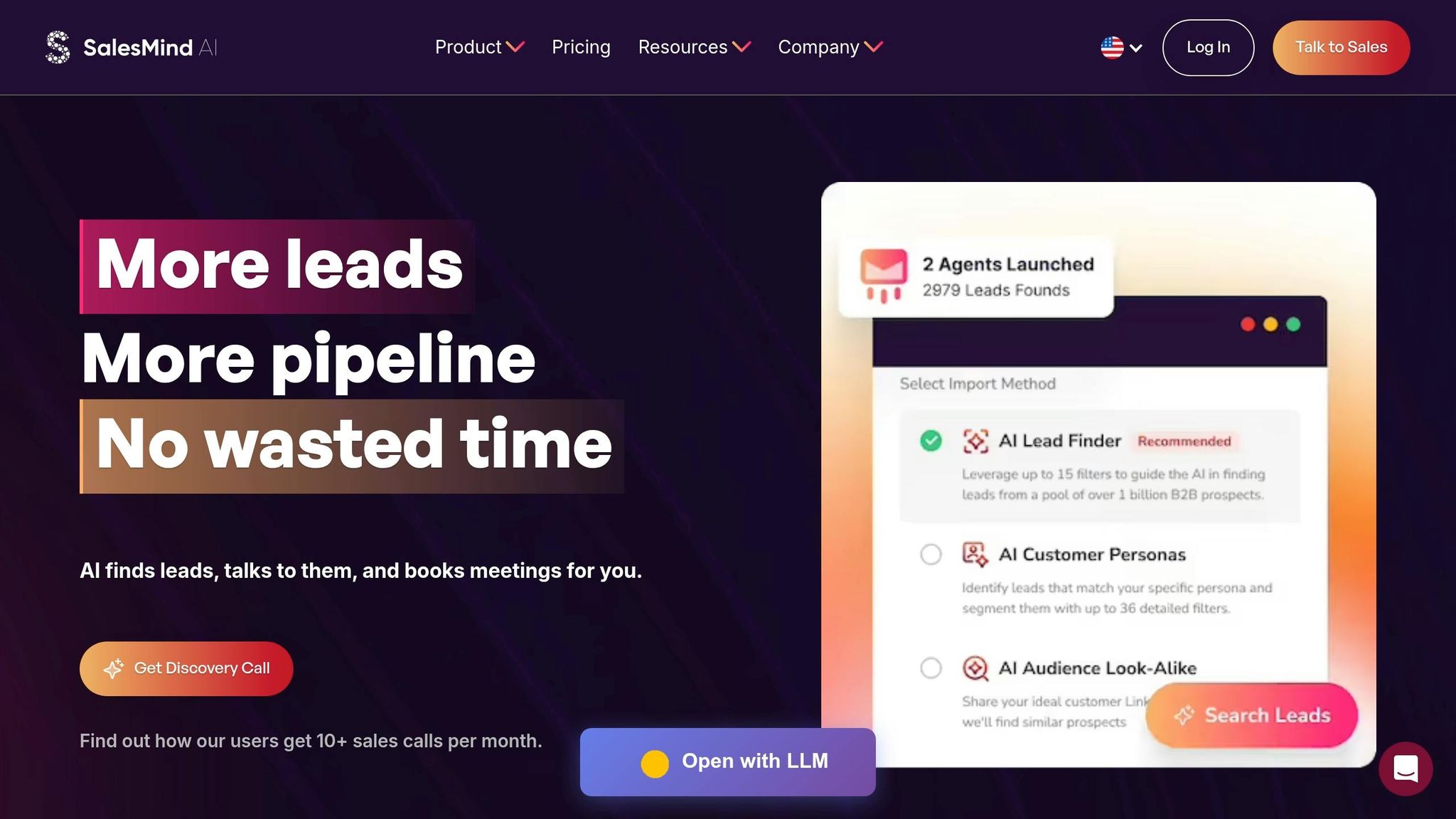
SalesMind AI fills a critical gap in sales analytics by blending LinkedIn outreach automation with AI-powered lead qualification. The platform automates personalized LinkedIn outreach, assigns real-time lead scores, and organizes all conversations into an AI-driven unified inbox. Unlike tools that focus solely on analyzing existing pipeline data, SalesMind AI actively generates and qualifies leads simultaneously.
This tool significantly boosts productivity in lead prospecting. Alex Lossing, CTO at Slash, shared:
"From the very first week, SalesMind AI boosted my productivity in lead prospecting by 10×."
Nick Heijman, CEO of HypotheekXperts, added:
"The results were sometimes almost too good - connection rates and responses exceeded expectations."
With a 4.7/5 rating on G2 and a perfect 5/5 on the Chrome Store, SalesMind AI has proven especially effective for teams aiming to generate 10 or more sales calls monthly through LinkedIn outreach. Priced at $99 per month for the Pro plan, which includes unlimited LinkedIn actions and lead scoring, it offers a focused and affordable solution for B2B prospecting. Plus, the platform integrates seamlessly with major CRMs via API, ensuring lead scores and outreach activities sync automatically with your sales tools.
Features that Drive Sales Success
AI-driven lead scoring is the backbone of SalesMind AI's analytics. It evaluates prospects against user-defined filters, generating a suitability score that helps sales teams zero in on high-conversion opportunities. Jure Grabljevec, CEO of Jure Design, commented:
"The concept as well as the automation are good and I like that it shows you a score on what the lead suitability with your filters is."
Real-time lead tracking removes the hassle of manually logging interactions. Rahul Pushkarna, Senior Advisor at Bounty Media, noted:
"SalesMind AI has proven very useful to our sales team in reducing the massive pain points of manually tracking each and every lead interaction."
The platform automatically logs connection requests, message exchanges, and response trends, giving teams instant visibility into prospect engagement without needing manual CRM updates.
The unified AI-powered inbox is another standout feature, consolidating replies from multiple LinkedIn accounts into one streamlined interface. The AI co-pilot prioritizes responses, applies tags, and sets reminders based on how prospects behave. Florian Decludt, Product Marketing at Clutch, praised this feature:
"It's the best tool out there to curate your audience on autopilot while focusing on higher-leverage tasks."
Automated follow-ups ensure consistent engagement without constant monitoring. The AI crafts personalized LinkedIn messages tailored to each prospect, dramatically improving connection rates compared to manual efforts. Teams using SalesMind AI report significant performance improvements, and the platform stays up-to-date with LinkedIn's evolving features through regular updates.
From generating and qualifying leads at the top of the funnel to tracking them through conversion and revenue, SalesMind AI provides full visibility and control over the sales process.
How to Implement AI-Powered Sales Analytics
Using AI-powered sales analytics can lead to impressive results, like a 10–20% boost in ROI and 15% increase in revenue [5]. But achieving these outcomes requires a clear, step-by-step plan.
Step 1: Assess Your Current Sales Tools
Start by evaluating your current sales process to identify where AI can make the biggest difference. Are your sales reps spending too much time on manual tasks like data entry? If so, you're not alone - 70% of sales teams spend more time on manual data entry than on actual selling activities [2]. This makes automation a game-changer.
Take stock of your existing tools, such as CRM systems, communication platforms, and ERPs, and document key metrics like lead volume, conversion rates, and sales cycle length. This baseline data will help you measure the impact of AI later [5]. If you’re using CRMs like Salesforce or HubSpot, check if your data is siloed across different platforms. Fragmented data is a common issue that can hinder progress [2]. Addressing this upfront lays the groundwork for meaningful improvements.
Step 2: Prepare and Organize Data
The effectiveness of AI depends on the quality of your data. Consolidate information from all customer touchpoints - CRMs, email platforms, LinkedIn, and more - and create a unified data model. Clearly define KPIs to track performance [2].
Use automated tools to clean your CRM regularly. This includes removing duplicates, filling in missing fields, and updating outdated records. Your data architecture should align with the metrics you want to measure, like connection rates, response times, or deal velocity [2]. Typically, implementing an AI platform involves a 4–6 week process that includes data migration, system integration, and user onboarding [2].
Step 3: Choose and Integrate AI Tools
Start small by piloting AI on a single workflow, such as lead generation or email sequencing, to prove its value before scaling up [5]. For example, platforms like SalesMind AI integrate seamlessly with major CRMs through APIs, automatically syncing predictive lead scores and outreach activities. This eliminates the need for manual updates.
When selecting an AI tool, prioritize those that offer real-time data exchange with your marketing and customer service software. Traditional systems often fail to provide real-time insights - 85% of companies face this challenge - so eliminating reporting delays should be a top priority [2]. Once integrated, regularly evaluate the tool’s performance to ensure it’s delivering the desired results.
Step 4: Monitor and Optimize Performance
Track key metrics like lead volume, conversion rates, and sales cycle length to gauge the effectiveness of your AI system. With clean data, AI can deliver forecasting accuracy of up to 95% [5]. Set up automated monitoring to run at regular intervals, such as every Monday morning, to stay informed about market trends and competitor activities [5].
AI works best when combined with human expertise. Use AI-driven insights to complement your team’s relationship-building skills and decision-making. Regular training ensures your sales reps can fully leverage new features. It’s worth noting that 51% of sales organizations report shorter sales cycles thanks to AI, but maintaining this success requires ongoing optimization and collaboration between humans and AI [5].
Future Trends in AI Sales Analytics for 2025
The AI market for Sales and Marketing is set to grow from $57.99 billion in 2025 to a staggering $240.58 billion by 2030, with an annual growth rate of 32.9% [2]. This rapid expansion is expected to reshape how businesses handle sales operations.
Federated Learning for Data Privacy
Data privacy is more than just a legal obligation - it’s a core concern for customers. With 87% of consumers believing data privacy is a fundamental human right and the average cost of a data breach reaching $4.45 million, businesses must prioritize smarter solutions [16]. Federated learning is one such approach. It allows AI models to train on decentralized data, keeping sensitive customer information on local devices rather than moving it to central servers. This method not only strengthens sales analytics but also ensures compliance with regulations like GDPR, CCPA, and PIPEDA.
As these security measures evolve, they also open doors for more refined customer engagement strategies.
Hyper-Personalization with Generative AI
Generative AI is revolutionizing sales by focusing on individuals rather than broad customer categories. A great example of its potential is JPMorgan Chase, which in 2019 saw a 450% boost in click-through rates using AI-generated marketing copy tailored to past engagement patterns [1]. By 2025, generative AI is projected to increase sales outreach response rates by 25% and conversions by 30% [17]. Tools like Outreach’s AI Revenue Agent have already demonstrated this potential, cutting outreach preparation time from 20 minutes to just 2 minutes - a tenfold improvement in efficiency [3].
This technology doesn’t stop at crafting personalized messages. It thrives on real-time customer behavior and sentiment, pushing personalization to new heights.
AI-Native Sales Data Infrastructure
The reliance on manual reporting is fading fast. Currently, 60% of companies still use manual methods for reporting [2]. However, leading organizations are moving toward unified, AI-driven platforms that integrate data from CRM systems, email, social media, and websites into a single, cohesive source. This shift eliminates data silos and delays associated with static reports. Notably, 53% of successful AI adopters started their journey by unifying their data sources [15].
These integrated systems offer real-time insights with up to 95% forecasting accuracy, enabling sales teams to make faster, data-backed decisions [5]. Beyond insights, such platforms empower AI to take on tasks like qualifying leads, scheduling follow-ups, and even adjusting pricing dynamically based on market trends [4].
Conclusion
AI-powered sales analytics has shifted from being an experimental tool to a cornerstone for competitive sales teams. Companies leveraging AI enjoy impressive benefits, such as achieving 91% accuracy in deal predictions, compared to just 67% with traditional methods [18]. Even more striking, sales teams using AI tools are outperforming quotas by up to 3.7 times [1]. The market for AI in Sales and Marketing reflects this momentum, with projections estimating it will grow to $240.58 billion by 2030 [2].
These numbers highlight the urgency to act now. Start by auditing your data quality - after all, poor data costs organizations an average of $12.9 million annually [20]. Then, consider launching a small-scale pilot project, such as improving lead scoring or refining email sequencing, to secure early wins. For example, Siemens demonstrated the power of AI in 2025 by piloting AI-driven forecasting across 4,000 sellers in 190 countries, boosting forecast submission rates to over 70% [6]. Companies that adopt this "start small, scale smart" approach often see the best results.
"AI isn't coming for your job, it's coming to multiply your impact." – Kofi Akyeampong, CEO, Enfluence Digital [19]
The competitive landscape is shifting fast. Organizations delaying AI adoption until after mid-2026 risk falling behind permanently. Early adopters, on the other hand, are reaping 20–30% time savings [5] and seeing a 50% increase in lead generation [19]. These businesses are already identifying high-intent buyers, scaling personalized outreach, and making real-time, data-driven decisions.
To succeed, you need to combine human expertise with AI's analytical power. Think of AI as your co-pilot, helping your team focus on strategic thinking and relationship-building. By integrating tools like SalesMind AI for tasks like automating outreach and lead qualification, your sales team can unlock these advantages and position your organization ahead of the competition.
FAQs
What data do I need before using AI sales analytics?
To make the most of AI-driven sales analytics, start by collecting two key types of data: demographic data (like job titles, company size, and industry) and behavioral data (such as website visits, webinar participation, and interaction history). It's crucial to ensure this data is accurate, consistent, and regularly updated. When these data sets are combined, AI can better analyze customer behavior, accurately score leads, and predict sales outcomes, streamlining processes and improving decision-making.
How can I pilot AI sales analytics without disrupting my team?
To integrate AI sales analytics effectively, begin by pinpointing the specific challenges your sales team faces and defining clear objectives. These could include streamlining repetitive tasks or boosting conversion rates. Conduct structured trials with measurable success criteria to gauge impact. It's crucial to involve your team from the start - offer training sessions and gather their feedback to ensure a smoother transition. Monitor performance closely and expand implementation gradually, fine-tuning your methods along the way. This step-by-step approach reduces disruptions and helps your team adjust while making the most of AI's potential.
How can I use AI to improve lead scoring and forecasting at the same time?
AI transforms both lead scoring and forecasting by leveraging advanced data analysis and predictive models. AI-driven lead scoring examines factors like demographics and behavior to rank prospects, improving precision and streamlining the process. At the same time, AI-powered forecasting analyzes historical trends and market data to predict future sales patterns. By combining these tools, businesses can align lead scores with forecasts, allowing for smarter prioritization, better use of resources, and increased revenue potential.
Related Blog Posts
Get AI Sales Insights Weekly