LinkedIn Event Ads vs. Organic Promotion
Compare LinkedIn Event Ads and organic promotion: costs, speed, engagement, and use cases — learn when paid reach or organic trust works best.
 Julien Gadea
Compare LinkedIn Event Ads and organic promotion: costs, speed, engagement, and use cases — learn when paid reach or organic trust works best.
Compare LinkedIn Event Ads and organic promotion: costs, speed, engagement, and use cases — learn when paid reach or organic trust works best.
Table of Contents
Which is better for promoting LinkedIn events: paid ads or organic methods? It depends on your goals. Paid Event Ads are ideal for quick results and reaching new audiences, while organic promotion focuses on leveraging your existing network at no cost.
Here’s a quick breakdown:
- LinkedIn Event Ads: Boost visibility fast, target specific audiences, and deliver measurable outcomes. Costs average $310 per lead but can reduce registration costs by up to 40%. Best for time-sensitive events or scaling attendance quickly.
- Organic Promotion: Free, but time-intensive. Relies on your network and builds trust over time. Leads cost about $164 on average and often show higher engagement and intent. Ideal for thought leadership or community-focused events. You can also automate LinkedIn event networking to maximize engagement without increasing manual effort.
Key insights:
- Paid ads generate 4.4x more registrations and 31x more viewers than non-promoted events.
- Organic methods achieve 47% lower costs per lead and 2–6% engagement rates vs. 0.4–0.6% for paid ads.
- Combining both strategies is the most effective. Start with organic to build trust, then amplify reach with paid ads.
Quick Comparison:
| Factor | Paid Event Ads | Organic Promotion |
|---|---|---|
| Cost per Lead | ~$310 | ~$164 |
| Speed | 24–48 hours | 3–6 months |
| Engagement Rate | 0.4–0.6% | 2–6% |
| Lead Quality | Mixed (colder leads) | Warmer, higher intent |
| Best For | Quick reach, new audiences | Building trust, long-term |
For the best results, use both methods together. Organic builds credibility, while paid ads scale your reach.
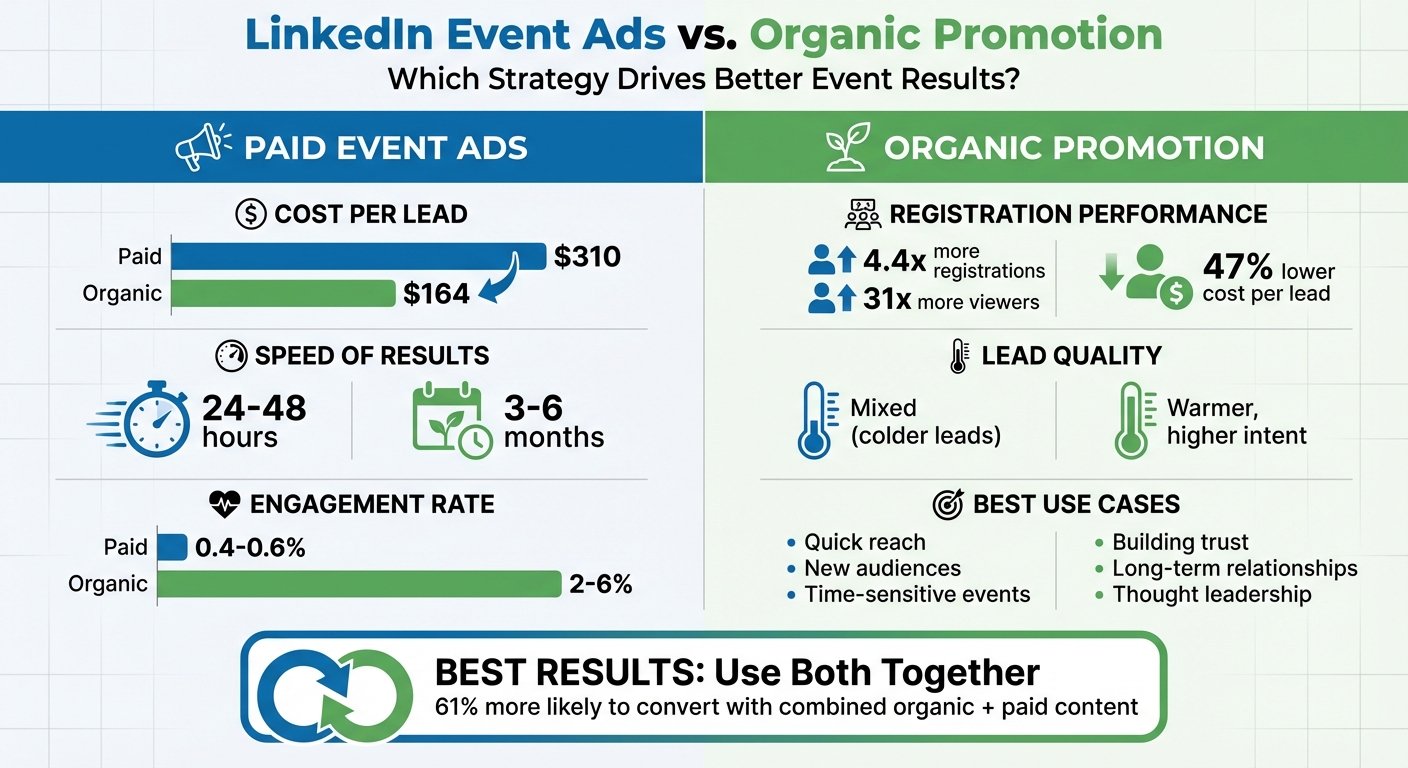
LinkedIn Event Ads vs Organic Promotion: Cost, Speed, and Performance Comparison
Update - Promote events with new LinkedIn Thought Leader Event Ad
What Are LinkedIn Event Ads?
LinkedIn Event Ads are a type of Sponsored Content designed to promote LinkedIn-hosted events directly in users' feeds. These ads guide your audience through three stages: a static image to drive registrations before the event, a live video stream during the event to encourage participation, and a replay video afterward for those who missed it [6][12].
The best part? Signing up is incredibly easy. With a single click on "Attend", users RSVP without leaving their feed. Once registered, they’re automatically added to the attendee list and receive reminders from LinkedIn [6][12]. This seamless process often leads to better performance compared to standard ad formats.
Event Ads are available within Classic ad campaigns aimed at Brand Awareness, Website Visits, or Engagement objectives [6][10]. Advertisers can either stick with a single ad set - where the ad adjusts dynamically using the same budget and targeting - or create three separate ad sets. The latter allows for more flexibility, letting you customize audiences, tweak introductory text, and refine bidding strategies for each stage [6][12].
Key Features of LinkedIn Event Ads
LinkedIn Event Ads make use of robust targeting options, including professional demographics, job titles, and company data [12]. These filters are essential when scaling LinkedIn outreach automation to ensure you're reaching the right decision-makers. They also support retargeting, enabling you to build full-funnel audiences based on event registrations, ad interactions, or video views. Keep in mind, though, that retargeting segments require at least 300 members to activate [12].
For live events, the Accelerated Delivery feature is a game-changer. This option spends your ad budget faster during the livestream, maximizing real-time viewership. It’s especially useful for events lasting 1 to 24 hours, as 70% of LinkedIn live viewers tune in via mobile devices [4][12].
Another standout feature is Thought Leader Event Ads. These sponsor posts from verified employees or executives, adding a personal touch while linking directly to a company-hosted LinkedIn Live event [6][10]. The technical details for these ads include a 4:1 image ratio pulled from the event page, a 600-character limit for introductory text, and a 255-character cap for the event name [11].
Pros and Cons of LinkedIn Event Ads
LinkedIn Event Ads deliver impressive results. They boast a 131% higher click-through rate compared to regular video ads, generate seven times more reactions, and receive 24 times more comments than standard video formats [1][2]. Even after the event, these ads continue to perform well, with a 19% higher engagement rate. Plus, attendees are 1.5 times more likely to engage with future marketing efforts. On top of that, marketers have reported up to 40% lower costs per registration [1].
But, like anything else, there are trade-offs. The most obvious downside is cost - you’ll need a dedicated advertising budget instead of relying solely on free organic posts [2]. Event Ads are also limited to Classic ad set types [6]. If you’re using a single ad set, you won’t be able to change the introductory text for different stages unless you create multiple sets [12]. Lastly, LinkedIn registration metrics can take 24–48 hours to update [12].
| Pros | Cons |
|---|---|
| Fast Visibility: Quickly boosts event discovery and registrations [10] | Cost: Requires a budget compared to free organic posts [2] |
| Dynamic Content: Shifts from static image to live video and replay seamlessly [6] | Format Limitations: Only available for Classic ad set types [10] |
| High Engagement: 131% higher CTR, 7x more reactions, and 24x more comments than standard video ads [1][2] | External Event Limitation: Stays static if the event is hosted outside LinkedIn [6] |
| Measurable ROI: Tracks registrations, live views, and engagement effectively [10] | Intro Text Constraints: Single ad sets limit text customization across stages [12] |
| Lower Costs: Up to 40% reduction in registration costs [1] | Reporting Delays: Metrics may take 24–48 hours to reflect [12] |
What Is Organic Event Promotion on LinkedIn?
Organic event promotion on LinkedIn relies on free strategies to boost registrations. Instead of spending on ads, you tap into your company page, employee networks, and personal profiles to connect with potential attendees. The focus here is on creating genuine connections and leveraging existing relationships. This approach can work alongside paid campaigns, offering a way to sustain engagement and build trust.
To make the most of your LinkedIn event page, start with an attention-grabbing event title and a 16:9 cover image (at least 480 pixels wide). As a page admin, you can send up to 1,000 direct invitations per week to your first-degree connections [14]. Since this limit exists, it’s crucial to be selective, inviting individuals most likely to be interested in your event.
Beyond your company page, employee advocacy can significantly extend your reach. When employees, speakers, or leadership share the event with their personal networks, it amplifies visibility far beyond your follower base [4]. This works because people tend to trust content shared by individuals more than branded posts.
"Professional audiences generally don't need fancy, big-budget livestreams. More often, they want interesting, authentic and timely content that provides value and helps them network." - Lucy Sonter, Global Product Adoption at LinkedIn Marketing [4]
It’s a good idea to set up your event 2 to 4 weeks in advance to give people enough time to discover and share it [14][2]. LinkedIn automatically sends reminders to registrants at key intervals: one week, three days, and 15 minutes before the event begins [4]. Align your organic posts with these reminders to maximize exposure.
Key Tactics for Organic Promotion
Getting results through organic promotion means combining consistent effort with a variety of content types. Posting at least once a week - or daily if you’re aiming for faster growth - helps maintain momentum and keeps your audience engaged [15].
One standout tool is LinkedIn Live, which outperforms standard videos. Live videos generate 7 times more reactions and 24 times more comments compared to regular native videos from the same creators [4][2].
Don’t overlook the event’s Networking tab. Encourage speakers to post in this space at least three days before the event to engage attendees and collect questions for the Q&A session [4]. This helps create a sense of community even before the event begins. Note that speakers must be first-degree connections with the organizer to receive invitations [14].
Another useful feature is organic targeting, which allows you to direct event-related posts to specific segments of your followers based on professional demographics [15]. This ensures your efforts reach the most relevant audience. To keep things fresh, mix in polls, text-only updates, and reshared brand mentions instead of constantly creating new content [15].
After the event, repurpose the content. Share the recorded session or highlight clips as on-demand material to continue generating leads long after the live event is over [4][2]. This extends the lifespan of your efforts and captures those who couldn’t attend live.
Pros and Cons of Organic Event Promotion
Organic promotion comes with both strengths and challenges. One of its biggest advantages is that it’s completely free - you’re investing time and effort rather than money. It also builds trust, as authentic content from personal profiles resonates more with audiences.
"Organic audiences are primed for conversion. By joining your community on LinkedIn, audiences have shown interest in your brand; and by engaging them with authentic organic content, you're constantly adding value." - Steve Kearns, AI & Marketing Leader [15]
This authenticity pays off. LinkedIn members who see both organic and paid content from a brand are 61% more likely to convert than those exposed only to paid ads [15]. Organic promotion lays the groundwork that makes future paid campaigns more effective.
However, there are limitations. Organic reach is restricted to your existing followers and first-degree connections [14]. The LinkedIn algorithm doesn’t automatically push your posts to everyone’s feed. Growth tends to be slower compared to paid methods, and you can’t target entirely new audiences outside your network.
Additionally, organic promotion requires a significant time commitment. Between creating content, coordinating employee shares, engaging on the Networking tab, and sending personalized messages, it’s a labor-intensive process. The 1,000 invitations per week cap can also slow down your efforts if you’re trying to attract a large audience quickly [14].
| Pros | Cons |
|---|---|
| No Financial Cost: No ad spend needed [14] | Limited Reach: Only reaches followers and first-degree connections [14] |
| Builds Trust: Personal profiles boost credibility [15] | Time-Consuming: Requires manual effort for outreach and engagement |
| Boosts Engagement: Live video drives 7x more reactions and 24x more comments [4][2] | Slower Growth: Takes longer compared to paid ads |
| Supports Conversion: Organic audiences are 61% more likely to convert when paired with paid content [15] | No Cold Targeting: Can’t reach audiences beyond your network |
| Long-Term Benefits: Strengthens community and trust beyond a single event [15] | Invitation Limits: Capped at 1,000 direct invitations per week [14] |
Paid Ads vs. Organic Promotion: Side-by-Side Comparison
Deciding between paid ads and organic promotion comes down to understanding what each method offers—much like choosing between cold email and LinkedIn outreach—and aligning it with your event goals. These two strategies differ significantly in terms of cost, speed, and the type of leads they attract.
Cost and Budget Requirements
LinkedIn Event Ads require upfront spending, managed through Campaign Manager. To see meaningful results, you’ll need a sizable budget - most B2B campaigns spend anywhere from $5,000 to $30,000+ per month [17]. On average, the cost-per-click ranges from $5 to $15+, with a lead in the B2B SaaS sector costing about $310 [7][17]. However, Event Ads are optimized for efficiency, often reducing the cost per registration by up to 40% compared to other LinkedIn ad formats [1][4].
Organic promotion, on the other hand, has no direct media costs but requires a significant time investment and depends on your existing follower base. Organic content is much cheaper per lead, averaging $164 compared to $310 for paid ads [7].
"Organic is a flywheel for paid. Alone, they are powerful. But together, they are unstoppable."
- Kylee Lessard, Product Marketing @ LinkedIn [3]
A practical tactic is to use the "Boost" button on high-performing organic posts. This allows you to quickly scale their reach by turning them into paid ads, combining the strengths of both approaches [2][13].
Speed of Results
When it comes to timing, paid ads and organic promotion operate on very different schedules. Paid ads deliver results quickly, often within 24 to 48 hours of launching [17]. Features like Accelerated Delivery ensure your budget is spent effectively during critical windows, making them ideal for time-sensitive events [10][8].
Organic promotion, however, takes time to gain traction, usually requiring 3 to 6 months to build steady momentum [17]. For effective results, start organic efforts at least 2 to 4 weeks before your event, with larger campaigns needing even more time [2][4]. Organic strategies, like LinkedIn Live videos, can also drive significant engagement - generating 7x more reactions and 24x more comments than standard native video posts [4].
Lead Quality and Conversion Rates
The quality and conversion potential of leads also differ significantly between these methods. Organic promotion often delivers higher-quality leads, as it builds trust and rapport before moving to a sales pitch. These leads tend to be warmer and show higher intent, resulting in better close rates [7][17]. Organic posts also achieve higher engagement rates, ranging from 2% to 6%, compared to the 0.4% to 0.6% typical of paid ads [7].
Paid ads, on the other hand, excel at reaching a larger audience. LinkedIn Event Ads boast a 131% higher click-through rate compared to regular video ads [1][8]. However, these leads are often colder and may need additional nurturing. Click-to-lead conversion rates for paid ads generally fall between 2% and 5% [17]. Interestingly, attendees gained through paid ads are 1.5x more likely to engage with future marketing efforts [1][8].
By combining both strategies, you can capitalize on their strengths - using organic methods to build trust and credibility while leveraging paid ads to expand your reach.
| Factor | LinkedIn Event Ads (Paid) | Organic Event Promotion |
|---|---|---|
| Cost per Lead | ~$310 [7] | ~$164 [7] |
| Speed of Results | 24-48 hours [17] | 3-6 months [17] |
| Engagement Rate | 0.4-0.6% [7] | 2-6% [7] |
| Lead Quality | Mixed; often lower intent [7] | High; warmer and higher intent [7][17] |
| Scalability | High; scales with budget [17] | Limited by time and network size [17] |
| Best For | Quick registrations, reaching new audiences | Building trust and long-term relationships |
sbb-itb-817c6a5
When to Use Paid Event Ads
Paid LinkedIn Event Ads are a powerful tool when you're looking for quick results and precise targeting. If your event is happening in 2–6 weeks and organic reach alone isn't enough to fill seats, these ads can make a real difference. They're especially useful for major launches or events where high attendance is a top priority. The combination of speed and advanced targeting makes them a standout choice compared to organic methods.
One of the biggest advantages of paid Event Ads is their ability to target specific audiences. Unlike organic posts that mainly reach your followers and their extended networks, these ads allow you to focus on particular job titles, seniority levels, and industries. For example, Salesforce recently used targeted Event Ads to cut costs per viewer while boosting engagement [2][5].
Paid Event Ads also come equipped with features designed for efficiency. The Accelerated Delivery option ensures your budget is spent during peak times, driving faster participation. Additionally, these ads adjust automatically based on timing - showing a static image before the event, switching to a live video stream during, and offering a replay afterward. All of this happens without requiring manual updates [6][10].
If you're looking to expand your reach beyond your existing network, paid ads are an excellent choice. On average, events supported by these ads see 4.4× more registrations and 31× more viewers compared to those without ads [5]. They're also ideal for retargeting. You can create custom audiences based on who registered or attended and use follow-up campaigns to nurture those leads. Notably, senior decision-makers, such as Directors and above at Fortune 500 companies, are 1.5× more likely to watch an event for over 30 seconds, highlighting the effectiveness of paid targeting [5].
For the best results, start your ad campaigns well in advance: 2–3 weeks before short virtual events, 3–4 weeks for webinars, and 4–6+ weeks for larger launches. This timeline ensures you get the most out of paid ads when time and targeted reach are essential.
When to Use Organic Event Promotion
Organic promotion thrives when you're focused on building long-term connections. Unlike paid ads, which deliver quick results, organic efforts steadily nurture a community over time. This approach is particularly effective for events aimed at thought leadership, education, or community building. Webinars, panel discussions, and sessions that share customer experiences or industry insights tend to perform well because they establish trust and credibility faster than generic content.
Employee-led sessions are especially powerful in this context. When engineers share technical solutions or product managers reveal behind-the-scenes stories, their personal authenticity resonates with audiences. In fact, content shared by employees often generates twice the engagement compared to the same content posted from brand accounts. This is especially true for thought leadership events, where individual credibility carries significant weight [18].
"By joining your community on LinkedIn, audiences have shown interest in your brand; and by engaging them with authentic organic content, you're constantly adding value, helping them in some way, and deepening that interest." - Steve Kearns, Head of Social Media Marketing, LinkedIn Marketing Solutions [15]
Organic promotion works best when you have time on your side. For virtual events, plan for 2–3 weeks of promotional lead time, while webinars and panels benefit from 3–4 weeks [16]. This timeline allows you to strategically use tools like built-in invitations and gives your network time to engage more deeply. Platforms like LinkedIn Live can amplify your efforts, generating 7x more reactions and 24x more comments than standard video content [2].
For those working with limited budgets or targeting niche audiences, organic methods are a smart choice. They help drive higher conversion rates by engaging your existing network. For example, LinkedIn Page followers who see a mix of organic and paid content are 61% more likely to convert than those exposed only to paid ads. Plus, professionals who attend your events are 1.5x more likely to engage with future marketing efforts from your company [15][1]. This kind of tailored engagement lays the groundwork for sustained interest in your events.
To keep your community engaged, maintain a consistent posting schedule on your company page, ideally weekly [15]. Encourage speakers and employees to share the event within their networks, and use interactive tools - like polls and event feeds - to spark conversations before the big day [4]. Organic promotion focuses on building meaningful connections rather than chasing sheer reach, creating a deeper and more lasting impact.
Using Both: A Combined Approach
The best LinkedIn event strategies don’t make you pick sides between paid ads and organic promotion - they combine the strengths of both. Organic content helps build trust and credibility within your network, while paid ads extend that trust to a broader audience. As Kylee Lessard from LinkedIn explains:
"Organic is a flywheel for paid. Alone, they are powerful. But together, they are unstoppable" [3].
Here’s why this approach works: LinkedIn Page followers who see both organic and paid content are 61% more likely to convert compared to those exposed to paid ads alone [15]. Organic posts establish your authority and foster relationships, and when you notice a post performing well, LinkedIn’s "Boost" button makes it easy to turn that content into a targeted paid campaign [13][15]. This combination of trust-building and reach extension has proven successful time and again.
For example, Salesforce has demonstrated how blending organic and paid efforts can lead to better cost efficiency and engagement [2]. Similarly, Automation Anywhere used paid ads to grow its LinkedIn follower base, which then amplified the reach of its organic LinkedIn Live broadcasts. By repurposing that live content, they generated thousands of leads through post-event promotions [2].
To execute this combined strategy effectively, start early. Launch organic discovery and paid campaigns about four weeks before your event. As the event approaches (around the 1–2 week mark), encourage speakers and employees to share posts, and use Thought Leader Ads to sponsor executive content. During the live event, engage actively in real-time through the networking tab, and run accelerated delivery ads to maximize your audience [4]. After the event, share organic highlights and use paid retargeting to reach registrants who couldn’t attend [2][9].
This integrated approach creates a powerful synergy - organic content builds trust, while paid ads amplify your message to a larger audience. Organic posts help refine your messaging, and paid campaigns scale those messages to the right professionals. The result? Immediate registrations and long-term relationship building. To take it a step further, tools like SalesMind AI (https://sales-mind.ai) can automate LinkedIn group and event outreach, seamlessly blending organic and paid strategies for even greater impact.
Conclusion
Deciding between LinkedIn Event Ads and organic promotion isn’t an all-or-nothing choice. Paid ads are ideal for quickly scaling time-sensitive events and reaching new audiences. With average costs ranging from $5 to $15 per click, a monthly budget of $5,000 to $30,000+ is typically required [17].
On the other hand, organic promotion focuses on building trust and nurturing long-term relationships [17]. This approach works better for smaller budgets (under $5,000 per month), establishing thought leadership, or enhancing credibility in your field. However, it requires patience, as organic strategies often take three to six months to gain momentum.
The most effective event strategies combine both methods. This hybrid approach allows you to benefit from each method’s strengths. Start with organic content to build trust and refine your messaging, then amplify successful posts with paid campaigns to expand your reach. Together, these strategies create a powerful cycle: organic efforts foster trust, while paid ads accelerate visibility and engagement.
Your decision should align with your timeline, budget, and the type of leads you want to attract. For startups, organic promotion is a great starting point, with paid campaigns added as the business grows. Established companies with tight deadlines can use paid ads for immediate results while continuing to nurture relationships organically.
To streamline your efforts, tools like SalesMind AI (https://sales-mind.ai) can be invaluable. By automating personalized outreach and follow-ups, this tool ensures no lead is overlooked - whether you're focusing on paid campaigns or organic relationship building.
FAQs
What’s the best way to combine LinkedIn Event Ads with organic promotion?
To make the most of LinkedIn Event Ads and organic promotion, combine them to enhance both visibility and engagement. Organic posts - like updates and event-related content - help build trust and keep your audience engaged. Meanwhile, paid Event Ads ensure your message reaches a broader, more targeted group.
A well-thought-out strategy pairs these two approaches seamlessly. Organic posts can spark interest and interaction, while Event Ads expand your reach to drive registrations. Use Event Ads to attract attendees before the event, keep them engaged during it, and reconnect with them afterward. You can also boost key organic posts, like those with registration links, to quickly increase their visibility.
By merging these tactics, you’ll boost your event’s reach, attract more attendees, and foster lasting connections with your audience.
What are the cost differences between LinkedIn Event Ads and organic promotion?
The price difference between LinkedIn Event Ads and organic promotion is quite noticeable. When you opt for Event Ads, you're looking at direct costs like pay-per-click (PPC) or pay-per-impression (PPI) fees. These typically range from about $5–$10 per click or $8 per 1,000 impressions, depending on factors like your audience size and targeting. For larger campaigns, these expenses can pile up fast.
On the flip side, organic promotion is far easier on your wallet since it mainly demands your time and effort rather than money. Activities like sharing posts, engaging with followers, and nurturing relationships are the core of organic strategies, making it a more affordable route financially.
If you’re after quick results with pinpoint targeting, Event Ads are an effective - though pricier - choice. Meanwhile, organic promotion works best for building long-term growth and trust without direct advertising costs. Deciding between the two boils down to your specific budget, goals, and how quickly you need results.
When is it better to use organic promotion instead of LinkedIn event ads?
When your aim is to build trust, create genuine connections, and engage with your audience consistently over time, organic promotion is often the way to go - especially if you're working with a tight budget. It’s an affordable approach that frequently sees better engagement rates than paid ads, making it a great choice for fostering long-term relationships.
Organic strategies are particularly effective for establishing a strong, consistent presence on LinkedIn. Personal posts from employees or founders often resonate well on the platform, helping to boost visibility and credibility. That said, if you’re running a time-sensitive campaign - like promoting an event that needs immediate attention - paid ads might be a more effective route.
 JG
JG