LinkedIn Analytics for Conversion Growth
How LinkedIn analytics and AI improve B2B targeting, lead quality, and ROI—using conversion tracking, Lead Gen Forms, predictive audiences, and CRM integration.
 Julien Gadea
How LinkedIn analytics and AI improve B2B targeting, lead quality, and ROI—using conversion tracking, Lead Gen Forms, predictive audiences, and CRM integration.
LinkedIn is the go-to platform for B2B marketers, offering unmatched access to decision-makers with its 1.2 billion users.
It delivers 2x higher conversion rates and 28% lower cost per lead compared to other platforms.
Key metrics like conversion rates, cost per lead (CPL), and return on ad spend (ROAS) help marketers optimize campaigns.
AI tools on LinkedIn, like Predictive Audiences and Lead Scoring, further refine targeting and boost campaign efficiency.
LinkedIn is the go-to platform for B2B marketers, offering unmatched access to decision-makers with its 1.2 billion users. It delivers 2x higher conversion rates and 28% lower cost per lead compared to other platforms. Key metrics like conversion rates, cost per lead (CPL), and return on ad spend (ROAS) help marketers optimize campaigns.
AI tools on LinkedIn, like Predictive Audiences and Lead Scoring, further refine targeting and boost campaign efficiency. For example, LinkedIn Lead Gen Forms can improve conversions by 2-3x, and AI-driven campaigns have reduced costs by 42%. By integrating LinkedIn analytics with CRM systems, businesses can track ROI and streamline sales processes.
This article explores how LinkedIn analytics and AI can transform your B2B marketing efforts, from targeting the right audience to improving lead quality and measuring ROI effectively.
LinkedIn B2B Marketing Performance Statistics and Conversion Benchmarks
LinkedIn's Performance in B2B Conversions
Platform Conversion Benchmarks
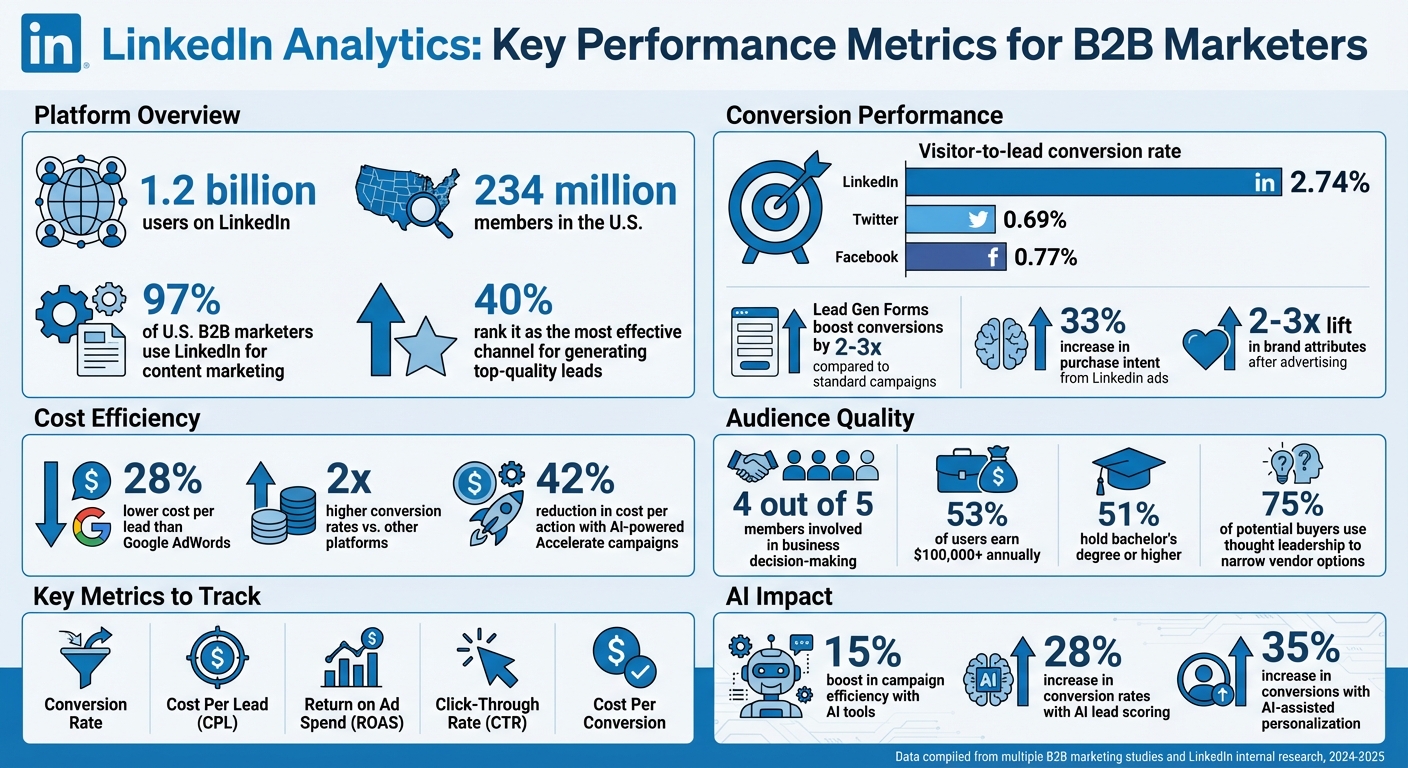
When it comes to B2B marketing, LinkedIn consistently delivers results that stand out. The platform boasts a visitor-to-lead conversion rate of 2.74%, which is nearly three times higher than Twitter's 0.69% and Facebook's 0.77% [7]. This gap becomes even more pronounced when marketers take advantage of LinkedIn's native tools. For instance, LinkedIn Lead Gen Form campaigns can boost conversions by 2-3x compared to standard Sponsored Content campaigns [3]. These forms remove the need for external landing pages, streamlining the process and capturing high-intent leads more effectively.
On top of that, LinkedIn proves to be cost-efficient. The platform's cost per lead is 28% lower than Google AdWords [1][3][7]. This means LinkedIn not only drives more leads but does so at a lower acquisition cost. These metrics underline LinkedIn's ability to combine efficiency with effectiveness, making it a standout choice for B2B marketers.
Lead Quality and Purchase Intent
A key factor behind LinkedIn's success is the quality of its leads, driven by its professional audience. Four out of five LinkedIn members are involved in business decision-making [1], and the platform attracts a highly affluent and educated user base. Over 53% of users come from households earning more than $100,000 annually, and 51% hold at least a bachelor's degree [1]. This concentration of decision-makers and high earners creates an audience primed for B2B engagement.
The results speak for themselves. Ads on LinkedIn lead to a 33% increase in purchase intent [1][7], and brands often experience a 2-3x lift in brand attributes after advertising on the platform [1]. Thought leadership content performs particularly well, with 75% of potential buyers stating that it helps them narrow down their vendor options. Additionally, 45% of business decision-makers and 49% of C-suite executives report that thought leadership content has directly influenced their decision to work with a company [3]. This emphasis on professional content fosters a natural progression from awareness to conversion.
Adoption Trends Among U.S. B2B Marketers
LinkedIn's ability to deliver high-quality leads is reflected in its widespread adoption among U.S. B2B marketers. 97% of them use LinkedIn for content marketing [1], and 40% rank it as the most effective channel for generating top-quality leads [1]. The platform's U.S. presence is particularly strong, with over 234 million members in the country [1].
Investments in LinkedIn continue to grow. LinkedIn Premium subscriptions have increased by 50% over the past two years, contributing to over $2 billion in annual revenue as of Q2 2025 [1]. Looking ahead, 57% of marketers plan to ramp up their organic marketing efforts on LinkedIn [1]. These trends highlight the platform's growing influence and its ability to consistently drive meaningful results for B2B marketers.
Beginner Guide To LinkedIn Ads Conversion Tracking For 2025
How LinkedIn Analytics Drives Conversion Optimization
Using LinkedIn analytics effectively can transform how you design and evaluate campaigns, making it easier to fine-tune strategies for better conversions.
Key LinkedIn Conversion Metrics
To improve conversion performance, you first need to grasp the metrics that matter most. One critical metric is the conversion rate, which tells you the percentage of users who take a desired action after engaging with your content. It’s calculated by dividing conversions by clicks or unique visitors [8][10]. This number reveals how well your campaigns turn interest into action.
Another important metric is cost per conversion, which shows how much you’re spending on average for each conversion [8][11]. For lead generation campaigns, cost per lead (CPL) is particularly useful, as it breaks down your ad spend by the number of qualified leads generated [10][11]. These cost-focused metrics help identify which campaigns are delivering the best results and where you might need to adjust your budget.
Return on ad spend (ROAS) goes a step further by measuring how much revenue your ads generate for every dollar spent [8][11]. It’s calculated by dividing the total conversion value by the amount spent, making it a key indicator of campaign profitability. Lastly, the click-through rate (CTR) measures how well your content convinces users to take the next step, showing the percentage of viewers who click on your links [9][10][11][12].
Together, these metrics provide a solid foundation for understanding your campaign’s performance and identifying areas where refined targeting can improve results.
Audience Insights and High-Intent Targeting
LinkedIn’s advanced targeting tools allow you to connect with the right decision-makers at the right time. By layering filters such as job function, seniority, and skills, you can zero in on key professionals while still reaching a large enough audience [3]. This is especially important in B2B contexts, where buying decisions often involve 3.1 to 4.6 groups within an organization, including departments like IT, finance, and HR [3].
Matched Audiences is a powerful feature that lets you target people you already have a connection with, such as website visitors, contacts, or specific companies [14][3]. For example, you can retarget users who visited certain product pages or upload contact lists for account-based marketing. Additionally, Predictive Audiences uses AI to create custom audiences based on your existing data, helping you expand your reach to prospects who are likely to engage and convert [15]. To make the most of predictive audiences, align your data source with your campaign objective - for instance, use Lead Gen Forms for lead-focused campaigns or conversion data for website actions [15].
Website Demographics offers insights into the audience traits that drive the most conversions, helping you refine your targeting strategy [3]. Since the average B2B buying committee includes 6.8 people [6], it’s essential to craft messaging that resonates with different roles within an organization, not just executives. As James Carroll, Team Lead for Paid Social at Tableau, puts it:
"LinkedIn Sponsored Content regularly delivers more high-quality net-new leads than any other social platform we use"
.
When you combine precise targeting with accurate attribution, you can create a strategy that consistently delivers results.
Attribution and ROI Measurement
To understand which LinkedIn activities are driving real business outcomes, accurate attribution is key. Conversion Tracking allows you to share customer actions with LinkedIn, helping you see how ads lead to conversions and enabling the platform to optimize delivery to users most likely to convert [16]. This creates a feedback loop that improves campaign performance over time.
You can also track referral traffic, which measures how many visitors come to your website directly from LinkedIn. This is a great way to evaluate LinkedIn’s role in driving external traffic for conversions [10]. Monitoring custom button clicks on your company pages and posts provides additional insights into how specific calls-to-action are performing [13].
For B2B marketers, account-level engagement reporting is particularly valuable. It shows how key accounts contribute to your pipeline and ROI, which is crucial given that the average B2B buying committee involves 6.8 people [6]. LinkedIn analytics offers a comprehensive view of your campaign performance, tracking everything from follower demographics and post impressions to CTR and engagement data [9]. These insights help you refine your strategy, understand audience behavior, and demonstrate the impact of your efforts [9].
How AI Improves LinkedIn Analytics
LinkedIn's analytics tools are already powerful, but when paired with AI, they become even more effective at refining targeting and boosting conversions. AI processes massive amounts of data in real time, uncovering patterns that allow businesses to zero in on the right audiences and achieve better results. Let’s explore how AI-driven targeting, lead scoring, and personalization elevate LinkedIn analytics into a high-performing conversion engine.
AI-Powered Targeting and Segmentation
AI takes audience segmentation to the next level by analyzing data like firmographics, engagement patterns, and customer lists to identify the most promising prospects. Tools like LinkedIn’s Accelerate use machine learning to find high-intent leads, highlight key decision-makers, and refine ideal customer profiles. For example, in October 2024, LinkedIn Accelerate campaigns reduced cost per action by 42% and boosted campaign efficiency by 15% [2]. These AI tools also map anonymous buying signals to specific accounts, uncovering hidden leads and prioritizing outreach based on real-time intent data.
Predictive Lead Scoring
AI-driven lead scoring uses a combination of behavioral, firmographic, technographic, and intent data to rank prospects with impressive accuracy. The system continuously learns from past results, improving its predictions over time [17][18]. Companies often notice tangible benefits within three to six months of adopting predictive AI [17]. For instance, in 2025, a B2B SaaS company implemented AI-powered lead scoring and saw a 28% jump in conversion rates [22]. By focusing efforts on high-priority prospects, businesses can shorten sales cycles and improve customer acquisition rates [18][19].
AI-Assisted Personalization and Messaging
AI enables personalized outreach at scale by fine-tuning message timing, crafting effective subject lines, automating follow-ups, and using chatbots to engage with prospects instantly [22]. This level of personalization can increase conversion rates by as much as 35% [21]. A standout example is BioCatch, which achieved a 5× increase in qualified pipeline within six months in 2025 by combining real-time AI optimization with tailored LinkedIn messaging [20]. As SuperAGI explains:
"As personalization and engagement become increasingly crucial, companies are turning to AI-driven tools to help them better understand their target audiences and tailor their marketing efforts accordingly"
.
By 2025, over 70% of B2B companies are expected to rely on predictive analytics, signaling a major shift toward AI-powered lead targeting [21].
Platforms like SalesMind AI bring these advanced capabilities together - targeting, scoring, and personalized messaging - to help businesses connect with high-intent prospects and streamline their sales processes.
Research-Backed Insights for LinkedIn Conversion Growth
Metrics Linked to Higher Conversions
Recent studies shed light on how LinkedIn drives conversion growth, building upon the core metrics we’ve discussed before.
LinkedIn's Conversion Tracking is a key tool for measuring campaign performance, offering metrics like conversion rate, cost per conversion, and return on ad spend [5]. One standout feature is Lead Gen Forms, which auto-fill fields using member profile data. These forms can improve conversion rates by 2-3× compared to standard Sponsored Content campaigns [3]. To put this into perspective, 62% of B2B marketers say LinkedIn is their top platform for generating leads - more than doubling the results of other social channels [3].
A real-world example? Bynder, a software company, implemented LinkedIn Lead Gen Forms and achieved a 400% increase in leads, with a 20% conversion rate [3]. Additionally, LinkedIn supports comprehensive tracking through both post-click and post-view conversion rates, allowing marketers to attribute conversions across the entire customer journey [5][3]. The Revenue Attribution Report goes even further, linking ad data to CRM outcomes. This provides insights into pipeline generation, revenue, and win rates, giving marketers a clear picture of their campaign’s ultimate success [6].
Data-Driven Optimization Patterns
The most effective LinkedIn campaigns tend to follow a few proven strategies. For instance, Predictive Audiences use first-party conversion data to target high-potential buyers, adapting retargeting efforts based on the behaviors of entire buying committees [15][24]. A/B testing of ad creatives and content types, combined with Conversion Tracking, helps identify which campaigns yield the most leads [3]. Additionally, adjusting conversion windows to match your business cycle ensures you accurately measure the time between ad interaction and conversion [5].
Advanced reporting tools and third-party platforms provide even deeper insights into audience behavior, engagement trends, and cross-channel performance, all of which are vital for refining your strategy [23][6]. Regularly reviewing these reports can help you spot patterns and optimize campaigns accordingly [23].
These strategies naturally lead to integrating analytics with CRM systems for a more complete view of campaign performance.
Integrating LinkedIn Analytics with CRM Data
Taking conversion tracking a step further, linking LinkedIn analytics to your CRM creates a closed-loop reporting system. This integration allows campaigns to incorporate revenue signals, focusing on qualified meetings and opportunities rather than just clicks [3][24]. LinkedIn supports direct connections with platforms like Marketo, Driftrock, Microsoft Dynamics 365, and Zapier, enabling seamless lead export and enriching CRM records for better follow-up [3][25].
LinkedIn’s Conversion Tracking also supports "CRM-based auto-created conversions", making it easier to measure the direct impact of ads within your CRM. Jeremy Sacramento, Content Marketing Manager at Dreamdata, highlights the importance of attribution in B2B marketing:
"Attribution has established itself as the go-to solution for putting a dollar figure on marketing; a saving grace for many B2B marketers, who struggle to make sense of the long and complex customer journey"
.
Tools like SalesMind AI further enhance this integration by streamlining lead qualification and follow-ups, directly linking LinkedIn outreach efforts with your sales processes. This kind of synergy between platforms ensures your campaigns are not just generating clicks but driving meaningful business outcomes.
Research Methods and Limitations
Sources and Study Types
This article relies on a mix of internal research, such as reports on AI adoption and small business growth trends [4], and advanced tools like Data Driven Attribution (DDA) through "LiDDA" to assign conversion credits based on causal patterns [26]. For example, A/B testing across 29 LinkedIn Accelerate campaigns revealed a 42% reduction in cost per action [2]. Additionally, third-party case studies, like one from DataSync Solutions, highlight impressive outcomes: a 300% boost in engagement, five times more qualified leads, and $127,000 in pipeline revenue [27].
While these methods provide valuable insights, certain challenges make accurate measurement and attribution more complex.
Measurement and Attribution Challenges
LinkedIn's analytics tools come with some limitations. Metrics can experience delays depending on the data source - whether it's the Conversions API, Insight Tag, or manual CSV uploads [5]. Discrepancies often arise when comparing LinkedIn's data with third-party reports due to differences in lookback windows, deduplication rules, and other settings [5].
Privacy concerns further complicate measurement. LinkedIn's conversion tracking may not always capture individual user behavior, instead relying on predictive AI models or on-device tracking [5]. Traditional analytics tools also struggle to measure engagement from newer AI-driven features, such as visibility in summaries, cited content, or follow-up query interactions. These factors play a significant role in building trust and driving downstream conversions [28]. Moreover, 37% of marketers cite poor data quality as their biggest multichannel challenge, with data issues costing organizations an average of $12.9 million annually [30].
Acknowledging these challenges is essential for effectively interpreting and applying the benchmarks outlined here.
How to Apply These Benchmarks
These benchmarks are not one-size-fits-all; they should be tailored to your industry, audience, and specific campaign goals. For example, consider adjusting conversion windows to better reflect your business cycle [5]. Barney Brown, Global Head of Sales Enablement at Amazon Web Services, emphasizes the importance of authenticity in leveraging AI:
"Although we use the term artificial intelligence, nothing about the buyer-seller relationship should be artificial. It should be genuine. The key question is, 'How can generative AI help our account teams become more effective and productive, so they can double down on their relationship skills?'"
Think of these findings as a foundation for experimentation. Test different strategies, monitor your key metrics, and refine your approach based on what resonates with your audience. The most effective campaigns blend data-driven insights with authentic relationship-building and ongoing optimization.
FAQs
How do LinkedIn's AI tools improve lead generation and boost conversions?
LinkedIn’s AI tools turn raw data into practical insights, making it easier for businesses to spot and connect with promising leads. By examining real-time signals - such as job changes, content engagement, and company growth - these tools assign predictive scores to leads, boosting conversion rates by up to 25%. Outreach becomes more effective too, with tools that fine-tune message content, timing, and even A/B testing to drive higher engagement.
On top of that, LinkedIn’s AI takes over time-consuming tasks like data entry, lead qualification, and follow-ups, freeing up sales teams to focus on building real connections. Features like intent-based recommendations and tailored next-step suggestions simplify the sales process, helping deals close faster. SalesMind AI ties all these features together, allowing businesses to expand their LinkedIn outreach without losing the personal touch.
What metrics should I track to improve LinkedIn B2B marketing performance?
To make the most of LinkedIn B2B marketing campaigns, it’s essential to focus on metrics that show how well you're engaging your audience and converting them into leads. Start with connection acceptance rate - this tells you how many prospects are accepting your outreach. Then, track the response rate to see how many of those connections are replying to your messages. Another key metric is the click-through rate (CTR) on your posts or ads, which shows how effectively your content grabs attention.
When it comes to financial performance, keep an eye on the conversion rate (the percentage of leads turning into qualified opportunities), cost-per-lead (CPL), and return on investment (ROI). These numbers help you measure the efficiency of your campaigns. On the engagement side, metrics like likes, comments, shares, and follower growth provide a snapshot of your brand’s reach and the impact of your content. Additionally, leveraging lead scoring can help you identify and prioritize the most promising prospects for follow-up efforts.
Tools like SalesMind AI can simplify this process by giving you real-time dashboards to monitor these metrics. With features like automated lead scoring and campaign performance insights, you can quickly identify what’s working. This flexibility allows you to tweak strategies - whether it’s refining ad copy or adjusting your targeting - to boost results and achieve a stronger ROI.
How does integrating LinkedIn analytics with a CRM enhance marketing ROI?
Integrating LinkedIn analytics with your CRM brings all your social engagement data - like post impressions and click-through rates - into one place. This consolidated view offers a deeper understanding of how prospects interact with your brand. Marketers can use this data to enhance lead profiles with real-time intent signals and apply advanced lead-scoring models. By zeroing in on leads already active on LinkedIn, sales teams can speed up the sales cycle and cut down on customer acquisition costs.
Tools such as SalesMind AI make this process even smoother by automating LinkedIn outreach data updates directly into the CRM. This not only removes the need for manual data entry but also triggers timely follow-ups and keeps lead scores accurate. With these insights, marketers can shift budgets to the most effective campaigns, measure the revenue impact of LinkedIn efforts, and fine-tune strategies on the fly - all leading to a stronger ROI.
{"@context":"https://schema.org","@type":"FAQPage","mainEntity":[{"@type":"Question","name":"How do LinkedIn's AI tools improve lead generation and boost conversions?","acceptedAnswer":{"@type":"Answer","text":"<p>LinkedIn’s AI tools turn raw data into practical insights, making it easier for businesses to spot and connect with promising leads. By examining real-time signals - such as job changes, content engagement, and company growth - these tools assign predictive scores to leads, boosting conversion rates by up to 25%. Outreach becomes more effective too, with tools that fine-tune message content, timing, and even A/B testing to drive higher engagement.</p> <p>On top of that, LinkedIn’s AI takes over time-consuming tasks like data entry, lead qualification, and follow-ups, freeing up sales teams to focus on building real connections. Features like intent-based recommendations and tailored next-step suggestions simplify the sales process, helping deals close faster. SalesMind AI ties all these features together, allowing businesses to expand their LinkedIn outreach without losing the personal touch.</p>"}},{"@type":"Question","name":"What metrics should I track to improve LinkedIn B2B marketing performance?","acceptedAnswer":{"@type":"Answer","text":"<p>To make the most of LinkedIn B2B marketing campaigns, it’s essential to focus on metrics that show how well you're engaging your audience and converting them into leads. Start with <strong>connection acceptance rate</strong> - this tells you how many prospects are accepting your outreach. Then, track the <strong>response rate</strong> to see how many of those connections are replying to your messages. Another key metric is the <strong>click-through rate (CTR)</strong> on your posts or ads, which shows how effectively your content grabs attention.</p> <p>When it comes to financial performance, keep an eye on the <strong>conversion rate</strong> (the percentage of leads turning into qualified opportunities), <strong>cost-per-lead (CPL)</strong>, and <strong>return on investment (ROI)</strong>. These numbers help you measure the efficiency of your campaigns. On the engagement side, metrics like <strong>likes, comments, shares, and follower growth</strong> provide a snapshot of your brand’s reach and the impact of your content. Additionally, leveraging <strong>lead scoring</strong> can help you identify and prioritize the most promising prospects for follow-up efforts.</p> <p>Tools like <strong>SalesMind AI</strong> can simplify this process by giving you real-time dashboards to monitor these metrics. With features like automated lead scoring and campaign performance insights, you can quickly identify what’s working. This flexibility allows you to tweak strategies - whether it’s refining ad copy or adjusting your targeting - to boost results and achieve a stronger ROI.</p>"}},{"@type":"Question","name":"How does integrating LinkedIn analytics with a CRM enhance marketing ROI?","acceptedAnswer":{"@type":"Answer","text":"<p>Integrating LinkedIn analytics with your CRM brings all your social engagement data - like post impressions and click-through rates - into one place. This consolidated view offers a deeper understanding of how prospects interact with your brand. Marketers can use this data to enhance lead profiles with real-time intent signals and apply advanced lead-scoring models. By zeroing in on leads already active on LinkedIn, sales teams can speed up the sales cycle and cut down on customer acquisition costs.</p> <p>Tools such as <strong>SalesMind AI</strong> make this process even smoother by <a href=\"https://sales-mind.ai/blog/linkedin-outreach-faq-15-common-questions-answered\">automating LinkedIn outreach</a> data updates directly into the CRM. This not only removes the need for manual data entry but also triggers timely follow-ups and keeps lead scores accurate. With these insights, marketers can shift budgets to the most effective campaigns, measure the revenue impact of LinkedIn efforts, and fine-tune strategies on the fly - all leading to a stronger ROI.</p>"}}]}
 JG
JG