AI Workflow Optimization: B2B Lead Qualification
AI cuts B2B lead qualification time by scoring prospects instantly, enriching contact data continuously, and triggering personalized outreach the moment a lead shows intent. Teams that adopt AI-driven qualification workflows report shorter sales cycles and higher conversion rates because reps spend time on leads that are actually ready to buy.
 Julien Gadea
AI cuts B2B lead qualification time by scoring prospects instantly, enriching contact data continuously, and triggering personalized outreach the moment a lead shows intent. Teams that adopt AI-driven qualification workflows report shorter sales cycles and higher conversion rates because reps spend time on leads that are actually ready to buy.
AI cuts B2B lead qualification time by scoring prospects instantly, enriching contact data continuously, and triggering personalized outreach the moment a lead shows intent.
Teams that adopt AI-driven qualification workflows report shorter sales cycles and higher conversion rates because reps spend time on leads that are actually ready to buy.
Table of Contents
AI is transforming how B2B sales teams qualify leads, saving time, reducing costs, and improving accuracy. Traditional methods waste up to 60% of sales reps' time on non-selling tasks, with only 27% of leads being sales-ready. AI automates lead scoring, prioritization, and data analysis, processing leads in 2–3 seconds with 75–90% accuracy, compared to the 10–30 minutes and 60% accuracy of manual methods. Companies using AI see 25–35% higher conversion rates and 30% shorter sales cycles.
Key Highlights:
- Time Savings: AI reduces manual qualification time by 83%, freeing reps to focus on closing deals.
- Improved Lead Scoring: AI evaluates hundreds of data points, updating scores in real time based on actions like visiting pricing pages or downloading case studies.
- Data Accuracy: AI combats data decay (up to 70.3% annually) by continuously verifying and enriching lead information.
- Personalized Outreach: AI crafts tailored messages, increasing response rates by 32% and reducing reliance on generic communication.
- Cost Efficiency: For a 15-person sales team, AI can save approximately $480,000 annually in wasted salary costs.
AI-driven tools like SalesMind AI streamline workflows by automating LinkedIn outreach, lead scoring, and CRM integration. These systems manage 15,000+ leads per month, far surpassing manual capacity. By leveraging AI, sales teams can focus on meaningful customer interactions, achieve faster response times, and close more deals.
Want to transform your lead qualification process? Start by defining your ideal customer profile, configuring AI for lead scoring, and setting up automated personalized outreach.
Common Problems in B2B Lead Qualification
Time-Consuming Manual Processes
Manual lead qualification eats up a huge chunk of time, leaving sales teams with less opportunity to actually sell. On average, it takes 15–20 minutes to qualify a single lead, which can add up to 6 hours of a rep's day - or 70% of their time - when managing dozens or even hundreds of leads daily [1][4]. This process often involves tedious administrative tasks, pulling reps away from meaningful customer interactions.
Speed is critical: companies that respond to leads within 5 minutes are 400% more likely to qualify them compared to those that take just 10 minutes longer [1]. However, manual methods can only handle 800 to 1,000 leads per month before quality starts to drop [4]. With the sheer volume of incoming data, manual processes simply can’t keep up, leading to missed opportunities and inefficiencies.
Too Much Data to Process
Sales teams are drowning in data. While human reps typically assess just 5 to 10 factors - like job title or company size - there are countless other signals they’re missing, such as website behavior, email engagement patterns, or changes in a prospect’s technology stack [1]. These overlooked signals hold valuable insights that could dramatically improve lead qualification.
Bad data is a costly problem. It wastes over 546 hours per year for reps chasing outdated or inaccurate information [6]. On top of that, contact databases decay at alarming rates - between 22.5% and 70.3% annually [6]. This means a lead’s details can become irrelevant almost overnight.
"Poor data quality costs U.S. businesses about $3.1 trillion annually." – Gartner [6]
While reps spend time verifying outdated or incomplete information, high-potential leads often get ignored, especially when their actions or behaviors go unnoticed.
Generic Communication That Doesn't Convert
When overwhelmed by manual processes and excessive data, sales teams often fall back on generic messaging, which fails to resonate with prospects. This approach is ineffective: personalized emails see 29% higher open rates and 41% higher click-through rates compared to generic ones [7][8]. Yet, many reps still rely on impersonal outreach, wasting 21% of their time and prolonging sales cycles [7].
Buyers are taking notice. 63% of B2B buyers say overly automated or "robotic" sales processes damage trust [8]. With the average B2B sales cycle now stretching 22% longer, every wasted day on poorly qualified leads is a missed chance to connect with high-intent prospects [8]. AI-driven tools can help by analyzing data at scale and crafting tailored messages that align with each prospect's unique needs and behaviors.
How to Automate Lead Qualification with AI in Make.com
How AI Improves Lead Qualification Workflows
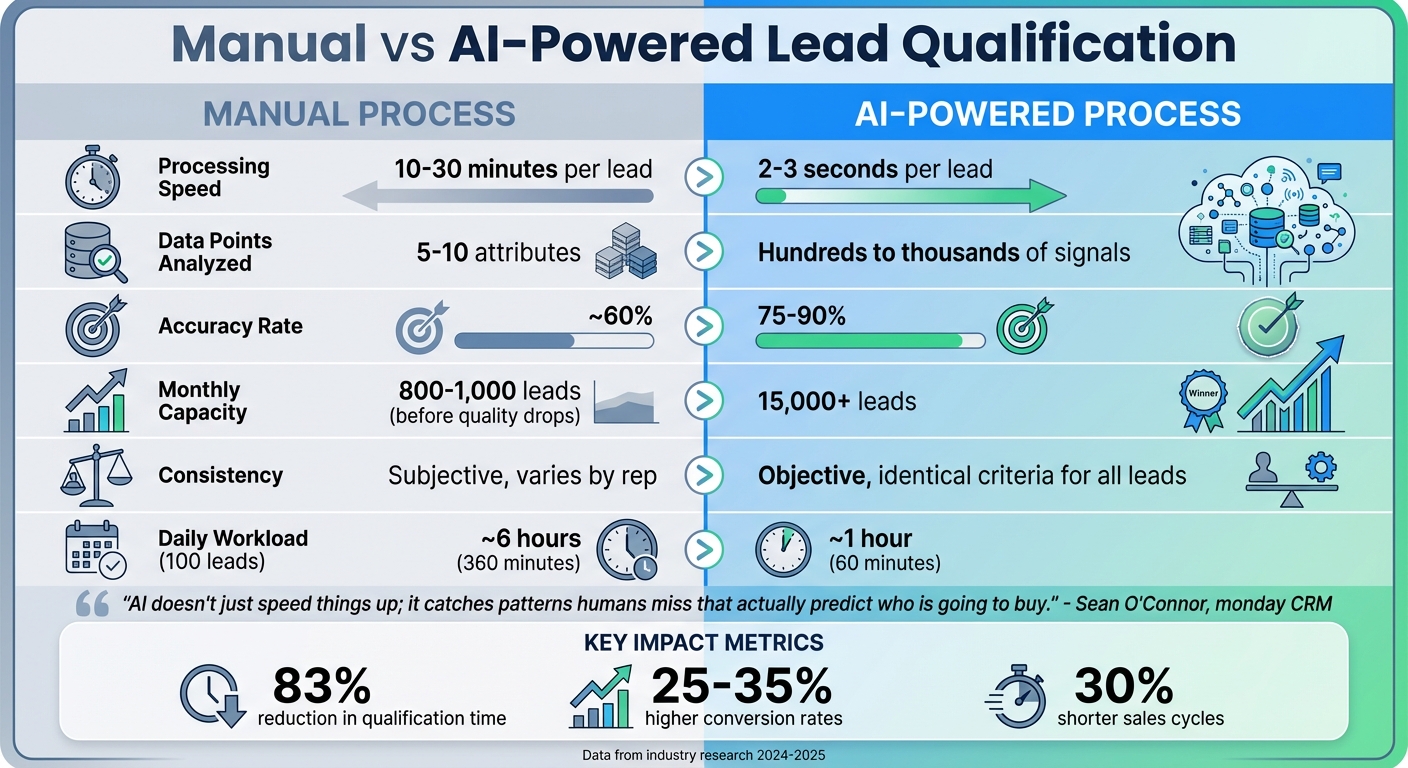
Manual vs AI-Powered Lead Qualification: Speed, Accuracy, and Efficiency Comparison
AI has revolutionized lead qualification, turning what was once a time-consuming and subjective task into a streamlined, data-driven process. Instead of painstakingly reviewing leads one by one, AI can analyze hundreds or even thousands of data points simultaneously, such as firmographics, demographics, technographics, and real-time behavioral signals [1][9]. By addressing challenges like time constraints and overwhelming data, AI enables businesses to cut through the noise and focus on personalized engagement, rather than generic outreach.
The results speak for themselves: AI-driven qualification can boost sales opportunities by 181%, improve conversion rates by 25–35%, and reduce sales cycles by 30% [9][5]. It processes leads in just 2–3 seconds with an accuracy rate of 75–90%, far outpacing the 10–30 minutes and 60% accuracy typical of manual reviews [4][3]. AI not only speeds things up but also identifies patterns that humans might overlook, applying consistent criteria across all leads.
"AI doesn't just speed things up; it catches patterns humans miss that actually predict who is going to buy." - Sean O'Connor, monday CRM [3]
By analyzing years of historical deal data, AI pinpoints the attributes and behaviors that correlate with successful conversions [1][10]. This allows sales reps to spend less time on guesswork and more time engaging with leads who are ready to buy.
Automated Lead Scoring and Ranking
One of AI's standout features is automated lead scoring, which transforms raw data into actionable rankings. AI assigns scores to leads based on their likelihood to convert, continually updating these scores in real-time as prospects take new actions. For instance, a lead's score might jump if they visit your pricing page multiple times or download a comparison guide [1][3].
AI applies traditional frameworks like BANT (Budget, Authority, Need, Timing), CHAMP, or MEDDIC at scale, combining them with insights from digital behaviors [9][4]. Modern systems weigh scores across four categories: demographic fit, behavioral engagement, intent signals, and timing factors [4]. This ensures that high-intent prospects automatically rise to the top of the sales queue. AI-powered lead scoring can increase conversion rates by up to 50% [10].
| Feature | Manual Qualification | AI-Driven Qualification |
|---|---|---|
| Processing Speed | 10–30 minutes per lead [3] | 2–3 seconds per lead [3] |
| Data Points | 5–10 attributes [1] | Hundreds to thousands of signals [1][9] |
| Consistency | Subjective, varies by rep [1] | Objective, identical criteria for all leads [1] |
| Scalability | Limited by headcount [1] | Handles 15,000+ leads monthly with ease [4] |
| Accuracy | ~60% [4] | 75–90% [4] |
Advanced AI systems also categorize prospect responses, such as "Interested", "Meeting Request", or "Wrong Person", and trigger automated workflows accordingly [1]. This ensures each lead receives the right follow-up without manual sorting.
Automatic Data Collection and Analysis
AI excels at gathering and analyzing data from multiple channels to create real-time lead profiles. It tracks "digital body language", capturing high-intent actions like visiting a pricing page or downloading a spec sheet and updating lead scores instantly [9][5]. This is particularly important because B2B contact databases decay at a rate of 22.5% to 70.3% annually [6]. AI combats this by continuously validating data through live web crawling and real-time verification, ensuring sales teams work with accurate information.
Machine learning algorithms dig into historical data from past deals to identify patterns that signal conversion potential [4][1]. Natural Language Processing (NLP) further enhances this by analyzing emails, chats, and form submissions to assess urgency, enthusiasm, and purchase readiness [3][4]. This sentiment detection helps prioritize genuinely interested leads over casual browsers.
With AI handling these tasks, sales teams spend 80% less time on manual lead evaluation, freeing them to focus on high-value activities [5]. Instead of hours spent verifying details or researching companies, reps receive structured lead summaries with actionable insights as soon as a prospect qualifies.
Customized Messaging for Every Lead
Personalized outreach is far more effective than generic messaging. Emails tailored to specific leads achieve a 32% higher response rate [11]. For instance, research-driven emails often see a 3–4% response rate, compared to just ~1% for generic mass emails [11]. AI can reference specific organizational changes or announcements, making buyers 74% more likely to engage [11].
Between 2023 and 2025, SAP implemented over 40 AI tools, enabling them to support 22,000+ new customer opportunities. By automating data analysis and using AI insights at every stage of the sales cycle, they cut their sales cycle from 12–18 months to just 3–6 months [11]. Similarly, Valpak quadrupled its closing ratio, improving from 11% to 40%, by leveraging AI-powered lead scoring and prioritization [9].
AI also optimizes follow-up sequences. For example, it detects "Out of Office" replies, pauses the sequence, and resumes it when the prospect returns, ensuring the message remains timely [1]. Response categorization happens within 15 seconds, compared to the 4–8 hours required for manual review [1]. Since 78% of sales go to the first responder [9], this speed advantage translates directly into more closed deals.
"AI doesn't replace salespeople - it makes them better." - AgentiveAIQ [9]
How SalesMind AI Handles B2B Lead Qualification
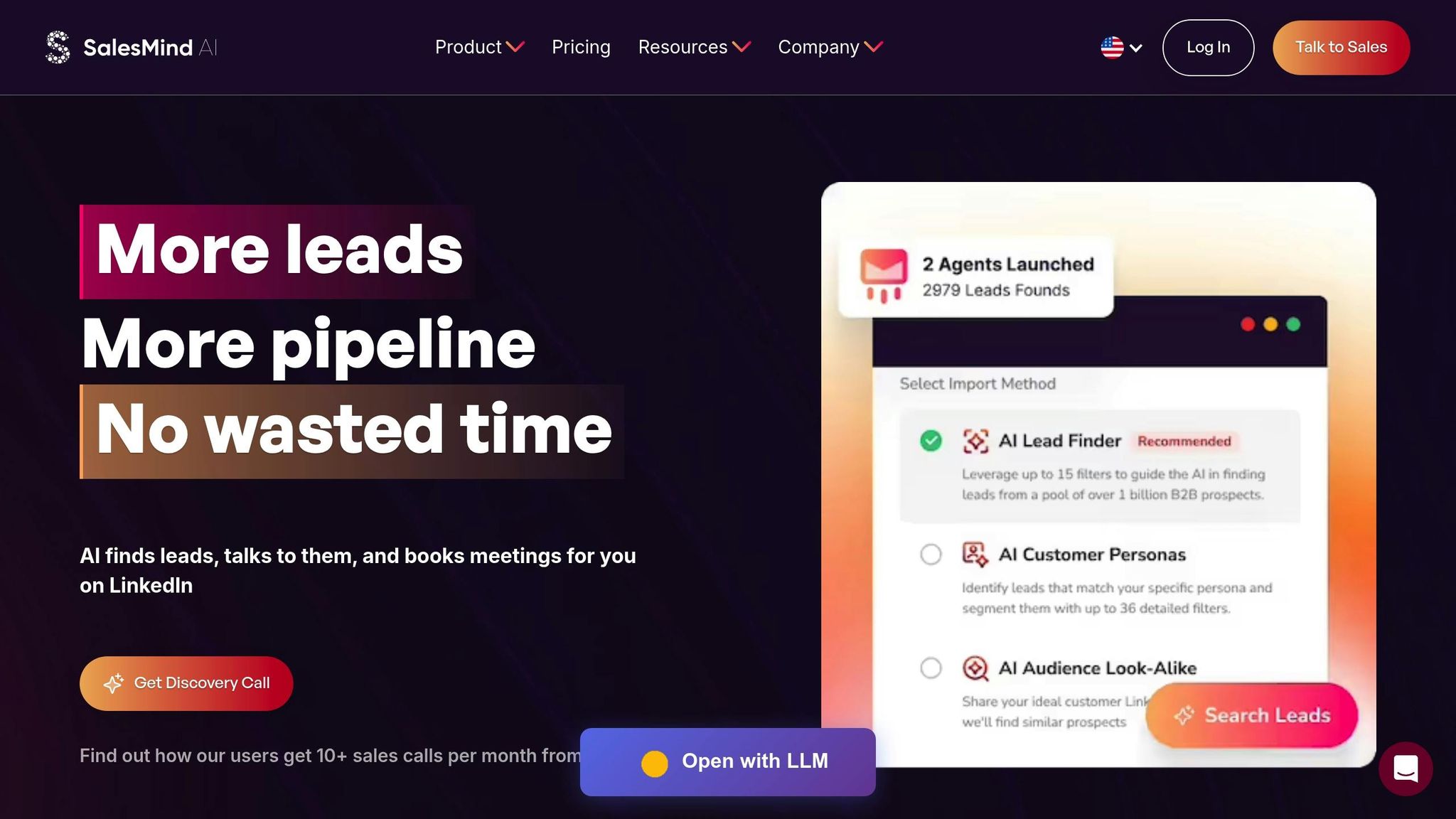
SalesMind AI streamlines LinkedIn outreach, automating the entire process from initial contact to follow-ups. By eliminating up to 70% of the time sales reps typically spend on tasks like research, scoring, and scheduling, it allows teams to focus on closing deals instead [14]. Through LinkedIn automation, lead scoring, and seamless CRM integration, the platform ensures that qualification is both efficient and personalized. Its standout features include automated messaging, a centralized inbox with lead scoring, and CRM synchronization.
Automated LinkedIn Messaging and Follow-Ups
SalesMind AI automates the process of sending personalized connection requests and messages, carefully timing them based on recipients' time zones to boost engagement [12][13]. Once a prospect responds, an AI co-pilot takes over, providing pre-written replies and managing follow-up sequences to ensure no opportunity is missed [12].
"The results were sometimes almost too good - connection rates and responses were way above what I expected."
Nick Heijman, Chief Executive Officer at HypotheekXperts [12].
In August 2024, Steven Huibers, COO of Policereports.ai, reported achieving three times better results in LinkedIn outbound campaigns compared to previous tools, thanks to SalesMind AI's automation [12]. Many users have highlighted its effectiveness, with some generating over 10 sales calls per month directly from LinkedIn outreach [12].
Centralized Inbox and Lead Scoring System
The platform’s unified inbox consolidates responses from all connected LinkedIn accounts, making it easy to manage conversations in one place [12]. This setup ensures that no high-value lead is overlooked, even during extended follow-up periods. Features like tagging and reminders help track the status of each lead [12]. The integrated lead scoring system assigns scores to prospects based on user-defined criteria, helping prioritize efforts on the most promising leads [12].
"From the very first week, SalesMind AI boosted my productivity in lead prospecting by 10×."
Alex Lossing, CTO at Slash [12].
Using behavioral data and predictive scoring, the platform enhances engagement and conversion rates, letting sales teams zero in on the leads that matter most [13].
CRM and LinkedIn Data Synchronization
SalesMind AI simplifies data management by directly syncing LinkedIn lead information with CRM platforms, eliminating the need for manual entry [13]. It enriches CRM records with LinkedIn-specific details and provides real-time updates, ensuring sales teams always have the latest prospect information [13]. Every interaction is automatically logged, reducing administrative work and ensuring no activity slips through the cracks [12].
"SalesMind AI has proven very useful to our sales team in reducing the massive pain points of manually tracking each and every lead interaction."
Rahul Pushkarna, Senior Advisor at Bounty Media [12].
sbb-itb-817c6a5
How to Add AI to Your Lead Qualification Process
AI has proven to be a game-changer in speeding up lead qualification. It integrates smoothly into your workflow, leveraging existing data to make the process faster and more efficient. By taking over the repetitive tasks, AI allows your team to focus on meaningful conversations with potential customers.
To get started, you’ll need to focus on three main areas: defining your ideal customer, teaching the AI how to score leads and gather data, and setting up outreach that feels personal even at scale.
Set Up Your Ideal Customer Profile
Before AI can identify the right leads, it needs to understand what success looks like. Start by analyzing 2–3 years of historical CRM data that includes both closed-won and closed-lost deals [1]. This data helps the AI identify patterns that predict success, moving the process beyond guesswork to decisions grounded in real outcomes.
When starting out, narrow your focus to 5–7 key variables [1][17]. These often include job title, company size, industry, and behaviors like visits to your pricing page. Companies using this approach have seen measurable improvements in conversion rates and revenue.
AI evaluates two main factors: fit and intent. Fit refers to firmographic details like company size or industry, while intent captures behaviors such as email clicks or demo requests [16]. For example, a prospect might match your ideal profile perfectly but show no recent interest. In that case, they shouldn’t rank higher than someone actively researching your product.
Configure Lead Scoring and Data Collection
Once your ideal customer profile is set, the next step is to score leads in real time. Effective lead scoring combines multiple data points. Assign higher scores to high-intent actions - like a demo request (+15 to +25 points) - and lower scores to less critical actions, such as reading a blog post (+1 to +5 points) [16]. Negative scoring is also important; for instance, student email domains or irrelevant industries might subtract 10–20 points [16][17].
Set thresholds for action: leads scoring above 70 should trigger immediate alerts, while those scoring between 40 and 69 can enter an automated nurturing process [16]. This ensures that your team focuses on the prospects most likely to convert. Research shows that 79% of leads fail to convert due to poor nurturing and qualification [16].
AI can dramatically reduce qualification time - by as much as 83% - saving up to 5 hours per day for each sales rep [1]. Use it to automatically fill in missing data, like a prospect’s tech stack, company revenue, or recent funding. Schedule quarterly reviews where your sales team can flag misqualified leads, and use this feedback to fine-tune the AI’s scoring model [3][1].
Create Automated Personalized Outreach
Personalized outreach works best when it’s backed by research, not generic templates. Advanced systems use a multi-agent workflow: one agent gathers data from sources like LinkedIn, another identifies buying signals, a third drafts the message, and a final agent verifies everything before sending [15]. This ensures accuracy and avoids mistakes caused by outdated information.
Start small with a 100-contact pilot program to test your messaging and measure reply rates before rolling it out on a larger scale [15]. Configure triggers that launch outreach based on specific actions, such as extended visits to your pricing page or comparisons with competitors [18][3].
AI can also categorize prospect replies automatically - e.g., "Interested", "Meeting Request", "Information Request", or "Out of Office" [1]. Each category triggers a tailored follow-up. For instance, if someone is out of the office, you can pause the sequence for 2–16 days and resume when they’re back [1]. This level of responsiveness pays off, as 74% of sales professionals report improved response rates when using AI tools [18].
Measuring Results and Improving Performance
Once you've implemented AI, it's crucial to keep an eye on key metrics like lead-to-opportunity conversion rates and speed-to-contact. Speed-to-contact measures how quickly you engage with a lead after capturing it. Another critical metric is prediction accuracy, which you can evaluate by tracking false positives and false negatives. For instance, if more than 40% of AI-qualified leads are rejected by your sales team, it may be time to rethink your ideal customer profile [1]. Similarly, examine leads that converted despite low AI scores - this can highlight overlooked signals that your model should be addressing [1]. Aim for benchmarks like 70%+ accuracy for MQL-to-opportunity and 25-35% for SQL-to-close rates [1]. These targets provide a solid foundation for refining your AI's performance.
Track Conversion Rates and Lead Speed
To measure efficiency gains, focus on metrics such as pipeline velocity and cost per qualified lead. Use the formula for pipeline velocity:
(Opportunities × Average Deal Value × Win Rate %) / Sales Cycle Length [2].
For context, traditional SDR costs range between $150-$300 per lead, whereas AI-driven systems operate on fixed platform costs, scaling effortlessly without adding extra headcount [1]. Evaluate sales rep productivity by tracking activities per rep and quota attainment - this will reveal if AI is effectively reducing administrative tasks [1].
Take Bureau as an example: in 2025, they adopted AI-powered coaching and CRM automation. The results? A 30% increase in deal conversions and an extra hour saved daily for each sales rep on CRM updates [2]. Companies with precise forecasting are also 10% more likely to achieve year-over-year revenue growth [2]. These numbers highlight how AI can directly enhance sales efficiency and outcomes.
How AI Learns and Gets Better Over Time
AI thrives on data, refining its predictive models by analyzing historical CRM inputs like firmographics, behaviors, and intent signals [1][4]. It automatically adjusts weights based on new trends. For example, if conversions spike for a particular industry or company size, the AI recalibrates to prioritize those factors - no manual tweaking required.
To keep your AI in sync with changing market conditions and buyer behaviors, implement a quarterly retraining cycle [1][4]. Establish feedback loops where sales reps flag misqualified leads, enabling the AI to learn from human insights it might have missed [1][2]. When properly maintained, AI-powered predictive scoring can be 40-60% more accurate than traditional rule-based methods [2]. Regular retraining and feedback ensure your AI stays sharp and aligned with evolving dynamics.
Manual vs. AI Workflow Comparison
The productivity difference between manual and AI-driven lead qualification is staggering. Manual systems typically falter once lead volumes hit 800-1,000, while AI can manage over 15,000 leads per month with ease [4]. Companies using structured qualification processes report 73% higher conversion rates and 35% shorter sales cycles [19].
| Activity | Manual Process | AI-Powered Process |
|---|---|---|
| Initial Lead Scoring | 10-15 minutes per lead [3] | 2-3 seconds per lead [3] |
| Research & Enrichment | 15-20 minutes per lead [3] | Instant/Automated [3] |
| Daily Workload (100 leads) | ~6 hours (360 mins) [1] | ~1 hour (60 mins) [1] |
| Scalability | Limited by headcount [1] | Handles thousands instantly [1] |
| Consistency | Subjective/Varies by rep [1] | Objective/Identical criteria [1] |
"The true cost of traditional qualification is not the leads you chase; it is the deals you could have closed while chasing them." - Zime.ai [2]
Using AI, sales reps can increase revenue by 41%, improve conversion rates by 20-30%, and free up to 5 hours daily for closing deals [1][2]. These efficiency gains make a compelling case for integrating AI into your sales processes.
Conclusion: What's Next for AI in B2B Lead Qualification
AI has moved from being a competitive advantage to becoming essential infrastructure for B2B sales teams. With 81% of teams already leveraging AI in some capacity, it's clear that this technology is reshaping how businesses operate in sales [21]. In fact, teams using AI are 1.3 times more likely to report revenue growth compared to those who don't [21]. Even more compelling, AI-augmented reps generate 41% more revenue per person ($1.75M vs. $1.24M) than traditional models [2]. These numbers highlight the transformative potential of AI, with the next wave promising even greater efficiency and automation.
Today’s advanced AI tools, like Agentic AI, are already automating tasks beyond simple lead scoring. They handle initial qualification conversations and follow-ups, streamlining workflows and reducing manual effort [20]. According to Gartner, by 2027, 95% of seller research workflows will begin with AI, a sharp increase from less than 20% in 2024 [20].
"AI is no longer a nice-to-have: 81% of sales teams are already using AI and those teams are significantly more likely to report revenue growth than non-users." – SalesHive [21]
Platforms like SalesMind AI are setting the standard for this evolution. They allow sales teams to scale from managing 500 leads to over 15,000 per month without needing to add more staff [4]. By continuously learning from closed-won and closed-lost data, these systems refine ideal customer profiles in real time, ensuring that qualification criteria stay relevant as market conditions change.
FAQs
How does AI enhance B2B lead qualification accuracy?
AI improves the precision of B2B lead qualification by examining behavioral patterns, real-time intent signals, and historical data. This approach helps businesses pinpoint and prioritize leads with the highest likelihood of converting, offering far more accurate lead scoring than older methods.
With AI-powered insights, sales and marketing teams can cut down on manual guesswork, concentrate on top-tier prospects, and simplify their processes. The result? Better conversion rates and greater efficiency.
How can a company integrate AI into its B2B lead qualification process?
To bring AI into your B2B lead qualification process, the first step is ensuring your data is in great shape - clean, accurate, and detailed. AI thrives on quality data, so this foundation is critical for reliable outcomes. Once that's in place, choose AI tools or algorithms that match your specific goals, whether it's analyzing engagement trends or scoring leads based on historical patterns.
Start small. Run a pilot program to see how well the AI performs before rolling it out on a larger scale. AI can handle tasks like lead scoring and routing, making sure top prospects are flagged and sent to the right sales team members. To keep things running smoothly, make it a habit to update your AI models with fresh data. This helps the system stay in tune with changing buyer behaviors.
By taking these steps, you can move from a manual, time-consuming lead qualification process to one that's data-driven and built for efficiency, delivering better outcomes in the long run.
How does AI improve outreach personalization to boost response rates?
AI takes outreach personalization to the next level by diving into data like company information, social media activity, and engagement trends. With this insight, it creates messages that feel custom-made for each prospect, addressing their unique needs and challenges. Forget cookie-cutter templates - these AI-driven messages are designed to truly connect, increasing the chances of a response.
What’s even better? AI handles this across multiple platforms, like email and LinkedIn, without sacrificing quality. Tools like dynamic messaging, trigger-based outreach, and real-time response tracking make sure your communication is always on point and perfectly timed. The result? More meaningful interactions and higher engagement rates.
 JG
JG