Engagement-Based Lead Scoring vs. Traditional Methods
Engagement-based scoring beats static rules because it reacts to what prospects actually do, not just who they are. This comparison breaks down how AI-driven models use real-time behavior signals to rank leads more accurately than traditional demographic scoring, and why that difference shortens sales cycles and reduces wasted rep time.
 Julien Gadea
Engagement-based scoring beats static rules because it reacts to what prospects actually do, not just who they are. This comparison breaks down how AI-driven models use real-time behavior signals to rank leads more accurately than traditional demographic scoring, and why that difference shortens sales cycles and reduces wasted rep time.
Engagement-based scoring beats static rules because it reacts to what prospects actually do, not just who they are.
This comparison breaks down how AI-driven models use real-time behavior signals to rank leads more accurately than traditional demographic scoring, and why that difference shortens sales cycles and reduces wasted rep time.
Table of Contents
Only 35% of salespeople trust traditional lead scoring, and 98% of leads scored this way fail to convert. Why? Predictive lead scoring vs. traditional methods highlights how static rules like job titles and form completions often fail, which often miss the nuanced behaviors that signal purchase intent.
Engagement-based lead scoring offers a better solution. It uses AI to evaluate real-time data - like website visits, email clicks, and LinkedIn activity - to identify high-potential leads with 2-3x greater accuracy. This approach adjusts dynamically, prioritizes high-intent actions, and can improve conversion rates by 20–40% in just 30–60 days.
Quick Overview:
- Traditional Scoring: Static, rule-based, relies on fixed attributes like job titles.
- Engagement-Based Scoring: AI-driven, analyzes real-time behaviors, adapts automatically.
- Results: AI scoring improves lead quality, shortens sales cycles, and boosts ROI.
Switching to engagement-based scoring is ideal for large lead volumes, complex sales cycles, or teams struggling with manual inefficiencies. It helps sales reps act on leads at the right time, maximizing opportunities and delivering measurable results.
Lead Scoring vs Signals and Why AI Signals Work Better Than Traditional Lead Scoring Algorithms
sbb-itb-817c6a5
What Is Traditional Lead Scoring?
Traditional lead scoring is a straightforward system for ranking potential leads based on fixed criteria. It assigns specific point values to certain attributes or actions - like adding +10 points for a "Director" title or +20 points for requesting a demo. The idea is simple: when a lead's total score hits a predefined threshold (say, 40 points), they’re flagged as "sales-ready" or labeled as a Marketing Qualified Lead (MQL). Sales and marketing teams then decide which traits or actions should earn those points.
This method relies heavily on static data, such as demographics (job title, seniority, location) and firmographics (company size, industry, revenue) using an AI lead finder tool. While it provides a clear framework, traditional lead scoring often struggles to adapt to the fast-changing dynamics of B2B sales. Let’s break down its key features and the challenges it faces.
Key Characteristics of Traditional Lead Scoring
At its core, traditional lead scoring uses simple "if-then" logic. Each attribute or action is tied to a fixed score, creating a system that’s easy to understand. Leads are typically ranked on a scale (often 1 to 100), offering a transparent view of how scores are calculated - no complex algorithms required.
Negative scoring is also part of the mix. For example, points might be deducted if a lead uses a competitor’s domain or a student email address. This helps teams avoid wasting time on leads that are unlikely to convert and keeps the focus on those that better match the Ideal Customer Profile (ICP).
However, traditional systems require manual updates. If market conditions shift or a new product launches, teams have to adjust the scoring rules themselves. The data sources are fairly static, relying on factors like job titles, company size, and basic form completions to determine whether a lead aligns with the ICP and has the potential budget for a purchase.
Common Challenges with Traditional Methods
While this approach offers clarity, it has some serious drawbacks. One of the biggest issues is its reliance on fixed attributes, which means a lead’s score is often a static snapshot. It doesn’t adjust as the lead’s interests or circumstances change.
"Traditional scoring freezes static attributes like title, industry, and budget into rigid rules that miss urgency, hesitation, and real intent." – Ionut Balan, CallFluent AI [7]
This rigidity can lead to missed opportunities. On average, companies using traditional lead scoring overlook 25% of high-potential leads and generate up to 30% false positives [5]. Sales teams often end up spending about 20% of their time on manual tasks like data entry and lead scoring [5]. Human bias can also creep in; for instance, rules might overemphasize actions like email opens while ignoring more subtle signals of buying intent.
Another challenge is tracking engagement within B2B buying committees, which often involve six to ten decision-makers. Traditional systems struggle to capture the collective behavior of these groups. Unsurprisingly, 47% of marketers say the quality of leads from traditional scoring needs improvement, and 43% feel it doesn’t offer enough insight into buying behavior [6]. This misalignment wastes sales resources and directly affects conversion rates and revenue growth.
What Is Engagement-Based Lead Scoring?
Engagement-based lead scoring takes a fresh approach to identifying high-potential leads. Instead of sticking to static attributes, it uses machine learning to analyze real-time behaviors, ranking prospects based on how likely they are to convert [2][3]. In simple terms, it focuses on what leads do rather than just who they are.
This method gathers data from various sources, including CRMs, website activities (like visits to pricing pages or content downloads), email engagement (opens, clicks, replies), and LinkedIn interactions [2][8]. Through a process called feature engineering, raw behavioral data is turned into metrics like engagement scores [2][10]. The AI detects patterns that traditional methods often miss, such as how specific page visits correlate with faster deal closures [8]. Unlike manual systems that rely on periodic updates, engagement-based scoring adjusts in real time as new intent signals are detected [3][8]. The impact is clear: AI-driven sales strategies can boost leads and appointments by over 50% [8], while manual scoring can result in up to 70% of leads being wasted due to ineffective follow-ups [3]. Plus, the AI continuously refines its scoring criteria by analyzing past outcomes, ensuring it focuses on the behaviors that genuinely drive conversions [2][9].
How Engagement-Based Scoring Works
The process kicks off with data integration. AI systems pull information from every touchpoint - marketing tools, website analytics, email campaigns, and LinkedIn - and turn it into actionable insights [2][8][10].
Using machine learning techniques like decision trees and gradient boosting, the AI uncovers complex links between behaviors and conversion likelihoods. For instance, it might identify that leads visiting a pricing page twice in one week are 40% more likely to convert [10]. Different interactions are weighted accordingly - visiting a pricing page or attending a webinar carries more significance than simply reading a blog post [2].
The scoring system updates instantly. If a lead clicks on an email, visits a product page, or engages with LinkedIn content, their score adjusts within seconds, enabling sales teams to act when interest is at its peak [8][10]. Quick responses matter: reaching out within an hour increases the chance of meaningful conversations with decision-makers by 7 times [8]. The AI also uses a feedback loop, analyzing every win or loss to refine its scoring criteria automatically [2][9]. This ongoing learning ensures the system adapts to changing buyer behaviors and market conditions, improving both efficiency and accuracy.
For example, in 2024, Workforce Software used AI-driven engagement tracking to monitor how target accounts interacted with its content. Over six months, the company achieved a 121% increase in engagement from in-market accounts by focusing on high-intent signals [2].
Advantages of Engagement-Based Scoring
One of the biggest benefits of engagement-based scoring is its ability to deliver real-time accuracy. AI can evaluate thousands of leads in seconds, spotting trends like prospects who visit pricing pages on mobile devices between 7–9 PM being twice as likely to convert [8]. This allows sales teams to spend 80% of their time on qualified leads, compared to just 30% with manual methods [8].
The system is also objective and data-driven. Unlike traditional methods that might rely on human judgment and miss subtle signals, engagement-based scoring evaluates every lead consistently [2][8]. Its scalability is another key advantage - AI-powered tools can easily handle a tenfold increase in lead volume without requiring extra staff [8].
Perhaps most importantly, this approach fosters better collaboration between sales and marketing teams. With a unified AI-driven scoring system, both teams can clearly see why a lead received a specific score, reducing conflicts and building trust.
Companies that use AI for lead scoring often see conversion rates increase by up to 50% compared to manual methods. Predictive scoring also helps shorten sales cycles by an average of 22% [10]. This dynamic, data-driven method offers a sharp contrast to traditional approaches and lays the groundwork for a deeper comparison.
Key Differences Between Traditional and Engagement-Based Lead Scoring
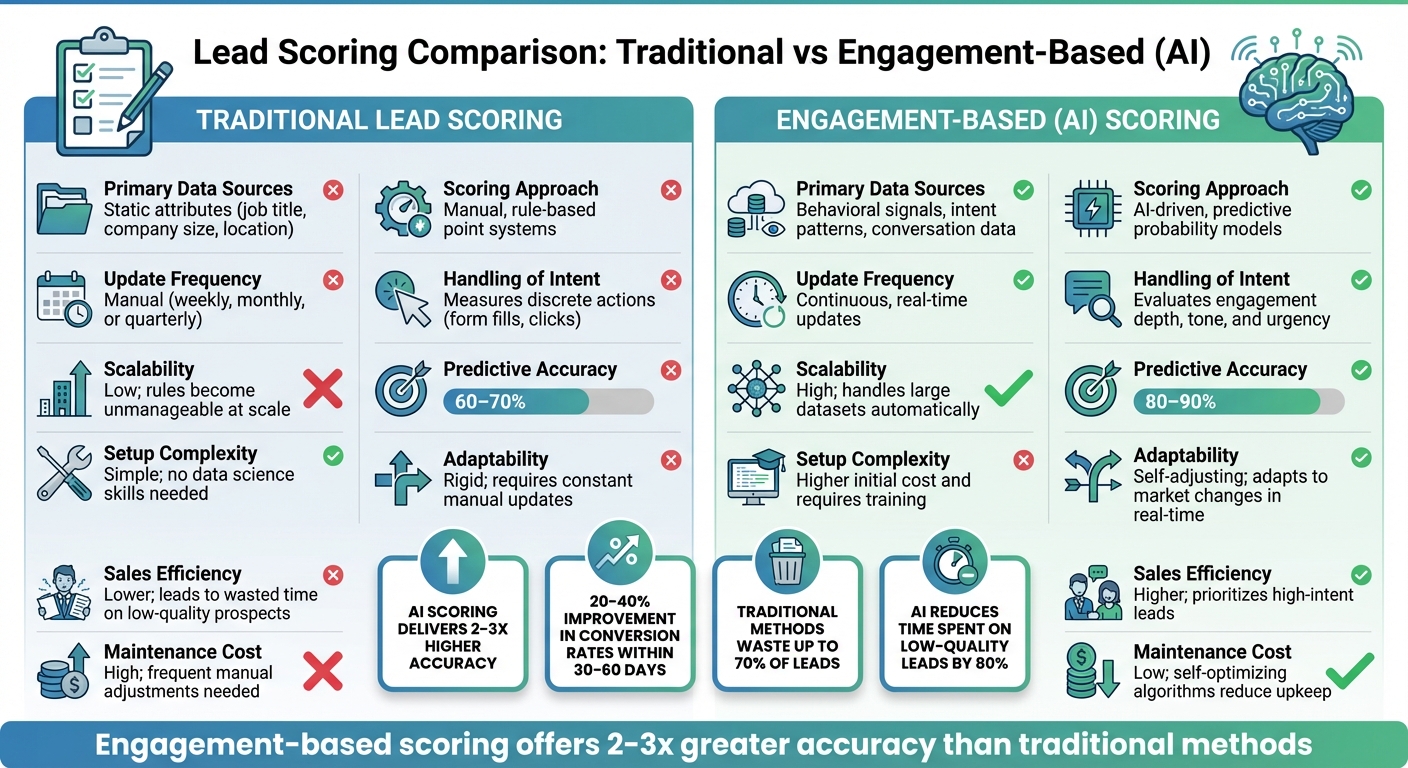
Traditional vs Engagement-Based Lead Scoring Comparison
Traditional and engagement-based lead scoring stand apart in their data sources, scoring methods, and how often they update. These differences highlight how each approach evaluates and prioritizes leads.
Traditional scoring relies on static data, like job titles, company size, industry, and location, as well as basic actions such as filling out forms or visiting pages [11][3]. On the other hand, engagement-based scoring focuses on dynamic behavioral signals. It tracks details like time spent on pages, repeated downloads, email interactions, and even conversational cues like tone and urgency [1][3][7]. While traditional methods simply check if a lead performed an action, engagement-based systems dig deeper into how and why those actions occurred, offering a clearer picture of intent [1].
The scoring methods differ too. Traditional systems use manual, rule-based point systems, often structured with "if/then" rules that demand frequent updates and maintenance [11]. Engagement-based systems, however, leverage machine learning and predictive algorithms. These tools analyze past outcomes and uncover patterns that manual processes often miss [11].
Update frequency is another key distinction. Traditional scoring typically involves manual updates that occur weekly, monthly, or even quarterly [11][3]. In contrast, engagement-based systems update in real time, responding instantly to new signals [3][7].
"AI lead scoring uses machine learning to rank prospects by purchase likelihood based on behavior, firmographics, and live intent signals, delivering 2-3 x higher accuracy than static point models." - Smartlead [3]
Comparison Table: Methodology and Data Sources
| Dimension | Traditional Lead Scoring | Engagement-Based (AI) Scoring |
|---|---|---|
| Primary Data Sources | Static attributes (job title, company size, location) [11] | Behavioral signals, intent patterns, conversation data [3][7] |
| Scoring Approach | Manual, rule-based point systems [11] | AI-driven, predictive probability models [11] |
| Update Frequency | Manual (weekly, monthly, or quarterly) [11] | Continuous, real-time updates [3] |
| Handling of Intent | Measures discrete actions (form fills, clicks) [1] | Evaluates engagement depth, tone, and urgency [7] |
| Scalability | Low; rules become unmanageable at scale [11] | High; handles large datasets automatically [3] |
| Predictive Accuracy | 60–70% [11] | 80–90% [11] |
Traditional models also rely on manual negative scoring to deprioritize low-quality leads, whereas engagement-based systems automatically adjust and deprioritize profiles that show no conversion potential [11][3]. This difference has a direct impact on efficiency: sales teams using traditional methods may spend 25–30% of their time on poor-quality leads. In comparison, AI-driven systems can improve conversion rates by 20–40% within just 30 to 60 days [11][1][7].
Advantages and Limitations of Each Approach
Let’s dive into the practical benefits and challenges that come with each lead scoring method.
Traditional lead scoring relies on straightforward, rule-based logic that can be set up without requiring data science expertise [3][4]. While this simplicity is appealing, it’s a static system that needs frequent manual updates to remain relevant [3][1][2]. Another drawback is that it often reflects human biases, which can skew the assessment of a lead’s true buying intent [3][1][7].
On the other hand, engagement-based scoring offers 2–3x greater accuracy by analyzing real-time intent signals alongside historical data [3][4]. It adapts automatically to market changes, reducing the need for manual intervention and cutting labor costs [3][2]. For example, in late 2025, a B2B fintech company switched from a rule-based system to an AI-powered platform that evaluated email engagement and session duration. The outcome? A 42% faster time-to-close and a 35% boost in win rate within just two quarters [1]. However, this approach does come with higher upfront costs and requires a brief learning curve [3][4]. Its accuracy also hinges on having access to high-quality data [3][2].
Traditional methods can lead to inefficiencies, with sales teams potentially wasting up to 70% of leads due to poor follow-ups [3]. By comparison, while the average salary for an SDR is around $60,000–$70,000 annually, AI scoring platforms cost roughly $1,500 per month - meaning companies could see a return on investment in as little as 10 days [3].
Here’s a quick side-by-side breakdown of their pros and cons:
Comparison Table: Pros and Cons
| Dimension | Traditional Lead Scoring | Engagement-Based (AI) Scoring |
|---|---|---|
| Accuracy | Static and prone to bias, lacks nuance [3] | Predictive, offering 2–3x better accuracy through machine learning [3] |
| Setup Complexity | Simple; no data science skills needed [3][4] | Higher initial cost and requires training [3][4] |
| Scalability | Limited; manual rules fail with larger datasets [1][7] | Highly scalable; processes thousands of signals automatically [3][4] |
| Adaptability | Rigid; requires constant manual updates [3][1][2] | Self-adjusting; adapts to market changes in real-time [3][2] |
| Sales Efficiency | Lower; leads to wasted time on low-intent prospects [1] | Higher; prioritizes high-intent leads [1][7] |
| Data Dependency | Relies on limited manual inputs like forms or clicks [3][7] | Needs high-quality data for best results [3][2] |
| Transparency | Fully transparent and easy to interpret [3][4] | Can feel like a "black box" without explainable AI features [3][2] |
| Maintenance Cost | High; frequent manual adjustments needed [3][4] | Low; self-optimizing algorithms reduce upkeep [3] |
Choosing the right system depends on aligning its strengths with your sales strategy. Tools like SalesMind AI leverage engagement-based scoring to deliver the precision and efficiency necessary for driving better conversion rates.
Performance Metrics and Results
When comparing scoring methodologies, the metrics highlight the tangible advantages of engagement-based lead scoring. For instance, companies that adopt AI-powered lead scoring see conversion rates improve by 25% compared to traditional methods. In the B2B space, this approach enables organizations to convert 50% more leads while reducing acquisition costs by 33% [12].
Engagement-based models also deliver impressive precision, achieving up to 98.39% accuracy in identifying high-value prospects. This far outperforms static, rule-based systems that are often influenced by bias [12]. A strong score-to-conversion correlation (r > 0.7) further supports this, with top-tier leads delivering conversion rates that are 3.5 times higher than average prospects [12].
AI-driven lead qualification significantly enhances efficiency. It can reduce the time-to-close by 50%, cut time spent on low-quality leads by 80%, and boost MQL acceptance rates to 85% or higher. This allows sales teams to focus on high-intent prospects immediately, aligning perfectly with the need for real-time adaptability [1][12].
The financial impact is equally compelling. Organizations leveraging advanced lead scoring achieve a 138% ROI, compared to just 78% for those without it. Forecasting accuracy improves by 47%, cost per lead decreases by 15%, and conversion rates rise by 20–40% within as little as 30–60 days [1][12]. These outcomes strongly validate the transition to AI-powered lead qualification.
When to Choose Engagement-Based Lead Scoring with SalesMind AI
Switching from traditional lead scoring becomes essential when your lead volume overwhelms your team's capacity. For example, if you're generating more than 500 leads but only engaging with 100, you're leaving opportunities untapped and wasting valuable resources.
Another clear signal is inefficiency in manual processes. When your team relies on spreadsheets or subjective judgment to qualify leads, it often results in inconsistencies and slower response times. Tools like SalesMind AI address these challenges by offering streamlined, data-driven solutions that eliminate guesswork.
How SalesMind AI Enhances Engagement-Based Scoring
SalesMind AI transforms lead qualification by monitoring real-time LinkedIn interactions. It tracks activities like profile views, message responses, content engagement, and connection patterns to distinguish between leads actively researching solutions and those casually browsing.
The platform’s AI-powered unified inbox consolidates LinkedIn conversations from multiple accounts into one view. This feature allows sales teams to identify which prospects are consistently engaging, making it easier to focus on high-intent leads without toggling between profiles.
Another standout feature is automated personalized messaging, which adjusts follow-up sequences dynamically based on each prospect's behavior. Instead of sticking to static drip campaigns, the system creates real-time, evolving conversations tailored to engagement levels.
SalesMind AI also integrates with your CRM in real time, automatically updating lead scores as prospects interact with your outreach. Whether a lead views your profile, opens a message, or clicks on a shared resource, sales reps can act quickly during moments of peak interest - no more waiting for scheduled follow-ups.
Scenarios Where SalesMind AI Provides Maximum Value
SalesMind AI shines in high-volume B2B environments. When companies are managing outreach to hundreds of prospects simultaneously, the platform processes engagement data at scale, automating tasks while maintaining the level of personalization manual methods can’t achieve.
For businesses with complex sales cycles that require 6–12 touchpoints, the platform’s ability to track detailed engagement patterns is invaluable. It helps identify behaviors that signal a lead is moving closer to conversion, giving teams a clear roadmap for follow-ups.
Finally, sales teams shifting to account-based marketing gain significant advantages from SalesMind AI's LinkedIn integration. By pinpointing multiple stakeholders within a target account who are engaging with your outreach, teams can prioritize opportunities more effectively. This account-level visibility changes the game for how prospects are approached and nurtured, ensuring no potential decision-makers are overlooked.
Conclusion
For years, traditional lead scoring methods have been a staple for businesses. However, they often fall short in today’s fast-paced B2B environment. Static point systems with manual updates not only waste valuable resources but also risk prioritizing leads with little potential.
Engagement-based scoring offers a smarter way forward. By analyzing real-time intent signals - like LinkedIn activity, website interactions, and content engagement - AI-powered outreach tools can deliver accuracy levels 2–3× higher than traditional models [3]. Companies adopting modern lead scoring methods report a 77% increase in lead generation ROI [13]. Even a modest 10% improvement in lead quality can drive a 40% boost in sales productivity [13].
SalesMind AI integrates these benefits seamlessly into your LinkedIn outreach. With real-time tracking, a unified inbox, and automated personalization, it eliminates the guesswork. Its ability to monitor engagement across entire buying committees - not just individual leads - provides the account-level insights critical for navigating complex B2B sales cycles.
The financial benefits are hard to ignore. AI-powered scoring can pay for itself in as little as 10 days, significantly outperforming the $60,000–$70,000 annual cost of hiring an SDR [3]. For companies handling large lead volumes, intricate sales cycles, or account-based strategies, engagement-based scoring isn’t just an upgrade - it’s a necessity to stay competitive.
This transition from traditional to engagement-based lead scoring empowers sales teams to act on opportunities as they arise. By leveraging real-time data and advanced analytics, businesses can secure every high-intent lead, transforming their sales process with actionable insights and measurable results.
FAQs
How does engagement-based lead scoring boost conversion rates compared to traditional methods?
Engagement-based lead scoring takes lead qualification to the next level by leveraging real-time behavioral data and AI-driven insights. Instead of depending on static factors like demographics, it evaluates dynamic activities - think website visits, email clicks, and social media interactions. This gives a much clearer view of which prospects are ready to take action.
Here’s the game-changer: by focusing on leads who are actively engaging, sales teams can reach out at the perfect time. This boosts response rates and improves conversions. Plus, it minimizes the chances of misjudging a lead's potential, making the entire sales process more efficient. The result? Better performance, fewer missed opportunities, and stronger revenue growth.
What are the main advantages of using AI for lead scoring in complex sales processes?
AI brings a whole new level of precision and efficiency to lead scoring, especially in complex sales cycles. It goes beyond traditional methods, which often rely on static factors like job titles or company size. Instead, AI processes a wide range of data points - such as engagement patterns, behavioral signals, and real-time actions - to pinpoint high-potential leads with greater accuracy.
Here’s how it works: AI taps into live data like website visits, email interactions, and social media activity. This dynamic approach ensures that lead prioritization stays relevant and up-to-date. It’s not just about identifying who might be interested - it’s about when they’re interested and how they’re engaging.
On top of that, AI simplifies workflows by providing real-time insights and automated alerts. Sales teams can act quickly on promising opportunities instead of wasting time on leads that are unlikely to convert. This shift not only boosts efficiency but also helps teams focus their energy where it truly counts - on leads with the highest potential for success.
By improving accuracy and speeding up decision-making, AI-powered lead scoring transforms how modern sales teams tackle the challenges of today’s intricate sales processes.
Why is real-time data important for accurate lead scoring?
Real-time data plays a key role in accurate lead scoring by offering up-to-the-minute insights into a prospect's actions and engagement. Tracking behaviors like email opens, website visits, or LinkedIn interactions helps businesses pinpoint which leads are worth prioritizing.
With access to real-time data, sales teams can act quickly on opportunities, reaching out to leads at the peak of their interest. This approach not only boosts conversion rates but also streamlines the sales process by directing attention to the most promising prospects.
 JG
JG