Predictive Scoring for Funnel Stages
AI-driven predictive scoring ranks leads (0–100), maps scores to TOFU/MOFU/BOFU, automates outreach and improves conversion rates and pipeline velocity.
 Julien Gadea
AI-driven predictive scoring ranks leads (0–100), maps scores to TOFU/MOFU/BOFU, automates outreach and improves conversion rates and pipeline velocity.
AI-driven predictive scoring ranks leads (0–100), maps scores to TOFU/MOFU/BOFU, automates outreach and improves conversion rates and pipeline velocity.
Table of Contents
Predictive lead scoring is a game-changer for sales teams struggling to prioritize leads. This AI-driven method evaluates hundreds of data points to rank leads by their likelihood to convert, replacing guesswork with measurable insights. Companies using predictive scoring report a 10–20% boost in conversion rates within a quarter and a 30% faster pipeline build. By analyzing CRM data, user behavior, and firmographics, predictive models assign scores (0–100) to leads, helping teams focus on high-value prospects.
Key takeaways:
- Top-of-Funnel (TOFU): Leads scoring 0–49 require nurturing with educational content.
- Middle-of-Funnel (MOFU): Leads scoring 50–74 benefit from targeted materials like case studies.
- Bottom-of-Funnel (BOFU): Leads scoring 75+ demand immediate sales outreach.
- Real-time scoring ensures timely engagement, with AI models retraining automatically for accuracy.
Using predictive lead scoring tools like SalesMind AI, businesses can integrate scoring with LinkedIn outreach, automating follow-ups and maximizing engagement. This approach not only saves time but also improves lead-to-customer conversion rates by focusing efforts where they matter most.
Setting Up Predictive Lead Scoring Using Machine Learning
sbb-itb-817c6a5
What Is Predictive Lead Scoring?
Predictive lead scoring uses artificial intelligence to rank leads based on their likelihood of converting. Unlike traditional scoring methods - where fixed points are manually assigned for specific actions or attributes (like 10 points for a job title or 5 points for downloading a whitepaper) - predictive models analyze hundreds of data points simultaneously. These models then assign a conversion probability score between 0 and 100. For example, a lead with a score of 85 is considered to have an 85% chance of converting, based on patterns observed in past successful customers [4]. What makes this approach even more powerful is that it learns continuously, refining predictions in real time as more data becomes available [4].
Predictive lead scoring doesn’t just sound smarter - it delivers results. It improves scoring accuracy by 20–40% compared to traditional rule-based systems. Companies adopting these models often see a 10–20% boost in conversion rates within the first quarter and achieve a 2–3x return on investment (ROI) within 6 to 12 months. Sales teams that prioritize leads using predictive scoring can also increase contact-to-opportunity conversion rates by 30–50% [4].
How Predictive Lead Scoring Works
The process begins with data integration. Predictive models pull historical data from your CRM, such as past wins, losses, and deal stages, and combine it with real-time behavioral data like website visits or email engagement. To make the insights even richer, third-party data sources like G2, LinkedIn, or job boards are added, bringing in firmographic and intent signals [4].
Once the data is aggregated, the system uses feature engineering to create meaningful attributes. For instance, it might calculate "engagement velocity" (how often a lead interacts) or "buying committee breadth" (the number of stakeholders involved in the decision-making process) [4]. The AI then identifies patterns that might not be obvious to humans - like specific sequences of web page visits or the timing of certain actions that often lead to a deal closing [4].
"AI lead scoring uses machine learning to automatically rank potential customers by their likelihood of purchasing, effectively providing real-time data analysis 24/7 without manual input."
– Sean O'Connor, Content Specialist, monday.com [1]
Modern systems calculate scores in near real-time, often within minutes of a lead being created or updated. This means sales teams can act immediately when a lead shows peak interest. The model also retrains itself continuously, using data from newly closed deals to maintain accuracy [4]. While most systems require at least 1,000 closed deals to identify statistically significant patterns, some can start producing results with as few as 40 qualified and 40 disqualified outcomes [4]. This real-time adaptability ensures that sales teams are always working with the most accurate insights.
| Feature | Traditional (Rule-Based) Scoring | Predictive Lead Scoring |
|---|---|---|
| Logic Source | Human intuition and "gut feel" | Historical data and AI algorithms |
| Maintenance | High; requires frequent manual updates | Low; retrains automatically |
| Data Scope | Limited (job titles, specific actions) | Broad (behavioral, firmographic, intent, external data) |
| Flexibility | Static; slow to adapt to changes | Dynamic; evolves with real-time outcomes |
| Accuracy | Prone to bias and subjectivity | Data-driven and statistically validated |
Why Predictive Scoring Improves Funnel Performance
For sales teams overwhelmed by lead volume, automated prioritization is a game-changer. By focusing only on high-intent leads, teams can skip the tedious introductory steps and dive straight into tailored solutions, significantly speeding up the sales process.
Predictive scoring also aligns sales and marketing teams by creating a shared understanding of what makes a lead "qualified." This reduces friction during handoffs and ensures that high-priority leads get immediate attention. Companies using AI-driven scoring have reported building their sales pipelines 30% faster by eliminating wasted effort on poor-fit leads [2].
Modern tools also offer transparency, showing why a lead received its score. For example, they might highlight factors like "Finance is a strong industry" or "Recent visit to the pricing page" to help sales reps personalize their outreach. Some systems even track "Score Trends", indicating whether a lead’s score is rising, falling, or holding steady based on recent activity [4]. By enabling targeted scoring at every stage of the funnel, predictive models help teams work smarter, not harder.
Applying Scoring to Each Funnel Stage
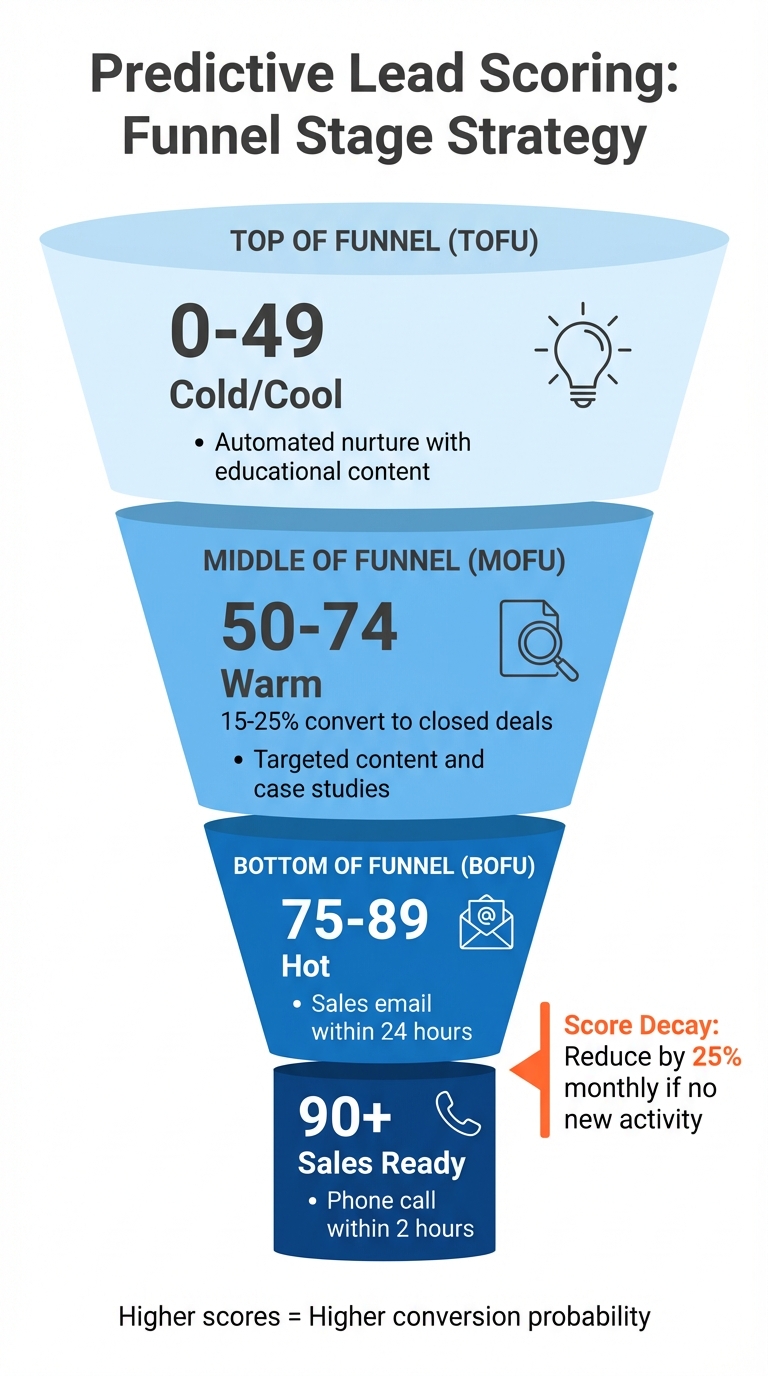
Predictive Lead Scoring Funnel Stages and Action Guide
The 3 Main Funnel Stages
The sales funnel is divided into three key stages, each representing a different level of buyer intent.
At the Top-of-Funnel (TOFU) stage, leads are just becoming aware of your brand. These individuals are in the exploration phase, where educational content is far more effective than direct sales pitches. You can even use AI prompts for lead generation to streamline this content creation. The focus here is on providing value and building trust.
In the Middle-of-Funnel (MOFU) stage, leads are actively evaluating their options. They’ve moved past basic awareness and are now comparing solutions, reading case studies, and assessing whether your product aligns with their needs. While their interest is growing, they’re not quite ready to make a purchase.
Finally, the Bottom-of-Funnel (BOFU) stage includes leads showing clear buying signals. These prospects are engaging in decisive actions, like reviewing pricing or requesting demos, indicating they’re ready for direct sales involvement. The key distinction across these stages lies in the intent demonstrated by the leads.
With these stages clearly defined, scoring thresholds can guide how you follow up with leads at each phase.
Assigning Score Ranges to Each Stage
Scoring thresholds are essential for categorizing leads into the appropriate funnel stages and determining the next steps for engagement.
- TOFU leads: These leads typically score between 0–49. At this stage, they are best suited for automated nurture campaigns featuring broad, educational content. There’s no need for immediate sales outreach here [8][9].
- MOFU leads: Scoring in the range of 50–74, these leads are more engaged and interested. They benefit from targeted materials like case studies or product comparison guides. While they’re nurtured primarily by marketing efforts, sales teams keep an eye on their activity. This group typically converts 15–25% of leads into closed deals [8].
- BOFU leads: Leads scoring 75 and above are highly engaged and ready for direct sales action. For scores between 75–89, a sales email should be sent within 24 hours. Scores of 90+ require immediate attention, with a phone call recommended within two hours [8]. For instance, in 2025, Seema Nayak, Marketing Manager at AdChina.io, implemented a policy where sales reps only contacted leads scoring 50 or higher. Lower-scoring leads were placed in automated workflows, resulting in a 25% boost in MQL-to-customer conversion rates [9].
To maintain focus on active prospects, scores should decay over time. For example, reducing scores by 25% monthly if no new activity occurs ensures that only recently engaged leads remain prioritized [8].
| Funnel Stage | Score Range | Lead Status | Recommended Action |
|---|---|---|---|
| TOFU | 0–49 | Cold/Cool | Automated nurture with educational content [8] |
| MOFU | 50–74 | Warm | Targeted content and case studies [8] |
| BOFU | 75–89 | Hot | Sales email within 24 hours [8] |
| BOFU | 90+ | Sales Ready | Phone call within 2 hours [8] |
Data Sources for Accurate Scoring
The reliability of predictive scoring models hinges on the quality of data they rely on. To build a system that effectively identifies high-value leads at every stage of the funnel, you need to draw from three key data categories. Each plays a distinct role in shaping the scoring process.
Company and Contact Information
Firmographic data helps determine if a lead aligns with your Ideal Customer Profile (ICP) before you dedicate resources to outreach. This includes details like industry, company size, annual revenue, geographic location, and job title [6][9]. For instance, if your product is tailored for mid-market SaaS companies with 100 to 500 employees, a lead from a 20-person startup or a massive enterprise with 10,000 employees would naturally score lower, even if their engagement level is high. This type of "fit" data acts as an initial filter, ensuring your sales team focuses on leads with genuine potential to convert. Companies prioritizing firmographic alignment in their scoring frameworks often report a 77% increase in lead-to-opportunity conversion rates [9].
Data accuracy is non-negotiable. Predictive models thrive on standardized, complete data - especially when it comes to revenue figures. Third-party tools can help enrich and fill in any gaps, boosting the model’s precision [2][9]. The results speak for themselves: effective lead scoring can drive a 79% boost in marketing-driven revenue [9]. While firmographic data sets the foundation, behavioral insights take lead qualification to the next level.
Engagement and Behavior Tracking
Behavioral data offers a dynamic layer of insight that complements firmographics. It highlights intent - separating casual browsers from serious buyers. By tracking how leads interact with your brand - whether they’re visiting pricing pages, downloading whitepapers, attending webinars, or engaging with emails - you can uncover implicit signals that often predict conversions more accurately than self-reported details [7][6].
"Lead scoring can help teams be more productive and efficient with the hours they dedicate to qualifying leads and prospecting." - Piyusha Pilania, Salesforce Consulting Manager, Horizontal Digital [7]
Key behavioral cues like the frequency and recency of interactions - such as multiple visits to a pricing page or attending a webinar shortly after an email invite - can signal a lead’s readiness to convert. AI models analyze these patterns through "Score Trends", identifying whether a lead’s interest is growing, stable, or waning, helping sales teams act at the perfect time [3]. For example, in one case study, 64% of financial industry leads were qualified within three days when specific behavior-based signals were detected [3]. On the flip side, negative behaviors like email unsubscribes or the use of non-corporate domains are flagged, resulting in point deductions to maintain pipeline quality [6][9].
Past Performance Data
Historical data from past wins and losses is invaluable for training scoring models to detect conversion patterns. By analyzing thousands of closed deals, AI can pinpoint which combinations of firmographic and behavioral signals are most strongly tied to successful sales [4][6]. This analysis often uncovers unexpected insights - like how a specific sequence of page visits or the speed of engagement might outweigh traditional indicators like content downloads [4].
For most predictive models, a dataset of at least 1,000 closed deals is needed to identify statistically significant trends. However, certain platforms can start training with as few as 40 qualified and 40 disqualified leads from recent months [4][5]. Companies leveraging predictive scoring based on historical data typically achieve a 20 to 40% improvement in accuracy compared to traditional rule-based systems [4]. To sustain this level of precision, models should retrain automatically - every 15 days or monthly - so they stay up to date with changing market conditions and new outcomes [4][5]. Incorporating historical performance data ensures your scoring models remain sharp and continually evolve alongside your business.
Building and Using AI Scoring Models
To create an effective AI scoring model, you need a solid foundation of accurate data and historical outcomes. The AI requires a minimum dataset to identify meaningful patterns. For example, Microsoft Dynamics 365 uses a starting point of 40 qualified and 40 disqualified leads to initiate modeling [5][10]. This baseline provides enough examples for the AI to distinguish between leads that are likely to convert and those that aren’t.
Training Models with Your Sales Data
Begin by connecting your CRM to the AI system. The AI will analyze thousands of closed deals to uncover firmographic and behavioral patterns associated with successful conversions. Each lead is assigned a score between 0 and 100, reflecting its likelihood of converting [3]. Once integrated, the system measures its accuracy using the Area Under Curve (AUC) metric [5].
To keep the model relevant, set it to retrain automatically [5]. This ensures it stays aligned with changes in buyer behavior and market conditions. For more complex sales funnels, you can implement per-stage modeling, which evaluates how specific attributes impact conversions at different stages of the funnel [10]. Once the model is trained, it can provide real-time scoring - calculating a lead’s value within minutes of being added to your CRM [3]. Scores are then grouped into grades from A to D, with A representing the highest likelihood of conversion [3].
Triggering Actions Based on Lead Scores
Lead scores can guide automated actions at every stage of the funnel. For top-of-funnel leads (scores 0 to 40), you might enroll them in educational email campaigns to build awareness without overloading your sales team. Mid-funnel leads (scores 41 to 70) could trigger tasks like assigning a sales owner or initiating personalized LinkedIn outreach strategies [1][11]. Bottom-of-funnel leads (scores 71 to 100) require immediate attention, such as notifying sales reps via Slack or initiating automated calls from AI sales development representatives (SDRs) [1][11].
To avoid outdated leads clogging your pipeline, apply score decay. For instance, you could reduce a lead’s score by 50% every 30 days if no new engagement occurs [11]. Additionally, monitor the top positive and negative factors influencing each lead’s score, as displayed in your scoring widget [3]. These insights empower sales teams to understand why a lead is ranked a certain way and adjust their strategies accordingly. By leveraging AI-driven scoring, companies can focus up to 80% of their time on qualified leads, compared to only 30% when using manual methods [1].
Next, we’ll explore how SalesMind AI uses these models to streamline funnel movement.
How SalesMind AI Enhances Lead Scoring
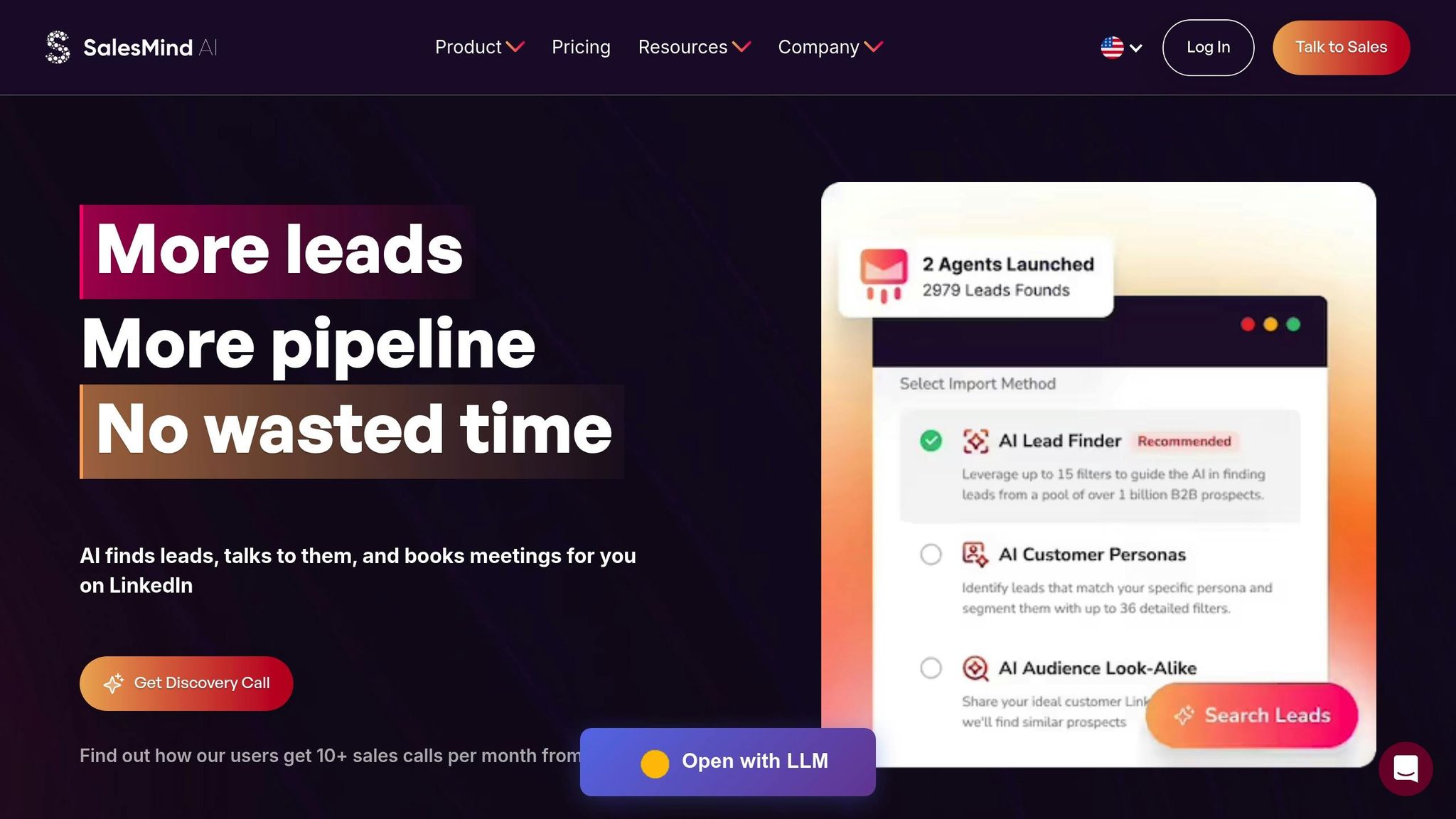
SalesMind AI takes predictive scoring to the next level by combining advanced AI insights with LinkedIn automation. The platform doesn't just analyze data; it acts on it. By evaluating thousands of data points - like demographics and behavioral patterns - it assigns scores that predict conversion likelihood. At the same time, it automates LinkedIn outreach, ensuring that high-potential leads are engaged right away. This dual strategy means you're not only identifying the best leads but also connecting with them in real time.
SalesMind AI's Scoring Capabilities
SalesMind AI's lead scoring system works seamlessly with CRMs like HubSpot and Salesforce, building profiles of your "ideal customer" based on past successes. Its Smart Prospect Extraction feature pinpoints promising profiles from LinkedIn interactions, such as event attendees, post engagers, or even followers of competitors. These prospects are then scored, enriched with complete contact details, and sent directly to your CRM.
The platform's unified inbox simplifies LinkedIn communications by tagging conversations with predictive scores and engagement levels. This helps sales teams prioritize their responses using data, not guesswork. Users have reported an average acceptance rate of 40% and a reply rate of 45% for automated LinkedIn outreach campaigns [12]. SalesMind AI's Advanced Personalization Engine ensures these results by combining AI-driven insights with contextual details to craft messages that truly connect with each prospect. As a result, these scoring and personalization features help push leads further down the AI sales funnel with ease.
Optimizing Funnel Movement with SalesMind AI
SalesMind AI accelerates the sales process by automating LinkedIn outreach based on predictive scores. High-scoring leads get immediate attention through automated notifications to sales reps, while lower-scoring leads are nurtured over time. This ensures every lead receives the right level of engagement, at the right moment.
On average, the platform helps businesses generate a monthly pipeline value of $100,000 by focusing sales efforts on the most promising opportunities [12].
"I've used a couple of other tools for LinkedIn outbound, but this has gotten me 3x the results" - Steven Huibers, COO of Policereports.ai [12]
SalesMind AI's continuous data loop - integrating LinkedIn engagement, CRM updates, and scoring models - keeps the system aligned with evolving buyer behaviors. This means the platform stays accurate and effective as your market shifts.
Tracking Scoring Performance
Keeping tabs on predictive scoring is essential if you want to fine-tune your model and avoid working in the dark. The trick lies in tracking the right metrics and using that data to keep your model performing at its best.
Metrics That Matter
Start by focusing on core metrics like accuracy, recall, and the F1 score. These help you gauge the quality of your predictions. Accuracy is calculated as [True Positives + True Negatives] divided by the total number of scored leads. Recall measures the percentage of actual positives correctly identified, and the F1 score balances precision and recall [13].
"Knowing how accurate a predictive scoring model is helps you decide whether the model is ready for use or needs to be fine-tuned for higher accuracy." – Microsoft Learn [13]
In addition to these technical metrics, pay attention to funnel outcome metrics that reflect real-world results. Keep an eye on the lead-to-customer conversion rate, MQL to SQL conversion rate, and pipeline velocity - the speed at which leads progress through the sales funnel. For example, teams using predictive scoring can build their sales pipelines about 30% faster by focusing less on poor-fit leads [2].
Daily operational metrics are equally important. Tracking lead score trends helps you prioritize prospects quickly, while monitoring the distribution of lead grades (A, B, C, D) ensures your sales team focuses on high-value opportunities. Another critical metric is the Area Under the Curve (AUC) score, which measures your model's ability to rank a won opportunity higher than a lost one. This is a key indicator of how ready your model is for action [13][5].
By analyzing these metrics, you can make timely adjustments to keep your model sharp and aligned with your goals.
Refining Models with New Data
To keep your model accurate, regular updates are a must. Aim to retrain it at least every 15 days or whenever you have significant new data [5]. As customer behaviors evolve, older models can become outdated, relying on patterns that no longer apply. If market conditions shift, consider shortening the training window to six months to focus on more recent, relevant data [13].
Using data windowing can help you prioritize the most valuable information. For instance, SalesMind AI employs a continuous data loop that integrates LinkedIn engagement, CRM updates, and scoring models. This allows your system to adapt automatically to shifts in buyer behavior, keeping scores aligned with current market trends without requiring manual adjustments.
Take time to review your confusion matrix every month for deeper insights [13]. This matrix breaks down:
- True Positives: Predicted won, actually won
- True Negatives: Predicted lost, actually lost
- False Positives: Predicted won, actually lost
- False Negatives: Predicted lost, actually won
If too many low-quality leads are making it through, raise your score threshold. If you're missing out on good opportunities, lower it [1].
Before retraining your model, clean and standardize your data. For example, unify titles like "VP" and "Vice President", remove duplicates, and exclude attributes with too much missing data. These steps help prevent false predictions [13][2]. While AI models can work with as few as 40 qualified and 40 disqualified leads, larger datasets generally lead to better accuracy [5].
Conclusion
Predictive scoring takes the guesswork out of lead qualification by providing data-driven insights that highlight promising opportunities instantly. Using AI models, hundreds of signals are analyzed in real time to determine which leads deserve immediate attention and which can be prioritized later. This method doesn’t just streamline the process - it accelerates pipeline growth by about 30% while increasing the percentage of qualified leads from 30% to 80% [2][1].
Success hinges on leveraging a platform that automates these processes effectively. For example, SalesMind AI integrates advanced lead scoring with LinkedIn outreach automation, creating a seamless feedback loop between engagement data and scoring models. This ensures your lead scores remain up-to-date without requiring constant manual input. Plus, acting quickly is critical - reaching out to a lead within an hour makes you seven times more likely to engage in a meaningful conversation with a decision-maker [1]. This combination of AI insights and automated outreach bridges the gap between identifying leads and engaging with them.
Getting started is simpler than you might think. Many AI systems require just 40 qualified and 40 disqualified leads from your recent history to begin learning. From there, the model continuously improves with every closed deal, missed opportunity, and new interaction.
For B2B SaaS companies aiming to scale without significantly increasing headcount, predictive scoring provides a clear and effective solution. An AI-driven sales representative can deliver the same output as 1.5 to 2 traditional reps [2], and companies using AI in sales see over a 50% increase in leads and appointments [1]. The real question isn’t whether to adopt predictive scoring but how quickly you can implement it to stay ahead in today’s fast-evolving sales environment.
FAQs
How can predictive lead scoring boost sales conversions?
Predictive lead scoring improves sales conversions by using data insights to pinpoint and prioritize the leads most likely to convert. This approach helps sales teams dedicate their time and energy to high-potential prospects, streamlining their efforts and speeding up deal closures.
With the help of AI and advanced analytics, predictive scoring ensures sales strategies are both targeted and personalized. This not only boosts engagement but also increases the chances of turning prospects into customers.
What types of data are needed for accurate predictive lead scoring?
Accurate predictive lead scoring depends on pulling together several types of data to create a clear picture of potential customers. Demographic data - like job titles, company size, and industry - helps identify who the lead is. Then there’s behavioral data, which tracks actions such as website visits, email clicks, or social media interactions to gauge their interest and intent.
You can also factor in firmographic data, such as a company’s revenue or location, and real-time engagement metrics, like how they respond to outreach or their recent activity. When these different data points are combined, AI-powered models can better predict how likely a lead is to convert. Plus, these scores can adjust dynamically as new interactions happen, keeping predictions fresh and relevant.
How does SalesMind AI use lead scores to automate LinkedIn outreach?
SalesMind AI uses predictive lead scoring to pinpoint and rank prospects with the highest potential. By evaluating these scores, the platform automates LinkedIn outreach with tailored messages, creating more impactful connections.
It also simplifies follow-ups and engagement, allowing sales teams to concentrate on the leads most likely to convert, all while cutting down on time and effort.
 JG
JG