How AI Analyzes Behavioral Data for Lead Qualification
AI that analyzes real-time behavioral signals transforms lead qualification by identifying high-intent prospects faster and with far greater accuracy.
 Julien Gadea
AI that analyzes real-time behavioral signals transforms lead qualification by identifying high-intent prospects faster and with far greater accuracy.
AI that analyzes real-time behavioral signals transforms lead qualification by identifying high-intent prospects faster and with far greater accuracy.
Table of Contents
AI transforms how businesses qualify leads by analyzing real-time behavioral data instead of relying on static details like job titles or company size. Behavioral data includes actions such as visiting pricing pages, clicking emails, or downloading resources - indicators of genuine interest and buying intent. Here's why AI-driven lead qualification outperforms manual methods:
For example, tools like SalesMind AI integrate data from LinkedIn, CRM platforms, and email systems to dynamically score leads, automate follow-ups, and streamline the qualification process. This allows sales teams to focus on closing deals rather than chasing cold leads.
What is Behavioral Data in Lead Qualification?
Defining Behavioral Data
Behavioral data captures the actions prospects take across digital platforms. This could include visiting a website, clicking on emails, downloading resources, replying to LinkedIn messages, or signing up for a product trial. Unlike demographic or firmographic data, which remain static, behavioral data offers a real-time glimpse into what a prospect is actively engaging with.
Take this example: demographic data might tell you that a prospect is a VP at a 200-person SaaS company with $10M in revenue. But behavioral data goes deeper, showing that this same prospect has been visiting your pricing page multiple times, downloading an ROI calculator, and reviewing integration documentation - clear signs of interest.
Why Behavioral Data Matters
While static data helps determine if a prospect fits your target audience, behavioral data reveals whether they’re ready to buy. AI-powered lead qualification systems excel at analyzing these dynamic behaviors, prioritizing them over static attributes to identify real buying intent.
Here’s why this matters: traditional lead scoring methods - relying on factors like job titles or company size - only reach about 15–25% accuracy. In contrast, AI systems that process 50+ behavioral signals can achieve 40–60% accuracy [4]. For example, Alex L., CTO at Slash Co, saw a dramatic improvement in 2025 when he implemented AI-driven behavioral tracking. By focusing on prospects actively engaging with his content, he increased lead prospecting productivity tenfold and generated 5 to 10 new conversations weekly [1].
Behavioral data also helps sales teams cut through the noise. A prospect who attends a product demo, spends time exploring case studies, and responds to follow-up emails clearly signals stronger buying intent than someone who simply downloads a general eBook. By zeroing in on these high-intent actions, sales teams can focus their energy on leads that are closer to making a purchase.
This distinction lays the groundwork for understanding the specific behavioral signals AI evaluates.
Why AI‑Powered Lead Scoring Is a Game-Changer: AISalesPad
Types of Behavioral Signals AI Analyzes
AI goes beyond traditional lead scoring, which typically focuses on just a handful of factors, by analyzing a wide range of signals to gauge buying intent accurately [4]. By leveraging behavioral and contextual data, AI creates a comprehensive view of how engaged a prospect is. These signals generally fall into three main categories: website and content engagement, email and campaign interactions, and social media activity. Let’s break down how these signals are used to refine lead qualification.
Website and Content Engagement
AI takes a deep dive into how prospects interact with your website. It tracks metrics like pages visited, time spent on each page, scroll depth, and how often a visitor returns. High-intent pages - such as pricing or product demo pages - carry significant weight. For instance, prospects who spend over two minutes on these pages and visit them repeatedly are 20–30% more likely to convert [4][5].
Another key factor is content progression. AI maps out whether a lead moves through the sales funnel by consuming content in a logical sequence - for example, starting with blog posts, then exploring case studies, and finally landing on pricing pages. Actions like registering for webinars, downloading resources, or using tools like ROI calculators are particularly telling. These high-value interactions correlate with conversion rates that are 40–60% higher than those based solely on demographic data [4].
Email and Campaign Interactions
Email behavior offers a treasure trove of insights into a prospect’s level of interest. AI evaluates metrics such as open rates, click-through rates, response times, and reply patterns to determine intent. For example, a prospect who clicks multiple links in a pricing email signals stronger engagement than one who only opens it. Similarly, consistent engagement with nurture campaign emails - like sequential opens and clicks - indicates growing interest.
In 2024, Henry F., an Enterprise Account Executive at
.
These patterns help AI identify high-priority leads, ensuring sales teams focus their efforts on the most engaged prospects.
Social Media Activity and Intent Signals
Social media platforms provide a unique window into buying intent. AI tracks actions like likes, shares, comments, mentions, and event participation to gauge both interest and sentiment. For example, a prospect who comments on product-related posts, shares case studies, or attends LinkedIn events demonstrates active interest and a connection to the brand [2].
AI doesn’t just look at the quantity of interactions - it also assesses their quality. Sentiment analysis plays a crucial role here. Comments that highlight challenges (e.g., "struggling with lead generation") or ask detailed questions about pricing or implementation often signal high intent. When combined with data from other channels, social media signals can boost accuracy rates to an impressive 99.5% [4].
For B2B sales teams focusing on LinkedIn, tools like SalesMind AI integrate various engagement metrics - such as connection acceptances, message replies, and profile views - with broader activity data. This ensures that prospects showing strong interest are seamlessly identified and prioritized for outreach [2].
How AI Processes Behavioral Data
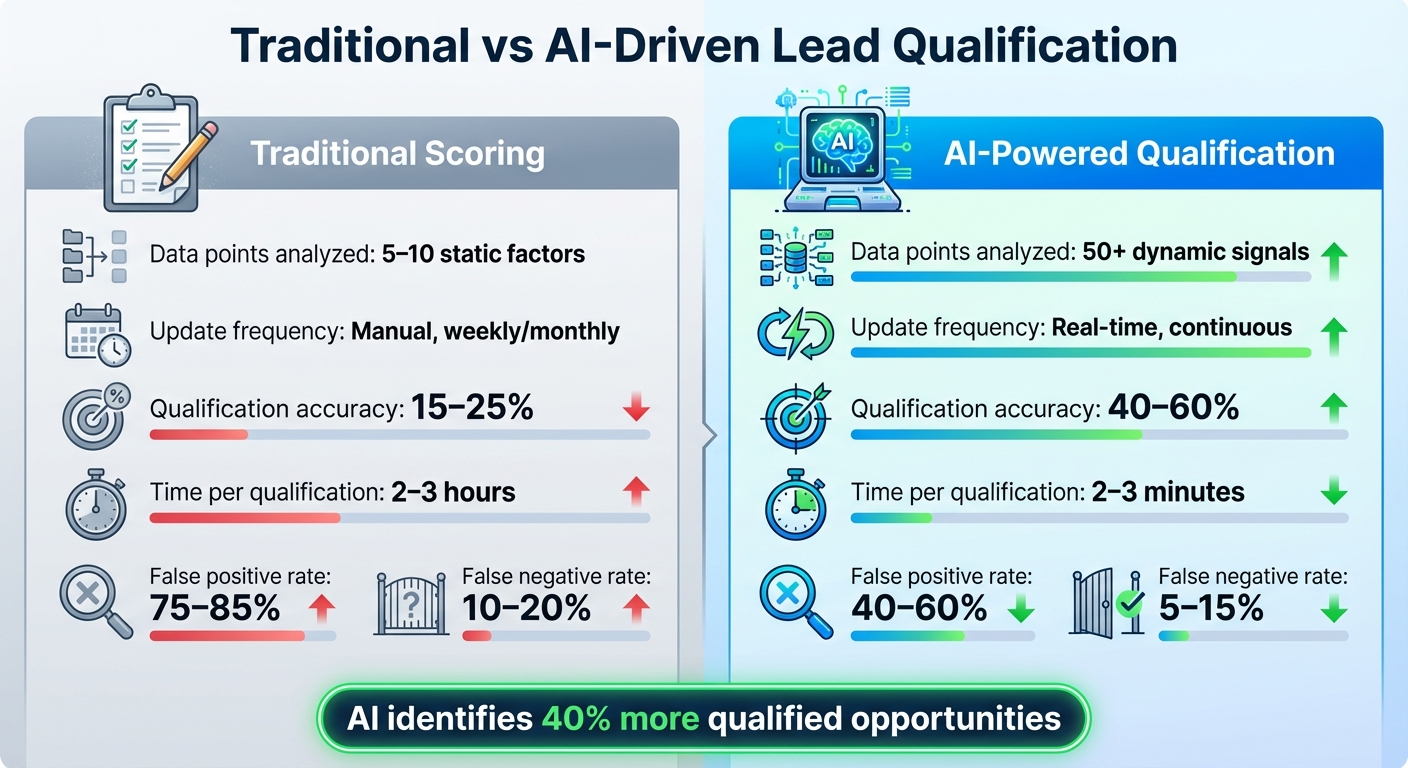
Traditional vs AI-Driven Lead Qualification: Performance Comparison
AI Techniques for Data Analysis
AI takes raw behavioral data and turns it into actionable lead scores using several machine learning techniques. At the core of this process is predictive modeling, which relies on algorithms like gradient boosting and logistic regression to uncover patterns in historical data. These models analyze behaviors such as email opens, visits to pricing pages, LinkedIn replies, and deal outcomes to dynamically assign scores that reflect a prospect's likelihood of converting.
Another key approach involves clustering algorithms, which group leads based on shared behavioral traits. For example, one cluster might consist of "implementation researchers" who frequently explore product documentation, while another might include "pricing-sensitive" prospects who repeatedly check cost-related pages. These insights help teams create outreach strategies tailored to each group's interests. Similarly, classification models sort leads into categories like MQL, SQL, or intent level by examining signals from website activity, email engagement, social media interactions, and CRM data.
When it comes to unstructured data, natural language processing (NLP) and sentiment analysis play a crucial role. These techniques analyze email replies, LinkedIn messages, and chat transcripts to uncover intent cues - such as questions about pricing or implementation timelines - along with urgency levels and overall sentiment. For instance, a prospect asking, "How quickly can we implement this?" signals both strong intent and time sensitivity. This information feeds directly into lead scores and routing systems.
For teams using LinkedIn as a prospecting tool, platforms like SalesMind AI integrate these techniques to analyze connection acceptances, message replies, profile views, and engagement with outreach sequences. The system continuously updates lead scores as new data comes in, automatically prioritizing conversations with the highest conversion potential in a unified inbox.
These advanced methods set the stage for a direct comparison between traditional and AI-driven scoring approaches, highlighting the stark differences in performance.
Traditional vs. AI-Driven Behavioral Analysis
Traditional lead scoring relies on rigid, rule-based systems. For example, a prospect might earn 10 points for registering for a webinar or 5 points for opening an email. These systems typically evaluate a limited set of static factors, such as job title or company size, and require manual or scheduled updates. This approach often lags behind real-time changes in buyer behavior, and adjustments to scoring rules must be made manually.
AI-driven systems, on the other hand, operate on an entirely different level. They monitor over 50 dynamic signals per lead, tracking micro-actions like scroll depth, repeat visits to specific pages, engagement in message sequences, and even sentiment in replies. These systems continuously learn from outcomes, adjusting in real time when certain behaviors are found to be stronger predictors of conversion.
The difference in results is striking. Traditional scoring methods achieve qualification accuracy - defined as the percentage of qualified leads that ultimately convert - of just 15% to 25%, with false positive rates as high as 75% to 85%. In contrast, AI-driven systems boost qualification accuracy to 40% to 60%, while cutting false positives to 40% to 60% and reducing false negatives to just 5% to 15%. The time savings are equally impressive: manual scoring takes 2 to 3 hours per prospect, whereas AI completes the process in just 2 to 3 minutes. This allows AI to identify roughly 40% more qualified opportunities by spotting subtle patterns that humans might overlook [4].
Metric
Traditional Scoring
AI-Powered Qualification
Data points analyzed
5–10 static factors
50+ dynamic signals
Update frequency
Manual, weekly/monthly
Real-time, continuous
Qualification accuracy
15–25%
40–60%
Time per qualification
2–3 hours
2–3 minutes
False positive rate
75–85%
40–60%
False negative rate
10–20%
5–15%
With AI, sales teams can focus their efforts on genuinely interested prospects rather than wasting time on unqualified leads. The system's ability to learn continuously ensures it stays accurate, even as market conditions and buyer behaviors evolve.
sbb-itb-817c6a5
How to Implement AI Behavioral Analysis with SalesMind AI
Step 1: Integrate Data Sources
To get started, bring all your critical data sources together by connecting SalesMind AI to your sales tools. Use API integrations to link platforms like LinkedIn, where you can track profile views, connection requests, message replies, and campaign engagement. Sync your CRM (such as HubSpot or Salesforce) via OAuth to align contact records, deal stages, and engagement history. Add your email platform and website analytics to capture actions like email opens, link clicks, and visits to key pages, such as pricing, demos, or case studies.
During setup, map data fields so that LinkedIn profile views automatically connect to CRM leads, creating a seamless flow of behavioral signals into one unified view. For instance, if a prospect checks out your pricing page and later accepts your LinkedIn connection request, SalesMind AI merges these signals into a single profile. Users have reported 99%+ accuracy in capturing signals after testing with sample data [3][4].
Once everything is connected, you can move on to setting up scoring systems that turn raw data into actionable insights.
Step 2: Configure Lead Scoring
Start by defining your Ideal Customer Profile (ICP) based on U.S.-specific firmographic details like industry, company size, region, and typical annual contract value. Assign point values to high-intent behaviors. For example, award 20 points to prospects who visit your pricing page multiple times within a week, 15 points to those who open an email twice, and 25 points for accepting a LinkedIn connection or replying to a message.
"The lead scoring system is particularly impressive, providing clear insights into lead quality", said Svit Babarovic from MountainDrop
.
Set thresholds for lead categorization (e.g., MQL: 60, SQL: 80). SalesMind AI evaluates 50+ dynamic signals and learns from past conversions, fine-tuning the scoring system as it identifies which behaviors are stronger predictors of success [4][7]. You can also use negative scoring to filter out unqualified leads, such as those who unsubscribe or explicitly indicate disinterest.
Step 3: Enable Real-Time Monitoring and Automated Follow-Ups
Activate real-time scoring so that every prospect action updates their score and priority instantly. This feature slashes qualification time from 2–3 hours to just 2–3 minutes per lead [4]. Set up workflow triggers for specific behaviors, like sending a follow-up within 24 hours if someone accepts a LinkedIn connection but doesn’t respond, or enrolling leads in nurture sequences after they engage with top-of-funnel content.
SalesMind AI ensures follow-ups are timely and personalized by analyzing recent prospect activity. You can also set limits on frequency and restrict sending to business hours to comply with U.S. norms and LinkedIn policies. Many users have reported generating 10+ sales calls per month from LinkedIn through these automated workflows [1].
Remember to review your workflows regularly to fine-tune your lead qualification process.
Step 4: Review and Optimize Lead Qualification
Use the unified inbox analytics to uncover which message templates and outreach strategies drive the most replies and meetings with U.S.-based prospects. Look for recurring objections - like budget concerns or feature gaps - and adjust your scoring rules to reflect these insights. For instance, if leads with long-term buying timelines rarely convert, you might lower their scores.
Experiment with A/B tests to refine follow-up cadences and messaging angles. Retrain the AI model using 500 to 1,000 historical leads to compare predicted scores against actual outcomes. Over time, this iterative process can raise qualification accuracy from 40% to 60% [4][6]. As more data flows in, the system evolves to stay aligned with shifting buyer behaviors and market conditions, keeping your lead qualification sharp and effective.
Benefits of AI for Lead Qualification
Better Accuracy and Prioritization
AI revolutionizes lead qualification by analyzing over 50 dynamic signals instead of the typical 5–10 static ones. This results in a conversion accuracy of 40–60%, compared to just 15–25% with manual methods [4]. It also significantly reduces false positives from 75–85% to 40–60%, and false negatives from 10–20% to 5–15% [4].
For instance, a B2B company improved its conversion rate from 3% by leveraging AI to focus on high-intent actions like visiting pricing pages and downloading content. Tools like SalesMind AI make this possible by identifying and prioritizing behaviors that indicate genuine interest [4][2]. This level of precision not only enhances the quality of leads but also dramatically shortens the qualification process.
Time and Resource Savings
Manual lead scoring can take hours, but AI accomplishes the same task in just minutes [4]. By automating repetitive processes, AI allows sales teams to dedicate more time to closing deals instead of sifting through data.
"From the very first week, SalesMind AI boosted my productivity in lead prospecting by 10×. At full capacity, the AI managed to get 5 to 10 new conversations started per week", said Alex L., CTO at Slash Co
.
SalesMind AI streamlines tasks like personalized LinkedIn messaging, lead scoring, and follow-ups using a unified inbox. This eliminates the need for hours of manual work, enabling companies to scale their outreach efforts without increasing staff. The faster response times also improve conversion opportunities, as leads are engaged at just the right moment.
Higher Conversion Rates
With its ability to combine accuracy and efficiency, AI helps businesses achieve higher conversion rates by targeting prospects at their peak engagement. SalesMind AI, for example, identifies 40% more high-quality leads by detecting subtle behaviors, such as multiple visits to a pricing page [4][7]. The system continuously learns from past interactions, refining its predictions and improving over time.
Metric
Traditional Scoring
AI-Powered Qualification
Qualification accuracy
15–25%
40–60%
Time per qualification
2–3 hours
2–3 minutes
False positive rate
75–85%
40–60%
False negative rate
10–20%
5–15%
Conclusion
AI has transformed lead qualification from a time-consuming, manual task into a highly efficient system. By analyzing dozens of behavioral signals - like website visits, email interactions, pricing page views, and social engagement - it identifies high-intent prospects with an accuracy of 40–60%, a significant improvement over the 15–25% accuracy of traditional methods [4].
What once took hours can now be accomplished in minutes, giving U.S. sales teams more time to focus on meaningful, revenue-generating conversations. This shift not only improves efficiency but also enhances lead prioritization, resulting in higher conversion rates and a stronger sales pipeline per representative. AI doesn’t stop there; it continuously learns from past outcomes, refining its predictions and setting the stage for integrated solutions that bring these benefits together.
Take SalesMind AI, for example. This platform combines behavioral scoring with automated LinkedIn outreach and an AI-driven inbox to streamline the entire process. It helps you identify top-quality leads, engage them at the right time, and automate follow-ups - all without the need to expand your team. By connecting directly to your data sources, SalesMind AI scores leads in real time and triggers personalized outreach based on their engagement patterns.
For businesses aiming to scale their sales efforts, the solution is straightforward: integrate behavioral data with tools like SalesMind AI, define your lead criteria, and let AI handle the heavy lifting. You don’t need a specialized data science team to get started. Modern platforms make it easier than ever to embrace AI-driven lead qualification while keeping the focus on growing revenue and building a robust pipeline.
FAQs
How does AI enhance lead qualification accuracy?
AI brings a sharper edge to lead qualification by diving into behavioral data and spotting patterns that conventional methods often overlook. It looks at things like how engaged a prospect is, their past interactions, and clear buying signals. This deeper analysis makes it easier to pinpoint high-quality leads.
By cutting down on false positives and zeroing in on leads that show genuine interest, AI helps sales teams work more efficiently. The result? Less wasted time, smarter use of resources, and better conversion rates.
What behavioral data does AI use to qualify leads?
AI takes a closer look at various behavioral cues to assess leads with greater precision. These signals include content engagement - things like opening emails, clicking links, or spending time on specific webpages. It also examines website interactions, such as visiting key product pages, and social media activity, like engaging with posts or checking out profiles.
Beyond these, AI factors in communication patterns, analyzing how often and when prospects respond to messages. By piecing together these insights, businesses can focus their energy on the most promising leads, making their sales efforts more efficient and targeted.
How can businesses use AI to qualify leads more effectively?
To make lead qualification more efficient, businesses can leverage tools like SalesMind AI to handle essential tasks automatically. AI can evaluate behavioral data, assign scores to prospects based on their level of engagement, and highlight the most promising leads. By automating tasks such as LinkedIn outreach, tailoring follow-up messages, and fine-tuning lead scoring models with the latest data, companies can simplify their sales processes and concentrate on top opportunities.
Keeping AI algorithms updated with new insights is key to improving accuracy and aligning with sales objectives, enabling businesses to connect with the right prospects on a larger scale.
{"@context":"https://schema.org","@type":"FAQPage","mainEntity":[{"@type":"Question","name":"How does AI enhance lead qualification accuracy?","acceptedAnswer":{"@type":"Answer","text":"<p>AI brings a sharper edge to lead qualification by diving into behavioral data and spotting patterns that conventional methods often overlook. It looks at things like how engaged a prospect is, their past interactions, and clear buying signals. This deeper analysis makes it easier to pinpoint high-quality leads.</p> <p>By cutting down on false positives and zeroing in on leads that show genuine interest, AI helps sales teams work more efficiently. The result? Less wasted time, smarter use of resources, and better conversion rates.</p>"}},{"@type":"Question","name":"What behavioral data does AI use to qualify leads?","acceptedAnswer":{"@type":"Answer","text":"<p>AI takes a closer look at various behavioral cues to assess leads with greater precision. These signals include <strong>content engagement</strong> - things like opening emails, clicking links, or spending time on specific webpages. It also examines <strong>website interactions</strong>, such as visiting key product pages, and <strong>social media activity</strong>, like engaging with posts or checking out profiles.</p> <p>Beyond these, AI factors in <strong>communication patterns</strong>, analyzing how often and when prospects respond to messages. By piecing together these insights, businesses can focus their energy on the most promising leads, making their sales efforts more efficient and targeted.</p>"}},{"@type":"Question","name":"How can businesses use AI to qualify leads more effectively?","acceptedAnswer":{"@type":"Answer","text":"<p>To make lead qualification more efficient, businesses can leverage tools like SalesMind AI to handle essential tasks automatically. AI can evaluate behavioral data, assign scores to prospects based on their level of engagement, and highlight the most promising leads. By automating tasks such as LinkedIn outreach, tailoring follow-up messages, and fine-tuning lead scoring models with the latest data, companies can simplify their sales processes and concentrate on top opportunities.</p> <p>Keeping AI algorithms updated with new insights is key to improving accuracy and aligning with sales objectives, enabling businesses to connect with the right prospects on a larger scale.</p>"}}]}
 JG
JG