Real-Time Sales Insights with AI Dashboards
Get live sales metrics, predictive forecasts, lead scoring, and automation to cut admin work and boost revenue with AI-powered dashboards.
 Julien Gadea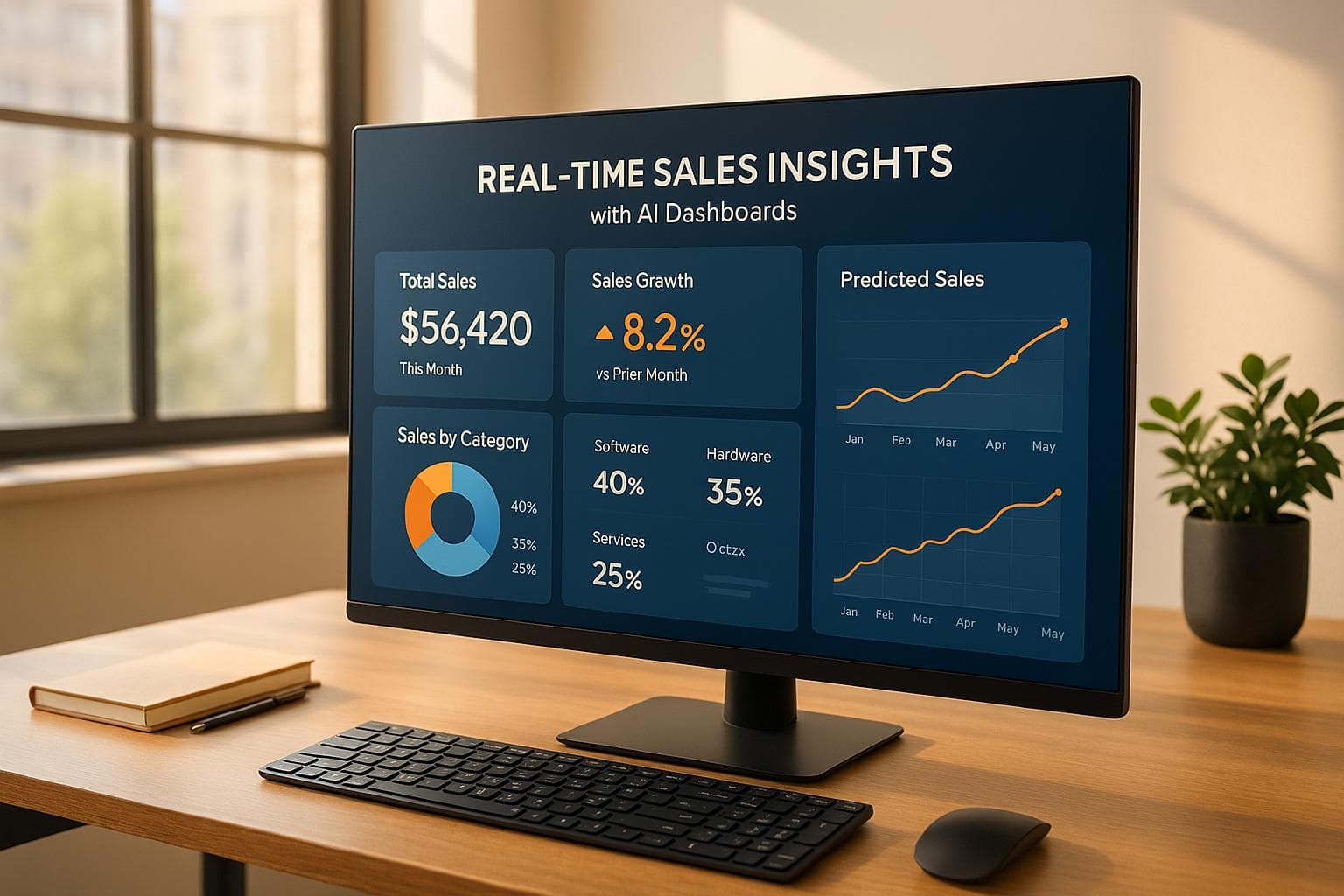
Get live sales metrics, predictive forecasts, lead scoring, and automation to cut admin work and boost revenue with AI-powered dashboards.
Get live sales metrics, predictive forecasts, lead scoring, and automation to cut admin work and boost revenue with AI-powered dashboards.
Table of Contents
AI dashboards are transforming sales by offering real-time insights that help teams act quickly and effectively. Unlike older methods that rely on static, outdated reports, these tools use predictive analytics, live data, and automation to improve decision-making, boost productivity, and increase revenue. Here's what you need to know:
- Faster Decisions: AI dashboards update metrics like pipeline health, deal velocity, and conversion rates instantly, enabling quick adjustments.
- Improved Accuracy: Predictive analytics achieve up to 91% accuracy in forecasting outcomes, compared to 67% with older methods.
- Higher Revenue: Sales teams using AI report 34% better performance within 60 days and a 10%+ revenue increase.
- Efficiency Gains: Automation reduces admin tasks by 20–30%, giving reps 15–25% more time to sell.
These dashboards consolidate data from tools like CRMs and communication platforms, offering a unified view of sales activity. Features like lead scoring, real-time anomaly detection, and AI-driven recommendations help prioritize deals, identify bottlenecks, and improve sales strategies. With the global AI market expected to reach $190 billion by 2025, adopting these tools is becoming essential for staying competitive.
From Traditional Dashboards to AI-Powered Systems
Problems with Traditional Sales Reporting
Traditional sales dashboards have always struggled to keep up with the fast pace of modern sales. They only provide a snapshot of past performance, leaving teams unable to act on real-time data. Hours are wasted on manual data entry - time that could be better spent connecting with prospects. By the time reports are compiled and analyzed, the insights are often outdated, sometimes by days or even weeks.
This lack of real-time visibility creates delays and missed opportunities. Teams are left in the dark until end-of-cycle reports consolidate fragmented data from multiple systems. This forces sales teams to rely on guesswork rather than actionable insights. Rahul P., Senior Advisor at Bounty Media, highlighted this frustration:
"SalesMind AI has proven very useful to our sales team in reducing the massive pain points of manually tracking each and every lead interaction. To have one master dashboard not just for yourself but for our entire team and try different lead lists, sequences, and track them all in real time is fantastic." [6]
Without predictive tools, sales teams are stuck reacting to problems instead of preventing them. This outdated approach has paved the way for AI-powered dashboards, which deliver immediate and actionable insights.
What AI-Driven Dashboards Offer
AI-driven dashboards address the shortcomings of traditional systems by transforming how sales teams operate. Instead of waiting for weekly reports, teams now have access to live data streams that update in real time. Whether it’s an email sent, a meeting scheduled, or a deal moved forward, the dashboard reflects these updates instantly, eliminating delays.
These systems resolve the fragmentation issue by consolidating data from CRMs, communication tools, and analytics platforms into one unified view. With interactive visualizations, sales managers can quickly identify which campaigns are bringing in the most qualified leads, which team members need additional guidance, and which deals require immediate attention [1].
The biggest game-changer? Predictive analytics. AI dashboards don’t just show the current pipeline - they predict which deals are most likely to close, when they’ll close, and which opportunities need urgent action. For example, SuperAGI implemented an AI-powered predictive analytics system that helped its sales team prioritize efforts, leading to a 15% boost in conversion rates [1].
Automation is another key benefit. AI dashboards analyze data from calls, emails, and meetings, while also summarizing high-level performance metrics. This eliminates the need for repetitive reporting tasks, freeing up sales teams to focus on what they do best: selling [1].
Current Adoption Rates and Market Data
The rapid adoption of AI in sales speaks volumes about its impact. A LinkedIn report predicts that by 2025, 60% of business owners will rely on AI to drive sales growth [4]. Companies that have already embraced sales AI report a 34% performance improvement within just two months [5].
When it comes to forecasting, AI systems achieve an impressive 91% accuracy in predicting deal outcomes, compared to just 67% with traditional methods. In optimal conditions, some AI tools push accuracy as high as 95% [5]. Here’s a quick comparison:
| Metric | Traditional Forecasting | AI-Powered Forecasting |
|---|---|---|
| Prediction Accuracy | 67% | 91% |
| Forecasting Method | Manual analysis, delayed updates | Real-time data processing, predictive models |
| Problem Detection | Post-analysis (often too late) | Continuous monitoring and early detection |
| Maximum Accuracy Potential | Limited | Up to 95% |
The benefits don’t stop there. Salesforce research shows that companies using AI-powered analytics see a 15% increase in average deal size. Gartner reports a 10% boost in sales win rates, while Salesforce highlights a 25% jump in productivity [1].
Adoption trends reveal a widening gap between top performers and laggards. High-performing sales teams are 1.9 times more likely to use AI for tasks like predictive lead scoring, and top performers are 2.5 times more likely to integrate AI into their daily workflows [7][4]. This shift signals that AI dashboards are no longer optional - they’re becoming essential for staying competitive.
Real-world examples further illustrate these benefits. SuperAGI deployed an AI-powered chatbot that uses natural language processing to qualify leads and route them to the right reps, cutting their sales cycle by 25%. Similarly, HubSpot found that companies using AI-driven chatbots saw a 25% increase in conversion rates [1].
The market momentum is undeniable. With the global AI market projected to hit $190 billion by 2025, investments in AI-powered sales tools are accelerating. Early adopters are gaining a clear edge in today’s competitive landscape [1].
3 Tools to Make AWESOME Sales Dashboards with AI (ChatGPT, Zebra AI & Copilot)
Core Metrics Tracked by Real-Time AI Dashboards
AI dashboards take raw sales data and turn it into insights you can act on, focusing on the metrics that directly influence revenue growth. They provide instant updates, giving teams the clarity they need to make informed decisions right when it matters.
Revenue and Pipeline Metrics
Metrics like pipeline volume, revenue forecasts, deal stages, and average deal size are updated in real time, offering a clear view of your current performance and future potential [1][3].
This real-time visibility has a big impact. For example, companies using AI-driven sales analytics report a 15% increase in average deal size [1]. These dashboards pinpoint where prospects are in the sales funnel and highlight which deals are most likely to close. This allows leaders to allocate resources more strategically.
AI dashboards also identify pipeline bottlenecks and stalled deals as they happen, enabling quick action [3]. Instead of waiting until a quarterly review to uncover problems, teams can address them right away.
Another key metric is deal velocity - how quickly deals move through each stage of the pipeline. By monitoring this, AI systems improve sales forecasting and help teams allocate resources more effectively [2].
AI-powered recommendations further enhance performance by boosting upselling and cross-selling success rates by 15–30%. These systems analyze customer behavior to suggest the right products or services at the right time, ensuring teams make the most of every opportunity [1].
But sales success isn’t just about revenue - it’s also about how efficiently teams operate.
Sales Efficiency and Productivity Metrics
Efficiency metrics measure how well your team turns effort into results. AI dashboards track pipeline health and rep productivity, analyzing the time spent on tasks and the outcomes they generate [1].
AI automation reduces administrative tasks by 20–30% and increases selling time by 15–25% [1]. By automating data entry, meeting summaries, and follow-ups, reps can focus on conversations that move the needle.
Opportunity prioritization is another game-changer. Businesses using AI for this purpose see a 25% boost in sales productivity [1]. Instead of working through leads in order of arrival, reps can prioritize based on deal size, likelihood to close, and strategic importance.
Activity metrics provide even more insights. Dashboards track calls made, emails sent, meetings scheduled, and conversion rates at every stage [1]. This granular data helps managers pinpoint where reps need support. For example, if a rep is making plenty of calls but not securing meetings, the issue might lie in their messaging. If meetings aren’t leading to proposals, it could be a qualification or timing issue.
Metrics like customer acquisition cost (CAC) and lifetime value (LTV) are also crucial. AI dashboards pull data from multiple sources to calculate these figures, giving you a complete picture of what it costs to acquire customers and how much revenue they generate over time.
Quota attainment tracking becomes more insightful with AI. Instead of simply showing whether reps met their targets, dashboards reveal the behaviors and activities that drive success. This allows managers to replicate effective strategies across the team.
These efficiency gains lay the foundation for better forecasting and activity analysis.
Forecasting and Activity Metrics
Once immediate sales metrics are optimized, focusing on forecasting and detailed activity insights helps refine long-term strategies.
Forecasting accuracy is a hallmark of top-performing sales organizations. AI dashboards, equipped with predictive analytics, achieve up to 91% accuracy, far surpassing traditional methods, which hover around 67% [5][4]. Under ideal conditions, some systems push accuracy as high as 95% [5]. These tools also improve revenue predictability by 10%, enabling continuous strategy adjustments [5].
Lead scoring is another critical component. AI dashboards analyze firmographic and behavioral data to evaluate lead quality [1]. By assigning scores based on how closely prospects match your ideal customer profile and their engagement levels, these systems make it easier to prioritize high-potential leads. For instance, SalesMind AI’s lead scoring system delivers clear, actionable insights for focusing on the most promising opportunities [6].
Svit Babarovic from MountainDrop, a Food and Beverage Retail company, shared their experience:
"The platform's intuitive interface and smart automation features have significantly boosted our sales efficiency. The lead scoring system is particularly impressive, providing clear insights into lead quality." [6]
Dashboards also track email response rates and call activity to uncover engagement trends. If response rates suddenly drop, managers are alerted immediately, allowing them to take corrective action without waiting for a monthly review.
Conversion rates at each pipeline stage are continuously analyzed. AI dashboards pinpoint where prospects drop off and recommend solutions to improve progression. For example, if deals frequently stall during the proposal stage, the system might suggest adding qualification questions earlier in the process or adjusting pricing structures.
The connection between AI dashboards and revenue growth is undeniable. Salesforce research shows that 83% of sales teams using AI have experienced revenue growth in the past year, compared to 66% of teams without AI [4]. Companies report 34% better performance within 60 days of adopting sales AI [5], with some achieving revenue increases of 10% or more [5].
High-performing sales teams are 1.9 times more likely to use AI for predictive lead scoring than their less successful counterparts [4]. Additionally, AI-using teams are 1.4 times more likely to report year-over-year headcount growth [4]. It’s no wonder that 60% of business owners expect AI to drive sales growth in the near future [4].
Research from Gartner further highlights the benefits, showing that businesses using AI-powered sales analytics see a 10% increase in sales win rates [1]. When combined with productivity improvements and enhanced forecasting, it’s clear that AI dashboards deliver measurable results across every aspect of sales performance.
sbb-itb-817c6a5
AI Technologies Behind Modern Sales Dashboards
Modern sales dashboards rely on advanced AI technologies to transform raw data into meaningful insights. These platforms don't just present numbers - they analyze trends, predict outcomes, and even suggest specific actions. The technologies behind these capabilities are the driving force behind their effectiveness.
Predictive Analytics for Lead Scoring
Predictive analytics uses machine learning to assess which leads are most likely to convert, analyzing both firmographic data (like company size and industry) and behavioral data (such as engagement levels and website activity). Instead of relying on intuition or basic filters, these systems dig into historical data to uncover patterns tied to successful conversions. By examining past deals - factors like email interactions, site visits, and industry trends - AI assigns scores to new leads based on their similarity to past successes.
For example, SuperAGI's AI platform improved conversion rates by 15% [1]. Machine learning ensures these predictions become more accurate over time, giving sales teams a significant edge. In fact, top-performing sales teams are nearly twice as likely to use AI for lead scoring. Companies leveraging AI analytics report an average increase of 15% in deal size [1][4].
Real-Time Anomaly Detection
Building on predictive analytics, real-time anomaly detection offers another layer of insight by flagging unusual patterns as they happen. This technology continuously scans sales pipeline data, comparing it to benchmarks and historical trends to identify potential issues. For instance, it might detect when a deal is stalling due to delayed responses, reduced engagement, or a regression in the sales cycle. These alerts allow sales managers to address problems before they escalate.
The speed of anomaly detection is a game-changer. Traditional sales reviews often occur weekly or monthly, leaving issues unnoticed for extended periods. Real-time detection, on the other hand, provides alerts within hours or days, enabling immediate action. By catching anomalies early, sales teams can make data-driven adjustments, creating what some organizations describe as a "clean and reproducible engine of revenue." Companies that prioritize real-time data insights report up to a 30% boost in efficiency compared to those relying on static reports [8][9].
AI-Generated Recommendations and Next Actions
AI-generated recommendations take things further by offering actionable guidance. These systems don’t just interpret data - they suggest specific next steps. Using natural language processing (NLP), the AI analyzes communication patterns and sentiment to craft personalized messaging that resonates with prospects.
A great example comes from SuperAGI, which implemented an AI-powered chatbot to qualify leads and direct them to the right sales representatives. This reduced the length of their sales cycle by 25% [1]. Beyond lead qualification, AI recommendations help prioritize deals needing immediate attention, fine-tune messaging strategies, and determine the best timing for outreach based on engagement data and past trends. This capability turns raw data into actionable strategies, making sales dashboards indispensable for dynamic sales teams.
Henry F., an Enterprise Account Executive at Salesforce, highlighted the impact of AI-recommended messaging:
"I've been impressed with some of the AI-recommended messaging. They pulled information from my website and other sources to curate recommended responses." [6]
How to Implement AI Dashboards in Your Sales Process
Introducing AI dashboards into your sales process is best done gradually. A step-by-step rollout not only reduces resistance but also builds confidence by showing clear benefits at each stage. This method turns the real-time insights and predictive analytics we discussed earlier into actionable steps. Starting with the basics ensures a smooth integration with your CRM and sets the stage for adding advanced features later.
Begin with Core Metrics
Start by focusing on the metrics that matter most: sales cycle length, conversion rates, and average deal size[1]. These provide a clear snapshot of your team's performance and help identify areas for improvement.
Additionally, measure the impact of AI on administrative tasks and selling time. For example, aim for a 20–30% reduction in admin work and a 15–25% increase in selling time per sales rep[1]. These early wins are crucial for getting buy-in from stakeholders and building momentum.
Some teams have seen noticeable improvements within just two months of implementation[5]. By concentrating on impactful metrics and avoiding overwhelming amounts of data, you can set the stage for long-term success.
Connect with CRM and Sales Tools
To make the most of your AI dashboard, integrate it with your existing tools like Salesforce, HubSpot, and Google Analytics[1]. This ensures the dashboard provides accurate, real-time insights. Without proper integration, you risk creating data silos and increasing manual data entry, which defeats the purpose of automation.
Real-time synchronization is a must. For instance, every sales activity logged in your CRM should instantly appear on the dashboard. Tools like Tableau and Power BI excel at creating interactive dashboards that connect seamlessly with CRM systems[1].
Before rolling out the system across your organization, establish clear data governance. Decide which metrics come from which platforms, set up automated data validation checks, and thoroughly test the system to ensure accuracy. While sales operations teams play a key role here, they often face challenges like data quality issues and integration hurdles. In fact, 33% of sales operations professionals report struggling with these obstacles due to limited resources[4].
Solutions like SalesMind AI tackle these challenges head-on. With features like a unified inbox and LinkedIn integration, it eliminates the hassle of tracking leads manually. Instead, it provides a centralized dashboard for real-time visibility into team activities[6].
Once these foundational integrations are in place, you can begin adding more advanced analytics to further enhance your sales process.
Add Advanced Features Over Time
With the basics covered, you can gradually introduce advanced features to boost your team's performance. This approach allows sales reps to see the value of each new feature before adding more complexity.
Start with deal velocity tracking and stage conversion rates to pinpoint where prospects drop off in the sales funnel. These insights can improve revenue forecasting and help address issues with targeting or messaging[4]. Companies using AI for forecasting have reported accuracy rates of 91%, compared to just 67% with traditional methods[5].
Next, implement AI-powered opportunity prioritization, which can increase sales productivity by 25%[1]. This feature helps reps focus on deals most likely to close, saving time and effort.
Finally, layer in tools like propensity scoring and attribution modeling. These advanced analytics link sales outcomes directly to specific AI features, making it easier to demonstrate ROI. For example, after deploying an AI chatbot with natural language processing, SuperAGI reduced their sales cycle length by 25% and boosted conversion rates by 15% with a predictive analytics platform[1].
Keep refining your sales process based on feedback from your team and real-world usage. Monitor adoption rates and adjust configurations as needed to ensure continuous improvement.
Alex L., CTO at Slash Co, shared his experience with this approach:
"From the very first week, SalesMind AI boosted my productivity in lead prospecting by 10×. At full capacity, the AI managed to get 5 to 10 new conversations started per week, opening doors to valuable connections I might not have reached otherwise." [6]
This gradual implementation strategy allows teams to adapt at their own pace while delivering measurable results. Businesses that use AI in their sales strategies often see a 10% or more increase in revenue, and teams using AI territory planning tools report being 40% more efficient[5]. Over time, these benefits add up as your team becomes more skilled at leveraging AI tools effectively.
Conclusion
AI dashboards provide a clear, real-time view of the metrics that drive revenue. By moving away from traditional reporting methods, businesses can make smarter, faster decisions using accurate predictions and actionable insights.
The numbers back this up. AI dashboards focus on the metrics that matter most - conversion rates, deal sizes, sales cycle lengths, and sales rep productivity. For instance, when SuperAGI adopted AI-powered tools, they reduced their sales cycle by 25% and increased conversion rates by 15%[1].
These tools don’t just track data; they transform it. Features like predictive analytics, real-time anomaly detection, and AI-driven recommendations turn raw data into strategic actions. Sales teams benefit significantly, spending 20-30% less time on admin tasks and 15-25% more time actively selling[1]. AI-powered prioritization tools also boost productivity by 25% and improve win rates by 10%[1].
Getting started is straightforward: focus on core metrics, integrate your CRM and sales tools, and gradually add advanced features like deal velocity tracking or propensity scoring. Many teams see measurable improvements in as little as 60 days[5].
The competitive edge is clear. Top-performing sales teams are 1.9 times more likely to use AI for predictive lead scoring compared to lower-performing teams[4]. Those using AI forecasting tools enjoy 10% higher revenue predictability[4]. With the global AI market projected to reach $190 billion by 2025[1], the real question isn’t whether to adopt AI dashboards - it’s how quickly you can make them a part of your sales strategy.
FAQs
How do AI-powered dashboards help sales teams work more efficiently and achieve better results?
AI-powered dashboards are changing the game for sales teams by offering real-time insights that spotlight trends, monitor performance, and highlight high-value opportunities. Unlike outdated methods that depend on manual data crunching or static reports, these dashboards leverage advanced algorithms to quickly process massive datasets and deliver actionable recommendations.
Key features like automated lead scoring, predictive analytics, and performance tracking allow sales teams to spend less time on tedious administrative work and more time closing deals. This efficiency boost not only saves time but also enables smarter decision-making, helping businesses hit their sales targets more quickly.
What key metrics do AI dashboards track to help boost sales and revenue?
AI-powered dashboards keep an eye on key metrics that directly impact sales performance and revenue growth. Among these are conversion rates, which show how efficiently leads are turning into paying customers, and average deal size, offering a glimpse into customer spending patterns. They also track sales cycle length, revealing how quickly deals move from start to finish, and pipeline value, which estimates the potential revenue from active opportunities.
With real-time analysis of these metrics, businesses can make smarter decisions, refine their sales approaches, and prioritize opportunities that have the biggest potential for driving growth.
How can a company integrate AI dashboards into their sales processes to achieve better results?
To make the most of AI dashboards in your sales processes, start by pinpointing the areas where real-time insights will drive the biggest improvements. This could include tracking leads, analyzing performance metrics, or monitoring customer engagement. Kick things off with a pilot program to explore the dashboard’s features and collect feedback from your sales team.
Once you’ve ironed out the details, gradually roll it out to the entire team. Provide training so they can confidently interpret the data and weave those insights into their daily routines. Use the dashboard to automate repetitive tasks like lead qualification and follow-ups - this way, your team can focus on more strategic, high-value activities.
Don’t forget to regularly evaluate how the dashboard is performing. Adjust its settings to keep pace with your changing sales objectives. Taking this step-by-step approach will help ensure smooth adoption while unlocking the full potential of AI-driven insights.
 JG
JG