Ultimate Guide to Real-Time Lead Prioritization
AI-driven real-time lead prioritization boosts conversions and shortens sales cycles by instantly scoring, routing, and focusing reps on high-intent prospects.
 Julien Gadea
AI-driven real-time lead prioritization boosts conversions and shortens sales cycles by instantly scoring, routing, and focusing reps on high-intent prospects.
AI-driven real-time lead prioritization boosts conversions and shortens sales cycles by instantly scoring, routing, and focusing reps on high-intent prospects.
Table of Contents
Real-time lead prioritization helps sales teams focus on leads most likely to convert, using AI to rank prospects instantly based on behavior, intent, and firmographic data. Unlike older systems that update infrequently, real-time tools adjust continuously, ensuring timely follow-ups and better results. Companies using these systems often see conversion rates improve by up to 4× and sales cycles cut by nearly 30%.
Key Takeaways:
- Speed matters: Responding to leads within 5 minutes makes you 100× more likely to connect than waiting 30 minutes.
- AI-driven accuracy: Predictive models achieve 75–90% accuracy, outperforming manual methods.
- Higher ROI: Businesses report 10–20% revenue growth and up to 80% lower qualification costs in the first year.
- Core features: Data integration, predictive scoring, real-time routing, and behavioral analysis ensure top leads get immediate attention.
With tools like SalesMind AI, sales teams can automate lead scoring, prioritize high-value prospects, and respond faster, driving better results. Investing in such systems reduces wasted effort and increases efficiency, making it a smart choice for B2B organizations looking to stay competitive.
AI Lead Scoring: How AI Filters Out Junk Leads (Automatically)
How AI Powers Real-Time Lead Prioritization
AI pulls together data from various sources like CRM platforms, marketing tools, website analytics, social media, and customer service logs to create a comprehensive profile for each prospect [6][7]. Using machine learning, it identifies key traits and behaviors that indicate which leads are most likely to convert [2][7]. By analyzing historical win/loss data, AI assigns numerical scores to new leads, giving businesses a clear picture of their closure potential instead of relying on guesswork [6][7]. This data fuels the systems described below.
Core Components of AI-Driven Systems
Four main elements drive the effectiveness of AI-powered lead prioritization.
- Data collection: AI gathers information from every interaction to build a complete, 360-degree view of each prospect [6][7].
- Predictive scoring algorithms: These algorithms analyze the collected data, identifying which features are most strongly linked to conversion [2][7].
- Real-time routing: Queue-based systems ensure high-priority leads are sent to available sales agents immediately, so no opportunity is missed [1].
- Behavioral analysis: AI tracks actions like downloading resources or attending events, continuously updating lead rankings based on the latest activity [7].
The results speak for themselves. AI-powered qualification boasts accuracy rates of 75–90%, compared to the 60–70% range seen with manual methods [6]. Companies using AI for lead scoring often see conversion rates improve by 20–30% and qualification costs drop by as much as 80% [7]. Plus, automated systems can handle upwards of 15,000 leads per month, while manual processes tend to struggle beyond 1,000 leads [6].
AI Models for Lead Scoring
AI models are the engines behind precise lead scoring. Here's how they work:
- Gradient Boosting algorithms (like XGBoost and LightGBM) are known for their strong predictive capabilities [2][8].
- Random Forest and decision tree models excel at analyzing complex data patterns by combining multiple decision trees for better accuracy [8].
- Neural networks are perfect for handling large datasets with unstructured data, such as analyzing email sentiment [7][8].
- For simpler cases, logistic regression offers an easy-to-interpret approach, especially when applied to structured CRM data [8].
Natural Language Processing (NLP) adds another layer by interpreting unstructured data from emails, chat logs, and social media to gauge sentiment and intent [6][7]. Meanwhile, unsupervised learning methods like k-means clustering help uncover hidden patterns by grouping similar prospects without needing predefined labels [8].
"The potency of using AI for predictive lead scoring lies in its ability to detect subtle correlations that are almost indiscernible for humans" [7].
Continuous Learning and Adaptation
AI systems don’t just stop at initial setup - they continuously learn and adapt to changing market conditions. By retraining on recent sales outcomes, both wins and losses, these systems refine their understanding of what makes a lead valuable [6][7]. Over time, accuracy rates often climb from 75% to 85–90% within just six months [6].
This adaptability also supports real-time updates to lead rankings, automatically adjusting to shifts in customer behavior, market trends, and seasonal demands - all without requiring manual rule changes [7].
To combat model drift, AI monitors its performance and updates training data to reflect current buyer behavior [8].
"AI-driven scoring, unlike conventional rule-based models, constantly learns from fresh data, enhancing its forecasts over time and adjusting to meet changing client behavior" [8].
The impact is clear: companies typically see a 10–20% revenue boost within the first year of adopting AI-driven lead scoring [7].
How to Implement Real-Time Lead Prioritization
Real-time lead prioritization combines smart data use, clear scoring frameworks, and active monitoring to ensure your sales team focuses on the most promising opportunities.
Integrating Data Sources
Start by analyzing 2–3 years of historical CRM data to uncover patterns tied to successful deals [9]. This includes both wins and losses, giving your system a clear understanding of what differentiates a lead that converts from one that doesn’t.
To keep leads moving quickly, connect web forms, intent providers, and APIs. Why? Because companies that respond to leads within 5 minutes are 400% more likely to qualify them compared to those who wait just 10 minutes longer [9].
Pull data from multiple sources - firmographic details (like company size and industry), behavioral signals (such as email engagement or visits to pricing pages), and technographics (current tools and platforms) - to build a well-rounded scoring process [9]. Use waterfall enrichment techniques to fill in missing data by querying several providers until verified information is found [9].
With this data foundation in place, the next step is to create scoring and routing rules that prioritize leads effectively.
Defining Scoring and Routing Rules
After integrating your data, focus on establishing scoring and routing rules to rank leads accurately. Start with 5–7 key variables, then fine-tune them over time using performance insights [9]. For example, assign more weight to high-intent behaviors like requesting demos or revisiting pricing pages, as opposed to passive actions like opening an email.
Set clear thresholds for SQLs (Sales Qualified Leads), targeting a conversion probability of at least 25–30%. Use a multi-layered routing system that factors in geography, industry, lead score, and sales rep availability. This prevents your team from being overwhelmed and ensures timely follow-ups [9][10].
Switch to queue-based routing instead of static lead lists. This approach automatically assigns the next best lead to available reps, significantly improving response times. In fact, teams using queue-based systems are 21x more likely to convert leads compared to those that wait an hour [4]. Add fallback mechanisms to handle unassigned leads, such as routing them to a manager or a default round-robin team [10].
Establishing Retraining and Monitoring Processes
Create a feedback system where sales reps can flag leads that were misqualified, helping your model improve continuously [9]. Retrain your AI models monthly or quarterly to stay aligned with market changes, and aim to maintain 75–90% accuracy in your predictions [6][9].
Keep an eye on false negatives - leads that convert despite low scores. Analyzing these cases can reveal overlooked behaviors that might improve your scoring system [9]. To ensure alignment, have your sales and marketing teams define MQL (Marketing Qualified Lead) and SQL criteria together. Establish a Service Level Agreement (SLA) for follow-up times to keep everyone on the same page [4]. Regularly review your rules to identify those with poor match or conversion rates, and adjust as needed [10].
sbb-itb-817c6a5
SalesMind AI for Real-Time Lead Prioritization
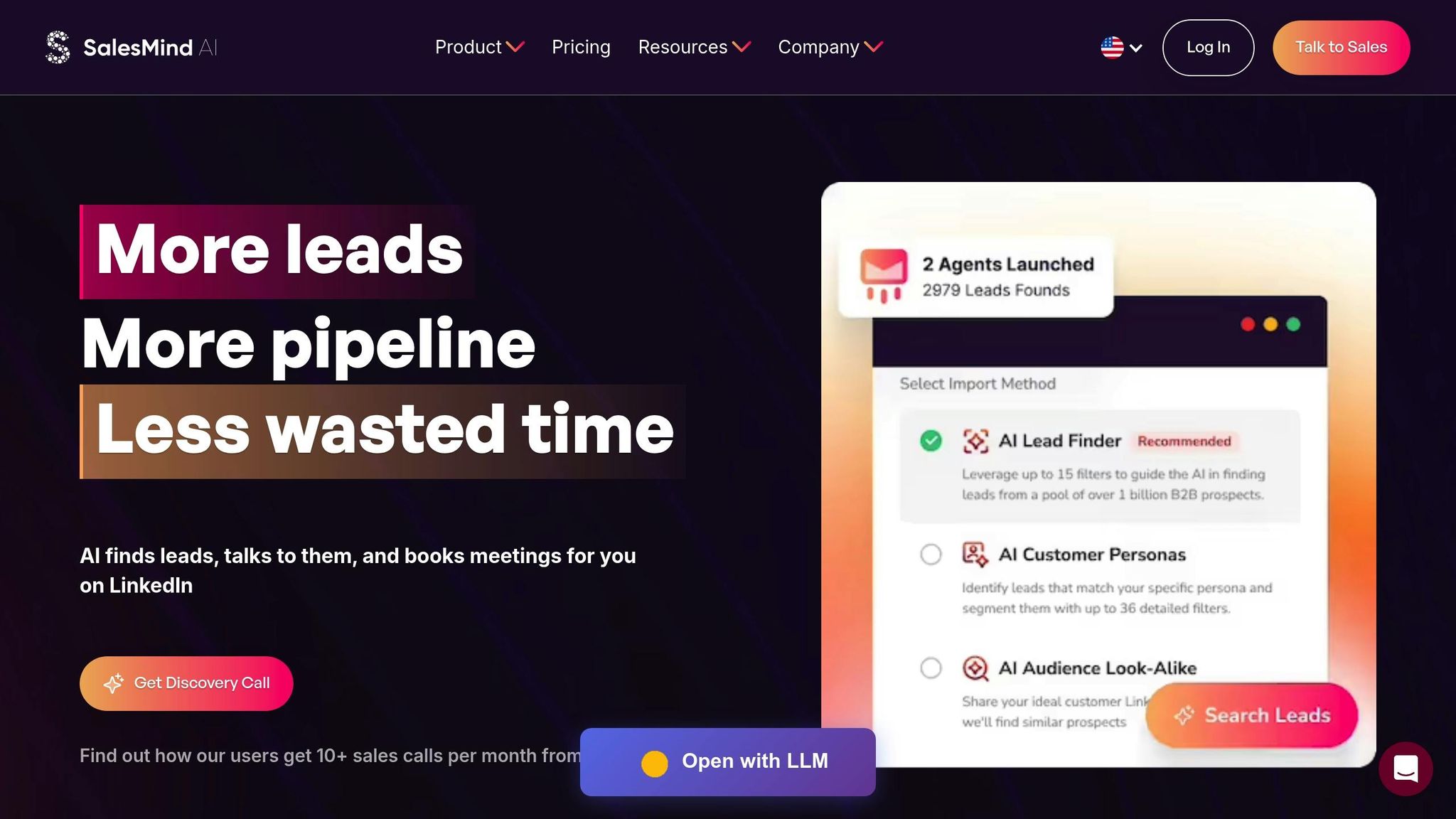
SalesMind AI combines LinkedIn automation, advanced lead scoring, and intelligent routing to help B2B sales teams zero in on the prospects most likely to convert. By leveraging AI, the platform identifies high-value leads and automates follow-ups at scale, strengthening the real-time prioritization framework highlighted earlier.
Key Features for Lead Prioritization
SalesMind AI uses lead scoring to analyze behavior, company data, and engagement metrics, ranking prospects in real time. This allows sales reps to focus on the top 25% of high-quality leads, which typically hold the greatest revenue potential [4]. The AI-powered unified inbox simplifies communication by consolidating messages from multiple LinkedIn accounts, ensuring conversations are easy to track and respond to promptly. This centralized approach helps sales teams stay organized and efficient.
With seamless LinkedIn integration, the platform automatically tracks actions like profile visits, message opens, and content engagement. These behavioral signals feed directly into the scoring model, prioritizing leads who take key actions - like revisiting your pricing page or requesting a demo. Plus, the platform’s scalability ensures it can grow alongside your team’s needs.
Plans and Pricing Comparison
SalesMind AI offers flexible pricing tiers designed to meet the needs of various sales teams:
- Basic Plan: Perfect for small teams starting out, this plan includes LinkedIn outreach automation, AI messaging, and basic lead scoring.
- Professional Plan: Ideal for growing teams, it adds advanced lead scoring, the unified inbox, and CRM integration for more sophisticated prioritization.
- Enterprise Plan: Tailored for large organizations, this plan features custom integrations and dedicated support to handle high lead volumes across multiple regions or industries.
By using predictive scoring, sales teams build pipelines about 30% faster, cutting down on wasted effort with poor-fit leads [11]. Additionally, companies that leverage AI for lead scoring report conversion rates nearly four times higher than average [4].
Automating Sales Processes
SalesMind AI doesn’t stop at lead scoring - it also automates essential sales processes. Personalized messaging, follow-ups, and lead qualification can all be automated, freeing up your team to focus on closing deals. For example, you can set up workflows that route leads exceeding a certain score threshold directly to sales reps for immediate follow-up [6]. This queue-based system ensures that reps always have access to the next best lead, eliminating delays caused by outdated static lists.
The platform’s AI continuously learns from team interactions, fine-tuning scoring models to maintain an impressive 75–90% accuracy rate [6]. Unlike traditional lead scoring methods, which often require manual updates and are influenced by human bias, SalesMind AI’s predictive approach is largely automated and self-improving [11].
Benefits and Challenges of Real-Time Lead Prioritization
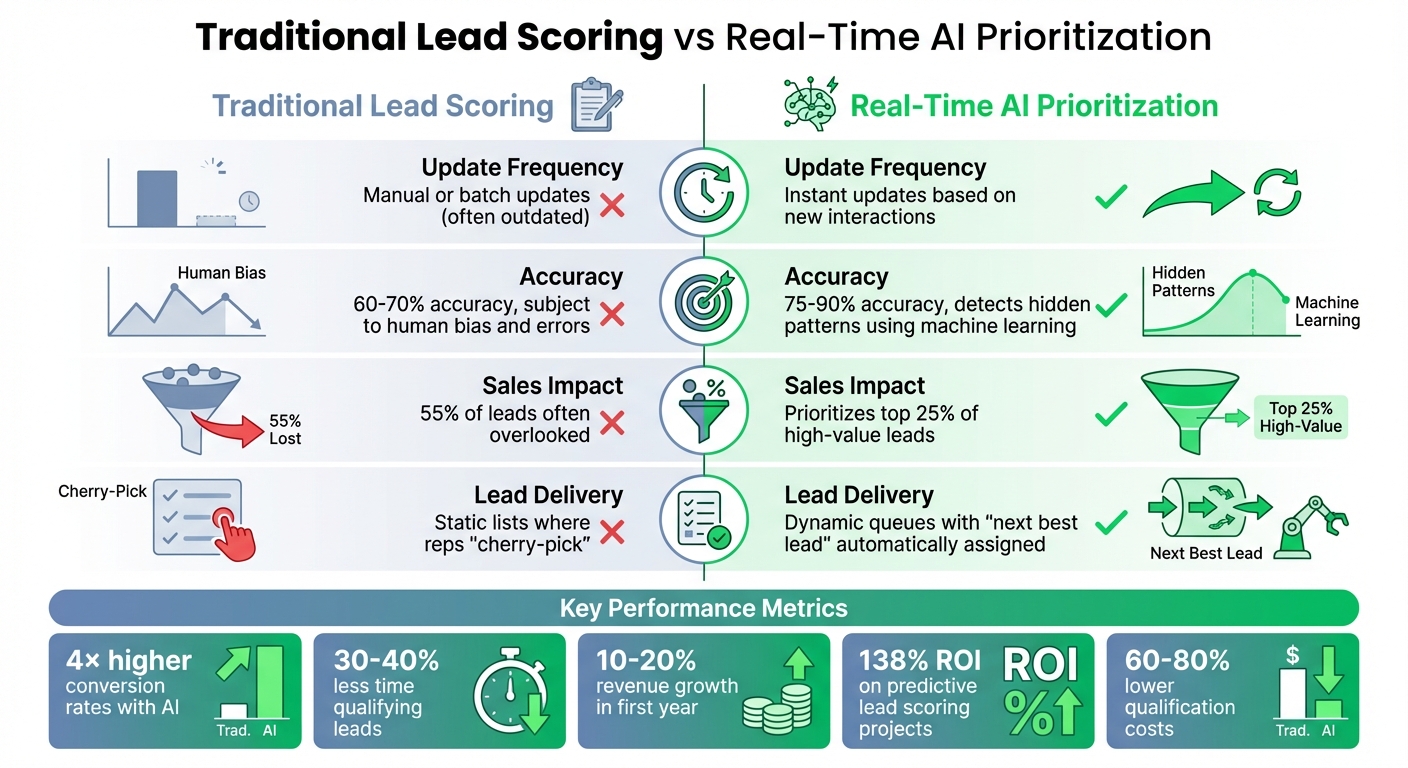
Traditional vs Real-Time AI Lead Scoring: Performance Comparison
Key Benefits and ROI Metrics
Real-time lead prioritization can transform the sales process, making it faster and more efficient. Sales reps spend 30–40% less time qualifying leads, which means they can focus more on closing deals [7]. Speed is critical here - companies that respond quickly see much faster conversion rates.
The financial upside is hard to ignore. Businesses often experience 10–20% revenue growth within the first year of adopting AI-driven lead scoring [7]. Even more impressive, companies leveraging AI for lead scoring report conversion rates nearly four times higher than the average [4]. Predictive lead scoring projects typically yield a return on investment (ROI) of 138% [4], while automation slashes lead qualification costs by 60–80% [7].
Real-time systems also supercharge productivity. With queue-based routing, sales teams complete three times more actions per hour and see a 35% increase in call connections [1]. Access to buyer intent data helps 65% of sales reps close more deals [4]. Unlike static lead lists - where around 55% of leads are ignored [4] - real-time prioritization ensures focus on the top 25% of leads with the highest revenue potential.
| Feature | Traditional Lead Scoring | Real-Time AI Prioritization |
|---|---|---|
| Update Frequency | Manual or batch updates (often outdated) [4] | Instant updates based on new interactions [1][7] |
| Accuracy | Subject to human bias and errors [2][4] | Detects hidden patterns using machine learning [7] |
| Sales Impact | 55% of leads often overlooked [4] | Prioritizes top 25% of high-value leads [4] |
| Lead Delivery | Static lists where reps "cherry-pick" [1] | Dynamic queues with "next best lead" automatically assigned [1] |
These benefits are game-changing, but implementing real-time prioritization isn’t without its challenges.
Overcoming Implementation Challenges
Even with its clear advantages, adopting real-time lead prioritization comes with hurdles. For starters, low-quality leads remain a major frustration, with 42% of sales reps citing this as their top complaint [3]. In fact, only 5% of salespeople consider marketing leads to be "very high quality" [4]. This often stems from a disconnect between marketing and sales efforts, a problem reported by 64% of organizations [4].
Another issue is unclear scoring logic. Sales teams are less likely to trust AI-driven scores if they don’t understand how rankings are determined [4]. To address this, opt for platforms with explainable AI that clearly outline why a lead scored high (e.g., "visited pricing page three times and attended a webinar") [7]. Transparency like this builds trust and encourages adoption.
Data quality problems also complicate things. Many businesses struggle with incomplete or inconsistent data, or they collect too many non-standardized attributes [3]. To overcome this, sales and marketing teams should collaboratively define an Ideal Customer Profile (ICP) based on factors like industry, company size, and location. This helps automatically disqualify poor-fit leads [3][5]. Additionally, syncing your system with your CRM ensures scores are continuously updated with sales feedback [7].
It’s also important to tackle data bias. Regularly review scoring models to ensure they don’t favor certain regions or company sizes based on outdated assumptions [2][4]. Using ensemble methods - blending multiple algorithms - can provide more reliable results across different segments [7]. Establishing a Service Level Agreement (SLA) between marketing and sales can also help. For example, marketing can commit to delivering high-quality leads, while sales agrees to specific follow-up times, aligning both teams toward shared revenue goals [4].
To refine prioritization further, integrate third-party intent data and technographic details about a prospect’s current tech stack [4]. Automated alerts for high-intent actions, like visiting the pricing page twice in 24 hours, can enable immediate and effective follow-up [4].
Conclusion
Leveraging AI for real-time lead prioritization has become essential for B2B sales teams aiming to stay ahead in an increasingly competitive landscape. With modern B2B buyers conducting thorough research before ever reaching out to sales teams [4], the opportunity to engage is shrinking. Quick, decisive responses are no longer optional - they're crucial.
As discussed earlier, AI-powered systems are replacing outdated, rule-based approaches to lead scoring. Traditional methods often leave organizations struggling to qualify leads effectively, resulting in missed opportunities. By focusing on the top 25% of high-value leads, businesses can allocate resources more strategically, driving greater revenue. When combined with dynamic queue-based routing, AI eliminates the inefficiencies of manual lead selection, boosting productivity and precision.
"Using AI for lead scoring and pipeline insights can boost conversion rates by almost 4× compared to the average." - Martal Group [4]
The impact of AI-driven lead scoring is clear. Companies adopting these tools often experience significant growth in revenue and conversion rates, with predictive scoring initiatives delivering measurable ROI [4][7]. Sales teams benefit from increased efficiency, making more calls and achieving better connection rates in less time [1].
SalesMind AI encapsulates these advancements with its cutting-edge lead scoring features, LinkedIn integration, and unified inbox. By automating lead prioritization and responding instantly to high-intent signals, the platform enables sales teams to focus on what truly matters: engaging prospects at the perfect moment. Its ability to integrate diverse data sources and adapt over time ensures teams are always working on the leads most likely to convert.
To succeed, businesses need aligned sales and marketing efforts, accurate data, and a commitment to continuous improvement. For those ready to invest, the rewards are substantial: shorter sales cycles, higher conversion rates, and a competitive edge that’s tough for slower competitors to match. Use these insights to refine your strategy and position your organization for long-term success.
FAQs
How can real-time lead prioritization boost conversion rates?
Real-time lead prioritization takes conversion rates to the next level by dynamically updating lead scores using live behavioral data - think website visits, email opens, or LinkedIn interactions. This approach helps sales teams strike while the iron is hot, engaging prospects precisely when their interest peaks. The result? Quicker responses and deeper, more impactful connections.
By leveraging these timely insights, businesses can zero in on their most engaged leads, boosting efficiency and delivering measurable outcomes. In fact, this method has been shown to drive up to a 20% increase in conversions.
How does AI improve the accuracy of lead scoring?
AI transforms lead scoring by swapping out old-fashioned, rule-based systems for smart, data-driven algorithms that continuously learn and adjust. It evaluates a wide range of signals - like website activity, email clicks, and LinkedIn interactions - and updates lead scores in real time based on the latest behaviors. This ensures that scores accurately reflect where a prospect stands right now.
By removing the delays of traditional methods and spotting patterns that might slip past human analysis, AI improves accuracy and cuts down on bias. The result? Higher conversion rates and sales teams that can zero in on top-priority leads, saving time while boosting productivity. Tools like SalesMind AI make it simple for businesses to integrate this functionality into their processes, delivering sharp, real-time lead prioritization.
What obstacles can arise when implementing AI-driven lead prioritization?
Implementing AI-driven lead prioritization comes with its share of challenges. For starters, it hinges on having access to high-quality, real-time data from multiple sources like website activity, email interactions, and CRM records. Any gaps or inconsistencies in this data can throw off the accuracy of lead scoring, making it harder to pinpoint top prospects. On top of that, B2B teams often deal with a huge volume of leads, which can make it tricky to quickly identify and focus on the most promising ones.
Another obstacle lies in shifting from manual or static lead scoring methods to AI-powered systems. Traditional approaches often overlook subtle behavioral patterns, and moving to an AI-based system may require teams to adjust workflows and place trust in algorithm-driven insights. Plus, integrating AI tools with existing platforms like CRMs or LinkedIn can be a complicated process.
To tackle these issues, businesses should prioritize building dependable data pipelines, regularly updating AI models, and choosing tools that blend smoothly with their current systems. Platforms like SalesMind AI can simplify this transition by automating lead scoring, cutting down on manual work, and offering clear, actionable insights that sales teams can rely on.
 JG
JG