Predictive Lead Scoring for Better Segmentation
How machine-learning lead scoring ranks prospects by conversion likelihood, improves segmentation, speeds pipelines, and enables real-time CRM actions.
 Julien Gadea
How machine-learning lead scoring ranks prospects by conversion likelihood, improves segmentation, speeds pipelines, and enables real-time CRM actions.
How machine-learning lead scoring ranks prospects by conversion likelihood, improves segmentation, speeds pipelines, and enables real-time CRM actions.
Table of Contents
Predictive lead scoring uses machine learning to identify which prospects are most likely to convert into customers. By analyzing historical data and real-time behaviors, it evaluates thousands of signals - such as job titles, website visits, and email interactions - to rank leads by their potential. This approach outperforms traditional scoring methods, achieving accuracy rates of 70–85% compared to 45–60%.
Key benefits include:
- Higher Conversion Rates: Teams using predictive scoring report a 50% increase in lead conversions and a 33% reduction in acquisition costs.
- Improved Segmentation: Leads are grouped into categories (e.g., high-priority, nurture, or discard), enabling tailored outreach strategies.
- Time Savings: Sales pipelines are built 30% faster by focusing on high-quality leads, and one AI-powered rep can match the output of 1.5–2 traditional reps.
- Real-Time Updates: Scores adjust instantly based on new actions, ensuring sales teams act during peak interest.
Setting Up Predictive Lead Scoring Using Machine Learning
How Predictive Lead Scoring Works
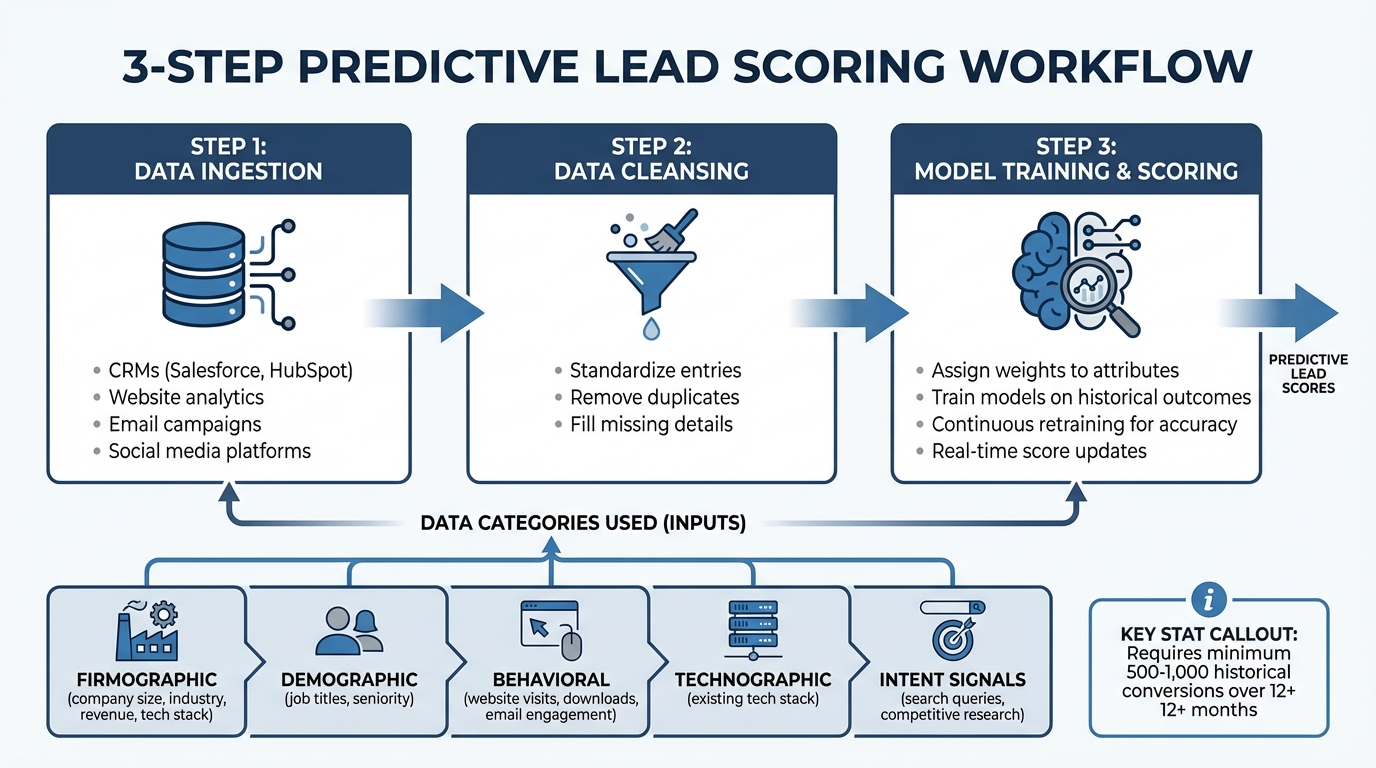
How Predictive Lead Scoring Works: 3-Step Process
Predictive lead scoring takes raw data and turns it into actionable insights. It all begins with data ingestion, where algorithms gather information from CRMs like Salesforce or HubSpot, website analytics, email campaigns, and social media platforms [2]. After collecting the data, the next step is data cleansing - a process that standardizes entries, removes duplicates, and fills in missing details [2]. Once the data is clean, key attributes are assigned weights, and models are trained using historical outcomes. These models are continuously retrained to maintain accuracy over time [2][7]. This entire process relies on diverse data inputs, which we’ll explore below.
Data Inputs and Analysis
Predictive models rely on five main data categories:
- Firmographic data: Includes company size, industry, revenue, and technology stack.
- Demographic data: Covers individual details like job titles and seniority levels.
- Behavioral signals: Tracks actions such as website visits, time spent on pages, downloads, and email engagement.
- Technographic data: Analyzes the prospect's existing tech stack.
- Intent signals: Captures buying readiness through search queries and competitive research activity [2][5][4].
This data comes from a mix of internal and external sources. First-party data - like CRM interactions, website analytics, and email metrics - helps refine accuracy [2][5]. External sources, such as intent platforms like ZoomInfo and Clearbit, LinkedIn activity, news about funding rounds or leadership changes, and industry reports, add valuable context [2][5]. Companies leveraging AI-powered lead scoring often see a 25% boost in conversion rates and save up to 30% of the time spent on lead qualification [5]. These rich datasets fuel the machine learning models discussed next.
Machine Learning Models in Scoring
Machine learning algorithms uncover complex patterns that would otherwise go unnoticed. For example, a prospect from a specific industry who visits a pricing page after reading a case study might have a 78% higher chance of converting than the average lead [7]. Algorithms such as logistic regression, decision trees, random forests, and neural networks analyze which features most accurately predict conversion [5]. Modern systems can score leads in near real-time, often within minutes [6].
Building a reliable model requires a minimum of 500 to 1,000 historical conversions spanning at least 12 months [1]. To further refine accuracy, many models include "negative lead scoring", which automatically deprioritizes poor-fit leads, such as competitors or students [4].
Dynamic and Adaptive Scoring
Adaptive scoring takes things a step further by using continuous learning to refine customer profiles based on real-world outcomes [1][2]. Scores update instantly when prospects take specific actions, like downloading a whitepaper or attending a webinar [2][7].
Systems also track "Score Trends", showing whether a lead is gaining, losing, or maintaining interest. This insight helps sales teams act quickly if a prospect’s engagement starts to drop [6]. To stay aligned with market changes or product updates, models should be retrained quarterly - or immediately following major launches or shifts in target markets [1]. By focusing efforts on high-quality leads, teams using AI-driven scoring can build sales pipelines about 30% faster [2].
Benefits of Predictive Lead Scoring for Segmentation
Improved Targeting and Conversion
Predictive scoring takes the guesswork out of lead targeting by relying on data instead of intuition. It analyzes extensive datasets to uncover patterns that might otherwise go unnoticed. For instance, a lead from a specific industry who interacts with a LinkedIn post and visits a pricing page might have a much higher chance of converting compared to an average prospect [7].
The results speak for themselves. While traditional rule-based systems achieve accuracy rates of 45–60%, predictive models boost that to 70–85% [1]. This leap in precision comes from combining firmographic data, behavioral cues, and intent signals to create a comprehensive profile of each prospect’s likelihood to make a purchase.
Efficient Use of Sales Resources
Predictive scoring doesn’t just improve targeting - it also ensures sales teams focus their efforts where they matter most. By automatically filtering out leads that meet basic demographic criteria but lack real buying intent, it prevents wasted time and resources.
Sales teams leveraging predictive scoring build their pipelines about 30% faster [2]. One AI-powered sales rep can often achieve the same output as 1.5 to 2 traditional reps by focusing exclusively on high-potential leads, leading to a 33% boost in productivity [2][1]. Notably, 98% of sales teams using AI report better lead prioritization [3].
Better Engagement Strategies
When leads are prioritized effectively, engagement strategies naturally improve. Predictive scoring enables advanced segmentation by grouping leads into four categories based on fit and engagement [7]. These categories include:
- Fast Track: High-fit, highly engaged leads that require immediate follow-up.
- Nurture: High-fit leads with lower engagement levels.
- Watch: Engaged leads that don’t fully align with the ideal customer profile (ICP).
- Discard: Leads with poor fit and low engagement.
This segmentation allows for more personalized outreach. High-scoring leads can trigger tailored follow-up sequences automatically [2]. Additionally, focusing on quality prospects reduces email volume to uninterested contacts by 20–30%, which improves open rates and email deliverability [2].
sbb-itb-817c6a5
Real-Time Scoring and CRM Integration
Real-Time Updates and Engagement
When it comes to converting leads, speed is everything. Companies that respond to leads within an hour are 7 times more likely to engage in meaningful conversations with decision-makers compared to those that delay their response [8]. This is where real-time scoring steps in, leveraging insights like LinkedIn activity and company mentions to analyze prospects’ engagement the moment it happens [8].
Unlike traditional manual methods, AI-powered scoring updates in seconds [8]. This allows sales teams to connect with prospects during the peak moment of interest, rather than relying on outdated weekly or monthly reviews. High lead scores can automatically trigger workflows such as "Score → Sequence", instantly adding qualified prospects into tailored LinkedIn or email follow-up campaigns. This efficiency enables teams to dedicate as much as 80% of their time to nurturing high-potential leads [2][8]. And with seamless CRM integration, this real-time response capability creates a cohesive lead intelligence ecosystem.
Integration with CRM Tools
CRM integration takes the power of real-time scoring to the next level by consolidating all lead data into one central hub. It combines website analytics, email interactions, social signals, and third-party data into a unified lead profile [8]. This comprehensive view becomes the go-to resource for both marketing and sales teams [8][9].
The time savings are impressive. On average, sales reps spend 8% of their week just figuring out which leads to prioritize [9]. By automating this process, AI-powered CRM systems can handle up to 10 times more leads without requiring additional manual effort [8]. These integrations also clean and prepare data automatically, ensuring that predictive models are built on accurate, high-quality information [3].
Transparency and Sales Team Confidence
For sales teams to trust AI-driven recommendations, they need to understand the "why" behind each lead score. Modern tools provide this transparency by showing exactly which factors influenced a score - such as whether a prospect visited a pricing page or fits the Ideal Customer Profile (ICP) [8][2]. This clarity is key to building confidence in AI systems.
"AI lead scoring uses machine learning to automatically rank potential customers by their likelihood of purchasing, effectively providing real-time data analysis 24/7 without manual input." - Sean O'Connor, Content Specialist, monday.com [8]
A gradual approach helps build trust. Start with conservative thresholds for "hot leads" and adjust as the model's accuracy proves itself [8]. When sales reps can see the reasoning behind a lead's prioritization, they are far more likely to act on AI suggestions. Tools like SalesMind AI exemplify this, combining advanced lead scoring with LinkedIn automation. By offering clear insights and syncing seamlessly with CRMs, these platforms enhance segmentation and streamline outreach, ensuring more effective engagement.
Conclusion
Key Takeaways
Predictive lead scoring is transforming how LinkedIn prospects are segmented. By analyzing thousands of signals - from firmographic details to behavioral patterns - it identifies prospects with the highest conversion potential. For B2B companies, this means converting 50% more leads while cutting acquisition costs by 33% [1].
Using multiple channels together takes these results even further. Combining LinkedIn, email, and phone outreach has been shown to boost response rates by 55% compared to relying on email alone [10].
Real-time scoring paired with CRM integration creates a streamlined system that captures and acts on prospect engagement at the most opportune moments.
The Role of SalesMind AI
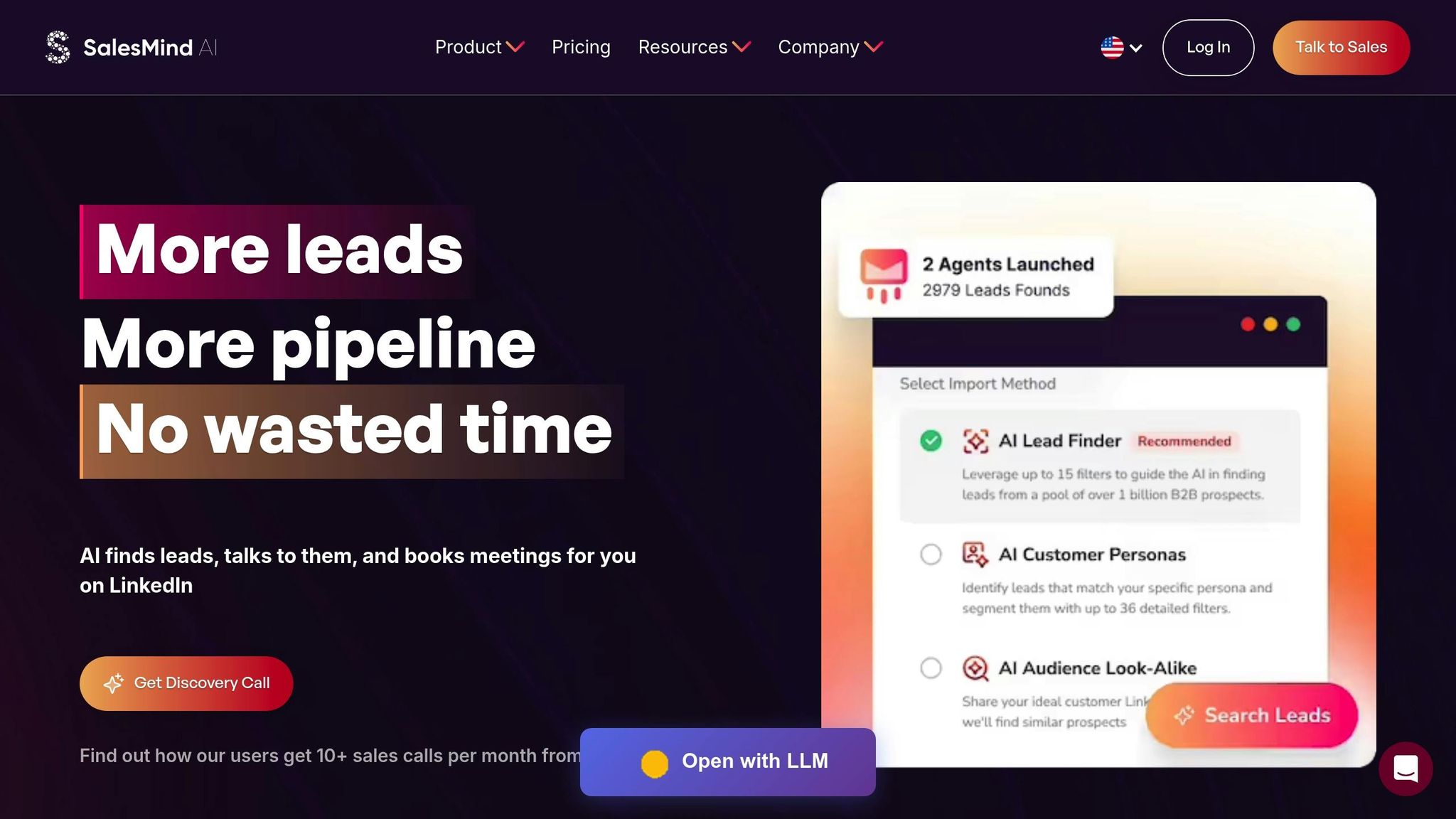
These advancements pave the way for solutions like SalesMind AI, which brings predictive scoring and LinkedIn automation into one cohesive system. From identifying prospects to delivering personalized outreach, SalesMind AI ensures no opportunity slips through the cracks. High-scoring leads automatically trigger customized follow-up sequences, making outreach both efficient and timely.
The platform’s unified inbox simplifies LinkedIn interactions, while CRM integration offers a complete view of lead behavior. By clearly explaining which actions - like visiting a pricing page or matching the ideal customer profile (ICP) - impact each score, SalesMind AI builds confidence in its recommendations. With its combination of intelligent scoring, automated workflows, and actionable insights, businesses can connect with the right prospects at the right time, turning LinkedIn into a consistent source of revenue.
FAQs
How does predictive lead scoring help increase lead conversions?
Predictive lead scoring relies on AI-powered analysis to assess potential customers by examining their demographics, actions, and engagement trends. By assigning a rank to each lead based on their chances of converting, it helps sales teams zero in on the most promising opportunities.
This method ensures sales representatives spend their time on leads with the highest potential, reaching out at the ideal moment. The result? Higher conversion rates and better efficiency. In fact, companies using predictive lead scoring have reported conversion rate boosts of up to 50%.
What data is essential for successful predictive lead scoring?
Successful predictive lead scoring works by blending several types of data to paint a detailed picture of your potential customers. It starts with demographic and firmographic information - think job titles, company size, industry, and location. These details help pinpoint accounts with high potential value. Then comes behavioral data, like tracking website visits, email engagement, or LinkedIn activity, which sheds light on a prospect's level of interest and intent.
On top of that, historical sales data - such as past deal outcomes, the length of sales cycles, and deal sizes - helps identify patterns that often lead to successful conversions. Finally, external insights - like a prospect's technology stack, relevant industry news, or content consumption habits - can highlight buying signals that might not show up in your internal data. When you combine all these pieces, predictive lead scoring helps you focus on the prospects most likely to convert, making your segmentation and outreach efforts much more effective.
How does real-time predictive lead scoring improve sales team productivity?
Real-time predictive lead scoring adjusts a prospect’s score immediately based on their most recent actions - like checking out your website, opening an email, or interacting on LinkedIn. This means sales teams can zero in on promising leads the moment their interest peaks, skipping over cold or mismatched prospects and moving the sales process along much faster.
With automated lead qualification and prioritization, teams can act quickly when a prospect’s score rises, often triggering well-timed, personalized outreach. This approach not only boosts conversion rates but also ensures sales reps spend their time engaging with leads that are more likely to close. The result? Shorter sales cycles and better overall efficiency. Pair this with tools like LinkedIn outreach automation, and you’ve got a system that simplifies follow-ups and keeps the entire team operating at peak productivity.
 JG
JG