How Predictive Lead Scoring Improves Engagement
Predictive lead scoring improves engagement by telling reps which prospects are most likely to convert before they reach out. This article covers how AI models analyze firmographic data, behavioral signals, and historical win patterns to rank your pipeline, so your team focuses energy where it will actually move the needle.
 Julien Gadea
Predictive lead scoring improves engagement by telling reps which prospects are most likely to convert before they reach out. This article covers how AI models analyze firmographic data, behavioral signals, and historical win patterns to rank your pipeline, so your team focuses energy where it will actually move the needle.
Predictive lead scoring improves engagement by telling reps which prospects are most likely to convert before they reach out.
This article covers how AI models analyze firmographic data, behavioral signals, and historical win patterns to rank your pipeline, so your team focuses energy where it will actually move the needle.
Table of Contents
Predictive lead scoring helps sales teams focus on leads most likely to convert, boosting efficiency and revenue. By analyzing historical data and real-time behaviors, it assigns scores (0–100) to rank prospects. Unlike manual methods, this approach updates continuously, saving time and improving accuracy.
Key Benefits:
- Increased Conversion Rates: Up to 50% improvement by prioritizing high-value leads.
- Faster Pipelines: Sales pipelines can grow 30% quicker.
- Personalized Outreach: Tailored messaging based on real-time insights.
- Shorter Sales Cycles: Reduce cycles by 22% and improve ROI by 70%.
How It Works:
- Data Analysis: Combines demographic, behavioral, CRM, and external data to score leads.
- Automation: Tools like SalesMind AI trigger personalized workflows when scores hit key thresholds.
- Continuous Updates: Models learn from new data every 10–15 days, ensuring relevance.
By focusing on the most promising leads, predictive scoring transforms sales efficiency and engagement.
How Do Predictive Lead Scoring Models Work? - Sales Saas Breakdown
Understanding Predictive Lead Scoring
Traditional vs Predictive Lead Scoring Comparison
Predictive lead scoring uses machine learning to assess and rank prospects based on their likelihood to convert, drawing insights from historical win-loss data. By identifying patterns in past behaviors, it assigns a score - usually on a 0–100 scale - that predicts the chances of a lead becoming a customer.
What sets predictive scoring apart from traditional methods is its ability to evolve continuously. These models learn from new data and adjust scores in real time, reflecting shifts in buyer behavior or market trends [6]. For instance, if a lead downloads a whitepaper and then visits your pricing page, the system detects this activity and updates the score immediately [3]. This dynamic approach gives sales teams access to the most up-to-date insights, helping them focus on the leads most likely to convert.
These systems rely on a variety of data inputs, which we’ll explore in the next section. But first, let’s compare predictive scoring with its traditional counterpart.
Traditional vs. Predictive Lead Scoring
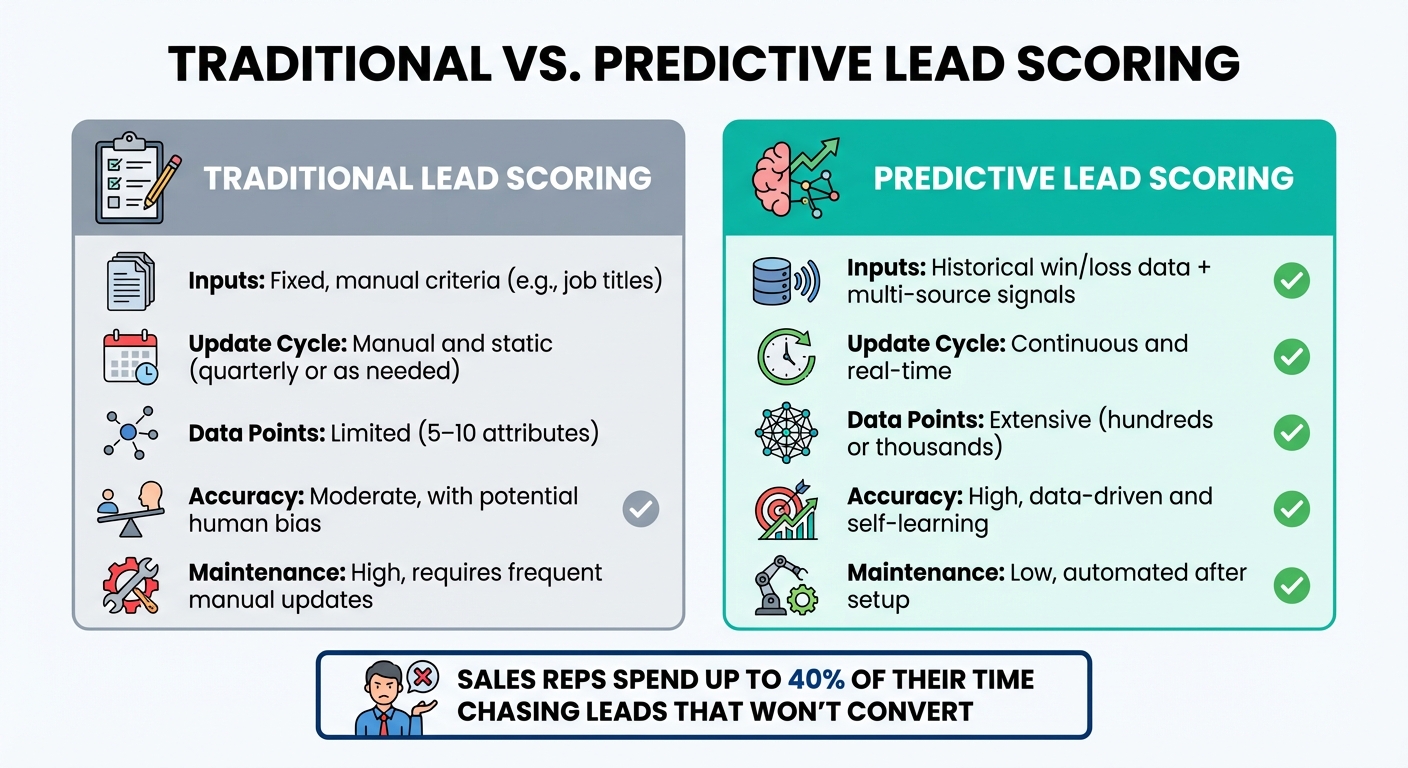
Traditional lead scoring is based on fixed, manually defined criteria. For example, a sales team might assign points for factors like job title, company size, or email interactions. However, these rules are static and need manual updates, making the process prone to subjectivity. Typically, traditional scoring considers only a handful of attributes - usually 5 to 10 [6].
Predictive lead scoring takes a completely different approach. It uses historical win/loss data and combines it with signals from multiple sources to build an objective, data-driven model. These systems retrain themselves automatically - often every 10 to 15 days - adapting to new patterns without requiring manual adjustments [5][6]. This means the accuracy of predictive scoring improves over time instead of declining.
Here’s a quick comparison:
| Feature | Traditional Lead Scoring | Predictive Lead Scoring |
|---|---|---|
| Inputs | Fixed, manual criteria (e.g., job titles) | Historical win/loss data + multi-source signals |
| Update Cycle | Manual and static (quarterly or as needed) | Continuous and real-time |
| Data Points | Limited (5–10 attributes) | Extensive (hundreds or thousands) |
| Accuracy | Moderate, with potential human bias | High, data-driven and self-learning |
| Maintenance | High, requires frequent manual updates | Low, automated after setup |
The difference in efficiency is massive. Sales reps can spend up to 40% of their time chasing leads that won’t convert [6]. Predictive scoring helps eliminate much of this wasted effort.
Data Sources Used in Predictive Lead Scoring
To understand why predictive lead scoring works so well, it’s important to look at the data it uses. These models draw from a variety of sources:
- Demographic data: Details like job title, role, and location help identify decision-makers.
- Firmographic data: Information such as company size, industry, revenue, and years in business determines if a lead matches your Ideal Customer Profile and has the budget for your solution [6].
- Behavioral signals: Activities like visiting your website (especially pricing pages), opening emails, clicking links, and downloading content reveal a lead’s intent and engagement level [6].
- Historical CRM data: Insights from past deals, interaction logs, and pipeline velocity refine the scoring model [6].
- External intent data: Broader signals like funding announcements or industry trends provide additional context.
A clean CRM is crucial before implementing predictive models. Standardizing data - like unifying “VP” and “Vice President” - prevents errors during training [6]. Most platforms also require a minimum dataset to generate accurate scores. For example, Microsoft Dynamics 365 needs at least 40 qualified and 40 disqualified leads from the past 3 to 24 months [5], while HubSpot requires at least 100 contacts to create "Contact priority" values [4].
"The beauty of predictive scoring is that it identifies these complex, multi-variable patterns that would be impossible to spot manually, then automatically applies this learning to new leads." – Frank Ferris, Sr. Manager, Product Specialists, Coefficient [6]
This data-driven approach offers a powerful way to prioritize leads and improve engagement.
How Predictive Lead Scoring Improves Engagement
Now that you know how predictive lead scoring works, let’s explore how it transforms engagement. Its advantages go well beyond just tidying up your CRM. These systems redefine how sales teams connect with prospects, driving noticeable improvements in conversion rates and revenue.
Focusing on High-Value Leads
Did you know that sales reps spend 40% of their time chasing leads that don’t convert? [6] Predictive lead scoring changes that. Automated alerts kick in when leads score above 80, helping sales teams build pipelines 30% faster by focusing on the top 3-5% of prospects [1][6].
The productivity gains are hard to ignore. A modest 10% boost in lead quality can make sales teams up to 40% more productive [9]. Even adding just one high-quality lead to a rep’s queue through better prioritization can generate about 10% more revenue [1]. On top of that, while reps currently spend roughly 8% of their week prioritizing leads, predictive scoring automates this task, freeing up time for actual selling [7].
These systems also uncover patterns that might otherwise go unnoticed. For instance, one model found that prospects from SaaS companies with 50–200 employees who visited a pricing page after reading case studies converted at a rate 78% higher than average [6].
This level of prioritization not only boosts efficiency but also lays the groundwork for more meaningful, personalized interactions.
Personalizing Outreach with Data Insights
Predictive scoring doesn’t just rank leads - it provides behavioral insights that reshape outreach strategies. By analyzing real-time data, sales teams can customize communication based on a prospect’s actions. For example, when a lead downloads a deployment guide, revisits the pricing page twice in a week, or attends a technical webinar, their score adjusts dynamically.
This data allows for tailored messaging. Instead of sending generic templates, sales reps can reference specific actions, creating more engaging and relevant conversations. For instance, if a prospect recently reviewed compliance documentation, that detail can serve as a strong conversation starter.
The impact is clear. Companies using predictive lead scoring report a 21% increase in lead conversion rates [10]. High-growth B2B firms see up to a 60% rise in sales-qualified leads [11], and marketing teams achieve a 30% better ROI by targeting the right prospects [11].
A great example comes from November 2025, when a cybersecurity software company worked with Directive Consulting to revamp its scoring model. By focusing on fit-and-intent scoring rather than just engagement metrics, the company boosted its average deal size by 28% in one quarter - without increasing its marketing budget [12].
"Lead scoring using CRM data helps you identify what your best customers have in common. Look at past leads and spot behaviors or traits that consistently lead to conversions." – Francis Rodino, Founder, Lead Hero [10]
Reducing Sales Cycles and Increasing Conversions
Beyond improving engagement, predictive scoring speeds up the entire sales process. By automatically promoting high-scoring leads from Marketing Qualified Lead (MQL) to Sales Qualified Lead (SQL), teams can eliminate delays and cut sales cycles by 22%, all while boosting ROI by up to 70% [10].
This data-driven approach removes the guesswork. Unlike traditional methods that rely on instincts, predictive scoring uses hard data to detect subtle buying signals. Companies using predictive analytics in lead management report a 20% increase in pipeline conversion rates and a 15% improvement in deal velocity [12].
For example, in 2025, a cybersecurity SaaS company used Lead Hero AI to track behavioral signals. They discovered that prospects who viewed compliance documents, attended technical webinars, and showed team-level engagement within 14 days converted at an impressive 94% rate. This insight helped slash their enterprise sales cycles by 67% [10].
With predictive lead scoring, organizations can improve conversion rates by up to 50% [2], turning ambitious sales targets into achievable milestones.
sbb-itb-817c6a5
How to Implement Predictive Lead Scoring
Getting started with predictive lead scoring involves a structured process that ensures your model works effectively from the ground up. Here's a breakdown of the steps, from preparing your data to fine-tuning the system.
Step 1: Audit and Prepare Your Data
The quality of your predictive model depends heavily on the data you provide. Begin by cleaning up your dataset: remove duplicates, standardize formats (like phone numbers and company names), and eliminate incorrect entries.
Organize your data into key categories: Demographic (e.g., job title, location), Company (e.g., industry, size), Behavioral (e.g., email clicks, website visits), and Spam (e.g., invalid entries) [7]. A good dataset should include a mix of historical leads - ideally around 40 qualified and 40 disqualified records created and closed within a timeframe of 3 months to 2 years [5]. If your internal data is limited, some tools can supplement it with anonymized aggregate data from other users [7].
Step 2: Define Your Goals and Success Metrics
Once your data is ready, set clear goals and metrics to measure the system's success. Start by calculating your baseline lead-to-customer conversion rate using this formula:
(Number of leads converted to customers) / (Total number of leads generated) x 100 [7].
This benchmark helps track performance improvements over time. Define objectives tied to business outcomes, such as boosting conversion rates, saving the 8% of time sales reps typically spend prioritizing leads manually [7], or improving revenue forecasting. Research shows that companies leveraging AI-based predictive lead scoring have seen sales increases of up to 27%, while manual systems tailored to specific needs have achieved over 18% growth [7].
Keep an eye on metrics like lead qualification rates, opportunity win rates, and how quickly leads move through your sales funnel [13].
Step 3: Choose and Train Your Scoring Tool
Pick a scoring tool that aligns with your needs. For instance, platforms like SalesMind AI offer advanced lead scoring and seamless LinkedIn integration. Feed the tool historical data from both successful and unsuccessful leads, and monitor its performance. To stay effective, the model should refresh regularly - every 6 to 24 hours - to adapt to changing buyer behaviors [7].
Step 4: Calibrate Scores and Connect to Your Systems
After training the model, normalize lead scores on a 0–100 scale. Set thresholds to prioritize leads: for example, scores above 80 could go directly to sales, 50–79 could be nurtured, and anything below 50 deprioritized [8].
Integration is crucial. Connect your scoring system to your CRM and outreach tools to ensure scores update in real time and trigger workflows. For example, when a lead surpasses a certain threshold, the system can instantly notify your sales team. Use CRM dashboards to track metrics like the monthly average of records scored and overall system usage, ensuring scalability as your lead volume grows [13].
Calibrated scores help your team focus on high-value leads, enabling timely and personalized outreach.
Step 5: Test, Monitor, and Refine
Before rolling out the model fully, test it on a sample of leads to confirm it can accurately distinguish high-quality from low-quality opportunities [8]. This step helps you catch potential issues early.
Ongoing monitoring is just as important. Review the model's performance quarterly [8]. If your lead-to-customer conversion rate declines, it could signal that buyer behaviors have changed, requiring a retraining of the model [7].
Also, gather feedback from your sales team to ensure the highest-scoring leads are translating into real opportunities. If successful deals consistently receive low scores, adjust the weights assigned to specific attributes [8]. You can also add negative scoring for less desirable traits, such as generic email addresses or visits limited to career pages [7][8]. Regular refinements will keep your model aligned with market shifts and ensure its continued effectiveness.
Using SalesMind AI for Predictive Lead Scoring
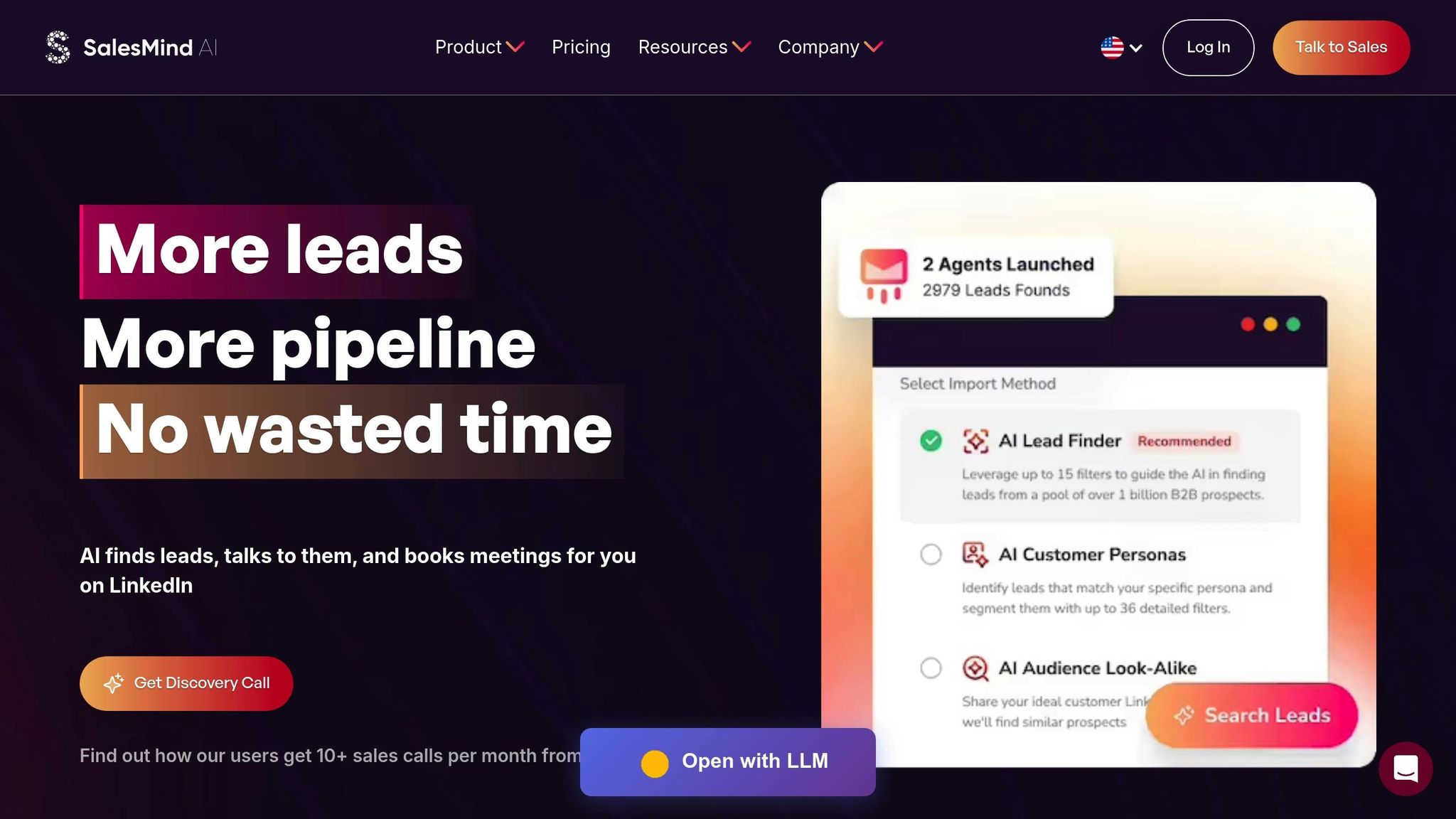
SalesMind AI combines predictive lead scoring with LinkedIn automation to help you connect with high-value prospects more effectively. This integration simplifies LinkedIn management while sharpening your outreach strategy.
AI-Powered Unified Inbox for LinkedIn Outreach
With SalesMind AI, all your LinkedIn communications are gathered into a single, unified inbox. No more jumping between multiple accounts or tabs - everything you need is in one place. This setup reduces the chances of missing important messages and keeps your outreach organized.
The unified inbox doesn’t just streamline communication; it also tracks engagement and feeds that data into your predictive scoring model. This creates a feedback loop where every interaction refines your lead scoring, ensuring your outreach efforts are always aligned with the most promising opportunities.
Advanced Lead Scoring and Real-Time Tracking
SalesMind AI leverages predictive modeling to analyze your past successes and craft an "ideal customer" profile. New prospects are scored based on how closely they match this profile, combined with real-time behavioral insights like website activity, content engagement, and LinkedIn interactions.
Scores are updated instantly, giving your team the chance to respond quickly with personalized outreach. This real-time tracking minimizes manual errors and guarantees that your most promising leads get the attention they deserve without delay.
CRM Integration for Automated Workflows
SalesMind AI works seamlessly with CRMs like HubSpot and Salesforce, bringing all your lead data into one centralized platform. When a lead’s score crosses your set threshold, automated workflows trigger follow-ups, freeing your team to focus on engaging with top prospects.
Conclusion
Predictive lead scoring has reshaped how businesses engage with prospects by using data to identify high-value leads at every stage of the buying journey. Companies adopting this approach have reported up to a 50% boost in conversion rates and built sales pipelines about 30% faster compared to traditional methods. The reason? Less time wasted on leads that don't fit, and more focus on those that do[1][2].
The transition from manual, rule-based systems to AI-powered models is a game-changer. These models adapt automatically to market shifts, allowing sales teams to concentrate on meaningful conversations with prospects who are ready to make a purchase[7].
Modern tools make this process even more seamless. Platforms like SalesMind AI integrate predictive scoring with LinkedIn automation and CRM systems. Features like a unified inbox for communications, real-time tracking for quick responses, and automated workflows for personalized follow-ups turn insights into immediate action.
Success with predictive lead scoring requires treating it as an ongoing process. Regularly monitor your model, refine it quarterly, and ensure your data stays clean and relevant. Define clear metrics for success and use each win or loss as a learning opportunity. This continuous improvement keeps your scoring aligned with your business goals and evolving buyer behaviors.
When paired with automation, accurate lead scoring transforms your sales process into a streamlined, revenue-driving machine.
FAQs
What makes predictive lead scoring more effective than traditional methods?
Predictive lead scoring leverages AI and machine learning to sift through extensive datasets, spotting patterns that reveal how likely a lead is to convert. Unlike older approaches that depend on fixed rules or manual scoring with a narrow set of criteria, predictive models adjust dynamically, using real-time data to refine their accuracy.
By taking this route, businesses can zero in on the most promising prospects, boost engagement rates, and base their decisions on solid, data-backed predictions instead of relying on guesswork or intuition.
What data is essential for successful predictive lead scoring?
To make predictive lead scoring work effectively, you need to focus on three main types of data:
- Demographic data: This includes details like job titles, locations, and company sizes. These factors help you zero in on the right audience for your business.
- Behavioral data: This tracks what potential leads are doing, such as opening emails, visiting your website, or downloading content. These actions give you a sense of how interested they are.
- Firmographic data: Think of this as the business-side information - industry type, revenue figures, and growth metrics. It helps you gauge the potential value of each lead.
By analyzing these data points, predictive models can pinpoint which leads are most likely to convert. This means you can focus your outreach efforts where they’ll make the biggest impact, boosting engagement and efficiency.
How does predictive lead scoring shorten the sales cycle?
Predictive lead scoring simplifies the sales process by pinpointing and ranking leads that are most likely to convert. By zeroing in on these high-value prospects, sales teams can better manage their time and resources, ultimately speeding up deal closures.
This method, grounded in data analysis, not only helps teams make quicker decisions but also boosts overall sales productivity. The result? Faster revenue growth and deeper connections with potential customers.
 JG
JG