Personalization at Scale: Challenges & Solutions
AI turns fragmented data and manual research into scalable, human-feel B2B personalization that boosts replies, qualified leads, and revenue.
 Julien Gadea
AI turns fragmented data and manual research into scalable, human-feel B2B personalization that boosts replies, qualified leads, and revenue.
AI turns fragmented data and manual research into scalable, human-feel B2B personalization that boosts replies, qualified leads, and revenue.
Table of Contents
77% of B2B buyers want personalized content, but only 25% feel their expectations are met. This gap is a massive opportunity for businesses to stand out. Companies that successfully scale personalization can see up to a 25% revenue boost, 80% higher conversion rates, and 6x better email transaction rates. But scaling personalization isn’t easy - it’s often blocked by fragmented data, outdated tools, and robotic automation.
Here’s the key takeaway: AI-powered tools can solve these challenges. By integrating data, automating research, and prioritizing leads, businesses can deliver tailored messages efficiently without losing the human touch. The result? 50% more qualified leads, 40–70% higher reply rates, and fewer wasted follow-ups. This article breaks down the challenges, solutions, and steps to scale personalization effectively.
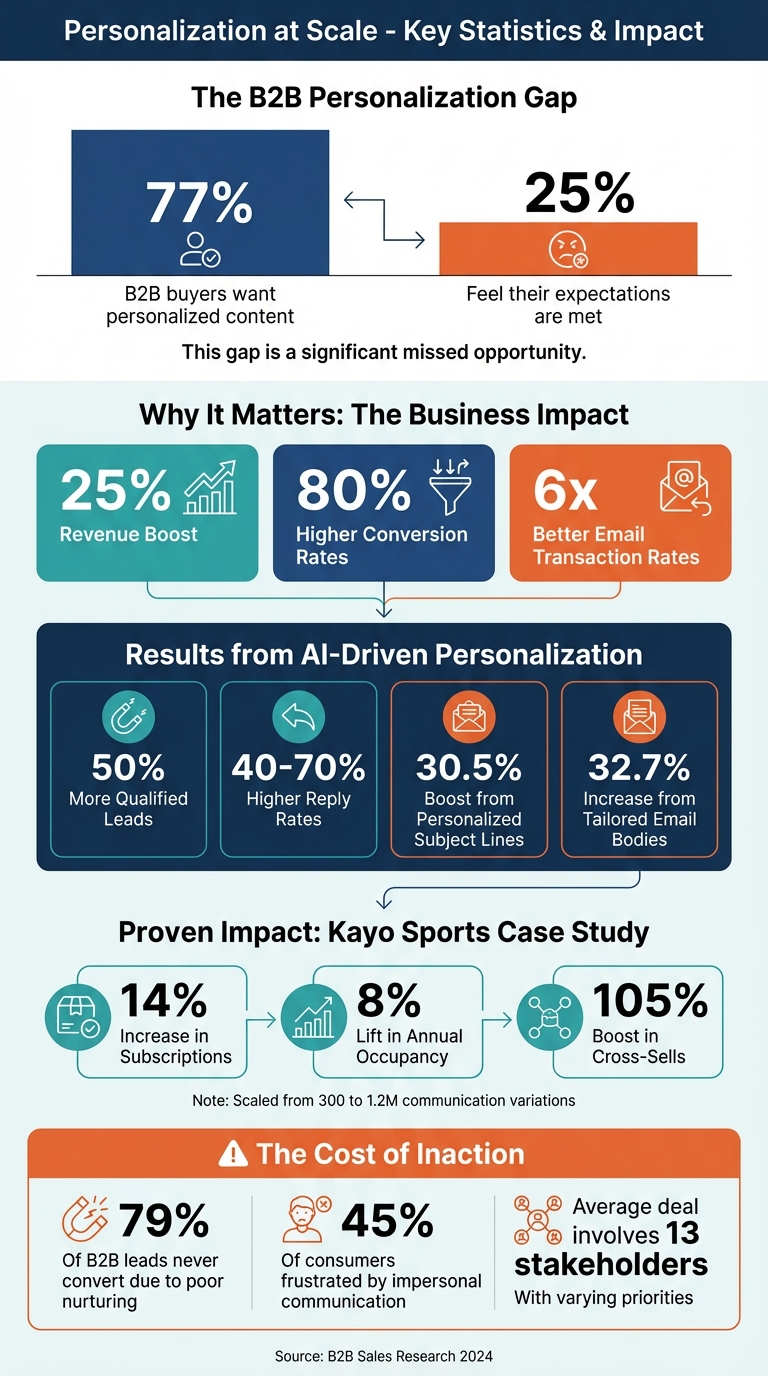
Personalization at Scale: Key Statistics and ROI Impact for B2B Sales
Main Challenges in Scaling Personalization
Data Management and Integration
Customer data is often scattered across multiple systems. For example, purchase history might sit in one database, app usage data in another, and email engagement metrics in a third. This lack of integration makes it tough to get a comprehensive view of each prospect[7]. Without this, sales teams risk sending outdated or irrelevant messages - like contacting someone who has recently changed roles or pitching a product they already use.
On top of that, poor data hygiene adds to the problem. Outdated job titles, incorrect industry classifications, or misidentified tech stacks can lead to generic outreach that misses the mark. And in today’s B2B landscape, where an average deal involves 13 stakeholders with varying priorities, fragmented data makes it nearly impossible to map out the buying committee effectively[10].
Legacy systems only make things worse. Older marketing tools often focus on one channel at a time, making it hard to create a seamless experience across email, LinkedIn, and phone calls[7]. To make matters worse, manually researching details like tech stacks, funding history, or organizational structures can take hours for just one account. This forces teams to choose between speed and personalization[10]. Add in stringent privacy regulations, and companies find themselves walking a tightrope between delivering personalized outreach and complying with data protection laws[7][11].
These issues with fragmented data and outdated systems create significant obstacles for maintaining engaging, personalized communication.
Maintaining Genuine Engagement
Automation has made it easier to reach more prospects, but it comes with a downside: interactions can feel robotic. Nearly half of consumers - 45% - report feeling frustrated by impersonal communication[9]. In B2B sales, this frustration often translates to ignored emails and lost opportunities.
The problem isn’t automation itself but how it’s used. Over-reliance on generic templates with placeholders like {{FirstName}} and {{Company}} is easy to spot, and it erodes trust. In fact, 79% of B2B leads never convert, often due to poor nurturing and a lack of authentic personalization. The solution? Combine AI-powered research with human oversight. AI can handle initial research and drafting, but humans are essential for refining messages and building genuine relationships.
"AI is the tool, not the strategy. Teams that win combine AI research automation with intentional personalization." - Maria Akhter, Editor, Outreach[10]
A better strategy is "signal-first personalization." This means identifying one verified signal - like a recent LinkedIn post, a funding announcement, or a product launch - and referencing it in the opening line. This approach not only demonstrates that the outreach is tailored but also boosts engagement. Emails with personalized subject lines, for instance, are over 20% more likely to be opened[1].
To ensure these efforts are effective, teams also need to focus on smart audience segmentation.
Audience Segmentation and Prioritization
Effective segmentation is critical for directing personalization efforts where they’ll have the most impact. Not all prospects require the same level of attention. The challenge lies in figuring out which accounts deserve deep, research-intensive personalization and which can be handled with lighter-touch automation. Poor segmentation can result in wasted effort on unqualified leads while high-value prospects are overlooked.
Data silos only make segmentation harder. When customer behavior, firmographic information, and engagement metrics are spread across disconnected systems, creating meaningful segments becomes a manual and time-consuming task[8]. To complicate things further, different teams often manage specific channels and are rewarded based on their performance in those channels, leaving little incentive for cross-channel collaboration.
Even when companies manage to integrate their data, they face another hurdle: the sheer volume of content needed to scale personalization. Traditional content creation processes often can’t keep up. Yet, trigger-based actions - like sending a message after a specific event - are three to four times more effective than standard communications[5]. Fully implementing personalization strategies can result in a 10% to 30% increase in revenue and retention[5]. Without proper prioritization, teams risk wasting time on low-priority leads while missing out on ready-to-buy decision-makers.
Personalization at Scale: Tools and Techniques
AI-Powered Solutions for Scaling Personalization
AI-powered tools present a practical way to address the challenges of fragmented data and impersonal outreach, paving the way for more effective and tailored customer engagement.
Data-Driven Insights and Automation
AI tools excel at solving data fragmentation issues by seamlessly integrating with existing systems like HubSpot and Salesforce. These integrations enable them to pull historical interaction data and generate actionable insights, providing a unified and complete view of prospects. This eliminates the hassle of switching between platforms to piece together a prospect's profile.
Many platforms employ specialized agents to streamline the process. For example, a Research Agent gathers information from sources like LinkedIn, company news, and earnings calls. A Draft Agent then transforms this data into personalized messages, while a QA Agent ensures the messages are accurate, on-brand, and error-free before they’re sent.
Platforms like SalesMind AI take personalization a step further by monitoring real-time signals - such as funding announcements, leadership changes, or technology migrations. When a relevant event occurs, the system can initiate outreach within 24 to 48 hours, ensuring timely responses. These tools also integrate with data enrichment services like Cognism and ZoomInfo, keeping organizational charts and technographic details current, so outreach efforts target the right decision-makers.
"Approximately 4,000 leads each month are enriched by our SDR team using Cognism's database. On average, 70% of monthly meetings are booked over the phone." – Michael Iannuzzi, Director of Marketing & Sales Development at Salesloft [4]
With these advanced integrations, AI doesn’t just unify data - it transforms how messaging is delivered at scale.
Personalized Messaging at Scale
Creating thousands of personalized messages is no longer about basic mail-merging. AI tools combine high-quality templates with real-time, context-aware details to craft outreach that feels personal and relevant. Typically, about 80% of the message follows a structured template, while the remaining 20% is customized with AI-researched insights - like referencing recent company achievements or addressing specific industry challenges [2].
Dynamic content insertion takes personalization to the next level. Instead of generic greetings, messages might highlight a prospect’s recent LinkedIn post about expanding into a new market or mention a press release about a new product launch. This level of detail matters: personalized subject lines can boost reply rates by 30.5%, and tailored email bodies have been shown to increase responses by 32.7% [4].
AI also adapts the tone and style of messages based on the recipient’s profile. For instance, it might use technical jargon for engineers while focusing on ROI for CFOs. To maintain quality, low-confidence drafts are flagged for human review before being sent. Additionally, multi-channel synchronization ensures a consistent narrative across email, LinkedIn, and phone calls, creating a cohesive outreach strategy.
With these personalized messages in place, AI further enhances efficiency by prioritizing leads dynamically.
Advanced Lead Scoring and Targeting
Not all prospects require the same level of attention, and AI-driven lead scoring helps prioritize efforts accordingly. Scores are adjusted in real-time based on actions like replying to a proposal or visiting a pricing page, while inactivity results in score reductions [14].
AI tools categorize leads into tiers to determine the level of personalization required:
| Account Tier | Personalization Standard | AI/Human Effort |
|---|---|---|
| A (Strategic) | Trigger + Persona Hypothesis + Tailored Proof | High-touch: AI research + Human review |
| B (Mid-Market) | Trigger or Industry Signal + 1–2 Custom Lines | Programmatic: AI-generated with spot checks |
| C (Long-tail) | Segment-based Template with Light Context | Low-touch: Fully automated AI |
For high-value (Tier A) accounts, AI combines detailed research with human input to craft deeply personalized outreach. Mid-market (Tier B) leads receive programmatic messages with a light review, while lower-tier (Tier C) accounts are handled through fully automated templates. This approach ensures resources are allocated efficiently, focusing the most effort on prospects with the highest potential.
sbb-itb-817c6a5
How to Implement Personalization at Scale
Building the Right Technology Stack
To scale personalization effectively, your technology stack should align with what McKinsey describes as the "4Ds": Data (unifying silos), Decisioning (AI-driven scoring), Design (modular content), and Distribution (real-time channel orchestration) [8]. Start by auditing your current technology to identify gaps between your CRM's existing capabilities and the need for real-time data activation across various channels.
The cornerstone of this effort is a centralized data platform that creates a unified customer identity. This approach directly tackles the data fragmentation issues mentioned earlier. For efficiency, integrate your sales engagement platform with your CRM. This will help manage sequences, call tasks, and reporting seamlessly [2]. You can also kick off personalized campaigns immediately by leveraging transaction histories and basic demographic data [5].
The goal is to turn personalization into a scalable system rather than a manual, creative task [2][3]. Tools like SalesMind AI combine LinkedIn automation with advanced lead scoring and a unified inbox, enabling teams to handle personalized outreach without constantly switching platforms.
"Personalization at scale relies on an organization's ability to orchestrate the 4Ds - Data, Decisioning, Design, and Distribution." – Sean Flavin and Jason Heller, McKinsey [8]
Cross-Team Collaboration
Once your tech stack is in place, collaboration across departments becomes critical. Achieving personalization at scale requires alignment between leadership roles like the CMO and CTO/CIO to develop a shared business case and technology roadmap [8]. Marketing, sales, and revenue operations teams need to agree on a single Ideal Customer Profile (ICP). Accounts should be segmented by firmographics, technographics, and buying roles to ensure consistent messaging [2].
Shift from siloed channel management to cross-functional, agile teams that focus on optimizing the entire customer journey [8]. When individual channel owners are only rewarded for their specific channel’s performance, collaboration often suffers. To address this, create a data governance council responsible for defining data requirements, usage, and oversight across marketing systems [8].
Feedback loops are essential for updating CRM data in real time [2]. Standardize your personalization triggers - such as funding announcements, hiring trends, or tech updates - by defining a small, repeatable set for each segment. This keeps outreach relevant without slowing down your team [2].
Measuring Success and Optimizing Efforts
With the right tools and processes in place, the next step is to measure outcomes effectively. Focus on both leading indicators and lagging metrics. Leading indicators might include signals per contact, AI confidence scores, QA pass/fail rates, and time to approval or send [1][13]. Engagement metrics track open rates, reply rates, and positive reply rates [3][2][6]. Progression metrics measure meetings per 100 contacts, qualified meetings, opportunities created, and deal velocity [3][2][1].
Before scaling, validate your approach with a 100-contact pilot. Define clear success criteria, such as achieving at least a 3% absolute lift or a 30% relative lift in reply rates compared to a control group [1]. Use multivariate testing to experiment with subject lines, openers, CTAs, and send times to quickly identify what works best [2].
"Measure personalization by outcomes, not word count." – SalesHive [2]
A great example of success comes from Kayo Sports in Australia. In fiscal year 2024, they launched their "Customer Cortex" personalization engine using reinforcement learning and Braze. This allowed them to scale from 300 to 1.2 million communication variations, driving a 14% increase in subscriptions, an 8% lift in average annual occupancy, and a 105% boost in cross-sells [7].
Automate feedback loops with tools like reply-classifier agents, which can parse inbound responses into categories like questions, disinterest, or meeting requests. These insights can then automatically update your optimization strategies [1][13]. Keep in mind, metrics are only as reliable as the data behind them. Make sure your systems allow your team to continuously correct outdated roles or misclassified tech stacks in the CRM [2]. By maintaining consistent measurement and agile optimization, you can ensure your personalization efforts remain scalable and effective, reinforcing the value of AI-driven outreach.
Conclusion
Personalization has become a cornerstone of effective B2B outreach. With 77% of B2B buyers expecting tailored content before making a purchase, yet only 25% feeling that vendors meet these expectations, there’s a clear gap - and an equally clear opportunity [2].
Traditional methods of personalization struggle to keep up with the demands of modern B2B sales. Data silos, time-intensive manual research, and the growing complexity of deals make these methods inefficient. This is where AI steps in, transforming what used to take hours into a process that can manage hundreds of accounts overnight [10]. It shifts personalization from a labor-heavy task to a scalable and efficient system.
The outcomes speak for themselves. Companies leveraging AI-driven personalization report tangible benefits, including improved response rates and revenue growth. In fact, top-performing organizations have seen up to a 25% lift in revenue and ROI as high as 8× [4][15]. As Forrester Research puts it:
AI is transforming B2B sales by automating routine tasks, providing actionable insights, and enhancing the customer experience [4].
To fully realize these benefits, businesses need to address challenges like fragmented tools and inconsistent engagement. A strong tech stack, clear alignment across departments, and ongoing performance tracking are essential. Platforms like SalesMind AI, which combines LinkedIn outreach automation with advanced lead scoring and a unified inbox, make it possible to deliver personalized outreach at scale. By using strategies like the 80/20 rule - combining solid templates with AI-generated customizations - tiering accounts by value, and monitoring metrics like signals per contact and QA pass rates, businesses can turn personalization into a strategic advantage.
The key is to treat personalization as a system. Define your audience segments, identify scalable strategies, and rely on data-driven automation to ensure relevance at every touchpoint [2]. The real question isn’t whether to adopt AI-powered personalization - it’s how quickly you can implement it to stay ahead in an increasingly competitive landscape.
FAQs
How does AI enhance personalized B2B sales outreach at scale?
AI is reshaping how businesses handle personalized B2B sales outreach by taking over tasks that used to require significant time and effort. It processes massive amounts of data - like industry trends, prospect activity, and major events such as promotions or funding rounds - to craft messages that feel specifically designed for each potential client.
With AI-driven tools, sales teams can streamline research, spot important signals, and send personalized messages to prospects on a large scale - all without losing the personal touch. This approach not only saves valuable time but also enhances engagement, increases response rates, and helps close more deals. By catering to the modern buyer's demand for customized communication, AI makes large-scale personalization both practical and impactful.
What challenges do businesses face when scaling personalized B2B outreach?
Scaling personalized B2B outreach isn’t without its obstacles. One of the biggest challenges is keeping messages relevant while handling an ever-increasing number of interactions. Writing messages that feel tailored to each prospect demands thorough research and a deep understanding of their specific needs - a process that’s not easy to replicate on a large scale.
Another tricky part is using data to drive personalization without losing that all-important human touch. Sorting through massive datasets and turning them into meaningful, customized content can quickly become overwhelming if you don’t have the right tools in place. This is where AI-powered solutions step in. These tools can take on tasks like drafting messages, qualifying leads, and managing follow-ups. By automating these processes, businesses can scale their personalization efforts without sacrificing quality, ultimately boosting engagement rates.
How does segmenting your audience improve personalized marketing?
Segmenting your audience helps businesses deliver more personalized marketing by grouping prospects and customers who share similar traits, behaviors, or needs. This approach enables companies to create tailored messages that connect with each group, boosting engagement and driving more conversions.
With the help of AI-powered tools, segmentation becomes even sharper. These tools analyze data such as industry, challenges, and engagement patterns to uncover valuable insights. This allows businesses to craft highly targeted outreach strategies and tweak them in real time, keeping messages relevant. By zeroing in on what each segment values most, companies can scale their personalized marketing efforts effectively and achieve better campaign performance.
Additional Resources
Craft a Winning B2B Value Proposition with Our Free Tool In the competitive world of B2B sales, standing out is everything. A well-defined value proposition can be the difference between closing a deal and losing a prospect’s attention. That’s where a smart, user-friendly solution like our B2B pitch generator comes in. It helps businesses articulate their unique strengths in a way that directly addresses client needs. Why Your Business Needs a Strong Value Statement Many companies struggle to communicate what makes their product or service indispensable.
Without a clear message, even the best offerings can get overlooked. Our tool simplifies this by breaking down complex ideas into a focused statement paired with actionable points. Whether you’re targeting tech startups or established manufacturers, having a polished pitch ready can set you apart. Tailored for B2B Success Designed with business-to-business dynamics in mind, this calculator considers real-world challenges like cost pressures or operational bottlenecks.
Input a few key details, and you’ll get a customized message that speaks to decision-makers. Stop guessing how to frame your offering—let a structured approach guide you to clarity and impact. FAQs How does this tool create a value proposition for my business? Our B2B Value Proposition Calculator uses the details you provide—your industry, customer challenges, and product benefits—to build a statement that’s specific to your context. It analyzes the pain points and matches them with the benefits you’ve outlined to create a message that feels authentic and targeted.
Think of it as a structured way to distill what makes your offering special into something a potential client can grasp instantly. Can I use this tool for any B2B industry? We’ve designed the calculator to work across a wide range of B2B sectors, from tech to logistics to healthcare. You just pick your industry and input the relevant details about your customers’ struggles and your solution’s strengths. The tool adapts to generate a statement that fits your niche, whether you’re selling software or industrial equipment.
Is the output customizable after it’s generated? Yes, the generated value proposition is a starting point. Once you get your statement and supporting points, you can tweak the wording to match your brand’s tone or add specific data if you’ve got it. We keep the output clear and concise, so it’s easy to edit without losing the core message that’ll hook your audience. {"@context":"https://schema.org","@type":"FAQPage","mainEntity":[{"@type":"Question","name":"How does this tool create a value proposition for my business?","acceptedAnswer":{"@type":"Answer","text":" Our B2B Value Proposition Calculator uses the details you provide—your industry, customer challenges, and product benefits—to build a statement that’s specific to your context.
"}},{"@type":"Question","name":"Can I use this tool for any B2B industry?","acceptedAnswer":{"@type":"Answer","text":" Absolutely! "}},{"@type":"Question","name":"Is the output customizable after it’s generated?","acceptedAnswer":{"@type":"Answer","text":" Yes, the generated value proposition is a starting point.
 JG
JG