Manual vs. Automated LinkedIn ROI: Comparison
Manual outreach gets higher replies and meetings but costs more; automation scales cheaply with lower response—balance both for best ROI.
 Julien Gadea
Manual outreach gets higher replies and meetings but costs more; automation scales cheaply with lower response—balance both for best ROI.
Manual outreach is more personal, with higher response rates (15–25%) and connection acceptance rates (40–60%). However, it's time-consuming, costly (up to $78,000/year), and limited to 150–250 prospects weekly. Cost per meeting: $60–$200.
Automated outreach scales easily, reaching 500–1,000+ prospects weekly at a fraction of the cost (~$3,000/year). Response rates are lower (5–10%), but cost per meeting drops to $10–$50. Risks include compliance issues if not managed carefully.
Table of Contents
Which LinkedIn outreach method delivers better ROI - manual or automated? Here's the answer:
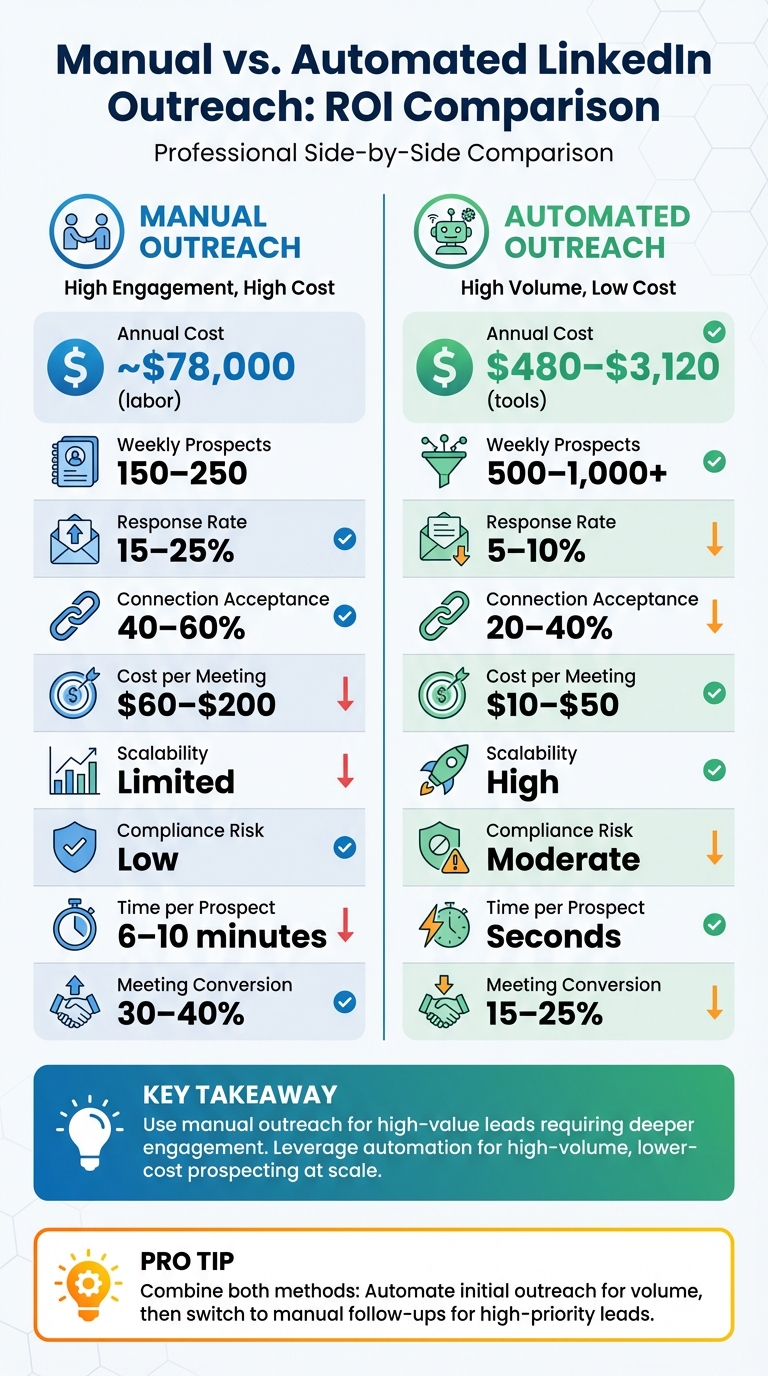
- Manual outreach is more personal, with higher response rates (15–25%) and connection acceptance rates (40–60%). However, it's time-consuming, costly (up to $78,000/year), and limited to 150–250 prospects weekly. Cost per meeting: $60–$200.
- Automated outreach scales easily, reaching 500–1,000+ prospects weekly at a fraction of the cost (~$3,000/year). Response rates are lower (5–10%), but cost per meeting drops to $10–$50. Risks include compliance issues if not managed carefully.
Quick takeaway: Use manual outreach for high-value leads requiring deeper engagement. Leverage automation for high-volume, lower-cost prospecting at scale.
Quick Comparison
| Metric | Manual Outreach | Automated Outreach |
|---|---|---|
| Annual Cost | ~$78,000 (labor) | $480–$3,120 (tools) |
| Weekly Prospects | 150–250 | 500–1,000+ |
| Response Rate | 15–25% | 5–10% |
| Cost per Meeting | $60–$200 | $10–$50 |
| Scalability | Limited | High |
| Compliance Risk | Low | Moderate |
Pro tip: Combine both methods. Automate initial outreach for volume, then switch to manual follow-ups for high-priority leads.
Manual vs Automated LinkedIn Outreach ROI Comparison
Manual LinkedIn Outreach: ROI Breakdown
The Manual Outreach Process
Manual LinkedIn outreach is all about hands-on effort. A sales rep begins by identifying prospects on LinkedIn, using filters like job title, company size, industry, and location. Once a prospect is identified, the next step is sending a connection request with a personalized note. If the request is accepted, the rep follows up with 1–3 tailored messages. Any replies are handled directly, and qualified leads are passed on for meetings or added to the CRM.
This process isn’t quick. Researching, crafting personalized messages, and tracking each prospect takes about 6–10 minutes. At this rate, a sales rep in the U.S. can typically reach 30–50 prospects daily, or 150–250 prospects weekly, with about 30 hours of effort.
Costs and Performance Metrics
While LinkedIn itself doesn’t charge for outreach, the labor costs can add up fast. If a sales rep’s time is valued at $50 per hour (a reasonable estimate for many B2B roles in the U.S.), 30 hours of outreach per week amounts to $1,500 weekly or $78,000 annually. And that’s just for outreach - not counting management overhead, CRM expenses, or the opportunity cost of time spent away from closing deals.
Despite the cost, manual outreach often delivers solid results. Well-run campaigns typically achieve connection acceptance rates of 40–60% and reply rates of 15–25%, thanks to the personalized, human touch. Among those who reply, about 30–40% convert into booked meetings. To break it down: reaching 100 prospects might cost $600–$1,000 in labor and result in 5–10 meetings. That puts the cost per meeting in the range of $60–$200, depending on the efficiency of the rep. For high-ticket B2B deals, this cost is often justifiable, as a single closed deal can easily cover the investment. These metrics provide a clear benchmark for comparing manual outreach with automated methods.
Pros and Cons of Manual Outreach
Manual outreach shines when personalization and trust are priorities. Each message can be tailored to reference a prospect’s recent LinkedIn activity, mutual connections, or company-specific challenges. This level of relevance often leads to stronger responses and higher-quality interactions, making it especially effective for relationship-driven or complex sales. Another advantage? Manual outreach stays within LinkedIn’s rules, reducing the risk of account restrictions or being flagged as spam.
That said, the downsides are hard to ignore. Manual outreach is time-intensive and costly per prospect, with limited scalability. A sales rep dedicating 30 hours a week to outreach can only contact 150–250 prospects - far from sufficient for teams with ambitious pipeline goals. The opportunity cost is also significant. Every minute spent researching profiles or writing messages is time that could be used for demos, negotiations, or closing deals. For campaigns focused on high volume or lower-value products, manual outreach often isn’t practical. These challenges set the stage for exploring automated outreach, where efficiency and scale take the lead.
Automated LinkedIn Outreach: ROI Breakdown
The Automated Outreach Process
When it comes to scaling LinkedIn outreach efficiently, automation is a game-changer. It eliminates the need for the time-consuming manual approach, where a sales rep might spend 6–10 minutes per prospect. Tools like SalesMind AI streamline the process by handling prospect data instantly. Here’s how it works: you define your target audience, set up the campaign, and let the platform do the heavy lifting. It sends out connection requests with personalized notes, follows up using multi-step message sequences, and tracks interactions in real time.
SalesMind AI takes personalization up a notch with AI-driven features. Dynamic placeholders can automatically insert details like a prospect’s first name, job title, or company, while behavioral triggers adjust follow-ups based on how prospects engage. A unified inbox keeps all conversations in one place, and advanced lead scoring identifies the most engaged prospects. This way, your team can focus on closing deals instead of wasting time chasing lukewarm leads.
Alex L., CTO at Slash Co., shared his experience: "SalesMind AI boosted my productivity in lead prospecting by 10× from the very first week", adding that it generated 5 to 10 new conversations weekly at full capacity[1].
Costs and Performance Metrics
The cost of automated outreach is a fraction of what manual efforts require. Most LinkedIn automation tools are priced between $40 and $250 per month per seat, which translates to $480 to $3,000 annually. Compare that to the $86,000 per year it might cost to employ a sales rep who spends 30 hours weekly on manual outreach. Automation also requires minimal setup time, making the savings both immediate and substantial.
Performance-wise, there are trade-offs. Automation typically achieves 5–10% response rates, compared to the 15–25% seen with manual outreach, due to less nuanced personalization. However, automation compensates with sheer volume. A sales rep might manually contact 150–250 prospects weekly, generating 30–50 responses. In contrast, automation can target 500–1,000+ prospects weekly, resulting in 40–100 responses despite the lower response rate. Connection acceptance rates for automation generally range from 20–40%, compared to 40–60% for manual efforts. Meeting conversions from responses tend to hover around 15–20% for automated campaigns.
Henry F., an Enterprise Account Executive at Salesforce, noted that during an 8-day free trial of SalesMind AI, he was "already getting 4–5 responses per day", confident they would convert to meetings. He added that automation saved him "days or weeks of consistent manual work"[1].
One of the standout benefits of automation is the cost per meeting, which often drops to $10–$50, far lower than the $60–$200 typically associated with manual outreach. These savings highlight the efficiency of automation while also pointing out some of its limitations.
Pros and Cons of Automated Outreach
The metrics make it clear: automation’s biggest strength is its ability to scale. With tools like SalesMind AI, you can reach hundreds - or even thousands - of prospects without needing to expand your team. This allows sales reps to focus on higher-value tasks like demos, negotiations, and closing deals. The cost per prospect decreases significantly, and campaigns can run around the clock.
Roberto K., Chief Product Officer at aCommerce, described SalesMind AI as a tool that "completely automated our sales prospecting on LinkedIn", enabling them to "reach out to hundreds or thousands of prospects without losing control" and "scale up our lead generation and thus our business effortlessly"[1].
Automation also provides real-time analytics and lead scoring, helping your team prioritize high-intent prospects and maximize ROI by focusing on the most promising leads.
That said, there are a few drawbacks. Automated outreach typically sees lower response rates per message (5–10% compared to 15–25% for manual outreach), especially if the messaging feels generic. There’s also a compliance risk: LinkedIn enforces strict limits on daily actions, and overusing automation or employing spammy tactics can lead to account restrictions or even bans. To avoid this, it’s best to keep automated actions within 50–100 connection requests or messages per day and use tools that mimic human behavior. Another concern is brand perception - if your messages come across as robotic or irrelevant, prospects might disengage or even report them as spam. The solution? Target well-defined segments, such as U.S.-based B2B SaaS CMOs at companies with 11–200 employees, to ensure your messaging stays relevant and engaging.
Manual vs. Automated LinkedIn ROI: Side-by-Side Comparison
Cost, Time, and Scalability Comparison
Let’s talk numbers. Manual outreach demands about 30 hours per week at $50/hour, adding up to a hefty $78,000 annually in labor costs. Compare that to automation tools like SalesMind AI, which range between $480 and $3,120 per year - a stark contrast.
Now, consider productivity. A sales rep manually reaches 150–250 prospects weekly, spending 6–10 minutes per person. Meanwhile, automated systems can manage 500–1,000+ prospects in the same time, processing each interaction in mere seconds. Manual outreach is limited by the hours in a day, but automation scales effortlessly without needing to expand your team.
| Metric | Manual Outreach | Automated Outreach |
|---|---|---|
| Annual Cost | ~$78,000 (labor equivalent) | $480–$3,120 (subscription) |
| Weekly Outreach Volume | 150–250 prospects | 500–1,000+ prospects |
| Time per Prospect | 6–10 minutes | Seconds (automated) |
| Scalability | Limited by human capacity | Unlimited without extra hires |
| Setup Time | Minimal (training only) | 1–2 hours initial setup |
Next, let’s see how these differences impact conversion rates and revenue.
Conversion Rates and Revenue Comparison
When it comes to connections and replies, manual outreach has the edge. Connection acceptance rates for manual efforts hover around 40–60%, while automation achieves 20–40%. Similarly, reply rates are 15–25% manually, compared to just 5–10% for automation. Meeting conversions follow the same trend: 30–40% for manual outreach versus 15–25% for automated approaches.
Let’s break it down further. Imagine sending 1,000 monthly connection requests:
- Manual outreach: With a 50% acceptance rate, you’d get 500 connections. At a 20% reply rate, that’s 100 replies. If 35% of those replies convert to meetings, you’d secure 35 meetings, leading to 7 closed deals at $5,000 each - $35,000 in revenue.
- Automated outreach: With a 30% acceptance rate, you’d see 240 connections. At an 8% reply rate, that’s 80 replies. If 20% of those replies convert to meetings, you’d get 16 meetings, resulting in 3 deals worth $15,000. While the revenue is lower, the labor cost savings are substantial.
The cost per meeting also highlights the difference. Automation costs $10–$50 per meeting, compared to $60–$200 for manual outreach. For high-ticket B2B deals (over $10,000) that require deeper relationships, manual outreach is the better choice. On the other hand, mid-ticket SaaS campaigns or broader outreach efforts benefit from automation’s ability to scale at a fraction of the cost.
| Conversion Metric | Manual | Automated |
|---|---|---|
| Connection Acceptance | 40–60% | 20–40% |
| Reply Rate | 15–25% | 5–10% |
| Reply-to-Meeting | 30–40% | 15–25% |
| Cost per Meeting | $60–$200 | $10–$50 |
Now, let’s explore the risks and the role of data quality in maintaining long-term success.
Risk and Data Quality Comparison
ROI isn’t just about numbers - it’s also about managing risks and ensuring high data quality.
Manual outreach has almost no compliance risk, as it mimics natural usage patterns, keeping accounts safe from restrictions. Automation, however, introduces moderate risks if not configured properly. Exceeding daily limits or sending spammy messages can trigger account restrictions. To minimize these risks, stick to conservative limits (50–100 connection requests or messages daily) and use tools that mimic human behavior.
Brand perception also differs. Manually crafted messages feel personal and authentic, which helps foster trust and build relationships. Automated messages, on the other hand, can come across as generic if not carefully executed. However, modern AI-powered tools like SalesMind AI can bridge this gap by personalizing messages, using behavioral triggers, and maintaining a human-like tone at scale.
Data quality is another key factor. Manual outreach allows for real-time adjustments, ensuring messages are accurate and relevant. Automation relies heavily on the quality of your initial data and targeting parameters. If your data is messy or your targeting is too broad, you risk irrelevant outreach. To avoid this, focus on well-defined segments, such as U.S.-based B2B SaaS CMOs at companies with 11–200 employees, and use advanced lead scoring to prioritize high-intent prospects.
| Factor | Manual | Automated |
|---|---|---|
| Compliance Risk | Very low (natural usage) | Moderate (if limits exceeded) |
| Brand Perception | Strong, personal, trusted | Can feel generic; AI tools can help |
| Relationship Building | Excellent depth and trust | Weaker unless enhanced by AI |
| Data Quality Control | High (real-time verification) | Dependent on targeting and data hygiene |
sbb-itb-817c6a5
Using Manual and Automated Outreach Together
When to Use Each Approach
Use automation for high-volume prospecting at the top of the funnel, and reserve manual outreach for leads that require a personal touch and relationship-building. Automation is perfect for quickly sending out connection requests and follow-up sequences to a large audience.
On the other hand, manual outreach shines when targeting enterprise-level prospects or leads that show high engagement. In these cases, response rates typically range from 15%–25%, with 30%–40% of those responses turning into meetings. This makes manual outreach a worthwhile investment for leads that demand deeper, more personalized interactions.
How SalesMind AI Supports Both Approaches
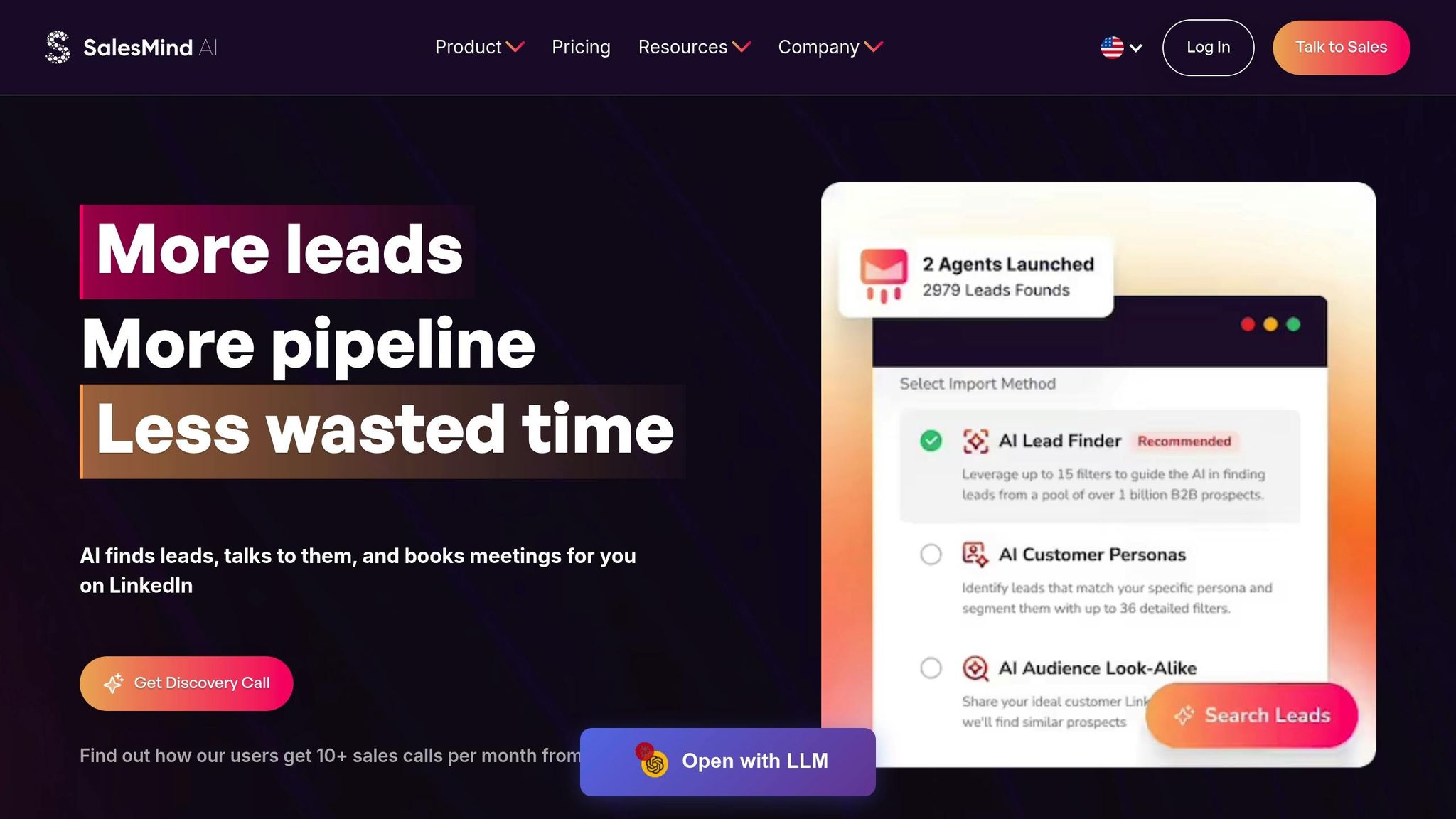
Advanced tools make combining these two approaches straightforward. SalesMind AI is designed to bridge the gap between automated and manual engagement with its key features. For example, its automated campaigns allow you to send personalized messages at scale, making it easier to connect with a broad audience efficiently. Meanwhile, its advanced lead scoring system evaluates engagement signals, firmographics, and behavior data to pinpoint the most promising prospects. This ensures your manual follow-ups are focused on leads that truly matter.
SalesMind AI also simplifies communication with its unified inbox, which brings all your LinkedIn conversations into one organized dashboard. An AI co-pilot enhances this experience by providing ready-to-use responses, tags, and reminders. This setup lets you seamlessly shift from automated outreach to personalized one-on-one engagement as soon as a high-priority lead responds. These features also make tracking ROI more precise and manageable.
ROI Measurement Best Practices
To measure ROI effectively, calculate the cost per meeting and per closed deal by factoring in both subscription fees and labor costs (estimated at $60/hour). Evaluate these metrics separately for both automated and manual outreach channels.
For automated outreach, focus on metrics like connection acceptance rates, reply rates, and meeting conversion rates. Use these insights to refine your templates and audience segments.
For manual outreach, track the time spent on each prospect tier and compare it to the revenue generated. If high-value prospects show better conversion rates, allocate more manual efforts to those segments. Make sure your automated outreach complies with LinkedIn's usage guidelines to avoid restrictions that could hurt your ROI. By reallocating resources to areas where manual outreach delivers stronger results, you can optimize your overall return on investment.
Top 3 strategies to automate outreach with free LinkedIn or Sales Navigator
FAQs
What compliance risks should I consider with automated LinkedIn outreach?
Automating LinkedIn outreach might seem like a time-saver, but it comes with its fair share of risks. For starters, it could violate LinkedIn’s terms of service, potentially leading to account restrictions or even permanent bans. On top of that, poorly managed automation can come across as spammy, which not only irritates recipients but can also damage your brand’s reputation.
There’s also the matter of privacy laws like GDPR and CCPA. If your outreach doesn’t align with these regulations, you could face legal penalties or lose the trust of prospective clients. To avoid these pitfalls, focus on personalization and transparency in your outreach efforts. It’s better to take the extra time to craft meaningful connections than to risk the consequences of a careless approach.
What’s the best way to combine manual and automated LinkedIn outreach?
To make the most of LinkedIn outreach, it's all about finding the right balance between efficiency and personalization. Start by leveraging automation tools like SalesMind AI to streamline tasks like identifying, qualifying, and engaging with leads. These tools save time and help ensure you're focusing on the right prospects.
But don’t stop there. Follow up with personalized messages to build authentic connections. Use the data and insights gathered through automation to craft messages that feel tailored and relevant. This combination of scalability and personal effort can lead to stronger engagement and better conversion rates.
How do I decide between manual and automated LinkedIn outreach?
When deciding between manual and automated LinkedIn outreach, it all boils down to your specific needs and resources. Are you aiming for deeply personalized, one-on-one connections? Then manual outreach might be your best bet, even though it requires more time and effort. On the flip side, if you're looking to reach a broader audience quickly, automated outreach can be a game-changer - though it may come at the cost of some personal touches.
Consider your goals, the time you can dedicate, and how critical personalized connections are for your strategy. For those prioritizing efficiency and scalability, automation tools like SalesMind AI can simplify the process while still allowing for a level of personalization that keeps your outreach effective.
 JG
JG