

.avif)




Find out how our users get 10+ sales calls per month from LinkedIn.
White label AI tools are transforming how agencies handle digital marketing. Instead of building costly in-house systems, agencies can leverage pre-built AI platforms under their own branding to automate tasks like LinkedIn outreach, lead scoring, and content creation. This approach saves time, reduces costs, and delivers measurable results, such as a 20-40% reduction in repetitive tasks and 245% revenue growth within a year.
Key takeaways:
- Efficiency Boost: Agencies using white label AI tools produce content 2-3 times faster and improve profit margins by 30-40%.
- Client Retention: AI-powered tools help agencies maintain high client satisfaction by offering personalized, 24/7 engagement.
- Revenue Growth: Agencies report significant increases in lead conversions and pipeline value, averaging $100,000 per month.
If you're an agency looking to scale without the overhead of additional staff or development, white label AI platforms like SalesMind AI provide a fast, scalable solution. From automating LinkedIn outreach to syncing CRMs, these tools make it easier to manage multiple clients and deliver results - while keeping your brand front and center.

White Label AI Tools Impact on Agency Performance: Key Statistics and ROI Metrics
Unlocking the Value: White-label AI, efficiency, and agency growth
Why Agencies Need White Label AI Digital Marketing Tools
Agencies are facing a tough challenge as client demands shift. Today, clients expect instant AI-driven solutions, personalized experiences, and measurable results. Meeting these expectations with manual processes is nearly impossible. White label AI tools offer a way to meet these demands while streamlining operations and delivering a solid return on investment (ROI).
Meeting Client Expectations for AI-Driven Results
Clients now assume that agencies use AI as part of their operations. In fact, 76% of consumers express frustration when companies fail to deliver personalized interactions[6]. This dissatisfaction can quickly push potential customers toward businesses offering 24/7 AI-powered engagement.
AI tools make it possible to scale engagement effortlessly. For instance, AI-driven LinkedIn automation has shown impressive results, with reply rates exceeding 55% and connection acceptance rates hitting 40%[1]. These aren’t just abstract numbers - they represent real, ongoing conversations happening round the clock. A great example is The Xcite Group in Denver. In 2024, they used AI for 24/7 lead capture, achieving a 20% increase in lead conversions and maintaining a 100% client retention rate[6].
Reducing Manual Work and Improving ROI
Manual tasks like SEO audits, data entry, and report generation eat up valuable time - time that could be spent on strategy or building stronger client relationships. AI-powered tools can cut that time dramatically. For example, content tools powered by AI can save up to 50% of the time spent on tasks and improve operational efficiency by threefold. Agencies using white label tools report 30–40% higher profit margins on resold services compared to agencies handling everything in-house[3][2][4].
"AI reporting automation cut our monthly reporting time from days to minutes. Clients get faster insights, and our account managers finally have time for strategy."
– Client Services Lead, Performance Marketing Agency[2]
One agency director shared that by incorporating AI workflows, 70% of SEO and content publishing tasks were automated, freeing up strategists to focus on large-scale campaigns[2]. These efficiency gains emphasize the need to choose AI tools that integrate smoothly into your current processes.
What to Look for When Choosing White Label AI Tools
Start by identifying tasks that consume more than two hours of your day. Then, evaluate tools based on how well they integrate with your existing systems, their ease of use, and pricing transparency[3].
Seamless integration is critical. As Sarah from Digital Dreams Agency noted, "Our tools just wouldn't play nice together. We had data scattered across three platforms, none talking to each other"[3]. Look for tools that natively integrate with your CRM, Slack, and Google Analytics to avoid creating data silos.
Pricing transparency is another essential factor. Entry-level plans typically range from $200 to $500 per month for basic white labeling. Mid-range options, offering full white labeling and priority support, can cost $500 to $2,000 per month[3][6]. For specialized tools, expect initial setup fees between $2,000 and $5,000 for full UI customization[1]. Resale margins for most agencies fall between 40% and 70% when reselling white label AI services[1].
Finally, prioritize tools with built-in compliance features. With regulations like GDPR and CCPA in place, privacy-first AI solutions and data isolation between client accounts are critical for protecting your agency and clients from legal risks[6].
SalesMind AI: White Label Solutions for Agency Growth
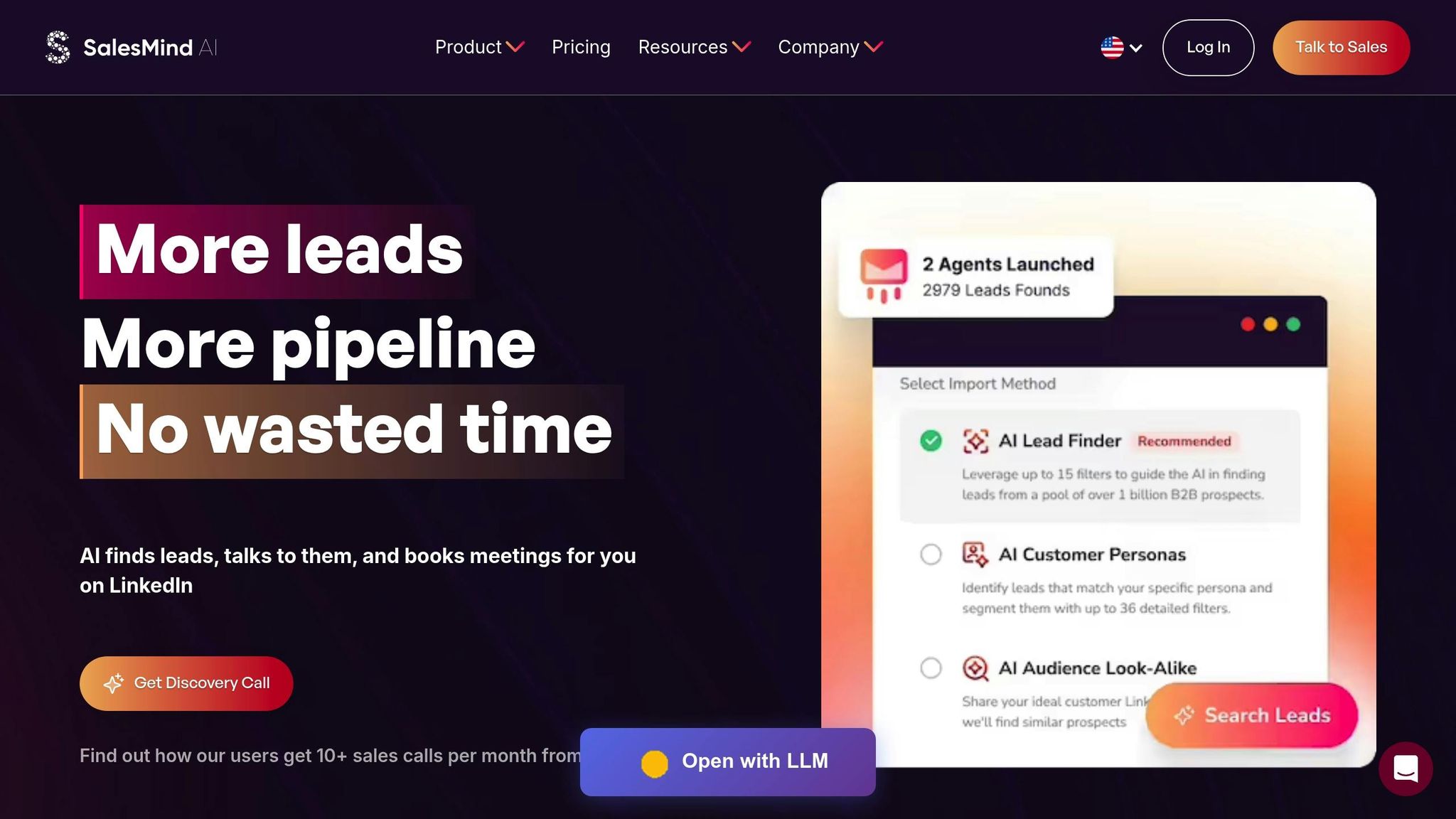
SalesMind AI offers a powerful white label platform designed to help agencies scale their operations efficiently. Built to streamline LinkedIn outreach, the platform automates connection requests, personalized messaging, and follow-ups - all while ensuring compliance with LinkedIn's automation policies. Trusted by over 4,000 companies, SalesMind AI is a go-to solution for B2B lead generation, serving agencies, startups, and recruiters alike[5].
On average, users generate $100,000 in pipeline value per month, with connection acceptance rates at 40% and reply rates at 42%. To date, the platform has helped generate more than $86 million in pipeline revenue[5]. Alex L., CTO at Slash Co, remarked, "From the very first week, SalesMind AI boosted my productivity in lead prospecting by 10×"[7].
Key Features of SalesMind AI
Unified AI Inbox: This feature consolidates LinkedIn replies from all client accounts into one interface, making it easier to manage conversations. The built-in AI co-pilot suggests responses, tags leads, and even sets reminders.
AI-Driven Lead Scoring: Automatically prioritize high-intent prospects based on criteria like location, role, industry, and behavior. The AI Prospect Profiler taps into a database of over 1 billion B2B contacts, delivering real-time insights that help agencies focus on the leads most likely to convert[5].
24/7 Automated Follow-Ups with CRM Sync: The platform ensures seamless lead management by syncing in real-time with CRMs like HubSpot and Pipedrive. This end-to-end automation reduces manual effort and speeds up the sales cycle[8][9]. Steven Huibers, COO at Policereports.ai, shared, "I've used a couple of other tools for LinkedIn outbound, but this has gotten me 3x the results"[5].
Agencies also get access to branded in-app chat, WhatsApp support, and a dedicated help center hosted on their subdomain. The entire platform can be customized with your agency's branding and deployed in just 7 to 14 days[10][5].
Pricing Plans for Different Agency Sizes
SalesMind AI offers flexible pricing plans that grow with your agency. The reseller program provides lower costs per seat as your client base expands, boosting your profit margins[5].
| Plan | Monthly Price | Target Audience | Key Features |
|---|---|---|---|
| Free Forever | $0 | Solo prospectors testing the platform | Basic prospecting features[1] |
| Starter Agent | $69 | Individual users or small teams | Basic LinkedIn automation, AI messaging[1] |
| Turbo Agent | Custom (6-month terms) | Growing agencies scaling operations | Higher limits, advanced automation[1] |
| Business Agent | Custom | Professional agencies with multiple clients | Full feature set, team management[1] |
| Enterprise | Custom Quote | Large agencies requiring unlimited accounts | Priority support, custom integrations[1] |
Setup Fee: A one-time fee ranging from $2,000 to $5,000 covers white label UI customization and domain mapping[1]. For tailored pricing based on your client volume, agencies can schedule a discovery call with the sales team[8].
How Agencies Benefit from White Labeling SalesMind AI
White labeling SalesMind AI allows agencies to expand their offerings without the need for costly development. Instead of building a platform from scratch, agencies can resell a proven tool that delivers results - like generating up to 200 qualified leads per week for active users[8].
Clients experience your branding at every touchpoint, from the interface to customer support, which reinforces your agency's authority and builds trust. The platform’s high ratings - 4.7/5 on G2, 4.4/5 on Trustpilot, and 5/5 on the Chrome Store - serve as strong social proof, helping to overcome client hesitations[7].
Revenue opportunities come in two forms: agencies can mark up the service price for clients and use the time saved by automation to onboard more clients. Nick Heijman, CEO at ExtractTech, summed it up well: "The results were sometimes almost too good - connection rates and responses were way above what I expected"[7].
sbb-itb-817c6a5
How to Implement SalesMind AI in Your Agency
Step-by-Step Setup and Integration Process
Getting SalesMind AI up and running involves a five-phase process that typically takes about two weeks from start to finish [5][10]. Begin by defining key performance indicators (KPIs) like MQLs, CAC, and pipeline value. At the same time, ensure your tech stack complies with GDPR and CAN-SPAM regulations.
During the branding phase, focus on customizing the platform to reflect your agency's identity. Upload your logo, set your color scheme, configure a favicon, and create a custom subdomain (e.g., app.youragency.com) to ensure your clients consistently engage with your brand. Next, migrate your data from legacy systems using CSV files or APIs, and standardize field names to enable accurate personalization.
Build your workflow automation by designing multi-step journeys that combine LinkedIn outreach, email, and SMS. Use conditional logic to adjust messaging based on prospect behavior or enriched firmographic data. SalesMind AI integrates seamlessly with CRMs through open REST or GraphQL APIs and Zapier connectors, ensuring smooth, real-time data flow. To maintain security, set role-based access controls, giving team members and clients appropriate permissions while restricting access to sensitive areas like billing or global templates.
"What ultimately made me choose SalesMind was the service." - Camilo Cardoso, CEO, Monomo [5]
Once setup is complete, launch with a pilot group of existing clients before expanding to your full client list. Monitor real-time dashboards to track deliverability rates and conversion improvements. Use this data to refine your processes before scaling to additional accounts. With integration complete, you’re ready to see how SalesMind AI can transform your B2B marketing and sales outreach.
Using SalesMind AI for B2B Marketing and Sales
Once implemented, SalesMind AI automates outreach, helping agencies deliver better results for their clients. For LinkedIn outreach, the platform handles everything - from sending connection requests to follow-up messages. Its AI Prospect Profiler taps into a database of over 1 billion B2B contacts, providing enriched firmographic data to help you focus on high-intent leads [5].
The Unified AI Inbox streamlines communication by consolidating all LinkedIn replies into one interface. Here, the AI co-pilot suggests responses and tags leads for follow-up. Automated follow-ups run 24/7 and sync with your CRM to keep lead statuses updated in real time.
Native AI tools simplify campaign creation. Features like subject-line testing and dynamic content blocks can cut campaign build time by up to 60% [5]. Plus, the platform’s hyper-personalized messaging engine is designed to bypass automation detection, ensuring outreach feels genuine and aligns with each client’s brand voice [5].
"The platform seems really intuitive, and I know different areas of our business have had success with this platform already." - David Plant, Business Development Director, Peninsula [5]
How to Customize Campaigns for Each Client
Once SalesMind AI is fully integrated, you can tailor campaigns to meet each client’s unique goals. Start by setting up individual client dashboards and assigning tailored roles, such as view-only access, to maintain transparency while minimizing the risk of accidental changes [5].
Adjust messaging templates to reflect each client’s industry, target audience, and brand tone. Use conditional logic to create dynamic workflows that adapt to prospect behavior and firmographic data. For instance, a SaaS client targeting enterprise accounts might benefit from a longer nurture sequence featuring educational content, whereas a recruiting agency might prioritize shorter outreach cycles with direct calls to action.
The platform’s white-label reporting tool lets you present live dashboards to clients, tracking metrics like MQL volume, pipeline value, and conversion rates. This shifts the conversation from activity-based metrics ("we sent 500 messages") to results-focused discussions ("we generated $75,000 in qualified pipeline"). As your client base grows, the reseller model reduces per-seat costs, increasing your profit margins and enabling you to scale services effectively without compromising quality [5].
Tracking Results and Scaling with SalesMind AI
Key Metrics to Track Agency Success
To measure your agency's success with SalesMind AI, focus on three core areas: engagement, pipeline growth, and operational efficiency. Start by analyzing engagement metrics like connection acceptance rates (around 40%) and reply rates (ranging from 42% to 55%)[1][5]. These figures show how well your AI-generated messages resonate with prospects.
Pipeline growth is another critical area. Keep an eye on your monthly pipeline value, which averages approximately $100K, and aim for 5-10 new qualified conversations each week that lead to booked calls[1]. For operational efficiency, look at productivity gains - users frequently report a 10x boost in output by automating manual prospecting tasks[1].
"I've used a couple of other tools for LinkedIn outbound, but this has gotten me 3x the results." - Steven Huibers, COO, Policereports.ai[5]
Financial performance also plays a big role. Agencies leveraging white-label reselling can see profit margins of 40%-70%, with client fees ranging from $2,000 to over $10,000 per month, while starting costs are as low as $69/month[1]. Regularly reviewing AI-generated lead scores helps refine your targeting and improve message effectiveness[1].
By tracking these metrics, you can confidently scale your operations and achieve better results.
How to Scale Services Across Multiple Clients
SalesMind AI's cloud-based infrastructure makes it easy to manage multiple clients, even on an enterprise scale. With support for unlimited LinkedIn accounts, you can oversee dozens of clients from a single, streamlined dashboard[1][5]. A unified inbox simplifies multichannel communication, allowing you to stay on top of all conversations efficiently[1].
To maintain secure workflows, implement role-based permissions. For example, you can grant clients view-only access to their dashboards while your team retains full control over campaigns[5]. Automated lead scoring powered by predictive analytics ensures your team focuses on high-conversion opportunities, saving time and effort[1]. Additionally, white-label branding lets you customize the platform with your agency’s logos, colors, and even subdomains (e.g., app.youragency.com), presenting the technology as your own proprietary solution[5][10].
Integrations with CRMs like HubSpot, Salesforce, and Pipedrive keep data synced automatically through APIs or Zapier, ensuring smooth operations as your client base grows[1]. For quick scaling, use the platform’s white-glove setup service to onboard new clients in under two weeks[5][10]. The MirrorProfiles integration further simplifies campaign management by running prospecting efforts under your brand without requiring technical expertise[1].
Scaling becomes manageable when you combine automation, customization, and seamless integration.
Using Data to Improve Performance Over Time
Real-time analytics are your secret weapon for refining performance. Review connection and reply rates weekly to uncover trends. For instance, if a particular industry segment consistently achieves reply rates above 55%, consider reallocating resources to target that vertical more aggressively[1]. The AI co-pilot also provides response suggestions during live conversations, helping you fine-tune your approach on the fly[1].
Leverage personality insights to tailor your messaging tone to each prospect's profile. Tracking which personality types convert most effectively for your clients can help you optimize outreach strategies for specific target markets.
"The results were sometimes almost too good, connection rates and responses were way above what I expected." - Nick Heijman, CEO, ExtractTech[5]
Keep an eye on deliverability rates, adjusting sending patterns if you notice any dips. The platform’s advanced IP management and human-like simulation allow you to engage with over 1,000 prospects daily while staying compliant with LinkedIn’s guidelines[1]. As you gather more data, document successful strategies in playbooks tailored to specific industries, company sizes, or job titles. These insights can give you an edge when presenting your services to potential clients.
Conclusion: How White Label AI Tools Help Agencies Grow
Summary of Agency Benefits
In a competitive marketplace, white label AI tools like SalesMind AI give agencies a powerful way to scale without the hefty investment in development teams. These tools allow agencies to roll out a fully branded sales automation platform in just 7–14 days, while maintaining profit margins of 40% to 70% [10][5][1].
SalesMind AI centralizes essential tasks like LinkedIn outreach, cold email campaigns, and CRM workflows into one easy-to-use dashboard. Plus, its built-in support system handles client inquiries via in-app chat and WhatsApp - all under your agency's branding [5]. This means your team can focus on strategic growth instead of getting bogged down with day-to-day support.
"The results were sometimes almost too good, connection rates and responses were way above what I expected." - Nick Heijman, CEO, ExtractTech [5]
The numbers speak for themselves: agencies using this platform report reply rates of 42% to 45% and generate an average of $100,000 in pipeline value every month [5][10]. These results not only enhance client relationships but also justify premium pricing, making AI integration a smart move for agencies looking to grow.
Next Steps for Agencies
To make the most of these benefits, start by identifying the high-volume tasks that take up the majority of your team's time - whether that's lead generation, prospect research, or follow-ups. SalesMind AI’s white label program offers custom subdomains, logos, and color schemes at no extra cost [5], enabling you to present the tool as your own proprietary solution right from the start, reinforcing your agency’s brand identity.
Focus on mastering one or two core AI services and calculate your unit economics to determine the right pricing structure. Many agencies successfully charge between $2,000 and $10,000+ per month for comprehensive AI-powered automation services [1]. By taking the leap with tools like SalesMind AI, your agency can streamline operations, strengthen its offerings, and open the door to new revenue opportunities.
FAQs
How can white label AI tools help agencies retain clients?
White label AI tools give agencies the power to offer cutting-edge, branded services while keeping their operations efficient. These tools can automate tasks like LinkedIn outreach, email campaigns, and lead scoring, helping agencies roll out new services faster, ensure consistent results, and sidestep delays caused by staffing challenges. The result? Tangible returns for clients, which boosts the chances of contract renewals and budget increases.
On top of that, these tools make personalization easier and help predict which prospects are most likely to convert. This allows agencies to zero in on high-value opportunities and deliver results backed by data. For clients, this translates to better campaign performance, shorter sales cycles, and stronger engagement - building trust and reinforcing the agency’s worth.
White label platforms also let agencies provide sleek, branded dashboards and clear performance reports. This transparency not only strengthens client relationships but also reduces misunderstandings, making it simpler to keep clients happy and loyal over time.
What costs should agencies consider when adopting white-label AI tools?
When agencies decide to integrate white-label AI tools into their offerings, they need to consider several important expenses. The subscription fee is one of the most common costs. Basic plans typically start at around $99 per month, while more advanced options can go up to $400 per month. For agencies seeking tailored solutions, pricing often shifts to a per-client or per-user basis, ranging from $100 to $700 per month, depending on the level of features and branding support included.
Another major expense to plan for is setup and integration costs, which can vary significantly. Setting up basic automation may cost between $2,500 and $15,000, but for more intricate, enterprise-level configurations, costs can exceed $50,000. These charges generally cover tasks like data migration, API integrations, and customizing workflows to fit the agency's specific needs.
Finally, agencies should factor in ongoing operational expenses, which include scaling licenses for additional clients, staff training, and support packages. Many agencies resell these tools to their clients at rates between $100 and $700 per month, allowing them to maintain healthy profit margins while covering recurring costs and any added services. By carefully budgeting for these expenses, agencies can ensure they get the most out of white-label AI tools while staying financially sustainable.
How can agencies customize white-label AI tools to match their brand identity?
Agencies can make white-label AI tools feel like an extension of their own brand by personalizing key client-facing elements. This means swapping out default logos, colors, and fonts for their own. Even the domain name can be customized. Some platforms take it a step further, offering options to tweak dashboard layouts, rename menus, and add custom widgets, allowing the interface to reflect the agency's specific style and tone.
Customization doesn’t stop at appearances. Agencies can fine-tune AI features to match their workflows. For example, they can set up campaign templates, establish personalized messaging rules, or define lead-scoring criteria tailored to their objectives. By integrating these tools with CRMs, email software, or analytics platforms, agencies can ensure a smooth transition from planning to execution. Some even embed AI capabilities into their own portals, making the technology feel invisible to clients while delivering a polished, cohesive experience.
Have You Ever Experienced Sales Done by AI?