5 Steps to Calculate CAC and LTV for SaaS
Calculate SaaS CAC and LTV in five steps to assess unit economics, improve retention, and hit a healthy LTV:CAC ratio.
 Julien Gadea
Calculate SaaS CAC and LTV in five steps to assess unit economics, improve retention, and hit a healthy LTV:CAC ratio.
Calculate SaaS CAC and LTV in five steps to assess unit economics, improve retention, and hit a healthy LTV:CAC ratio.
Table of Contents
Understanding CAC (Customer Acquisition Cost) and LTV (Lifetime Value) is critical for SaaS businesses to manage growth and profitability. Here's a quick breakdown:
-
CAC: Measures what you spend to acquire a customer. Formula:
(Total Sales + Marketing Expenses) ÷ New Customers Acquired.
Example: If you spend $95,000 and gain 50 customers, your CAC is $1,900. -
LTV: Represents the total profit a customer brings over their relationship with your business. Formula:
(ARPU × Gross Margin) × Customer Lifespan.
Example: With an ARPU of $100, 80% gross margin, and a 24-month lifespan, LTV is $1,920. -
LTV:CAC Ratio: Shows profitability. A ratio of 3:1 is ideal.
Example: If LTV is $1,920 and CAC is $500, the ratio is 3.84.
Key steps to calculate these metrics:
- Gather data: Include all sales/marketing costs and customer metrics.
- Calculate CAC: Total acquisition costs ÷ new customers.
- Find Customer Lifespan:
1 ÷ Churn Rate. - Calculate LTV:
(ARPU × Gross Margin) × Lifespan. - Interpret the LTV:CAC Ratio:
- Below 3:1: High costs, low profit.
- 3:1–5:1: Healthy.
- Above 5:1: Potential underinvestment in growth.
Regularly reviewing these metrics helps optimize costs, improve retention, and decide when to scale using white label B2B lead generation. Keep your payback period under 12 months for faster reinvestment.
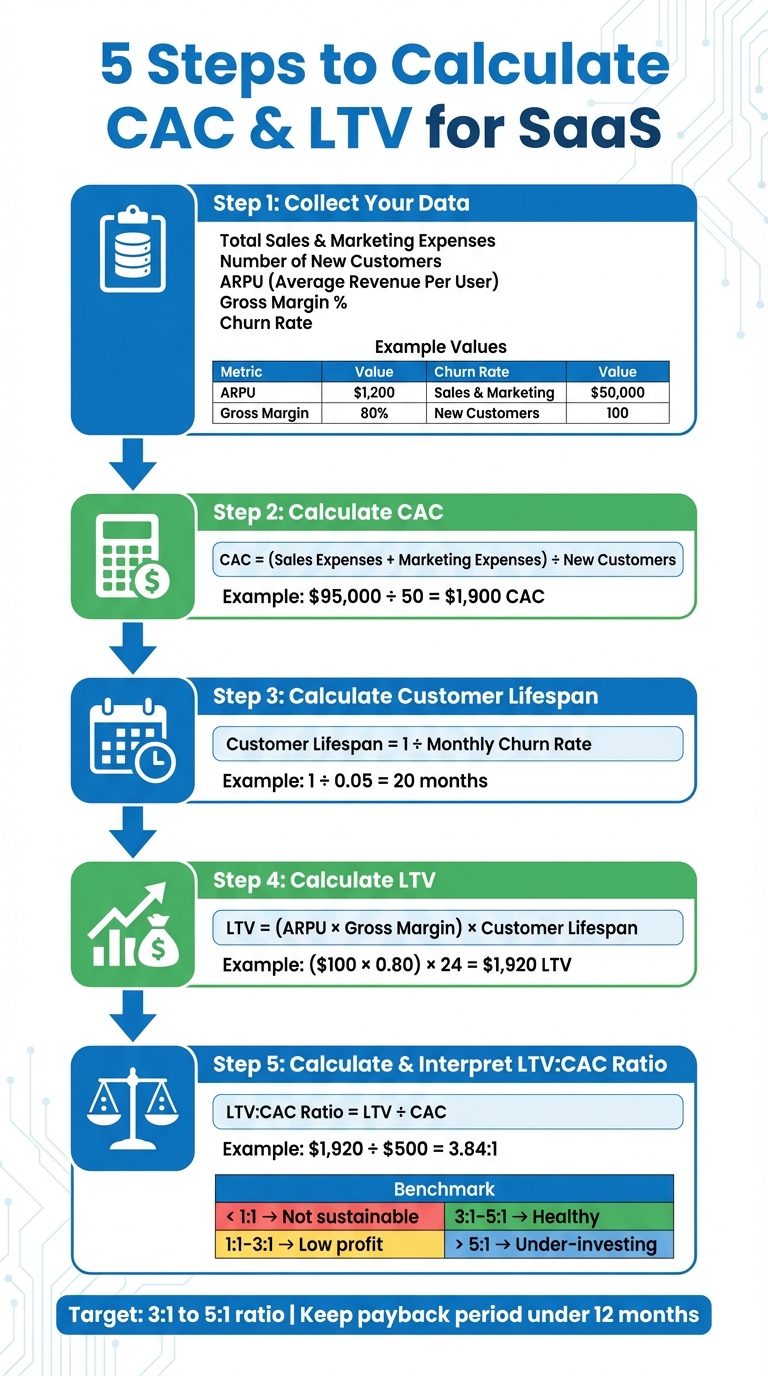
5-Step Process to Calculate CAC and LTV for SaaS Businesses
SaaS Metrics: LTV, CAC, CAC Payback Periods, and More
sbb-itb-817c6a5
Step 1: Collect Your Data
Before diving into calculations for CAC (Customer Acquisition Cost) and LTV (Lifetime Value), you need to gather the right data. Without accurate numbers, your results won't be reliable.
Metrics You Need
To calculate CAC, you'll need two key figures: your total sales and marketing expenses and the number of new customers acquired during the chosen timeframe. Sales and marketing expenses should include everything - salaries, commissions, ad spend, software tools for outreach, and even overhead costs like office rent for those teams [1][5].
For LTV, you'll need these three metrics:
- Average Revenue Per User (ARPU)
- Gross Margin percentage (revenue minus the cost of goods sold)
- Churn Rate (the percentage of customers lost during a given period) [1][2]
Here’s how these metrics might look in practice:
| Metric | Example Value | Why It Matters |
|---|---|---|
| ARPU | $1,200.00 | Helps estimate the average revenue generated by each customer. |
| Gross Margin % | 80% | Reflects profitability after covering the cost of delivering your product or service. |
| Churn Rate | 2.5% | Shows how long customers stick around, directly affecting LTV. |
| Sales & Marketing | $50,000.00 | Represents the total cost of acquiring customers. |
| New Customers | 100 | The basis for calculating CAC, showing acquisition volume. |
Make sure to account for all related expenses, including contractor fees, employee benefits, software subscriptions, and even portions of founder salaries where applicable [4][5].
As Ben Murray, Founder of The SaaS CFO, explains:
CAC can be viewed like an upfront investment or even a type of debt – you spend money today and recover it over time from customer payments [4].
Choose Your Time Period
Consistency is key when selecting a time frame for your metrics. Whether you’re looking at the past 12 months, a quarter, or a rolling three-month average, stick to a single period for all your calculations. For example, if you're using annual churn, pair it with annual recurring revenue. Likewise, if you're calculating monthly CAC, use monthly customer counts [9].
For high-volume, self-service SaaS businesses, monthly data typically works well. On the other hand, if you're running an enterprise model with only a few deals closing each month, a rolling quarterly average can help smooth out fluctuations [8]. Wall Street Prep emphasizes this:
The important thing is to remain consistent throughout the entirety of the calculation with either monthly or annual metrics in order to avoid timing mismatches [9].
Once you've gathered all the data, you're ready to move on to calculating your CAC in the next step.
Step 2: Calculate Customer Acquisition Cost (CAC)
Now that you've gathered your data, it's time to calculate your Customer Acquisition Cost (CAC). This metric shows how much you spend to acquire each new customer. Here's the formula you'll need:
CAC Formula and Example
The formula is simple: CAC = (Total Sales Expenses + Total Marketing Expenses) / Number of New Customers Acquired [1][4][3]. Be sure to include all relevant sales and marketing costs, such as salaries, commissions, ad spend, content creation, software, and overhead [1][5].
Here’s an example to make it clearer: Imagine your SaaS company spent $50,000 on sales team salaries and commissions, $30,000 on Google and Facebook ads, $5,000 on marketing tools and software, and $10,000 on content creation in a single month. That totals $95,000 in spending. If this effort brought in 50 new customers, your CAC would be $1,900.00 [1].
When calculating, only count new paying customers - those making their first purchase during the selected timeframe [4][10]. Exclude leads that haven’t converted, free trial users who haven’t paid, and repeat purchases from existing customers. Adam Hoeksema, Co-founder of ProjectionHub, offers a helpful guideline:
If it touches the prospect, include it [10].
This approach ensures you're accounting for all relevant costs in your CAC calculation.
One key distinction to keep in mind: There’s a difference between Paid CAC and Blended CAC. Paid CAC focuses only on customers acquired through paid channels, while Blended CAC includes all new customers - whether they came from paid efforts, organic traffic, or referrals - divided by your total acquisition costs [10]. Separating these metrics helps you evaluate the efficiency of different channels.
Step 3: Calculate Average Customer Lifespan
To understand how long a customer sticks around, you’ll need to calculate the average customer lifespan using your churn rate.
Customer Lifespan Formula and Example
Here’s the formula to determine the Average Customer Lifespan:
Average Customer Lifespan = 1 ÷ Monthly Churn Rate
First, convert your churn rate into a decimal. For example, a 5% churn rate becomes 0.05. Using this, if your SaaS business experiences a 5% monthly churn rate, the calculation would look like this:
1 ÷ 0.05 = 20 months
This means that, on average, a customer stays with your business for about 20 months before leaving. The relationship here is straightforward: the lower your churn rate, the longer your customers tend to stick around. For instance, a 2% churn rate translates to an average lifespan of 50 months, while a 10% churn rate shortens it to just 10 months.
Sean M. Cameron provides further clarity:
If you start with a cohort of 100 customers and apply a constant churn rate every month, you'll get an exponential decay... Mathematically this can be simplified to the following formula to find the average Customer Lifetime: 1 / Churn Rate. [11]
This metric is essential because it feeds directly into the calculation of Lifetime Value (LTV). By knowing how many months of revenue you can expect from each customer, you’re better equipped to assess their overall value - something we’ll dive into next.
Step 4: Calculate Lifetime Value (LTV)
Now that you’ve figured out your customer lifespan in Step 3, it’s time to assess the financial contribution each customer brings to your business. This is where Lifetime Value (LTV) comes into play. LTV represents the actual economic value of a customer - not just the revenue they generate, but the profit they contribute after accounting for costs.
Why focus on gross profit instead of total revenue? Because gross profit factors in essential expenses like hosting, infrastructure, third-party tools, and customer support. As Ron Gill, former CFO of NetSuite, puts it:
"I'm surprised at how often I see a SaaS product architected in a way that means they'll never clear a decent gross margin. Including GM in the calculation highlights a crucial lever for improving your LTV:CAC ratio" [11].
LTV Formula and Example
To calculate LTV, you’ll combine your average monthly profit per customer with how long they typically stay with you:
LTV = (ARPU × Gross Margin) × Average Customer Lifespan
Let’s break it down with an example. Imagine your SaaS business earns $10,000 in monthly recurring revenue from 100 active accounts, giving you an Average Revenue Per User (ARPU) of $100 per month. With an 80% gross margin and a monthly churn rate of 4.16%, your average customer lifespan is 24 months.
Here’s the math: ($100 × 0.80) × 24 = $1,920
This means each customer contributes $1,920 in profit over their lifetime. This number is key - it sets a benchmark for how much you can reasonably invest in acquiring new customers. Plus, it becomes a critical input for evaluating your LTV:CAC ratio, which we’ll dive into next.
Step 5: Calculate and Interpret Your LTV:CAC Ratio
Now that you've calculated your LTV (e.g., $1,920) and CAC (e.g., $500) in Step 2, it's time to put these numbers together to assess your financial health. Here's how to do it.
LTV:CAC Ratio Example
To calculate your LTV:CAC ratio, divide your LTV by your CAC. For instance, if your LTV is $1,920 and your CAC is $500, the result is a ratio of 3.84.
This means for every dollar spent acquiring a customer, you generate about $3.84 in lifetime value, which is well above the commonly accepted benchmark of 3:1 [1].
Sal Rehmetullah, Co-founder of Fattmerchant, emphasizes the importance of these metrics:
CAC and LTV are the two most crucial metrics for CFOs to track because they dictate your sales strategies [7].
Your ratio doesn't just measure profitability - it also gives insight into how aggressively you can scale your operations [7].
Benchmark Ratio Table
Here's a quick guide to interpreting your LTV:CAC ratio:
| Ratio Value | What It Means | Suggested Action |
|---|---|---|
| < 1:1 | Losing money; not sustainable | Address unit economics immediately or consider shutting down [1] |
| 1:1–3:1 | Low profit; high risk | Reduce CAC or increase LTV urgently [1] |
| 3:1–5:1 | Healthy and sustainable | Continue scaling and fine-tune operations [1] |
| > 5:1 | Outstanding profitability; under-investment risk | Consider increasing sales and marketing spend to grow faster [1] |
If your ratio is below 3:1, focus on reducing CAC by exploring cost-effective acquisition methods like LinkedIn automation tools, SEO, or referral programs. Simultaneously, work on increasing LTV by improving customer retention or upselling to current customers [1]. On the other hand, if your ratio exceeds 5:1, you might be under-investing in growth - this is a good time to ramp up your sales and marketing efforts [1].
Next, we’ll dive deeper into how these metrics fuel SaaS growth.
How CAC and LTV Drive SaaS Growth
Tracking Customer Acquisition Cost (CAC) and Lifetime Value (LTV) is central to managing sustainable growth in SaaS. By understanding these metrics, you can make smarter decisions about where to allocate your marketing budget, when to expand your sales team, and which acquisition strategies bring in the most profitable customers. This insight also enables more detailed analysis across different acquisition channels.
Breaking down CAC by channel - like paid ads, SEO, outbound sales, or LinkedIn outreach or cold email - helps identify which methods yield the best returns. For instance, if paid ads result in a 2:1 LTV:CAC ratio but organic content achieves 6:1, it’s clear where to focus your efforts and resources [6][4].
Your LTV:CAC ratio also serves as a signal for when to ramp up growth. Tomasz Tunguz, a Venture Capitalist at Redpoint, emphasizes its importance:
"The LTV/CAC ratio is the single most important metric for understanding the economics of a SaaS business" [2].
A ratio of 5:1 or higher could indicate that you’re underinvesting in growth opportunities [2][1]. This metric helps guide when to scale more aggressively and invest in growth initiatives.
Automation offers another way to reduce CAC by 12–15% [12]. Tools like SalesMind AI can simplify LinkedIn outreach, lead qualification, and follow-up management. By cutting down on manual tasks, these tools allow your team to focus on high-potential leads, ultimately increasing profitability.
Timing also plays a crucial role in managing acquisition costs. Monitoring your CAC Payback Period - the time it takes to recover your acquisition expenses - can reveal how quickly you can reinvest in growth [1][4]. Companies with payback periods under 12 months are typically in a better position to scale rapidly compared to those taking 18 months or longer to recover their investment.
Conclusion
Calculating CAC (Customer Acquisition Cost) and LTV (Lifetime Value) goes beyond crunching numbers - these metrics are the foundation of a sustainable SaaS business. As David Skok, Venture Capitalist at Matrix Partners, aptly explains:
A healthy company should have an LTV to CAC ratio that is at least 3 [2].
If your CAC starts creeping above your LTV, it’s a red flag that your unit economics need immediate attention. These metrics aren’t just theoretical - they’re your roadmap for ensuring profitability and long-term growth.
Let’s revisit the five-step framework: gather your data, calculate CAC, determine the customer lifespan, compute LTV, and analyze the LTV:CAC ratio. Make it a habit to review these calculations quarterly. This regular check-in helps you adapt to changing business conditions, optimize acquisition channels, and decide when to scale or pull back.
Accuracy is key. Ensure every cost is accounted for [1]. When calculating LTV, focus on gross profit (revenue minus COGS) instead of total revenue. This approach gives a clearer picture of the actual contribution to your bottom line [1].
Don’t overlook the payback period - it’s just as critical. Successful SaaS companies typically recover their CAC in 5 to 7 months [4]. A payback period under 12 months is considered healthy, while anything beyond 18 months signals that your unit economics need a serious overhaul [1].
To streamline your efforts, tools like SalesMind AI can help reduce CAC by automating tasks like LinkedIn outreach, lead qualification, and follow-ups. By cutting down on manual work and improving sales efficiency, automation enables your team to focus on high-value opportunities while lowering the cost per customer. Start applying these formulas today to refine your strategies and drive smarter, more sustainable growth.
FAQs
What can I do to improve my LTV to CAC ratio if it’s below the ideal 3:1?
To improve your LTV to CAC ratio, you need to focus on two main objectives: increasing Lifetime Value (LTV) and reducing Customer Acquisition Cost (CAC).
To boost LTV, try strategies like upselling, introducing premium pricing tiers, or cutting down on customer churn by enhancing retention initiatives. On the flip side, to bring down CAC, focus on segmenting your audience to target high-value prospects, eliminate spending on underperforming marketing channels, and invest in tools that make your sales process more efficient.
Striking the right balance between these efforts can help you aim for a healthier LTV to CAC ratio - ideally above the 3:1 benchmark.
What should I keep in mind when selecting a time period for calculating CAC and LTV?
When determining the time frame for calculating Customer Acquisition Cost (CAC) and Lifetime Value (LTV), it's important to pick a period that matches your sales cycle and reporting needs - typically monthly or quarterly. This helps maintain consistency and ensures the data remains relevant to your analysis.
Choose a time frame that captures enough data to account for seasonal trends and smooth out any early-stage fluctuations. For newer businesses, avoid overly short periods, as they can magnify temporary spikes or drops. Instead, select a duration that reflects your company’s current growth phase and provides reliable averages to guide your decisions.
Why should you use gross profit instead of total revenue when calculating LTV?
Focusing on gross profit instead of total revenue gives a clearer view of a customer's profitability. Gross profit factors in the direct costs of providing your service - like hosting or support expenses - offering a better understanding of the actual value each customer contributes to your business.
When you base your LTV calculation on gross profit, it reflects the real profitability of your customers. This approach helps you avoid inflated numbers that could lead to poor strategic choices, ensuring your growth strategies are grounded in sustainable financial realities.
 JG
JG