Build or Buy? The Ultimate List of White Label Lead Gen Tools to Scale Your Agency in 2025
Compare top white-label lead generation tools, pricing, integrations, and white-label features to decide whether to build or buy for agency growth in 2025.
 Julien Gadea
Compare top white-label lead generation tools, pricing, integrations, and white-label features to decide whether to build or buy for agency growth in 2025.
Compare top white-label lead generation tools, pricing, integrations, and white-label features to decide whether to build or buy for agency growth in 2025.
Table of Contents
Scaling your agency requires a key decision: build custom lead generation tools or buy white-label solutions? Building tools offers control but demands high costs, time, and technical resources. White-label tools, however, are faster to deploy (often in 1–2 weeks), cost-effective, and require no development. In 2025, AI-powered platforms dominate lead generation, boasting reply rates of 42–45% and delivering millions in revenue. This article explores five top white-label tools - SalesMind AI, ActiveCampaign, SocialPilot, LeadDyno, and GoHighLevel - covering features, pricing, and suitability for scaling your agency efficiently.
Key Takeaways:
- White-label tools save time and money: No need for months of development or hiring specialized teams.
- AI-driven platforms improve efficiency: They automate outreach, integrate with CRMs, and boost productivity.
- Customization is crucial: Choose tools that align with your agency’s branding and workflow needs.
- Pricing varies: From $15/month (ActiveCampaign) to $497/month (GoHighLevel), options fit different budgets.
Quick Comparison:
| Tool | Focus | Starting Price | White-Label Tier | Key Agency Benefit |
|---|---|---|---|---|
| SalesMind AI | LinkedIn & Cold Email | Custom Quote | Custom Quote | Scalable pricing, AI outreach |
| ActiveCampaign | Email Marketing & CRM | $15/mo | Tiered | Low-cost entry, CRM integration |
| SocialPilot | Social Media | $25.50/mo | $170/mo | Social media lead generation |
| LeadDyno | Affiliate Marketing | $49/mo | $49/mo | Referral tracking, branding |
| GoHighLevel | All-in-One SaaS | $97/mo | $297/mo | Templates, mobile app, CRM |
This guide helps you decide whether to build or buy and choose the right tool for scaling in 2025.
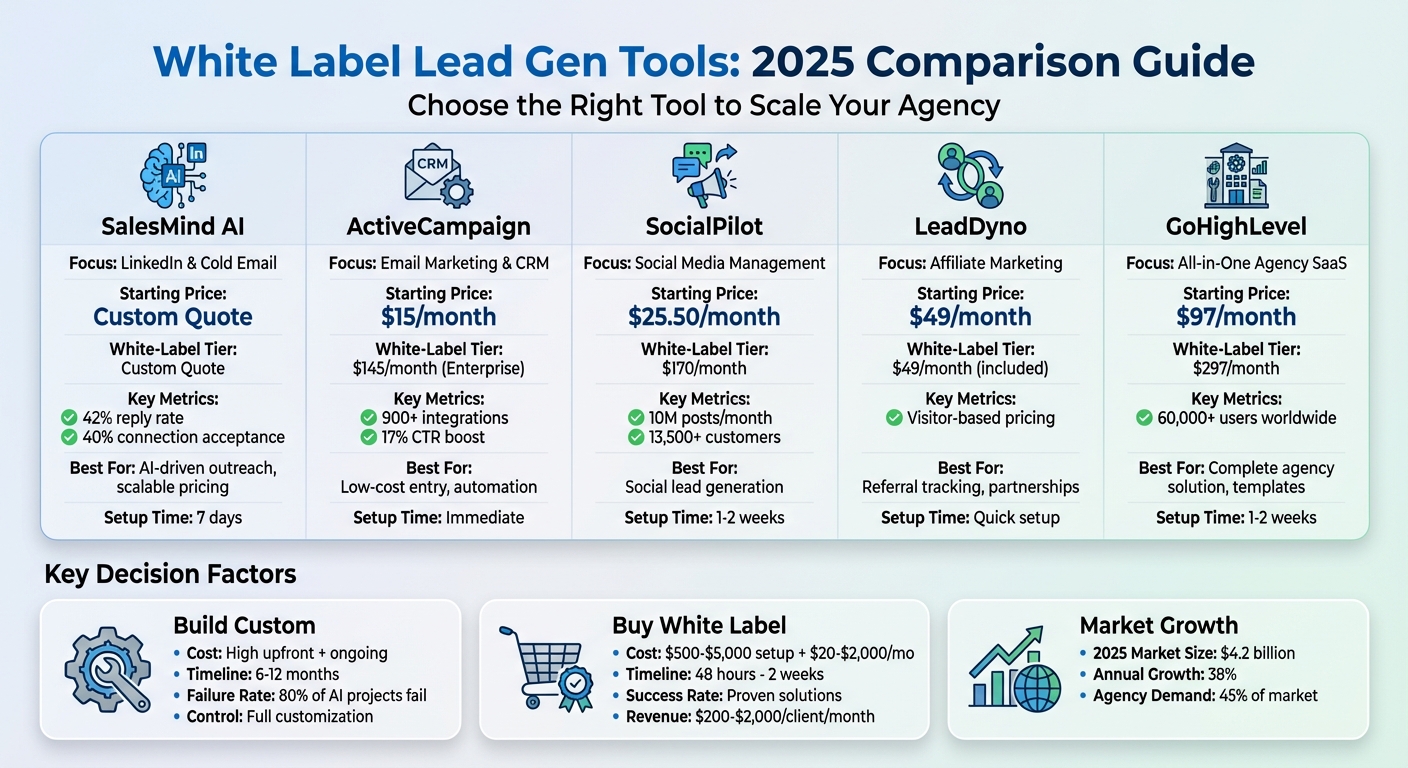 White Label Lead Generation Tools Comparison 2025: Features and Pricing" style="max-width:100%; margin:1em auto; display:block;">
White Label Lead Generation Tools Comparison 2025: Features and Pricing
4 white label SaaS tools that will make you $$$ in 2024 [lead gen tools]
What to Consider When Choosing White Label Lead Gen Tools
Picking the right white label lead generation tool is a game-changer for agencies. The right choice will align with your current workflow and grow alongside your business, while the wrong one could tie you to inflexible systems or inflate costs as you scale. To make the best decision, it's important to weigh factors like branding, integration, pricing, and specialized features.
Customization and branding should be at the top of your list. The tool you choose needs to reflect your agency's identity across all client-facing interfaces. Some platforms only allow basic branding, like swapping logos, while others offer full control over dashboards, reports, and overall user experience. Opt for tools that let you create a seamless, branded experience for your clients.
Integration capability is another critical factor. Agencies often juggle multiple tools - CRMs, ad networks, communication platforms, and more. Your lead generation tool should integrate smoothly with your existing software stack. As ActiveCampaign highlights:
"A seamless integration process ensures a smooth workflow and prevents unnecessary disruptions to marketing operations" [3].
Before committing, check whether the tool supports direct integrations or offers API access. Run tests with real data to identify potential syncing issues early on.
Pricing structure and scalability can make or break your investment. Entry-level pricing might seem attractive, but costs can climb quickly depending on user volume and feature needs. Prices range from $15/month for basic tools to $497/month for platforms with full white-label capabilities [3][4]. Be sure to calculate long-term costs and consider whether you can resell the platform to clients while maintaining healthy margins.
B2B-specific features are essential if your agency focuses on business-to-business clients. Look for tools that support LinkedIn automation, advanced lead scoring, and multi-touch attribution. These features are crucial for personalizing outreach and tracking engagement across the long sales cycles typical in B2B industries. To ensure the tool delivers, review G2 ratings and case studies to see how it performs in real-world scenarios.
1. SalesMind AI
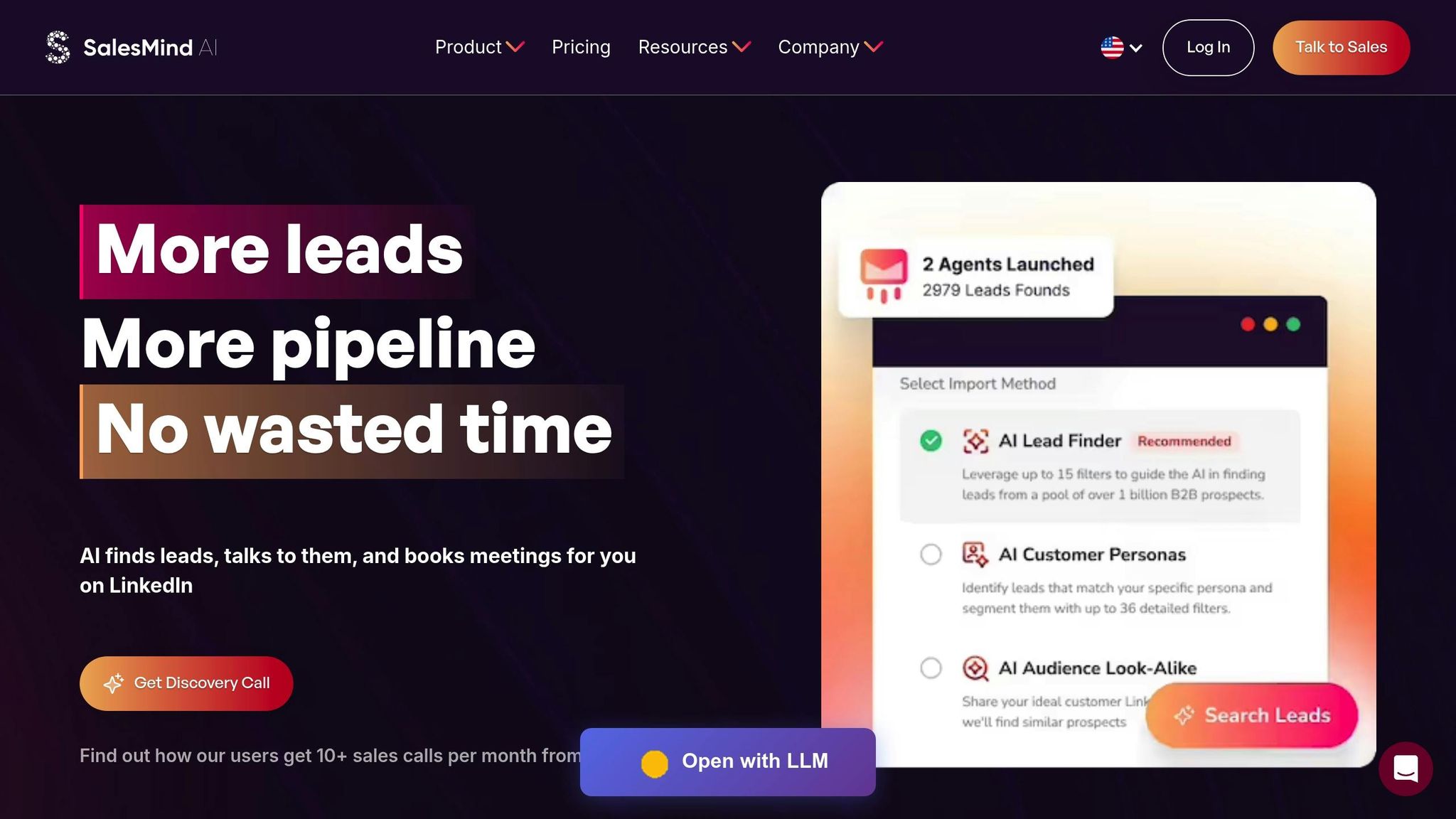
When it comes to tools that prioritize customization, seamless integration, and efficiency, SalesMind AI emerges as a standout option. Designed to scale B2B lead generation without the need for additional developers or support, this platform combines LinkedIn automation with AI-driven personalization. It takes care of the entire prospecting funnel, from sending connection requests to executing multi-step follow-ups. Users have reported impressive metrics, including an average reply rate of 42% and a connection acceptance rate of 40% [1]. It’s a prime example of how a ready-to-use solution can outperform custom-built systems.
LinkedIn Automation
SalesMind AI operates 24/7, running outreach campaigns that bypass LinkedIn's automation filters by leveraging hyper-personalized messaging. It tailors outreach using prospect and company data, combined with MBTI insights to adjust tone and approach [5]. For enterprise users, its cloud-based infrastructure can manage outreach to over 1,000 prospects daily [5]. Steven Huibers, COO at Policereports.ai, shared his experience:
"I've used a couple of other tools for LinkedIn outbound, but this has gotten me 3x the results" [1].
CRM Integration
The platform integrates seamlessly with major CRMs like Salesforce, HubSpot, and Pipedrive. It also supports Zapier and offers REST API access for additional flexibility [5]. Its Unified AI Inbox consolidates replies from LinkedIn, email, WhatsApp, and Telegram into a single dashboard, enhanced with AI-generated reply suggestions and automated lead scoring. Reflecting on its efficiency, Rahul P., Senior Advisor at Bounty Media, remarked:
"SalesMind AI has proven very useful to our sales team in reducing the massive pain points of manually tracking each and every lead interaction" [2].
White-Label Capabilities
For agencies, SalesMind AI offers full white-label functionality, allowing customization of logos, colors, and subdomains - all at no additional cost [1]. Agencies also benefit from dedicated in-app chat and WhatsApp support under their own branding. Volume discounts are available as client bases grow, enabling agencies to launch their branded SaaS platforms in just 7 days, without any development effort [1]. To date, the platform has supported over 4,000 companies and generated more than $86 million in total pipeline revenue [1].
Pricing Tiers
SalesMind AI offers flexible pricing options. The Starter Agent plan starts at roughly $69/month, with Turbo Agent and Business Agent plans available for scaling operations. A full white-label setup typically costs between $2,000 and $5,000 [5]. The platform also provides a 7-day free trial with no credit card required. User reviews speak to its effectiveness, with ratings of 4.7/5 on G2, 4.4/5 on Trustpilot, and 5/5 on the Chrome Store [2].
2. ActiveCampaign
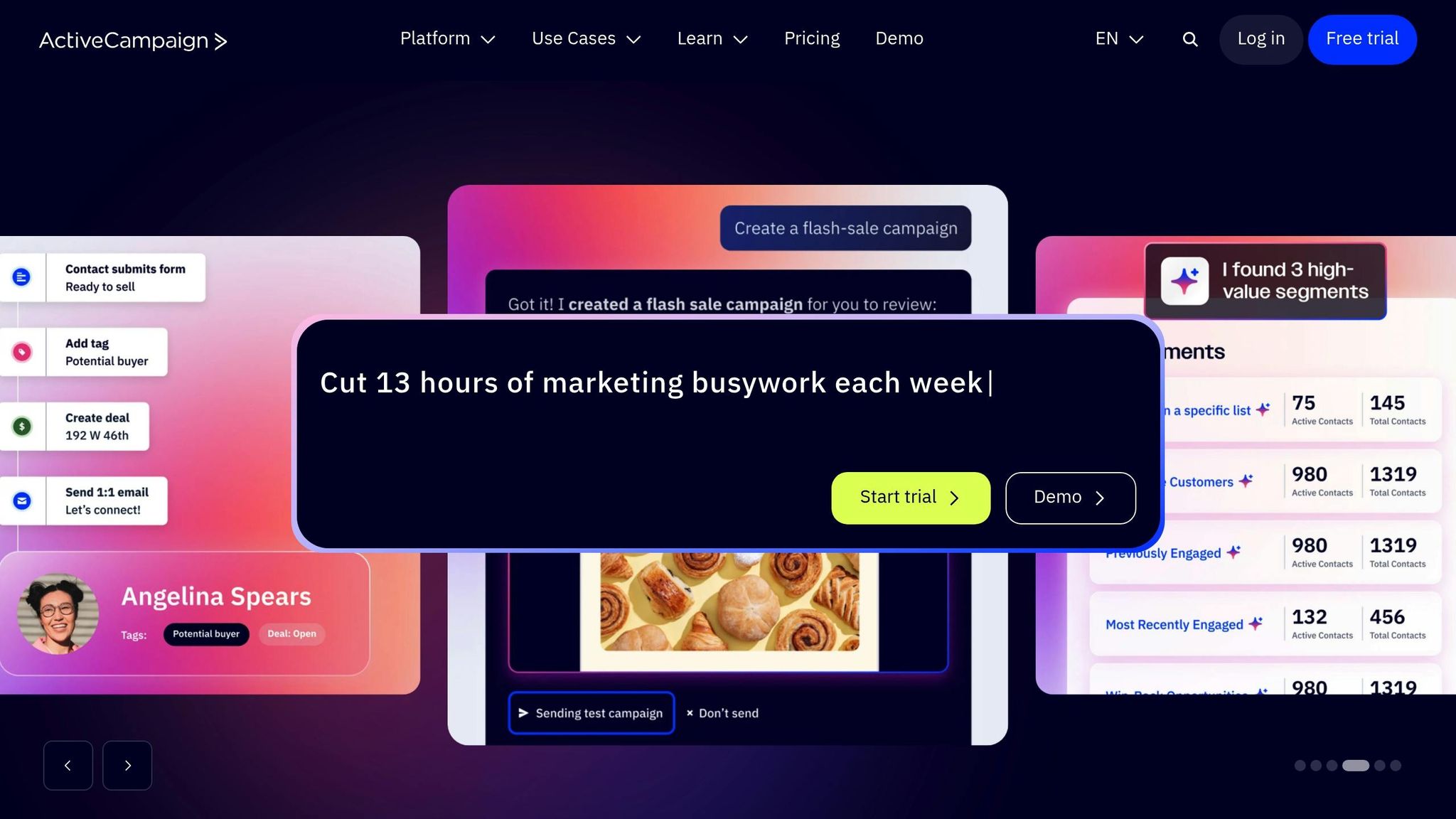
ActiveCampaign combines email automation, CRM tools, lead scoring, segmentation, and over 1,000 integrations, making it a powerful choice for managing multiple client campaigns efficiently [6]. It's especially effective for agencies aiming to align marketing and sales efforts across various client accounts.
CRM Integration
ActiveCampaign comes with a built-in CRM that tracks sales opportunities alongside marketing efforts [3]. It integrates seamlessly with popular B2B tools like Salesforce, Microsoft Dynamics 365, and Zendesk Sell, ensuring data flows smoothly across your tech ecosystem [6]. The platform's automated lead scoring helps identify and prioritize high-value prospects based on their engagement levels. For instance, in 2024, UK-based consultancy Slick Business used ActiveCampaign's integration features to automate client onboarding and segment Facebook followers, driving a 600% increase in course sales revenue [6]. They shared their experience:
"I recently upgraded to ActiveCampaign Plus and the things that it has unlocked for me! It's nearly all about the integration side of things!" – Slick Business [6]
White-Label Capabilities
ActiveCampaign also offers full white-labeling options for enterprise clients, allowing agencies to customize the platform extensively. Enterprise accounts can replace ActiveCampaign branding with their own, including custom domains, logos, and tailored HTML/CSS designs [10]. Branding can even be personalized for individual client accounts, providing each client with a dashboard featuring their unique logos and colors. The AI Brand Kit simplifies this process by importing fonts and colors directly from a client’s website to ensure consistency across email designs [9]. Career consultancy Wonsulting utilized these features to onboard new clients and deliver highly targeted content, resulting in 25,000 newsletter signups in just one month [9].
Pricing Tiers
ActiveCampaign offers three pricing plans: the Starter plan at $15/month, the Plus plan at $49/month (which includes advanced automation and AI content generation), and the Enterprise plan at $145/month, which supports full white-labeling, custom reports, and premium integrations. All plans are based on a 1,000-contact limit [3][10][11]. Users have reported a 17% boost in click-through rates using the Predictive Sending feature, with 88% stating the platform delivers value quickly [7].
Scalability for B2B Sales
The platform’s automation engine supports complex, behavior-driven workflows with over 900 pre-built templates, such as the "Lifecycle Nurture for New Leads" recipe. It also offers five-way split testing to refine content and integrates with LinkedIn Ads to unify email and ad campaigns [3][6][8][9]. These tools make ActiveCampaign an excellent option for agencies looking to streamline operations and scale their B2B sales efforts effectively into 2025.
3. SocialPilot
SocialPilot stands out as a comprehensive white-label solution designed for social media management. With over 13,500 customers worldwide [12], this platform supports major networks like LinkedIn, Facebook, Instagram, and TikTok. It's particularly appealing for B2B agencies aiming to maintain a consistent and professional social media presence. Impressively, SocialPilot handles 10 million posts monthly and has already published more than 5 billion posts [14][15].
White-Label Capabilities
SocialPilot's Premium ($100/month) and Ultimate ($200/month) plans unlock full white-labeling options. These include custom domains, branded dashboards, and personalized login pages [12][13][14]. Agencies can also rebrand analytics reports with their own logos and colors. For added functionality, the platform integrates with Google Tag Manager, enabling features like personalized chatbots or cross-selling opportunities directly within the white-labeled dashboard [12][13].
Scalability for B2B Sales
Managing over 100 client accounts from one centralized dashboard, SocialPilot is tailored for B2B agencies [12]. It offers LinkedIn document publishing and bulk scheduling of up to 500 posts at once, streamlining operations [14][15]. Approval workflows for clients and managers make content reviews across multiple accounts more efficient [14].
For example, Team Elevation Brands switched to SocialPilot to boost capacity while maintaining profit margins [15]. Similarly, Brittany McNicholas of The Senior Strategist in Minnesota leveraged SocialPilot’s cost-effective tools to expand her client base without immediately hiring additional staff [15].
Pricing Tiers
SocialPilot offers four pricing options:
- Essentials: $30/month for 7 accounts and 1 user.
- Standard: $50/month for 15 accounts and 3 users.
- Premium: $100/month for 25 accounts, 6 users, and white-label reports with unlimited client seats.
- Ultimate: $200/month for 50 accounts, unlimited users, advanced white-label features, and a dedicated account manager [14].
Annual billing comes with a 15% discount, and there’s a 14-day free trial available - no credit card required [12].
"After spending 3 weeks comparing social media scheduling tools, SocialPilot emerged as the best option. It surpasses Hootsuite and Buffer in value, cost, and exceptional customer support." – Jenna D., Founder, Life in Düsseldorf [12]
With its extensive features and flexible pricing, SocialPilot makes social media automation a practical and scalable solution for B2B agencies.
sbb-itb-817c6a5
4. LeadDyno
LeadDyno takes a unique spin on lead generation by focusing on affiliate and referral tracking. Instead of handling outreach or social media management, it helps agencies transform partner networks into steady streams of qualified leads. This makes it an excellent fit for B2B agencies that depend on partnerships or aim to create referral programs for their clients.
CRM Integration
LeadDyno seamlessly connects affiliate marketing efforts with CRM systems. It automatically channels leads from affiliate partners straight into the sales pipeline, preserving attribution so sales teams know exactly which affiliate referred each lead. This setup removes the need for manual data entry, minimizes lead duplication or loss, and ensures timely follow-ups.
White-Label Features
The platform also offers white-label options, such as custom domains and branded affiliate portals. With these tools, agencies can rebrand the affiliate interface using their own logo, colors, and domain name, creating a cohesive brand experience for clients. This is particularly useful for agencies that want to include referral programs in their services without exposing the technology behind them.
Flexible Pricing
LeadDyno uses a pricing model based on monthly unique visitor volume. This makes it adaptable for smaller agencies while still supporting larger operations as they grow. Agencies only pay for the traffic they generate, keeping costs aligned with their usage and client base expansion.
With its scalable pricing and white-label capabilities, LeadDyno is well-suited to help agencies grow their referral programs in the years ahead.
5. GoHighLevel
GoHighLevel is a comprehensive platform designed to help agencies operate like software providers. With a global user base of over 60,000, it’s built to grow alongside agencies of all sizes [18].
White-Label Capabilities
One of GoHighLevel’s standout features is its "Snapshots" system. This allows agencies to create ready-to-use templates for specific niches, like real estate, dental practices, or HVAC services [17]. These templates include funnels, workflows, and automations, enabling agencies to onboard new clients almost instantly without starting from scratch.
On top of that, GoHighLevel offers a unified communication inbox. This feature merges leads from multiple channels - SMS, email, Facebook Messenger, Instagram DMs, WhatsApp, and Google Business Profile - into one streamlined, white-labeled dashboard [16].
"This turns a standard agency into a SaaS company overnight - without building any software." - GoHigh Impact [17]
The platform’s white-label capabilities extend beyond communication, offering tools to simplify and enhance agency operations.
CRM Integration
GoHighLevel also functions as a robust CRM. Its SaaS Pro plan automates key tasks like client onboarding and billing through Stripe, cutting down on time-consuming administrative work [17]. Designed with B2B niches in mind, its automation workflows help agencies standardize operations across their client base [17].
Pricing Tiers
The SaaS Pro plan is priced at $497 per month and includes features such as SaaS Mode, automated billing, white-label mobile app functionality, and the ability to rebill clients with a markup [17][18]. While the mobile app feature is included, publishing the app requires separate Apple and Google Developer accounts, which come with annual fees [18]. Many agencies use this platform to offer high-value services, often charging onboarding fees between $500 and $2,000 to set up the white-labeled environment for their clients [17].
Feature and Pricing Comparison
Here’s a breakdown of pricing and features for five popular white-label lead generation tools. The table below highlights key details, making it easier to evaluate which platform aligns with your agency's needs.
SalesMind AI provides a flexible reseller model where per-seat costs decrease as your client base expands, making it ideal for scaling. It focuses on AI-driven LinkedIn outreach and cold email campaigns. Agencies can launch a fully branded reseller platform in under two weeks, complete with a custom subdomain, branded help center, and white-labeled chat support [1].
ActiveCampaign is an affordable choice for startup agencies, starting at $15/month. It’s tailored for email automation and CRM workflows. White-label features are available through tiered plans, so costs may increase as your agency grows.
SocialPilot offers white-labeling on its Agency+ plan, priced at $170/month. For those starting out, the professional plan begins at $25.50/month, focusing on social media management and lead generation.
LeadDyno stands out for its affordability, with customized branding included in its base plan at $49/month. It’s particularly suited for agencies specializing in affiliate lead generation and referral tracking.
GoHighLevel delivers an all-in-one agency solution. The entry-level plan starts at $97/month, while its advanced Unlimited plan, priced at $297/month, includes features like a branded mobile app and a Snapshot system for duplicating client setups with ease.
The table below summarizes these comparisons:
| Tool | Primary Focus | Starting Price | White-Label Tier | Key Agency Benefit |
|---|---|---|---|---|
| SalesMind AI | LinkedIn & Cold Email | Custom Quote | Custom Quote | Scalable pricing with decreasing per-seat costs [1] |
| ActiveCampaign | Email Marketing & CRM | $15/mo | Tiered | Low cost entry with over 900 integrations [3] |
| SocialPilot | Social Media Management | $25.50/mo | $170/mo | Focused on social media lead generation [3] |
| LeadDyno | Affiliate Marketing | $49/mo | $49/mo | Cost-effective affiliate tracking with branding [3] |
| GoHighLevel | All-in-One Agency SaaS | $97/mo | $297/mo | Advanced tools like Snapshot system and mobile app |
This comparison helps you weigh the pros and cons of building your own solution versus leveraging white-label platforms for faster growth.
How to Decide: Build vs. Buy
Choosing between building custom lead generation tools or purchasing white label solutions boils down to four main factors: cost, timeline, technical capacity, and scalability. Let’s break down the key trade-offs for each option.
Start by evaluating the total cost. Building in-house comes with significant upfront expenses, including development costs, salaries for specialized talent, and ongoing investments in bug fixes, security updates, and adapting to changes like LinkedIn algorithm updates. It's worth noting that over 80% of in-house AI projects fail due to skill gaps or data-related challenges [19]. On the other hand, white label solutions require a one-time setup fee - ranging from $500 to $50,000 - and predictable monthly subscription costs, which can vary from $20 to over $2,000 per client.
Time-to-market is another critical factor. Developing a custom solution can take anywhere from 6 to 12 months (or longer) before it starts generating revenue. In contrast, white label platforms can be up and running in as little as 48 hours, with most launches occurring within 1–2 weeks. This quick turnaround not only accelerates revenue generation but also frees up your team to focus on sales and client acquisition instead of months of development work.
Growing Your Agency with White Label Tools in 2025
White label tools eliminate the need for expensive in-house development and hiring specialized staff. By choosing a ready-to-use solution, your agency can tap into advanced AI-powered outreach features almost instantly. This allows your team to focus on closing deals rather than dealing with the complexities of software management. The result? Smoother operations and a stronger position to seize opportunities in a booming market.
The financial upside is clear. Agencies typically charge anywhere from $200 to $2,000 per month for white-labeled AI outbound platforms, making it a lucrative offering [20].
The market is showing no signs of slowing down. By 2025, the white label marketing automation sector is projected to hit $4.2 billion, with an annual growth rate of 38% [21]. Digital marketing agencies already account for 45% of market demand [21]. Meanwhile, trends like AI integration, privacy-focused marketing, and no-code workflows are making high-level automation tools more accessible - even for teams without technical expertise.
To ensure success, consider launching a 60-90 day pilot program with a small group of 5-10 client accounts. This approach helps you test integration reliability and gauge user adoption [21]. When selecting a tool, match it to your agency's needs and budget. Entry-level tools are available for as little as $9-$15 per month, while mid-market options often involve setup fees ranging from $2,500 to $15,000 and revenue-sharing agreements of 25-40% [21].
FAQs
What are the key advantages of using white-label lead generation tools for agencies?
White-label lead generation tools provide agencies with a quick and budget-friendly way to enhance their service offerings without the hassle of developing custom software. These tools come ready to use, fully branded with your agency’s identity, and are managed by the provider, saving both time and the expense of hiring a development team.
Packed with features like AI-driven automation, CRM integrations, and scalable outreach capabilities, these platforms enable agencies to manage more prospects efficiently while ensuring communication stays on-brand. They also open doors to new revenue opportunities - whether through reselling the service or bundling it with existing offerings. Plus, the actionable analytics included help fine-tune performance and maximize ROI.
By adopting white-label solutions, agencies can concentrate on growing their business, offer top-tier services, and establish themselves as industry leaders - all without the burden of handling complex technology.
How do white-label lead generation tools work with my current CRM?
White-label lead generation tools are built to work effortlessly with well-known CRM systems like Salesforce, HubSpot, and Microsoft Dynamics. These integrations ensure that key prospect data - like LinkedIn messages, email campaigns, and scheduled meetings - automatically syncs with your CRM in real time. This removes the hassle of manual updates, keeping contact records, lead stages, and pipelines current without added effort.
For businesses using more specialized or on-premise CRMs, many tools provide custom API options. These allow agencies to adapt integrations to meet their specific requirements. With two-way synchronization, any updates made in the CRM, such as changes to lead scoring or statuses, are instantly reflected in the lead generation platform. This seamless setup enables agencies to roll out branded services quickly while ensuring data consistency and smooth workflows for their clients.
What should agencies consider when deciding to build or buy lead generation tools?
When deciding between creating custom lead generation tools or opting for white-label solutions, agencies need to weigh factors like cost, time, and scalability. Developing a custom tool involves a hefty upfront investment - often running into tens of thousands of dollars - along with ongoing maintenance and the need for a dedicated development team. In contrast, white-label solutions usually come with lower initial costs, include regular updates, and transfer the technical workload to the vendor.
Time-to-market is another key factor. White-label tools enable agencies to roll out services quickly - sometimes in just a few days - allowing for faster revenue generation. Custom-built tools, while offering more flexibility, can take months to design, build, and launch, potentially slowing down business growth.
It’s also important to consider long-term ROI and support. White-label platforms often come equipped with features like CRM integrations, account management tools, and ongoing updates, making them easier to scale over time. While custom solutions can deliver higher profit margins, they demand continuous investment in development, security, and upgrades. Balancing these considerations carefully will help agencies select the best option to align with their growth plans for 2025 and beyond.
 JG
JG