

.avif)




Find out how our users get 10+ sales calls per month from LinkedIn.

In 2026, businesses face a critical decision: build a custom white-label lead generation tool or buy an existing solution. Here's the key takeaway: buying a solution like SalesMind AI is faster, less expensive upfront, and easier to maintain, while building your own offers complete control but comes with higher costs, longer timelines, and significant risks.
Key Insights:
- Time to Market: SalesMind AI can launch in 7–14 days, whereas custom-built solutions take 6–18 months.
- Cost: Building a platform costs $100,000–$500,000 upfront, plus $10,000–$50,000 monthly for maintenance. SalesMind AI starts at $69/month, with a one-time setup fee of $2,000–$5,000 for white-label features.
- Scalability: SalesMind AI supports automated outreach and easy scaling. Custom builds require ongoing engineering and higher resource investment.
- Risk: 80% of in-house AI projects fail due to skill gaps or data challenges. SalesMind AI eliminates these risks with a proven, ready-to-use system.
Quick Comparison:
| Feature | SalesMind AI | Custom-Built Solution |
|---|---|---|
| Time to Market | 7–14 days | 6–18 months |
| Upfront Cost | $2,000–$5,000 setup fee | $100,000–$500,000 |
| Monthly Cost | $69+ | $10,000–$50,000 |
| Scalability | Automated, cloud-based | Requires ongoing resources |
| Customization | Moderate (branding, UI) | Full control |
| Risk | Low | High |
For most businesses, buying a white-label solution like SalesMind AI offers a quicker, lower-risk path to scaling lead generation. However, building a custom platform may suit enterprises with niche needs and resources to manage long-term risks and costs.

Build vs Buy White Label Lead Gen: Cost, Time & Risk Comparison 2026
Launch Your White-Label AI Lead Generation Agency in 2025 | Done-For-You Enterprise System
1. SalesMind AI
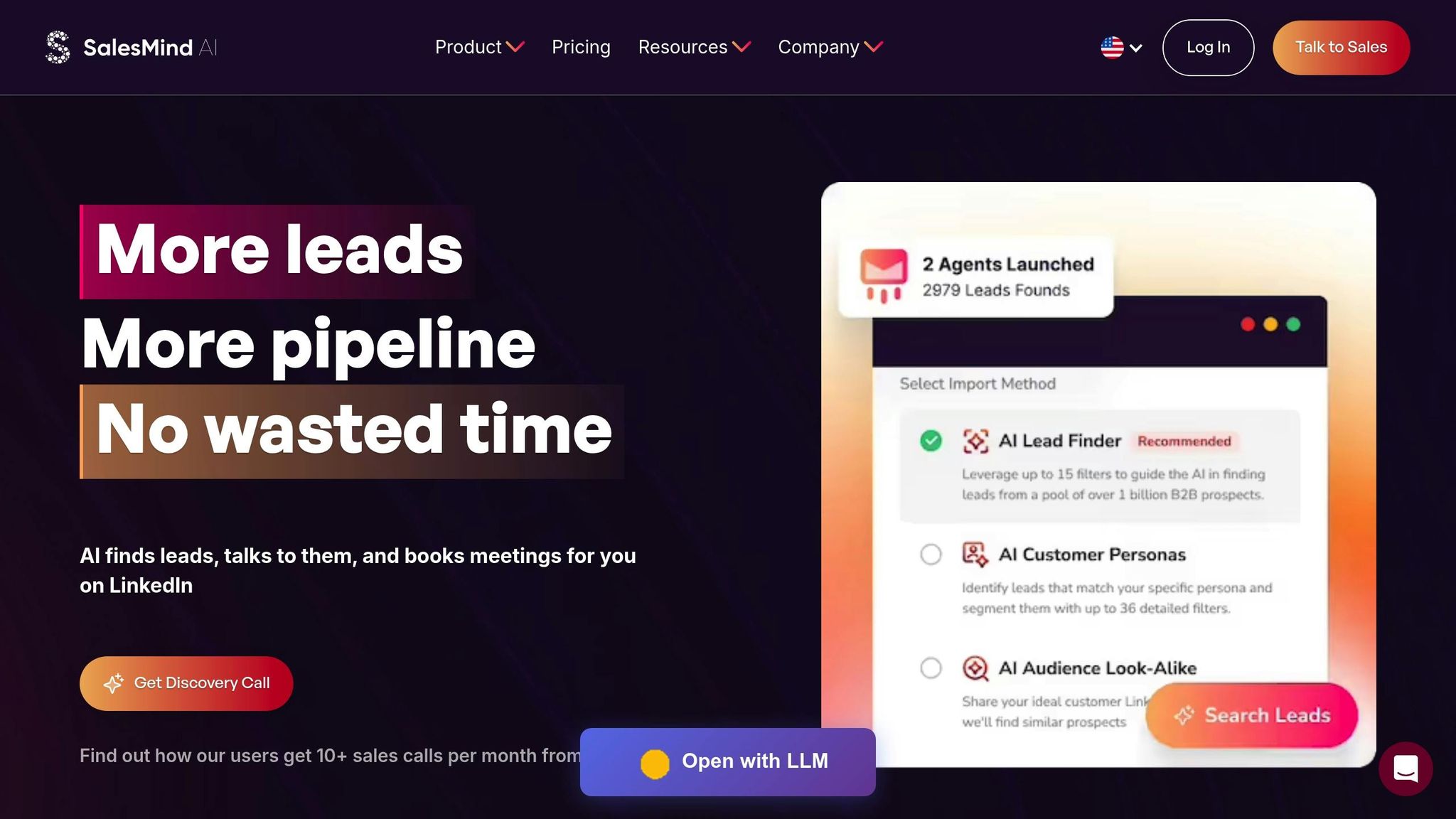
SalesMind AI provides a ready-to-use white-label lead generation platform that agencies can fully customize and launch within 7–14 days - no developers needed [2][5]. At its core, the platform focuses on LinkedIn automation through its MirrorProfiles integration. This feature uses advanced IP management and realistic behavior simulation to safely handle multiple client accounts under your agency’s branding [4]. Users report impressive results, with connection acceptance rates at 40% and reply rates ranging from 42% to 55%. To date, the platform has driven over $86 million in pipeline revenue for its users [2][4].
Features
SalesMind AI’s cloud-based system enables outreach to more than 1,000 prospects daily across multiple channels, including LinkedIn, email, WhatsApp, and Telegram - all managed through a unified inbox [4]. It also incorporates MBTI analysis for lead segmentation and real-time AI-powered conversation analysis, complete with reply suggestions [4]. For white-label users, the platform offers full customization options, such as branded logos, colors, subdomains, and even a dedicated help center for clients [2][4].
"Probably 3 years ahead and new features every month!"
- Erwan C., CEO of Intangible Capital Value [2]
These features make the platform a strong contender for agencies looking to scale their lead generation efforts.
Pricing
The Starter Agent plan is priced at $69 per month, offering basic LinkedIn automation, and includes a free forever plan for testing purposes [4]. For full white-label customization - such as UI adjustments and custom domain mapping - a one-time setup fee of $2,000 to $5,000 applies [4]. Enterprise plans, which allow unlimited accounts, are available through custom quotes, with agencies typically achieving profit margins of 40% to 70% when reselling services [4]. A 7-day free trial is also available, requiring no credit card [4].
Scalability
The platform’s cloud infrastructure is built to grow with your needs. Enterprise tiers support unlimited LinkedIn accounts, leads, and campaigns, while tiered access controls make it easy to manage internal teams and external clients [4]. Trusted by over 4,000 companies, SalesMind AI boasts a database of more than 1 billion B2B contacts [2]. On average, users generate $100,000 in pipeline value per month. Plus, with 24/7 automated outreach, agencies can scale without immediately needing to hire additional staff [2][5].
Integration
SalesMind AI integrates seamlessly with popular tools to streamline workflows. Native connections to Salesforce, HubSpot, and Pipedrive ensure lead data flows directly into your CRM. Additionally, Zapier support allows for custom workflows tailored to specific needs [4]. The unified inbox further simplifies management by consolidating conversations from LinkedIn, email, WhatsApp, and Telegram into one interface [4].
"SalesMind AI has elevated my LinkedIn experience, offering exceptional customer service to maximize the impact of their product."
Independent reviews rate SalesMind AI 8.4 out of 10 overall, with an impressive 9.5 out of 10 for its lead generation capabilities [4].
2. Custom-Built White Label Solution
Opting for a custom white label platform gives you complete control over the system, but it comes with some hefty trade-offs. For starters, developing such a solution typically takes anywhere from 6 to 18 months to be market-ready. The initial investment? Anywhere between $100,000 and $500,000. This cost covers hiring top-tier talent like data scientists and machine learning engineers - who often command six-figure salaries - as well as expenses for cloud infrastructure and necessary data licenses [3].
Features
A custom-built system lets you design exactly what your business needs. Want a powerful database that pinpoints ideal prospects using firmographic, technographic, and intent-based data? You can build it [3]. AI-driven lead scoring can boost your conversion rates by 25% while slashing acquisition costs by 15% [3]. Adding a personalized messaging system? That could deliver 29% higher open rates and 41% higher click-through rates compared to generic outreach [3]. The main draw here is the ability to tailor every single element - from workflows to integrations to user interfaces - to perfectly align with your business processes.
"The concept is to use third-party infrastructure that integrates seamlessly, creating what industry experts call 'invisible technology'." - Callin.io [6]
But there’s a catch. Over 80% of AI projects fail to meet their goals due to challenges like skill gaps, data problems, or lack of a clear strategy [3]. Before diving into a custom build, it’s crucial to evaluate your internal expertise. Can your team not only build the system but also maintain and retrain the AI models as market dynamics evolve? If not, this path could be riskier than it seems.
This level of customization is a stark contrast to the simplicity of plug-and-play solutions.
Pricing
The costs don’t stop once the system is built. Ongoing maintenance - including updates, infrastructure management, and retraining AI models - can run between $10,000 and $50,000 per month [1]. Add in the salaries and benefits for your internal sales development reps (SDRs), and the total ownership costs climb even higher. Over a five-year period, custom-built systems often end up costing 40% to 60% more than white-label SaaS solutions due to maintenance and upgrades [6].
Custom integrations also come with a price tag. Connecting your system to tools like CRMs or marketing automation platforms typically costs between $5,000 and $25,000 per integration [1]. These expenses can quickly add up, especially as your tech stack grows.
Scalability
Scaling a custom-built platform is no small feat. Unlike off-the-shelf solutions, custom systems require continuous engineering to support growth. As you move from a small pilot program to a full-scale rollout, you’ll likely hit technical infrastructure limits that demand constant re-engineering [3]. In fact, custom builds often consume 70% to 85% more internal development resources compared to implementing a white-label solution [6].
"AI is not a set-it-and-forget-it project." - Vito Vishnepolsky, Founder, Martal Group [3]
Another challenge? Knowledge silos. If only a handful of developers understand your proprietary system, losing those team members could severely impact your ability to maintain or scale the platform. That said, if lead generation is a critical part of your business strategy, a custom build allows you to create specialized algorithms that can uncover high-value prospects others might miss [3].
Integration
Custom integrations offer seamless, native connectivity with your internal tools - whether it’s a CRM, business intelligence platform, or ERP system. Unlike relying on third-party APIs, custom integrations are built specifically for your needs [7]. However, they come with their own challenges. Developing these integrations manually can take over 12 weeks for complex projects [7].
To minimize risks, consider a phased deployment strategy. Start by rolling out integrations to a small pilot group, gather feedback, and refine the system before launching it company-wide. This method can cut implementation failures by roughly 60% [6]. While time-intensive, this approach ensures smoother integration and a better overall outcome.
sbb-itb-817c6a5
Advantages and Disadvantages
When deciding between SalesMind AI and a custom-built solution, it often comes down to balancing speed with control. SalesMind AI can be up and running in just two weeks, avoiding lengthy development timelines[2]. In contrast, creating a custom solution can take anywhere from 6 to 18 months to complete[1], with ongoing maintenance costs ranging from $10,000 to $50,000 per month[1]. SalesMind AI simplifies this by including updates and maintenance as part of its subscription plan.
The financial aspect also paints a clear picture. Custom-built solutions typically take 24 to 48 months to break even, while a white-label platform like SalesMind AI can achieve this in just 2 to 4 months[1]. It’s worth noting that 60% of businesses abandon white-label implementations when they misjudge the technical challenges involved[1]. Additionally, hidden costs can inflate expenses by 20% to 40%[1]. These factors underscore why speed and simplicity often outweigh the appeal of full customization in many B2B strategies.
Here’s a quick comparison of the two options:
| Feature | SalesMind AI | Custom-Built Solution |
|---|---|---|
| Time to Market | Immediate deployment | Lengthy development period |
| Upfront Cost | No development needed | High initial investment |
| Monthly Maintenance | Included in subscription | $10,000–$50,000[1] |
| Customization | Branded UI, logos, subdomains[2] | Full UI/UX control and proprietary features |
| Scalability | Instant, automated outreach[2] | Requires more teams and infrastructure[1] |
| Support | Built-in branded help center[2] | Must be developed and staffed internally |
| Break-Even Point | 2–4 months[1] | 24–48 months[1] |
SalesMind AI provides mid-level branding options, such as custom logos, brand colors, unique subdomains, and tailored user roles[2]. On the other hand, custom solutions allow for deeper customization, offering complete control over the user interface and the ability to develop proprietary features. Interestingly, while 73% of businesses value full customization, fewer than 30% of platforms are capable of delivering this level of depth[1].
Another key advantage of SalesMind AI is its ability to handle 24/7 outreach without requiring additional staff or infrastructure[2]. Custom solutions, however, demand larger development teams and expanded infrastructure to scale effectively[1]. Multi-model AI strategies can improve task completion rates by 40%[1], but Gartner warns that by 2027, 40% of AI agent projects may fail due to challenges with model limitations or infrastructure complexity[1].
Conclusion
When deciding between a custom-built solution and a ready-made platform, it all comes down to your priorities and available resources. If you’re looking for a quick launch and want to focus on driving revenue instead of diving into software development, SalesMind AI offers a hassle-free option that can be up and running in less than two weeks [2]. This makes it an excellent choice for marketing agencies, consultants, or teams with limited resources who need an enterprise-level platform without a hefty upfront investment [1]. For many businesses, the convenience and reliability of a pre-built solution often outweigh the risks and complexities of custom development.
On the other hand, building a custom solution tends to make sense only for large enterprises with very specific needs or when maintaining complete control over data is an absolute must [1]. But it’s a risky path - over 80% of in-house AI projects fail to meet their goals due to challenges like skill gaps or data limitations [3]. These efforts often require significant resources that could be better spent on growth-oriented initiatives.
For the majority of B2B businesses in 2026, the track record of SalesMind AI speaks for itself. Todd Krise, CEO of Mercenary Marketing, shared his experience after adopting a white-label AI platform in October 2025. His agency saw content production speeds increase fivefold and slashed operational costs by 60% within just 30 days [1]. This kind of performance underscores the value of ready-made solutions for businesses aiming to scale efficiently.
FAQs
What are the key advantages of using a white-label lead generation tool like SalesMind AI instead of creating your own solution?
Using a white-label lead generation platform like SalesMind AI can save you both time and money compared to building your own system from the ground up. Since the core product is already developed and maintained, you can roll out a fully branded service within days - no need to hire a development team or invest in expensive upfront engineering. Plus, the platform takes care of hosting, security, and updates, making it easy to scale as your business grows.
Another big advantage? It helps you boost your profit margins. With access to advanced AI-driven tools like LinkedIn outreach, cold email automation, and CRM integration at wholesale rates, you can rebrand and resell these services at a markup. This allows you to focus on delivering value to your clients while the platform handles updates, compliance, and ongoing maintenance. It’s a smart, efficient way to offer cutting-edge technology without the headaches of building it all yourself.
What are the cost differences between building a custom lead generation platform and using SalesMind AI?
Building your own lead generation platform can become a pricey endeavor. It typically involves hiring a team of developers and engineers, covering hosting expenses, and keeping the system updated - costs that can quickly spiral in terms of both time and money.
On the other hand, SalesMind AI offers a ready-to-use, AI-driven lead generation platform that’s fully branded and available through a subscription service. This means you can skip the hassle of assembling a development team, avoid hefty upfront costs, and keep ongoing expenses manageable. Plus, with flexible, no-commitment pricing, SalesMind AI presents an affordable alternative to the challenges of creating a custom solution from scratch.
What risks should businesses consider before building their own white-label lead generation tool?
Building a custom white-label lead generation tool might sound like a great idea at first, but it comes with some serious challenges that businesses need to think through carefully.
First, there are development hurdles. If your team doesn’t have the specialized skills to create a reliable and polished platform, you could end up with inconsistent performance and a subpar user experience. And let’s be honest - nothing damages a brand’s reputation faster than a clunky, unreliable tool. On top of that, keeping the platform updated and running smoothly over time can become a major headache, especially as technology and customer expectations continue to shift.
Then there’s the issue of costs spiraling out of control. Sure, building in-house might seem like a money-saver at first glance, but the reality is very different. Between the initial development costs, ongoing upgrades, and ensuring everything works seamlessly with third-party APIs, the expenses can add up fast. These hidden costs often end up outweighing whatever savings you thought you’d gain.
Finally, don’t overlook the compliance and operational risks. Managing personal data means you’ll need to stay on top of privacy laws like GDPR or CCPA. Falling short here can lead to hefty fines and serious damage to your reputation. Operationally, you could face issues like scalability problems, integration hiccups, or delays in hiring the right developers - all of which can slow down your launch and hurt your bottom line.
For many companies, these challenges make it clear why opting for a tried-and-tested white-label solution is often the smarter move. It saves time, money, and a whole lot of stress.
Have You Ever Experienced Sales Done by AI?