10 Benefits of Predictive Lead Scoring with AI
AI-powered predictive lead scoring boosts conversions, shortens sales cycles, improves lead prioritization, personalization, and real-time insights.
 Julien Gadea
AI-powered predictive lead scoring boosts conversions, shortens sales cycles, improves lead prioritization, personalization, and real-time insights.
AI-powered predictive lead scoring boosts conversions, shortens sales cycles, improves lead prioritization, personalization, and real-time insights.
Table of Contents
Predictive lead scoring with AI helps sales and marketing teams focus on leads most likely to convert by analyzing large amounts of data. This approach improves efficiency, prioritizes high-potential prospects, and reduces wasted effort. Key benefits include:
- Improved sales efficiency: Automates lead ranking, saving time and effort.
- Better lead prioritization: Uses data to identify high-fit and high-interest leads.
- Eliminates guesswork: Removes bias from lead evaluation.
- Personalized outreach: Provides insights for tailored communication.
- Higher conversion rates: Teams report up to a 20–30% increase in conversions.
- Shorter sales cycles: Identifies ready-to-buy prospects faster.
- Aligns sales and marketing: Creates a shared, data-driven definition of qualified leads.
- Scales with data growth: Handles large datasets effortlessly.
- Upsell and retention opportunities: Flags customers for upgrades or churn risks.
- Real-time insights: Updates scores instantly based on new actions.
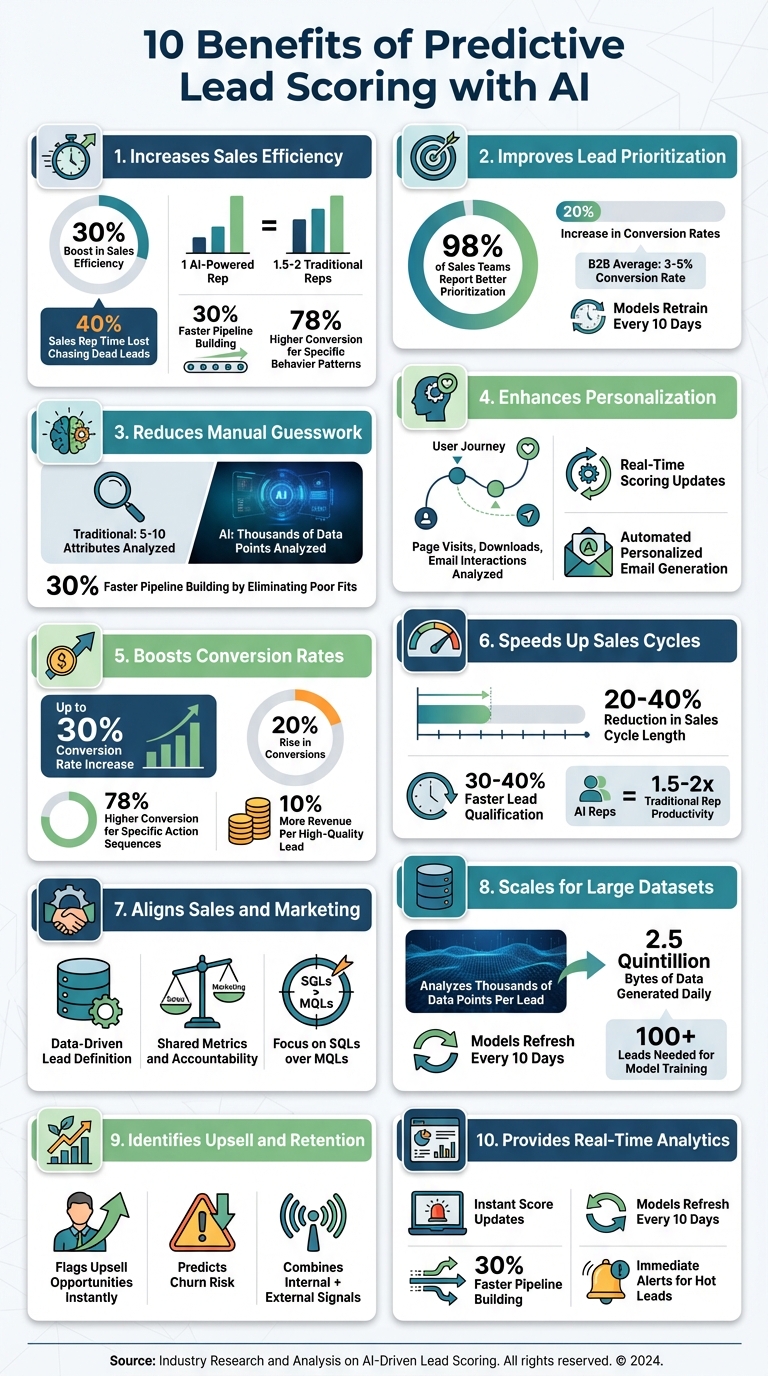 Lead Scoring: Key Statistics and Impact" style="max-width:100%; margin:1em auto; display:block;">
10 Benefits of AI Predictive Lead Scoring: Key Statistics and Impact
Why AI‑Powered Lead Scoring Is a Game-Changer: AISalesPad
1. Increases Sales Efficiency
AI takes the guesswork out of lead ranking, streamlining the sales process and making it more efficient. With AI-powered predictive lead scoring, sales teams no longer need to spend hours manually updating spreadsheets or relying on gut feelings to prioritize leads. Instead, the system automatically ranks prospects by their likelihood to convert. High-potential leads are highlighted instantly, while less promising ones are deprioritized, allowing sales reps to focus their efforts where it counts.
Consider this: sales representatives can lose up to 40% of their time chasing leads that go nowhere [4]. On top of that, nearly half of sales reps struggle to follow up consistently because they’re overwhelmed by the sheer volume of leads [5]. Predictive scoring solves these issues by automating tasks like data ingestion, cleaning, and enrichment. What used to take days - such as standardizing job titles or adding company data - is now handled in seconds [1][5]. This automation transforms raw data into actionable insights, seamlessly connecting lead analysis with real-time engagement.
The results speak for themselves. Teams using predictive scoring tools can build their sales pipelines about 30% faster by cutting out poor-fit leads [3]. Businesses also report a 30% boost in sales efficiency when prioritizing leads with these tools [5]. In fact, one AI-powered sales rep can often match or exceed the output of 1.5 to 2 traditional reps [3].
AI doesn’t just save time - it uncovers patterns that might otherwise go unnoticed. For example, the system might identify that prospects who download a specific whitepaper and visit the pricing page within 48 hours are 78% more likely to convert [4]. These insights act as automatic triggers, notifying reps to take immediate action.
To get the most out of predictive scoring, set clear thresholds (e.g., 80/100) to trigger alerts or initiate personalized outreach [3]. Make sure the scoring model is integrated directly into your CRM so everyone on the team can access and act on the scores [4][2]. Additionally, clean your data regularly by removing duplicates and standardizing formats - AI’s effectiveness depends heavily on the quality of the data it processes [3][5].
Platforms like SalesMind AI are designed to take full advantage of predictive scoring, helping your team focus on high-quality leads and streamline the sales process.
2. Improves Lead Prioritization
AI doesn’t just help rank leads - it completely changes how sales teams decide whom to contact and when. Instead of relying on gut feelings, AI uses algorithms to sift through thousands of data points and calculate the likelihood of a lead converting. These calculations are based on three key categories of data:
- Explicit data: Information like job titles, company size, industry, and annual revenue.
- Implicit data: Actions such as website visits, email clicks, and time spent on pricing pages.
- External intent signals: Insights from technographics, funding announcements, and social media activity [3].
This detailed analysis powers a sophisticated 2D prioritization model that categorizes leads based on two factors: "Fit" (how well they match your Ideal Customer Profile) and "Interest" (their level of engagement). This means sales teams can avoid wasting time on leads that seem interested but don’t align with the ideal customer profile.
The benefits of this approach are huge. For example, 98% of sales teams using AI report better lead prioritization [1]. And companies that implement predictive lead scoring often see their conversion rates jump by as much as 20% [2]. Considering that average B2B conversion rates usually sit between 3% and 5%, that kind of improvement can be the difference between hitting or missing sales targets.
Another game-changing feature is real-time scoring updates. If a prospect visits your pricing page, their score updates instantly, signaling the sales team to act quickly. AI platforms also retrain their models every 10 days, ensuring they stay aligned with shifting market trends [1] [3].
Taking this a step further, tools like SalesMind AI integrate lead scoring with LinkedIn outreach. By combining behavioral signals with firmographic data, these platforms help sales teams focus on the most promising prospects at exactly the right time.
3. Reduces Manual Guesswork
AI takes lead prioritization to the next level by removing the subjective decisions that often undermine traditional scoring methods. In manual scoring, personal biases can easily creep in. For instance, a sales rep might prioritize a CEO simply because of their title, even if that individual has shown no interest in your offerings. Another rep might focus exclusively on leads from big companies, overlooking smaller prospects who are actually ready to make a purchase. This inconsistency can lead to missed opportunities and inefficiencies.
AI tackles this issue head-on by replacing subjective judgments with precise, data-driven models. Rather than relying on gut instincts, predictive scoring uses historical data on successful and unsuccessful deals to identify patterns that truly drive conversions [5]. Every lead is evaluated using the same criteria, whether it’s a VP at a tech startup in Austin or a director at a large corporation in New York. This consistency ensures fairness and accuracy across the board, seamlessly integrating into existing sales workflows and amplifying the efficiency gains discussed earlier.
"By 2025, relying on guesswork in sales is a luxury nobody can afford." – Nitish Chauhan, Author at Smartlead [3]
AI doesn’t just level the playing field; it also dramatically enhances the depth of analysis. While manual scoring might consider 5–10 basic attributes, AI dives into thousands of data points, offering insights like email engagement rates or the time it takes for a lead to interact with your content [4][7]. This level of detail not only builds trust in the data but also lays the groundwork for fully automated, streamlined evaluations.
The results speak for themselves. Teams using predictive scoring can build their sales pipelines about 30% faster by focusing their efforts on high-quality leads rather than wasting time on poor fits [3]. However, to make the most of these tools, it’s essential to start with clean CRM data. Standardizing details - like ensuring "VP" and "Vice President" are treated the same - prevents errors and ensures accurate scoring [3]. Additionally, selecting tools with explainability features can make a big difference. For example, if a lead gets a high score due to a "recent pricing page visit", your team can trust the system and tailor their outreach for maximum impact [3].
4. Enhances Personalization
AI takes personalized outreach to a whole new level. Predictive scoring doesn’t just rank leads - it provides context by analyzing user behavior, such as page visits, downloads, and email interactions. This means sales teams can understand not only who to contact, but why they’re worth reaching out to.
With these detailed insights, sales communication becomes far more targeted. Instead of sending out generic messages, representatives can reference specific actions taken by a lead. For instance, if someone frequently visits case studies and downloads an ROI calculator, your outreach can cut straight to a tailored product comparison or even a discount offer. AI also breaks down lead scores (e.g., "Fits ICP + recent visit to pricing page"), giving sales reps actionable details to make every conversation more relevant.
AI also helps distinguish between casual interest and serious intent. A lead who reads a blog post requires a different approach than one who watches a product demo and dives into a case study. By tracking this behavioral sequence, teams can fine-tune their strategy - offering educational content to early-stage prospects while sending demo invitations to those showing clear buying signals.
What’s more, AI keeps your strategy dynamic with real-time updates that refine outreach timing.
"Generative AI crafts personalized emails instantly, merging efficiency with tailored messaging." – Salesforce
Real-time scoring ensures outreach is timely and relevant. Some platforms even leverage generative AI to automatically write personalized emails based on a lead’s behavior and industry. This makes it possible to scale individualized outreach without adding extra manual work. Tools like SalesMind AI combine these insights with automated messaging, allowing sales teams to engage prospects at scale while keeping every interaction meaningful.
5. Boosts Conversion Rates
Focusing on top-tier prospects can significantly improve conversion rates. Companies leveraging AI-driven lead scoring have reported conversion rate increases of up to 30%[8]. Studies also indicate that predictive scoring can lead to a 20% rise in conversions by pinpointing leads that share characteristics with past successful customers[2].
Here’s how it works: AI sifts through thousands of data points - like email engagement and pricing page visits - to identify leads most likely to convert. For instance, if a prospect follows a specific sequence of actions, such as exploring your features page, reading case studies, and then checking out pricing, they’re 78% more likely to convert compared to the average lead[4].
Beyond prioritization, real-time engagement takes conversion rates to the next level. AI continuously updates lead scores, enabling your team to act when interest peaks. High-scoring leads (e.g., those rated 80 or above) can automatically trigger follow-ups, like instant email sequences or alerts for sales reps[3]. This quick response ensures that no opportunity slips through the cracks.
As Bardeen emphasizes:
"Predictive lead scoring helps ensure that sales reps are engaging with the right prospects at the right time, increasing the likelihood of successful conversions." – Bardeen[2]
Predictive scoring doesn’t just improve efficiency - it accelerates pipeline growth. Teams using this approach build pipelines about 30% faster, as they focus less on low-quality leads[3]. Plus, each additional high-quality lead can contribute around 10% more revenue[3]. Tools like SalesMind AI combine advanced scoring with automated outreach, simplifying the path to closing deals.
sbb-itb-817c6a5
6. Speeds Up Sales Cycles
A long sales pipeline can cool down prospects and weaken their intent to buy. But predictive scoring powered by AI changes the game. It flags ready-to-buy prospects in real time by detecting high-intent behaviors like multiple visits to pricing pages, downloading ROI calculators, or attending product demos. With these insights, your team can take action right when interest is at its peak, saving time and keeping momentum alive[5][4].
The results speak for themselves. Companies using predictive scoring often see their sales cycle shrink by 20–40%[9]. Even the lead qualification process becomes more efficient, with AI cutting that time down by 30–40%, allowing sales reps to focus on closing deals instead of chasing cold leads[9].
Here’s how it works: when a lead hits a specific score threshold (like 80 or higher), your CRM can automatically send alerts or move the lead straight to a product demo. Automation takes it a step further by acting immediately on these high-intent leads, fast-tracking them through the pipeline. Meanwhile, lower-scoring leads are routed into nurturing campaigns, ensuring your team invests their energy where it matters most[9].
Faster sales cycles don’t just save time - they also drive revenue. AI-enabled sales reps can match the productivity of 1.5 to 2 traditional reps[3]. By combining quicker deal closures with higher conversion rates, your team can handle more deals without needing to expand the workforce.
SalesMind AI takes this a step further by integrating advanced lead scoring with LinkedIn outreach. This ensures your team can identify and engage high-intent prospects the moment they exhibit buying signals, making every interaction count.
7. Aligns Sales and Marketing Teams
Sales and marketing teams often find themselves at odds when it comes to lead quality. Marketing might deliver a high volume of leads, but sales may deem many of them unqualified, which can result in finger-pointing and frustration. Predictive lead scoring helps resolve this tension by introducing a data-driven, objective way to define what makes a lead "qualified." This shared definition gives both teams a common ground to work from.
Instead of relying on subjective opinions, both departments can focus on prioritizing lead quality over sheer quantity. Using historical conversion data, predictive models identify which leads are most likely to result in closed deals. This shifts the focus from merely generating Marketing Qualified Leads (MQLs) to converting Sales Qualified Leads (SQLs). The result? A stronger connection between sales and marketing, built on mutual accountability and shared goals like improving lead-to-opportunity conversion rates. This alignment, powered by data, lays the foundation for more effective predictive lead scoring.
"By establishing a clear, data-driven definition of a qualified lead, both departments can work towards a common goal and measure success using the same metrics." – Bardeen [2]
To make this alignment work in practice, it’s essential to bring both teams together early on. Hold collaborative workshops where sales and marketing define the lead scoring criteria before implementing the AI model. Regular feedback loops - such as quarterly reviews - are also crucial. These allow sales to share insights on lead quality, helping refine the algorithm over time. Additionally, ensure your CRM and marketing automation systems use standardized data formats. This consistency ensures the AI generates reliable scores that both teams can trust. Tools like SalesMind AI even integrate with LinkedIn outreach, providing shared visibility and smooth handoffs between teams.
8. Scales for Large Datasets
As your prospect database grows, manual lead scoring becomes unmanageable. Analyzing thousands - or even millions - of contacts by hand is simply not feasible. This is where AI-powered predictive lead scoring shines. These systems are built to handle massive datasets, processing leads across hundreds of variables without slowing down. The result? A system that scales effortlessly, paving the way for better data integration and automation.
While traditional scoring methods might assess 5–10 attributes per lead, AI models dive much deeper. They analyze thousands of data points - pulling insights from CRM records, email engagement, website activity, social media interactions, and more [4]. Anya Vitko, Content Marketing Specialist at Vendasta, sums it up perfectly:
"AI systems handle high volumes of data and leads without performance degradation" [7].
This means that as your database grows, your scoring system doesn’t just keep up - it gets better. Unlike manual methods that falter under pressure, AI thrives in high-volume scenarios.
This scalability becomes especially valuable when entering new markets, managing multi-channel campaigns, or handling multiple clients. AI-powered platforms like Salesforce Einstein even refresh their models every 10 days to integrate the latest data, ensuring your scoring remains accurate and up to date [1].
AI systems also streamline processes beyond scoring. They automate complex workflows like data ingestion, cleansing, feature engineering, and model training - eliminating the manual bottlenecks that traditional methods often face [3]. Considering that 2.5 quintillion bytes of data are generated daily, automation is no longer optional for modern lead management [6].
With this scalable infrastructure, teams can seamlessly connect data to automation tools. For example, using a dataset of over 100 converted and non-converted leads provides the historical context needed to refine scoring models [4]. Once integrated, high-scoring leads can automatically trigger priority email sequences or sales alerts [3]. Platforms like SalesMind AI take it a step further, syncing LinkedIn outreach data with your scoring system to ensure real-time accuracy across your entire prospect database.
9. Identifies Upsell and Retention Opportunities
Predictive lead scoring isn't just about finding new prospects - it’s also a powerful tool for identifying opportunities to grow and retain your existing customer base. Instead of relying on guesswork or manual account checks, AI dives into behavioral patterns to spot customers who might be ready to upgrade or those at risk of leaving.
For example, if a customer starts exploring advanced product features or visits pricing pages, the system flags them as potential upsell candidates instantly [5]. On the flip side, AI can track data like support tickets, login frequency, and overall engagement to predict which accounts are likely to renew and which ones might need extra attention [4].
This data-driven approach helps account managers focus their efforts where it matters most - on customers showing clear signs of interest or risk. Say a customer attends a webinar about a new product or downloads an ROI calculator. Their score automatically increases, triggering an alert for the team to follow up promptly [4].
The system also picks up on red flags. For instance, if a customer logs in less often or only interacts with basic content after repeated visits, it could indicate churn risk. These warnings allow teams to step in before it’s too late [4]. By combining internal CRM data with outside signals - like a customer’s company securing new funding or changes in key personnel - predictive scoring ensures account managers always have up-to-date insights to guide their actions [3]. These timely alerts make AI-powered predictive scoring a game-changer for streamlining every stage of the sales process.
10. Provides Real-Time Analytics and Insights
Traditional lead scoring systems tend to update on a schedule and often require manual tweaks. AI-powered predictive scoring, however, works differently. It keeps an eye on incoming data and adjusts lead scores the moment new information comes in. For example, if a prospect clicks on an email, visits your pricing page, or downloads a whitepaper, their score updates right away to reflect their heightened interest. This kind of dynamic adjustment highlights how AI can simplify and speed up sales processes.
Why does this matter? Buyer behavior can change quickly. A lead that seemed uninterested yesterday might suddenly engage with your content today. AI systems are designed to catch these shifts in real time by pulling data from your CRM, marketing automation tools, website analytics, and even social media. Some platforms even refresh their predictive models every 10 days to stay on top of new trends and adjust scoring criteria accordingly [1].
This constant updating doesn’t just reflect current interest - it also enables immediate action. For sales teams, this is a game-changer. Instant alerts let representatives know when a lead crosses a "hot" threshold, thanks to high-intent actions. Anya Vitko, Content Marketing Specialist at Vendasta, explains:
"As new data comes in, AI models adjust scoring criteria in real-time - ensuring your lead scoring system is always aligned with the current market" [7].
On the flip side, real-time analytics also lower a lead’s score when engagement drops. For instance, if a prospect stops interacting - maybe they’re only skimming basic blog posts or they unsubscribe from emails - the system immediately adjusts their score downward. This ensures sales reps don’t waste time chasing leads that have lost interest. By reducing follow-up delays and keeping the focus on engaged prospects, AI-driven predictive scoring helps sales teams build pipelines about 30% faster by concentrating on high-quality leads [3].
Conclusion
AI-powered predictive lead scoring is reshaping how sales and marketing teams operate by helping them zero in on prospects who are genuinely ready to buy. The numbers speak for themselves: teams leveraging predictive scoring see pipelines grow about 30% faster, enjoy up to a 20% bump in conversion rates, and achieve a 30% increase in overall sales efficiency [3][2][5].
What makes this approach so impactful? Predictive lead scoring eliminates guesswork and human bias, replacing it with real-time, data-driven insights. Unlike traditional methods that rely on limited data points and rigid rules prone to becoming outdated, predictive models analyze thousands of signals - behavioral, demographic, and intent-based - all at once. These models continuously learn from closed deals and adapt as market dynamics shift, ensuring that both sales and marketing teams operate with a unified, objective definition of a qualified lead.
"Predictive lead scoring changes the game by turning data into clarity. Using AI prospecting, you don't guess who is hot – you know." – Smartlead [3]
For B2B teams looking to adopt this advanced strategy, SalesMind AI offers a tailored solution. The platform combines AI-driven lead scoring with LinkedIn integration, automated personalized messaging, and a unified inbox to streamline outreach efforts. By centralizing lead qualification and follow-ups, SalesMind AI empowers teams to identify high-value prospects quickly and engage them at the perfect time.
FAQs
How does AI-powered predictive lead scoring boost sales efficiency?
AI-driven predictive lead scoring takes the guesswork out of sales by ranking prospects based on how likely they are to convert. This means sales reps can concentrate their energy on leads that matter most, cutting down on time wasted with unqualified prospects and boosting overall efficiency.
With a clearer focus on high-priority leads, teams can grow their pipelines faster, close deals more quickly, and rely on data-backed insights to make smarter decisions that drive better outcomes.
How does AI determine which leads are most likely to convert?
AI assesses leads by examining various elements, such as demographic and firmographic details, previous interactions, and current behaviors. These behaviors might include website visits, email engagement (like opens and clicks), LinkedIn activity, and other indicators that show interest or intent.
Using this information, AI detects patterns and ranks leads based on their likelihood to convert. This allows sales and marketing teams to concentrate their efforts on the leads that have the highest potential.
How does AI-powered lead scoring improve personalized outreach?
AI-powered lead scoring taps into data like website visits, email opens, LinkedIn activity, and demographic details to build a real-time profile of each prospect. This allows sales teams to craft outreach that aligns with a prospect's specific interests and buying intent, making every interaction feel personal instead of one-size-fits-all.
By dynamically assigning and updating conversion likelihood scores, AI helps identify high-potential leads and recommends the best messaging, product features, or content for each segment. This ensures outreach happens at the perfect moment - whether it’s following up after someone checks out your pricing page or engaging after a LinkedIn interaction - leading to higher response rates and faster sales cycles.
SalesMind AI takes it a step further by automating tasks like personalized messaging, lead qualification, and follow-ups. This frees up sales teams to concentrate on the most promising leads and close deals with greater efficiency.
 JG
JG