AI Revenue Attribution Metrics for B2B Sales
AI revenue attribution tells you which touchpoints actually drove the deal, not just the last click. In complex B2B sales with multiple stakeholders and long cycles, this matters. This article covers the key attribution models, the metrics worth tracking, and how AI handles the multi-touch complexity that manual spreadsheets cannot.
 Julien Gadea
AI revenue attribution tells you which touchpoints actually drove the deal, not just the last click. In complex B2B sales with multiple stakeholders and long cycles, this matters. This article covers the key attribution models, the metrics worth tracking, and how AI handles the multi-touch complexity that manual spreadsheets cannot.
AI revenue attribution tells you which touchpoints actually drove the deal, not just the last click.
In complex B2B sales with multiple stakeholders and long cycles, this matters.
This article covers the key attribution models, the metrics worth tracking, and how AI handles the multi-touch complexity that manual spreadsheets cannot.
Table of Contents
AI revenue attribution is transforming how B2B companies understand and optimize their sales and marketing efforts. Here's the key takeaway: AI identifies which touchpoints in a sales journey drive revenue, helping businesses allocate budgets more effectively and improve decision-making.
Key points:
- B2B sales are complex: Deals involve 6–10 stakeholders, 266+ touchpoints, and take 6–9 months.
- AI improves accuracy: AI increases attribution accuracy by 15–30% and reduces reporting time by up to 90%.
- Metrics matter: Focus on metrics like Marketing Attributed Revenue, Revenue Per Channel, and Customer Acquisition Cost Attribution to measure performance.
- Budget optimization: Companies using AI often shift 10–25% of budgets to higher-performing channels.
- Actionable insights: AI reveals how combinations of touchpoints (e.g., cold email vs LinkedIn outreach) impact conversions and shortens sales cycles by up to 45%.
AI-powered systems reduce guesswork, align sales and marketing teams, and provide data-driven insights to improve ROI. For businesses spending $10,000+ monthly on marketing, adopting AI attribution could be a game-changer.
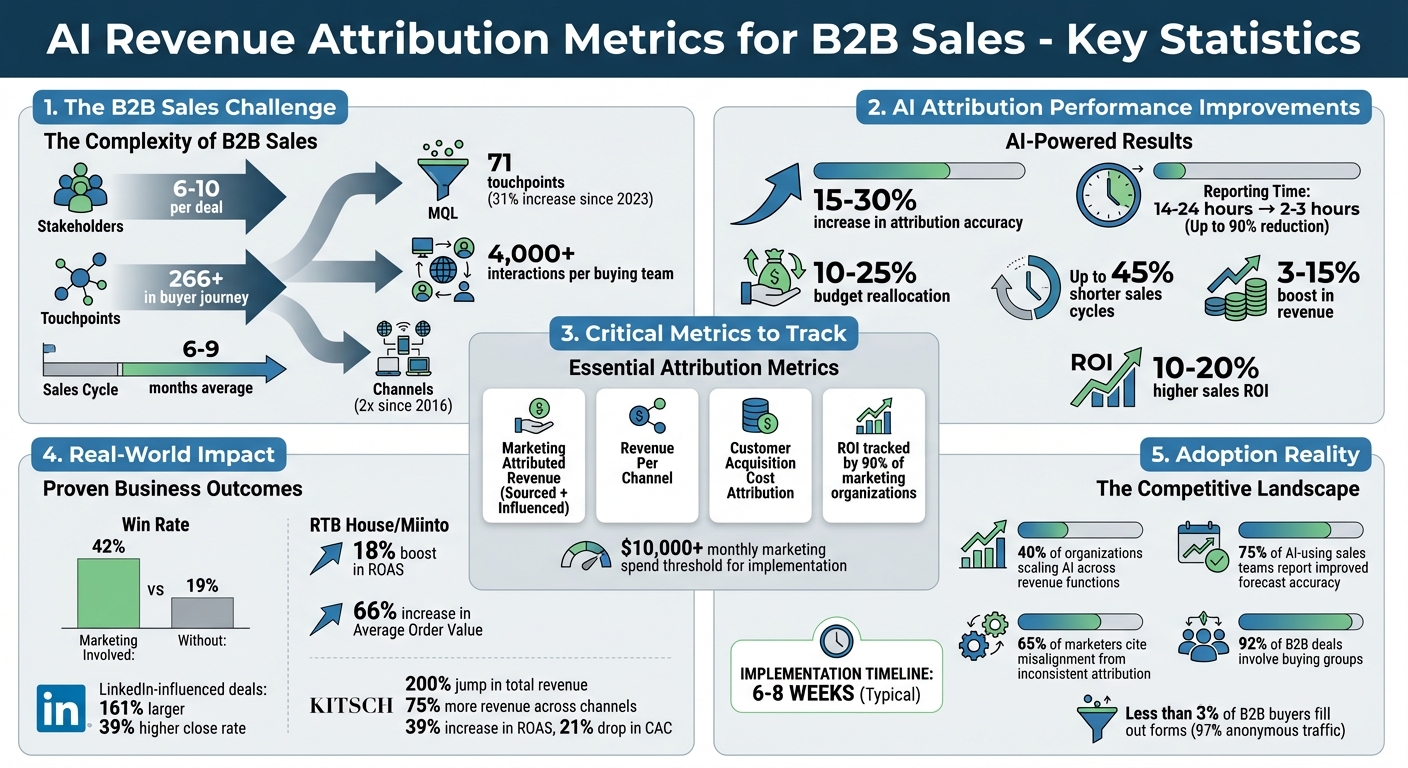
AI Revenue Attribution Impact: Key Statistics and Performance Metrics for B2B Sales
The New Rules of Revenue: Nick Turner on AI, Attribution & Modern Buyers
sbb-itb-817c6a5
Key Revenue Attribution Metrics
Let’s dive into three core metrics that form the backbone of AI-driven revenue attribution. These metrics help identify which interactions truly drive results, thanks to AI’s ability to deliver sharper insights.
Marketing Attributed Revenue
This metric connects marketing efforts directly to closed deals by tracking the total revenue generated or influenced by marketing activities. AI plays a key role here by calculating Incremental Lift - the difference in closing probability when specific touchpoints are present versus when they’re absent [5][8].
In simple terms, this metric breaks revenue into two categories:
- Sourced revenue: Deals that marketing initially identified.
- Influenced revenue: Deals touched by marketing at any stage of the buyer’s journey [10].
Considering that 92% of B2B deals involve buying groups and the average conversion cycle lasts 320 days, understanding these categories is critical [7][10].
"Attribution isn't about credit. It's about finding directional truth." - Nadia Davis, VP of Marketing, CaliberMind [6]
This metric also helps settle debates about campaign performance by translating engagement into measurable business outcomes like pipeline growth and revenue [6]. For example, AI might reveal that technical blog posts lead to a 40% higher average contract value, even if they extend the sales cycle [1].
The next step is to evaluate the role of individual channels in driving revenue.
Revenue Per Channel
Once you’ve attributed revenue, it’s time to analyze how each channel contributes to deal value. AI can determine the average revenue and influence of each channel per deal [5]. This goes beyond basic metrics like clicks, offering a clearer picture of which channels actually close deals.
This granular analysis is especially important in today’s B2B landscape, where buying teams engage in over 4,000 digital and human interactions during their journey [10]. AI can uncover how touchpoints interact, showing, for instance, that pairing a product demo with a case study might convert at a higher rate than the demo alone [5].
Customer Acquisition Cost Attribution
This metric ensures that acquisition costs are accurately distributed across all touchpoints that contribute to a deal. AI compares total investment to "Influenced Revenue" to calculate the real ROI of specific campaigns [5][9]. This prevents overspending on channels with low returns.
"The primary problem that most marketers run into is they've actually never seen attribution that works…anything that uses Google Tag Manager or the Google infrastructure doesn't provide transparency. You can't see cost - ever." - Ryan Koonce, CEO, Attribution [9]
To get precise Customer Acquisition Cost (CAC) data, integrate your attribution platform with ad platforms like LinkedIn, Google, and Facebook to pull real-time spend data [9]. This data is even more powerful when synced with LinkedIn automation tools for B2B sales funnels to track lead progression. This approach becomes especially worthwhile when your monthly marketing budget exceeds $10,000 [7]. With 90% of marketing organizations now tracking ROI [10], having detailed CAC insights by channel and campaign sequence is crucial for smarter budget allocation.
AI-Powered Attribution Models
Traditional attribution models often stick to rigid rules, failing to reflect the complex and evolving nature of customer journeys. In contrast, AI-powered models dig into historical data to pinpoint the touchpoints that genuinely drive conversions [5] [12]. By building on existing metrics, these models deliver sharper, data-backed insights into how customers interact across their journeys.
Multi-Touch Attribution with AI Weighting
Instead of assigning fixed percentages to touchpoints, AI learns from past closed deals to determine the actual impact of each interaction. Some systems even leverage Shapley Values, a game-theory-based approach that fairly distributes credit by evaluating each touchpoint’s unique contribution [5].
"Attribution in B2B is broken. Multi-touch journeys span months and dozens of interactions... Traditional models - first touch, last touch, even multi-touch - oversimplify reality and lead to bad investment decisions." - Max, Cargo [5]
This is especially relevant in B2B, where the average deal now takes 6 to 9 months and involves 6 to 10 stakeholders [5]. AI can uncover interaction effects that traditional models miss. For instance, it might reveal that pairing a webinar with a case study triples the conversion rate compared to the webinar alone [5]. Companies using AI attribution often report a 15–30% boost in accuracy, reallocate 10–25% of their budgets to higher-performing channels, and cut reporting time from 14–24 hours to just 2–3 hours [2]. These insights form the foundation for further refinements based on user engagement.
Behavior-Weighted Attribution Models
Building on multi-touch insights, behavior-weighted models go a step further by factoring in the quality of engagement. Instead of simply counting touchpoints, AI evaluates how meaningful those interactions are. For example, spending five minutes reading a technical whitepaper carries far more weight than a quick three-second page visit [1] [3].
A great example comes from RTB House and Miinto, where deep learning algorithms analyzed customer journeys based on engagement patterns. This approach resulted in an 18% boost in Return on Advertising Spend (ROAS), a 66% increase in Average Order Value (AOV), and a 200% jump in total revenue [1].
"AI attribution engines use machine learning to analyze every customer interaction and assign credit based on actual influence, not predetermined formulas." - David Zeledon, Head of Growth Marketing, HockeyStack [12]
These systems also perform counterfactual analysis, essentially asking, "Would this deal have closed without this specific interaction?" This method uncovers the true incremental value of each touchpoint. With B2B buyers now averaging 71 touchpoints to produce a single Marketing Qualified Lead - a 31% increase since 2023 [12] - understanding which interactions matter most has become critical.
Time-Decay Attribution for Long Sales Cycles
Time-decay models shine in long sales cycles by prioritizing recent interactions. Traditional methods often rely on arbitrary rules, like fixed half-lives, but AI brings a smarter approach. By analyzing historical data, it learns how timing actually affects conversions.
Using Recurrent Neural Networks (RNNs), AI examines the sequence and timing of interactions to uncover patterns that drive higher conversion rates [1]. For example, it might find that a demo followed by a case study within three days closes deals at twice the rate of the same touchpoints spaced three weeks apart.
"With influence-based models, we can see how different interactions build momentum. It's a way to track how each touchpoint adds to the overall decision-making process, especially for longer, multi-stakeholder sales cycles." - Adam Holmgren, Co-founder, Fibbler [3]
These systems also excel at account-level attribution by aggregating all stakeholder interactions. This is crucial, as 67% of B2B buyers engage with more than five pieces of content before making a purchase decision [3]. Together, these AI-driven models offer a well-rounded way to accurately attribute revenue and understand customer journeys in depth.
How to Implement AI Attribution Systems
Setting up AI-powered attribution systems requires thoughtful preparation, clean data, and the right tools. Most organizations can get a system up and running in about six to eight weeks by following a phased approach [2]. This process is essential for improving revenue attribution in B2B sales.
Data Collection and Integration
Attribution systems rely on a single source of truth - a centralized hub that gathers data from all customer touchpoints [1][11]. This means linking tools like your CRM (e.g., Salesforce or HubSpot), marketing automation software, ad platforms, website analytics, and sales engagement tools into one data warehouse [5][16].
Here’s the challenge: less than 3% of B2B buyers fill out forms, leaving 97% of web traffic anonymous [15]. That’s where identity resolution steps in. AI connects anonymous web sessions, ad clicks, and email interactions into cohesive customer journeys once prospects identify themselves [2][13]. For B2B companies, this data is then aggregated at the account level, reflecting the reality that buying decisions often involve 14 to 23 people [15].
Before integrating tools, conduct a thorough audit of your data sources. Standardize naming conventions and enforce consistent UTM parameters to avoid data silos and ensure clean inputs for AI models [6][11]. Clean data directly improves the accuracy of attribution. For example, Bynder implemented an AI-driven revenue platform under Demand Generation Manager Marko Ivanov and saw a 2.5x increase in outbound pipeline, achieving full ROI in just four months [15].
Don’t forget offline interactions. Incorporate data from event platforms and custom CRM events to track high-impact activities like trade shows, discovery calls, and executive dinners [11]. These touchpoints often carry more weight than digital ones but are frequently overlooked in traditional systems.
Once your data foundation is solid, the next step is selecting the right AI tools to make the process efficient.
Selecting the Right AI Tools
Choosing the right platform comes down to three key factors: analytics capabilities, CRM integration, and scalability [5][1]. Look for tools that seamlessly connect with your existing tech stack and can handle expanding data volumes without constant engineering support. Many platforms now offer no-code implementation, allowing marketing teams to deploy tracking in under 30 seconds using secure OAuth connections [14][13].
Modern tools can reduce manual work dramatically. Tasks that once took 14 to 24 hours can now be completed in just 2 to 3 hours, saving 83% of the time [2]. The tools should also align with your finance team’s reporting systems to eliminate conflicting ROI calculations [2]. Multi-touch attribution often starts delivering returns when marketing spend exceeds $10,000 per month [7].
For LinkedIn outreach and lead generation, platforms like SalesMind AI (https://sales-mind.ai) integrate features such as unified inboxes and advanced lead scoring directly into attribution systems.
A compelling example: In 2023, Custom Truck One Source used AI-powered conversational email to handle 45,000+ monthly website visitors. Led by Sales Development Manager Walker Smith, the five-week project resulted in 132 qualified contacts and generated $6 million in new pipeline [15].
"The amount of work conversational email does in a day would take someone on my team a week to do. It's like having five more SDRs working simultaneously." - Walker Smith, Manager of Sales Development, Custom Truck One Source [15]
Once you’ve chosen the right tools, the next step is to map your buyer journey for precise attribution.
Mapping the Buyer Journey
To achieve accurate attribution, you need a detailed map of how buyers navigate your sales process. Define key milestones in the buyer journey and tag all assets with relevant metadata [16]. With B2B buyers now using an average of 10 channels for research - double the number from 2016 [15] - your map must account for interactions across all platforms.
A typical implementation follows this timeline [2]:
| Phase | Duration | Key Activities |
|---|---|---|
| Discovery | Week 1 | Audit data sources, tracking, and taxonomy; define KPIs |
| Integration | Weeks 2–3 | Connect MAP/CRM/ad platforms; configure identity rules |
| Modeling | Week 4 | Enable model suite; calibrate weights; set up holdouts |
| Pilot | Weeks 5–6 | Compare models; run marginal ROI analyses; train teams |
| Scale | Weeks 7–8 | Roll out dashboards; align finance and marketing reporting |
Keep in mind that 84% of B2B buyers choose their preferred vendor before ever engaging with a salesperson [10]. Your journey map should include "dark funnel" activities - untracked interactions like word-of-mouth recommendations and anonymous research on sites like G2 or TrustRadius [5][15]. After deployment, retrain your models quarterly to keep up with changing market trends and buyer behaviors [5][2].
Using Attribution Data to Improve Sales and Marketing
AI-powered attribution systems can help businesses make smarter budget decisions, craft more personalized outreach, and improve collaboration between sales and marketing teams. Companies that leverage these insights effectively often see 10–25% of their budgets shift toward higher-performing channels within just a few months [2].
Allocating Budgets to Top-Performing Channels
Attribution data provides clarity on which channels are driving revenue. For example, if 35% of your budget goes to paid ads but they only account for 22% of revenue, it's time to rethink your allocation [5]. AI tools also highlight how different touchpoints work together. One study revealed a 38% increase in impact when a case study followed a product demo, showing the value of multichannel outreach strategies [5].
Take the example of a B2B software company in 2025 that used Karrot.ai to analyze LinkedIn and CRM data. They discovered that 42% of closed-won deals were influenced by LinkedIn marketing, and those deals were 161% larger than average [13]. Similarly, another company using a U-shaped attribution model found that on-demand webinars following live events were their top drivers of new opportunities. This insight led them to shift funds from less effective live sessions to on-demand content [6].
Here's a snapshot of how budget reallocation might look based on AI-driven attribution data [5]:
| Channel | Current Budget % | Revenue Attribution % | Adjustment Needed |
|---|---|---|---|
| Paid Ads | 35% | 22% | -13% |
| Webinars | 10% | 20% | +10% |
| SDR Outbound | 10% | 25% | +15% |
| Events | 30% | 15% | -15% |
Before committing to large-scale changes, validate adjustments with small test groups and analyze marginal ROI [2]. Also, incorporate cost data from platforms like LinkedIn and Google to calculate true ROI, not just conversion rates [9].
Don’t overlook untracked interactions such as word-of-mouth or community discussions, which play a crucial role in brand awareness [5]. To keep pace with market changes, retrain attribution models every quarter [5][2].
Personalizing Outreach Based on Attribution Data
Once budgets are optimized, attribution insights can be used to refine outreach strategies. For example, a cloud infrastructure provider in 2025 found that enterprise prospects who accessed technical documentation within 48 hours of a sales demo were three times more likely to convert. By sending personalized technical resources right after demos, they boosted enterprise deal velocity by 40% [1].
Timing is another critical factor. Temporal analysis can help identify the "golden window" for outreach. One CRM provider discovered that accounts with webinar attendees had 2.8x higher win rates and 45% shorter sales cycles when outreach was timely and personalized [1]. For companies targeting multiple stakeholders, attribution data can reveal which roles engage with specific content. For instance, CFOs might gravitate toward ROI calculators, while technical leads prefer product documentation [17][13].
AI tools can further enhance this process. Emails powered by AI achieve 10% higher open rates and twice the reply rates [18]. Plus, AI can cut the time spent on crafting personalized outreach by up to 90%, making it easier to scale across the funnel [18]. Tools like SalesMind AI offer features like lead scoring and unified inboxes, seamlessly integrating with attribution systems to streamline LinkedIn outreach and lead generation.
To maximize effectiveness, focus on assets that deliver the greatest impact. For instance, if a case study consistently drives conversions, make it a centerpiece of your sales sequences [5][1].
Improving Sales and Marketing Team Alignment
Attribution data fosters alignment between sales and marketing by creating a single source of truth. This eliminates disputes over lead quality and campaign effectiveness, replacing subjective opinions with objective data [19][2]. Shared definitions for metrics like MQLs, SQLs, and "high intent" ensure smoother handoffs between teams [19][17][20].
By linking marketing efforts to metrics such as pipeline growth and win rates, attribution systems help reposition marketing as a strategic growth driver rather than just a cost center [6][20]. For instance, LinkedIn-influenced opportunities have been shown to close 39% more often [20]. Moreover, deals with significant marketing involvement achieve a 42% win rate, compared to just 19% for those without [5]. This data encourages sales teams to act quickly on marketing-qualified leads.
To maintain alignment, develop a measurement charter that outlines attribution windows, interaction rules, and key performance indicators [17]. Involve Revenue Operations as a neutral overseer to ensure data reliability and model accuracy [17].
"When everyone understands the logic behind the model, attribution transforms from a source of debate into a source of clarity."
– April Robb, Directive Consulting [17]
Unified attribution platforms can reduce reporting time by 30–50% [19], allowing teams to focus on strategy instead of debating credit. This approach strengthens collaboration and drives better results, creating a more cohesive go-to-market strategy.
Conclusion: Growing Your Business with AI Revenue Attribution
AI-driven revenue attribution is reshaping B2B sales strategies. Instead of relying on outdated single-touch models, it uncovers the real connections between touchpoints and conversions in complex sales cycles that often span 6–9 months and involve 6–10 stakeholders [5]. These insights pave the way for measurable improvements in performance.
The results speak for themselves: AI attribution can deliver a 3–15% boost in revenue and 10–20% higher sales ROI [23]. For example, in 2025, KITSCH discovered that email was undervalued through AI attribution, leading to 75% more revenue across all channels, a 39% increase in ROAS, and a 21% drop in CAC. Similarly, Cognism adjusted its LinkedIn budget from 55% to 62%, achieving over 2× growth in just one year [22][5].
But it’s not just about budget optimization. AI attribution also tackles the ongoing disconnect between sales and marketing. With 65% of marketers citing misalignment caused by inconsistent attribution data [4], having a shared scoreboard can reduce internal disputes and keep teams focused on growing the pipeline rather than arguing over credit.
"Attribution isn't about credit. It's about finding directional truth."
– Nadia Davis, VP of Marketing at CaliberMind [6]
The competitive landscape is evolving fast. Today, 40% of organizations are scaling AI across revenue functions [21]. Michelle Morgan, Research Manager at IDC, highlights the urgency:
"This disparity between non-investors and early adopters indicates that organizations using revenue technology face a critical juncture, where those without advanced AI strategies risk falling behind competitors."
For companies ready to act, tools like SalesMind AI offer features like advanced lead scoring and a unified inbox, seamlessly integrating with attribution systems to automate personalized outreach based on intent signals.
To get started, focus on auditing your data quality, setting attribution windows that reflect typical B2B sales cycles of 90+ days, and choosing AI tools that account for the "dark funnel" of untracked activities. Many successful companies begin with directional insights and refine their strategies over time. With 75% of sales teams using AI reporting improved forecast accuracy [23], the question isn’t if you should implement AI attribution - it’s how soon.
FAQs
How does AI enhance the accuracy of revenue attribution in B2B sales?
AI improves how businesses track and understand revenue attribution in B2B sales by using machine learning to break down complex buyer journeys. These journeys often involve multiple stakeholders and touchpoints across various channels. Traditional methods struggle to capture this complexity, but AI excels at identifying patterns and connections between interactions and outcomes with a higher level of precision.
This sharper accuracy allows businesses to allocate their resources more efficiently, fine-tune campaigns, and make smarter, data-backed decisions that boost sales. With AI, companies gain a clearer picture of what truly drives revenue, enabling them to adjust their strategies for better results.
How does AI improve budget optimization in marketing?
AI is revolutionizing how marketers allocate their budgets by dissecting complex customer journeys across multiple touchpoints and channels. Traditional attribution models, like first-touch or last-touch, often oversimplify these interactions. This can lead to poor budget allocation decisions. In contrast, AI-powered attribution leverages machine learning to identify which touchpoints actually drive revenue. This means marketers can confidently invest in activities that deliver the most impact.
What makes AI even more powerful is its ability to adapt. It processes new data and adjusts to market changes in real time, constantly refining attribution models. This ensures that marketing budgets are consistently directed toward the most effective campaigns and channels. The result? Higher ROI and less wasted spend.
On top of that, AI automates many of the time-consuming tasks involved in attribution. By taking over these processes, it allows marketing teams to shift their focus to strategic initiatives, ultimately improving efficiency and driving growth.
How do AI-powered attribution models improve collaboration between sales and marketing teams?
AI-powered attribution models enhance teamwork between sales and marketing by delivering a transparent view of how various touchpoints impact revenue. These models dig into data from the entire customer journey, helping teams pinpoint which strategies work best and where to focus their efforts.
With data-backed insights, AI helps bridge communication gaps between teams, aligning marketing activities with sales goals. The result? Streamlined processes, smarter budget use, and improved performance in boosting B2B revenue.
 JG
JG