AI and Predictive Lead Scoring: Key Data Sources
AI-driven predictive lead scoring combines firmographics, behavior, CRM and social signals to prioritize high-value prospects in real time.
 Julien Gadea
AI-driven predictive lead scoring combines firmographics, behavior, CRM and social signals to prioritize high-value prospects in real time.
AI-driven predictive lead scoring combines firmographics, behavior, CRM and social signals to prioritize high-value prospects in real time.
Table of Contents
Predictive lead scoring uses AI to analyze data and rank prospects based on their likelihood to convert. Unlike older methods, it combines diverse data - like demographics, behaviors, CRM records, and even social media activity - to provide accurate, real-time updates. This helps sales teams focus on high-priority leads, boosting conversion rates by 20–30% and cutting manual scoring time by 30–40%.
Key Takeaways:
- Demographics & Firmographics: Defines who your leads are (e.g., job title, company size). Works best when integrated with real-time updates and validated across multiple sources.
- Behavioral Metrics: Tracks actions like email clicks, website visits, and webinar attendance. Strong indicator of buying intent.
- CRM & External Data: Combines internal records with third-party insights for a complete view of lead quality.
- Social Media & Website Analytics: Captures engagement signals like LinkedIn interactions or pricing page visits to refine lead prioritization.
AI platforms like SalesMind AI merge these data types into a single system, offering real-time scoring and actionable insights. To maximize results, ensure your data is clean, updated, and synced across platforms. Businesses adopting AI-driven scoring report 10–20% revenue growth in the first year.
1. Demographic and Firmographic Data
Data Depth
The depth of your demographic and firmographic data plays a crucial role in how effectively AI can predict which leads are most likely to convert. Basic details like a job title or company name just won’t cut it. AI thrives on detailed datasets - think industry classifications, company size, revenue, technology stacks, and even organizational hierarchies. With this level of granularity, AI can uncover conversion patterns and correlations that speed up pipeline development by as much as 30% compared to traditional methods [6][3].
Take, for example, a leading platform that pulls data from over 30 third-party B2B sources, tracking more than 200 million companies and 700 million contacts [5]. This extensive coverage allows AI to identify nuanced correlations, such as how specific combinations of industry, company size, and technology stack consistently lead to conversions [6][3].
To ensure accuracy, multi-source validation is key. For high confidence in lead-to-account matching, systems need eight data points to validate individual records and six for company data [5]. Without this level of validation, incomplete or inaccurate input can derail the AI’s performance - a classic case of "garbage in, garbage out" [6][3]. Building this robust data foundation is essential for real-time precision in lead scoring.
Real-Time Accuracy
Even with rich datasets, keeping information up to date is critical for accurate AI predictions.
Static data quickly becomes outdated. A prospect’s job title, company size, or even location can change, and if your AI is working with stale information, your lead scores will be off. Real-time accuracy depends on continuous data cleansing and automated updates. These processes ensure duplicates are removed, formatting is standardized (e.g., unifying "VP" and "Vice President"), and missing fields are filled in [7][3].
Some AI systems, like a top industry solution, refresh their data every 10 days to account for shifting market trends and buyer behaviors [2]. This ensures that lead scores reflect current realities rather than outdated snapshots. Advanced B2B customer data platforms can process and score over 10,000 enriched records per minute [5], keeping pace with the ever-changing flow of new information.
Integration Potential
Demographic and firmographic data only delivers value when it integrates seamlessly into your workflows. The best AI platforms use API-driven integration to connect with CRMs, marketing automation tools, and external data providers in real time [7][5]. This eliminates data silos and ensures lead scores are updated instantly as new information comes in.
Before integration, standardization is crucial. All data sources need to align on formats for fields like industry, location, and company size so the AI can interpret and score leads accurately [3]. Without this uniformity, you risk fragmented profiles that undermine precision. By setting up real-time syncing between your CRM and AI tools, sales teams can access updated lead scores directly within their existing interface, avoiding the need to juggle multiple platforms [7][3].
Predictive Value
The real power of demographic and firmographic data lies in feature engineering, where AI identifies and weighs specific attributes based on their historical impact on conversions [6]. For instance, the model might reveal that mid-sized healthcare companies using a particular technology stack convert at three times the rate of other segments.
This level of insight also enables mapping individual personas to specific buying centers and account hierarchies, offering a clearer picture of your Total Addressable Market (TAM) [5]. Instead of focusing solely on individual leads, this approach emphasizes account-level intelligence - a game-changer for complex B2B sales cycles where multiple stakeholders influence purchasing decisions [7].
2. Behavioral and Engagement Metrics
Data Depth
When you combine behavioral insights with demographic and firmographic data, you get a clearer picture of lead quality. Demographic data tells you who a lead is, but behavioral metrics reveal what they’re doing - offering strong signals of intent. For instance, AI can analyze complex interaction patterns, turning metrics like "time spent on website" into actionable engagement scores. Think about it: a prospect who visits your pricing page three times, checks out competitor reviews, and attends your webinar is clearly more interested than someone who just downloads an eBook [1][7].
This deeper understanding comes from aggregating data across multiple touchpoints. Website visits, content downloads, email clicks, social media interactions, webinar attendance, app usage, and even sentiment analysis from customer service chats or helpdesk logs all contribute to a detailed activity profile. These patterns can even highlight pain points or potential churn risks [7][4]. The key here is maintaining real-time accuracy to keep up with evolving buyer behavior.
Real-Time Accuracy
Static scoring systems often fail to keep up with the ever-changing nature of buyer behavior. AI, on the other hand, adapts in real time, ensuring your lead scores remain relevant as markets shift [7]. For example, Salesforce Einstein refreshes lead scores every 10 days to prevent outdated insights and capture emerging trends [2]. If a lead suddenly visits your pricing page, AI can instantly adjust their score and notify your sales team [1].
This kind of immediacy is critical. Nearly half (44%) of sales reps admit they’re too busy to follow up on every lead [1]. Real-time tracking helps teams zero in on prospects actively showing buying intent. One B2B SaaS company saw a 30% boost in conversion rates after implementing Salesforce Einstein’s AI-powered scoring, which combined historical data with real-time interactions [8]. To make the most of these insights, integrating AI into your existing systems is crucial.
Integration Potential
Behavioral metrics are only as useful as their ability to integrate with your existing tools. Seamless API-driven connections between CRMs, marketing automation platforms like HubSpot and Marketo, website analytics, and social media streams make this possible [7][4].
External integrations can add even more context. Platforms like G2, LinkedIn, or TrustRadius can reveal when prospects are researching competitors or switching jobs - both strong indicators of purchase timing [1]. For example, one e-commerce company integrated website activity, purchase history, and email engagement data into its AI model. The result? A 25% shorter sales cycle and a better ROI by focusing on high-intent leads [8].
Predictive Value
Behavioral data often carries more weight than demographic information because it reflects actual buying intent rather than just a good profile match [7]. AI can uncover patterns that might go unnoticed, like specific sequences of content engagement that reliably lead to conversions [8]. For instance, visits to pricing, comparison, or demo pages are stronger indicators of intent than general content views [7].
The order of actions also matters. A prospect who visits your pricing page before checking out a product overview may convert 40% more often than someone who does the reverse [4]. AI can also track engagement across multiple stakeholders within an account, identifying "Marketing Qualified Accounts" (MQAs). These MQAs are often better predictors of revenue than individual leads [7]. Workforce Software demonstrated this by achieving a 121% increase in account engagement over six months by focusing on where buyers were in their journey [7].
"The Demandbase platform is the perfect ABX engine to help companies understand intent and not just spam potential customers with unwanted emails." - Linda Johnson, Global Director of Marketing Operations, Workforce [7]
3. CRM and External Data Sources
Data Depth
Your CRM is the backbone of any predictive lead scoring system, housing first-party data like lead demographics, firmographics, and historical interactions. This information serves as the foundation for AI to identify traits that define successful leads [3]. By analyzing past deals, machine learning models can pinpoint patterns that align with conversions [2].
However, CRM data alone only paints part of the picture. External sources provide a broader perspective by adding intent signals - like industry updates, funding announcements, or market trends - that internal data often lacks. Think of it this way: your CRM offers a detailed view of a lead's journey, while external data enriches that view with third-party insights from providers such as ZoomInfo or Clearbit [8]. By merging these external signals with CRM data, businesses can bridge the gap between historical performance and current intent, creating a more comprehensive dataset that enhances predictive accuracy.
Real-Time Accuracy
Unlike static updates in your CRM, external data sources provide real-time behavioral signals [3]. These instant updates allow lead scores to adjust dynamically as new activities occur. For example, if a prospect visits your pricing page or downloads a whitepaper, AI can immediately incorporate that behavior into their score. This responsiveness is critical - 98% of sales teams using AI-enabled CRM platforms report improved lead prioritization with this approach [2]. By focusing on leads showing active buying intent, teams can allocate their efforts more effectively.
Integration Potential
The true power of predictive lead scoring lies in its ability to integrate seamlessly across data sources. Your CRM serves as the central hub where internal records and external signals converge, offering a unified view of lead behavior [3]. Modern platforms make this integration effortless with native compatibility and APIs that synchronize data in real time [8]. Bi-directional synchronization ensures that AI-updated lead scores are immediately reflected in your CRM, and vice versa [10]. Clean data is crucial, and automated cleansing tools help maintain consistency [2]. Companies that successfully implement AI in their sales processes have reported over a 50% increase in leads and appointments [10]. A standout example is SalesMind AI, which combines CRM data with external signals to deliver actionable, real-time lead insights.
Predictive Value
By blending historical CRM data with fresh external signals, AI uncovers complex patterns that drive more efficient sales pipelines. This combination accelerates pipeline development by focusing on high-potential leads [8][6]. Machine learning algorithms like Random Forest and XGBoost excel at identifying these non-linear relationships within the combined dataset [8]. Sales teams leveraging predictive lead scoring often build their pipelines 30% faster by avoiding poor-fit leads [6]. Plus, adding just one high-quality lead through improved scoring can lead to a 10% revenue increase [6]. For example, one B2B SaaS company saw a 30% jump in conversion rates after adopting AI-driven scoring that merged CRM history with real-time external signals [8]. Regularly retraining these models ensures they stay aligned with changing market conditions and buyer behaviors [8].
"AI lead scoring uses machine learning models to analyze vast datasets - web activity, email engagement, CRM updates, and more - to predict which leads are most likely to convert." - Anya Vitko, Content Marketing Specialist, Vendasta [3]
4. Social Media Activity and Website Analytics
A Closer Look at Behavior
Social media and website analytics provide a unique window into user behavior, offering insights that go beyond basic CRM and external data. These platforms capture signals like follows, likes, comments, and shares, which reflect genuine interest in a brand[11][9]. Meanwhile, website analytics track user actions such as viewing product demos, reading case studies, or visiting pricing pages, painting a clearer picture of lead intent[11].
When these insights are combined, AI shifts from focusing solely on static firmographic data to building a dynamic model of interest that evolves with user engagement[11]. For example, a LinkedIn follow might be assigned 20 points, while interacting with a post adds 15 points. Leads that follow specific behavioral patterns, such as this, are shown to convert at a rate 78% higher than average[11].
Staying Current with Real-Time Updates
AI tools excel at processing social and web interactions as they happen, updating lead scores within minutes of any new activity[9]. Platforms such as HubSpot and Salesforce Einstein use this technology to refresh scores in real time, ensuring sales teams are working with the most up-to-date data on prospect interest[7][11]. This approach has been shown to cut the time to respond to inbound leads by 31%[9].
Bringing It All Together
Modern AI solutions integrate seamlessly with marketing platforms and CRMs, centralizing data from social media and websites. Tools like Marketo, HubSpot, and Pardot allow behavioral data - like content downloads or email clicks - to be incorporated into predictive algorithms alongside social signals[7]. A standout example is SalesMind AI, which combines LinkedIn engagement metrics with website analytics to provide actionable insights directly in a unified inbox.
Smarter Predictions
AI doesn’t just score leads; it identifies complex patterns that traditional methods might overlook. For instance, a specific combination of social engagement followed by a website visit can signal a strong likelihood of conversion[11]. On the flip side, AI uses negative scoring to flag behaviors that suggest a higher risk of churn[9]. Without this predictive prioritization, sales teams could waste up to 40% of their time chasing unqualified leads[11].
sbb-itb-817c6a5
Setting Up Predictive Lead Scoring Using Machine Learning
Pros and Cons
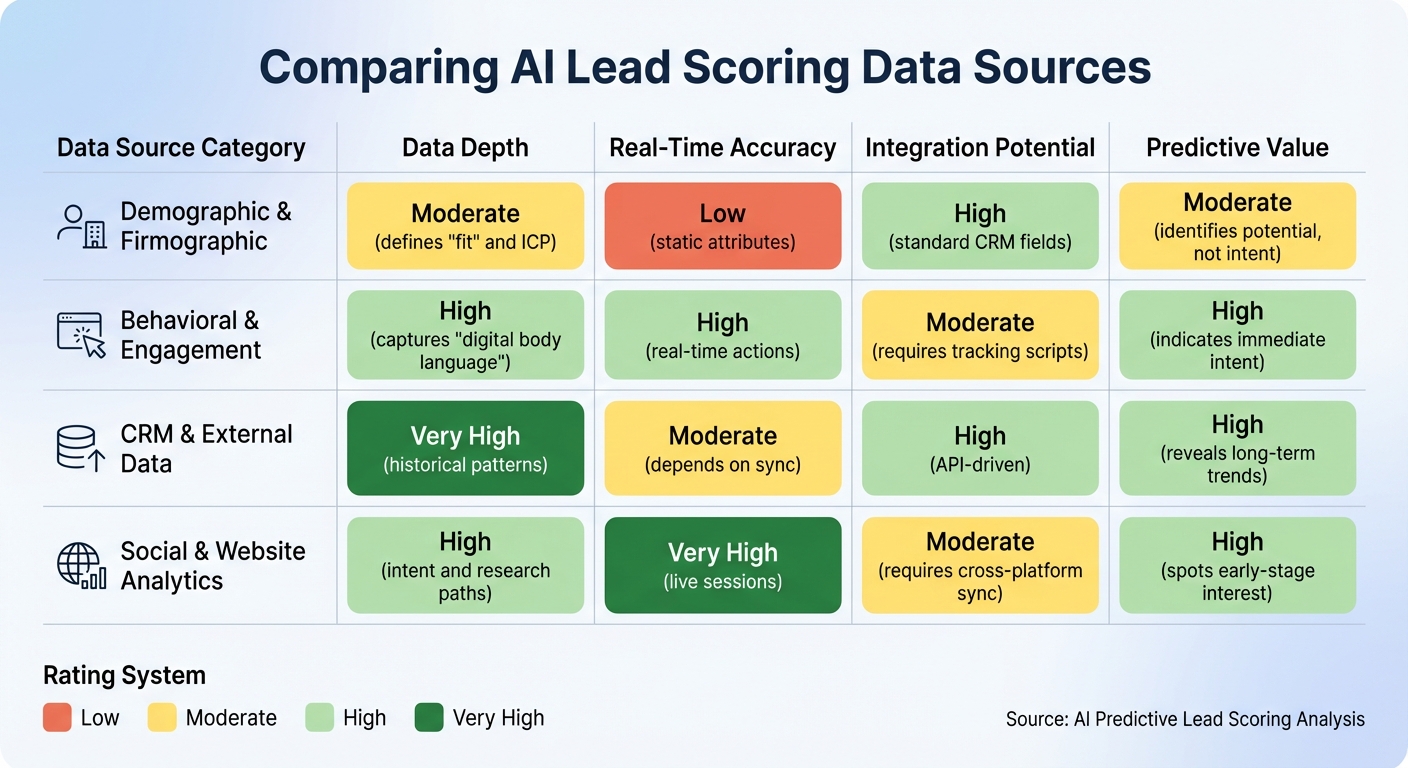
AI Lead Scoring Data Sources Comparison: Depth, Accuracy, Integration & Predictive Value
After diving into the specifics of each data source, here’s a quick look at their strengths and limitations when it comes to predictive lead scoring.
Each type of data brings its own advantages and challenges to the table, making them valuable in different ways.
Demographic and Firmographic Data lay the groundwork for identifying leads that align with your ideal customer profile (ICP). These data points integrate seamlessly with common CRM fields, making them easy to use. However, they’re usually static and limited to just 5–10 attributes in traditional models. While they help define who a lead is, they don’t reveal how ready they are to make a purchase[7][11].
Behavioral and Engagement Metrics shine when it comes to capturing real-time actions, like checking out a pricing page or downloading a whitepaper. These signals are fantastic for gauging immediate intent.
CRM and External Data Sources provide deep historical insights, offering context over time. APIs make integration straightforward, but the accuracy of real-time predictions depends heavily on maintaining clean, updated data. Issues like outdated or duplicate entries can weaken the reliability of your scoring model[1][12].
"As long as your data is well maintained and hygienic, you'll eliminate errors using predictive lead scoring." - Collin Couey, Software Advice[12]
Social Media and Website Analytics are excellent for identifying early-stage interest with real-time precision. They’re great at spotting intent signals, but syncing data across platforms can be tricky. Companies leveraging AI in lead scoring have reported a 20% to 30% boost in conversion rates[4].
Here’s a quick comparison of the key attributes across these data sources:
| Data Source Category | Data Depth | Real-Time Accuracy | Integration Potential | Predictive Value |
|---|---|---|---|---|
| Demographic & Firmographic | Moderate (defines "fit" and ICP) | Low (static attributes) | High (standard CRM fields) | Moderate (identifies potential, not intent) |
| Behavioral & Engagement | High (captures "digital body language") | High (real-time actions) | Moderate (requires tracking scripts) | High (indicates immediate intent) |
| CRM & External Data | Very High (historical patterns) | Moderate (depends on sync) | High (API-driven) | High (reveals long-term trends) |
| Social & Website Analytics | High (intent and research paths) | Very High (live sessions) | Moderate (requires cross-platform sync) | High (spots early-stage interest) |
This breakdown offers a clearer picture of the trade-offs, helping you understand how to leverage these data sources for better results.
Conclusion
Relying on just one data source for lead scoring can seriously limit how accurately you evaluate prospects. By combining data from demographics, behaviors, CRM systems, and social media, you get a full picture of each lead - showing not only who they are but also what actions they’re taking. This more complete method removes much of the guesswork and minimizes the biases often found in traditional scoring systems[8].
AI-powered lead scoring takes things to the next level by improving how leads are prioritized and boosting overall efficiency. It uses historical data to detect patterns, like specific sequences of website interactions, that manual methods might overlook[8].
SalesMind AI brings it all together by integrating LinkedIn activity, behavioral insights, and CRM data into a single platform. Its advanced scoring system automatically ranks leads based on real-time engagement, while the AI-driven inbox simplifies follow-ups. This streamlined process helps sales teams cut the time spent on initial lead qualification by 30–40%[4]. This kind of unified system lays the groundwork for consistent sales success.
Before diving into any AI-based scoring tool, make sure your data is clean - remove duplicates and correct any inconsistencies[7]. When you feed high-quality data into your AI model, you could see efficiency gains and a 10–20% increase in revenue within the first year[4]. Incorporating these strategies into your sales process can lead to measurable growth and stronger results.
FAQs
How does AI enhance the accuracy of predictive lead scoring compared to traditional methods?
AI has transformed predictive lead scoring by tapping into vast amounts of real-time data, including email engagement, website behavior, and LinkedIn activity. Traditional methods often depend on static rules or basic demographic details, but AI takes it a step further. Using machine learning, it uncovers hidden patterns and adjusts to shifts in customer behavior.
This smarter approach helps businesses zero in on the most promising leads, ensuring sales teams spend their time where it matters most. Plus, as AI keeps learning and improving, it provides sharper, more actionable insights to streamline lead qualification.
How does real-time data improve the accuracy of predictive lead scoring?
Real-time data takes predictive lead scoring to the next level by factoring in the most recent behavioral signals - like website visits, email opens, and social media interactions. This means lead scores aren’t static; they adjust dynamically to reflect a prospect's latest actions.
With these live insights, sales teams can reach out at the exact moment a lead shows peak interest. This timely engagement not only boosts the chances of meaningful conversations but also helps drive higher conversion rates. Acting on real-time data empowers businesses to stay proactive and make smarter, quicker decisions.
Why is integrating data essential for improving AI-powered lead scoring?
Data integration plays a key role in AI-driven lead scoring by merging different signals - like website visits, email opens, LinkedIn interactions, and CRM updates - into a single, real-time dataset. This unified approach allows AI to spot patterns more effectively, delivering more precise lead rankings and instant updates whenever new actions take place.
When integration falls short, data silos can create inefficiencies and cause teams to miss valuable opportunities. By capturing all interactions automatically, sales teams can focus on the most promising leads at the right moment, boosting response rates, conversions, and overall ROI. Tools like SalesMind AI simplify this process, automating data flow and helping teams work more efficiently.
 JG
JG