AI-Powered Segmentation vs. Manual Targeting
Compare AI segmentation and manual targeting—how AI boosts speed, accuracy, scalability, cost efficiency, and personalization for sales and marketing.
 Julien Gadea
Compare AI segmentation and manual targeting—how AI boosts speed, accuracy, scalability, cost efficiency, and personalization for sales and marketing.
Compare AI segmentation and manual targeting—how AI boosts speed, accuracy, scalability, cost efficiency, and personalization for sales and marketing.
Table of Contents
AI-powered segmentation outperforms manual targeting by automating audience analysis and adapting to real-time behaviors. While manual targeting relies on broad, static groupings, AI uses dynamic data to create highly specific, actionable segments. Here’s why AI is the smarter choice for modern sales and marketing:
- Speed: AI processes thousands of prospects in minutes; manual methods take days or weeks.
- Accuracy: AI analyzes hundreds of variables for precise targeting; manual targeting often relies on outdated, limited data.
- Scalability: AI handles millions of profiles effortlessly; manual approaches struggle to scale without significant time and cost investment.
- Cost Efficiency: AI reduces labor costs and optimizes ad spend; manual methods are resource-intensive and less effective.
- Personalization: AI creates tailored messaging based on real-time behaviors; manual targeting offers only surface-level customization.
Quick Comparison
| Feature | Manual Targeting | AI-Powered Segmentation |
|---|---|---|
| Speed | Slow; updates take weeks | Instant; real-time updates |
| Accuracy | Limited; prone to human error | High; analyzes complex data |
| Scalability | Labor-intensive to scale | Handles millions of profiles easily |
| Cost Efficiency | High labor costs | Low cost, automated processes |
| Personalization | Basic; static demographics | Advanced; real-time behaviors |
AI-powered segmentation saves time, cuts costs, and delivers better results by leveraging real-time data and automation. Businesses already using AI report higher conversion rates, increased sales, and improved efficiency. If you want to stay competitive, AI isn’t just an option - it’s the future of AI for sales and targeting.
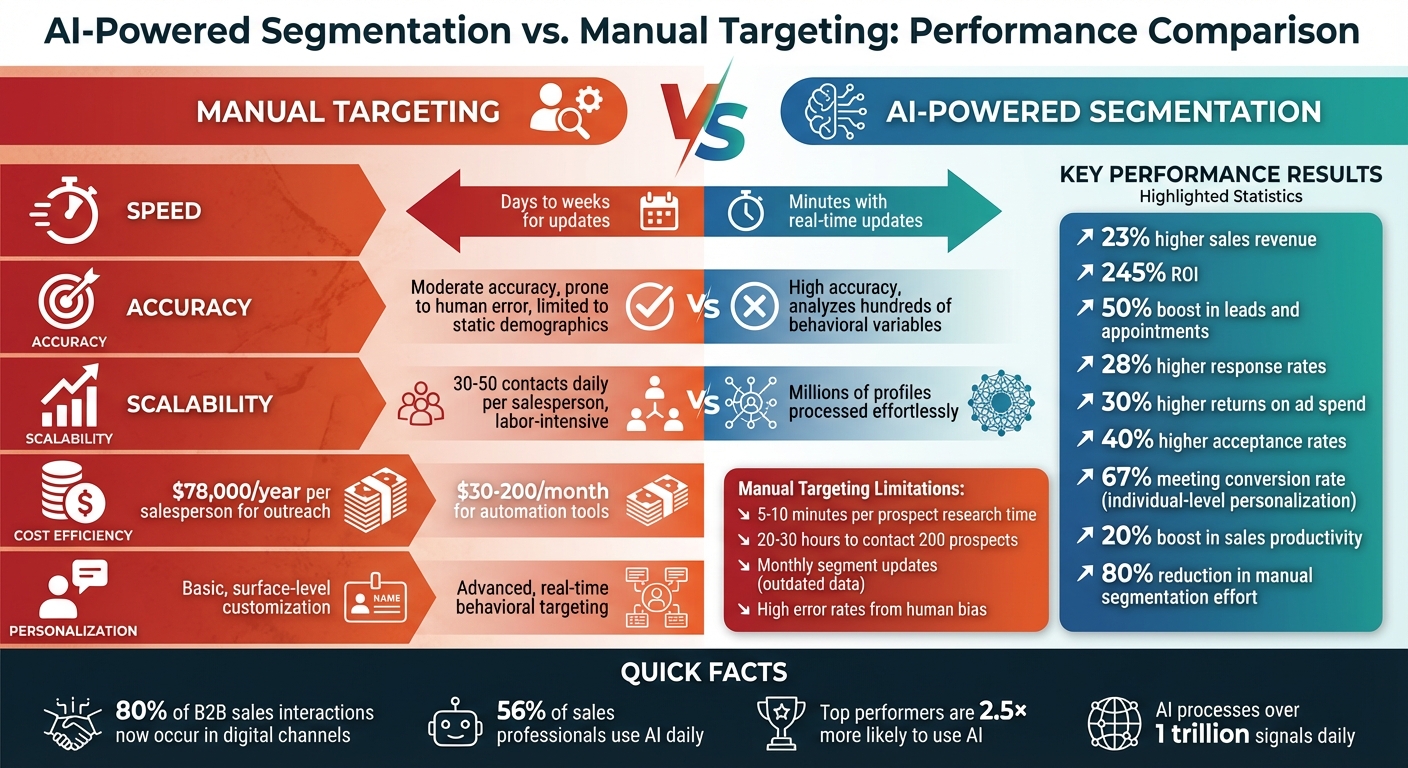
AI-Powered Segmentation vs Manual Targeting: Key Performance Metrics Comparison
Problems with Manual Targeting
Manual targeting significantly limits your sales team's productivity. On average, a salesperson spends 5–10 minutes per prospect researching, personalizing messages, and handling follow-ups. This means they can only reach about 30–50 contacts daily, requiring 20–30 hours just to contact 200 prospects. The effort grows linearly with your outreach goals, making it hard to scale effectively [7].
The financial cost of manual outreach is also steep. If a salesperson's time is valued at $50 per hour, weekly outreach costs can hit $1,500 per person. Over the course of a year, this adds up to $78,000 per salesperson for LinkedIn outreach alone. In contrast, automation tools cost just $30–$200 monthly, offering a far more cost-effective solution. Beyond the time and money involved, manual methods are also hampered by human limitations.
As Famelab.io explains:
"Manual outreach hits a ceiling based on human capacity, whilst automation can theoretically run 24/7." [7]
Human errors further compound the inefficiencies. Biases in manual segmentation often lead to inaccurate targeting, as analysts may unconsciously associate certain job roles with outdated or stereotypical demographics. When juggling multiple campaigns, misclassification and oversights are nearly inevitable. By comparison, AI-driven campaigns deliver approximately 30% higher returns on ad spend, thanks to their precision and scalability [8].
Another major drawback is the inability of manual targeting to keep pace with changing customer behaviors. Manual segments are typically updated on a monthly basis, leaving them out of sync with real-time shifts in buyer behavior [6]. This delay means critical signals - like recent job changes, engagement with posts, or visits to pricing pages - are often missed. Competitors leveraging real-time data can swoop in and engage these prospects before you do [7]. These limitations highlight why manual targeting struggles to compete in fast-moving sales environments.
sbb-itb-817c6a5
Benefits of AI-Powered Segmentation
AI-powered segmentation takes the guesswork out of targeting by addressing the inefficiencies of manual methods. It processes massive amounts of data - like visit frequency, content preferences, device usage, and engagement patterns - in a matter of seconds to pinpoint high-value customer clusters [5].
The speed advantage is hard to ignore. While manual segmentation struggles as your audience grows, AI can analyze and reorganize millions of customer profiles in minutes. This efficiency translates into real savings: sales professionals using AI save an average of 1.5 hours per week on lead and company research [18]. Not surprisingly, top-performing sales teams are 2.5× more likely to use AI daily compared to their peers [18]. These tools don’t just save time - they improve real-time performance, enable personalized outreach, and scale effortlessly.
Real-Time Updates
Manual targeting often relies on outdated quarterly lists, which means your data is stale almost as soon as it’s updated. AI-powered systems, on the other hand, refresh segments in real-time by continuously processing incoming data. Whether someone visits your pricing page, downloads a whitepaper, or switches jobs, AI catches these changes instantly and adjusts your outreach to engage prospects at the perfect moment [5][14].
AI doesn’t just stop at static updates - it tracks ongoing behaviors like clicks, session data, and social media interactions to ensure your segments stay relevant [5]. For instance, LinkedIn’s AI tool, Accelerate, helped early adopters reduce their cost-per-lead by 21% by automating tasks like bidding strategies and account list generation [12].
Better Personalization
AI takes personalization to a level that manual targeting simply can’t achieve. Instead of relying on broad categories like job titles or industries, AI leverages hundreds of behavioral and intent signals to create highly specific micro-segments [5].
Take TechSolutions Inc., a B2B technology company that adopted AI-driven segmentation in June 2025. By using clustering algorithms and natural language processing, they dynamically tailored proposals based on real-time segment data. The result? A 30% increase in lead conversion rates and a 25% reduction in sales cycles [2].
Personalization driven by AI goes beyond adding someone’s name to an email. It analyzes profiles to adjust tone and messaging based on professional personas, ensuring outreach feels relevant and authentic [15]. A 2025 case study revealed how different levels of personalization impact outcomes:
- Company-level personalization (addressing industry-specific pain points) boosted open rates by 23%.
- Role-based personalization (focusing on challenges tied to specific positions) increased response rates by 41%.
- Individual-level personalization (tailored to content preferences and engagement history) achieved a 67% meeting conversion rate [12].
In another example, a B2B software company targeting 1,000 enterprise accounts used AI to automate personalization across role-based segments. The results were striking: a 187% jump in click-through rates, a 3.2× increase in qualified opportunities, and $18.7 million in influenced pipeline within just six months [11]. As Single Grain puts it:
"The most successful AI-driven LinkedIn ABM campaigns don't just replace human decision-making. They amplify human strategic thinking by handling the data-intensive optimization work that would otherwise consume entire marketing teams." [12]
Scalability
Scaling manual targeting is nearly impossible as your prospect list grows. AI eliminates this bottleneck entirely. Automated pipelines reduce manual segmentation efforts by 80%, allowing teams to expand their reach without additional hires [6]. Companies using AI for lead scoring have reported conversion rate improvements of up to 50% [4].
The difference becomes even clearer when you consider how AI handles data. While manual analysis can take weeks, AI processes millions of users in minutes - even in complex B2B scenarios involving multiple stakeholders and diverse data sources like CRM systems, social media, and web analytics [5][17]. By managing this data effectively, AI-powered segmentation can boost campaign performance by 40–60% [6].
Tools like LinkedIn’s Accelerate demonstrate this scalability by launching optimized account-based marketing sequences in under five minutes, automatically generating account lists and creative assets [12]. This efficiency directly impacts revenue: companies investing in AI for sales and marketing report 3–15% higher revenues and 10–20% greater sales ROI on average [16]. Some even see 4–7× higher conversion rates compared to traditional outbound efforts [16].
Additionally, generative AI is lightening the load for marketers. Over half (51%) of marketers using these tools report a significant reduction in tedious manual tasks [13]. This frees up your team to focus on closing deals and building relationships instead of spending hours curating prospect lists.
AI-Powered Segmentation vs. Manual Targeting: Direct Comparison
Building on the earlier discussion, comparing AI-powered segmentation with manual targeting highlights some clear differences. Manual targeting depends on static assumptions and broad demographic data, which can quickly become outdated. In contrast, AI-powered segmentation processes behavioral and contextual data simultaneously, uncovering patterns that humans might overlook [19][9]. This fundamental distinction sets the stage for a closer look at the two approaches.
The efficiency gap is hard to ignore. With manual methods, creating a single segment can take days or even weeks, requiring significant IT resources. On the other hand, AI enables marketers to create and activate segments in just minutes using simple, natural language prompts [19]. As LiveRamp explains:
"AI streamlines audience segmentation by letting marketers build segments through simple, natural-language commands, which are then translated into logic applied across all available customer data." [19]
Cost is another differentiator. Manual targeting often comes with high labor expenses, while AI optimizes ad spend by focusing on high-intent prospects [19][20]. This process is often facilitated by specialized AI lead generation tools that automate prospect identification. The results speak volumes: companies using AI for sales segmentation report a 20% boost in sales productivity [9], and AI-driven marketing can improve overall efficiency by 30% [10]. Furthermore, 85% of companies believe AI will be a key driver of future sales growth [9].
Here’s a breakdown of the key differences:
Comparison Table
| Metric | Manual Targeting | AI-Powered Segmentation |
|---|---|---|
| Accuracy | Moderate; relies on static demographics like "women 25-34" [19] | High; analyzes hundreds of behavioral and contextual variables [19] |
| Speed | Slow; takes days or weeks to create and refresh segments [19] | Instant; segments created in minutes, updated in real-time [19] |
| Scalability | Low; requires more manpower and budget to scale [10] | High; processes millions of data points with minimal added cost [19][10] |
| Personalization Depth | Surface-level; based on basic demographics or past purchases [19] | Deep; targets intent and real-time behavior with predictive analysis [19] |
| Error Rates | Higher; prone to human mistakes and manual data entry errors [9] | Lower; automated logic reduces errors [19] |
| Cost Efficiency | Low; high labor costs and harder to measure ROI [10] | High; reduces wasted spend and lowers long-term labor costs [19][10] |
The impact of AI-powered segmentation is clear. 73% of companies using AI report improved customer satisfaction, while 71% see increased sales [9]. AI-driven email campaigns deliver an impressive 42:1 ROI [10], and businesses using dynamic AI segmentation achieve a 40% higher lead-to-opportunity conversion rate compared to static, manual methods [21].
How AI-Powered Segmentation Works in LinkedIn Sales Automation
AI has revolutionized LinkedIn sales automation by processing massive amounts of data in just minutes, identifying key buying signals like funding announcements, executive hires, or shifts in tech stacks [3]. This level of efficiency and precision is something manual research simply can't match. Tools like SalesMind AI leverage this capability to streamline LinkedIn outreach, making the process faster and more effective.
SalesMind AI Features
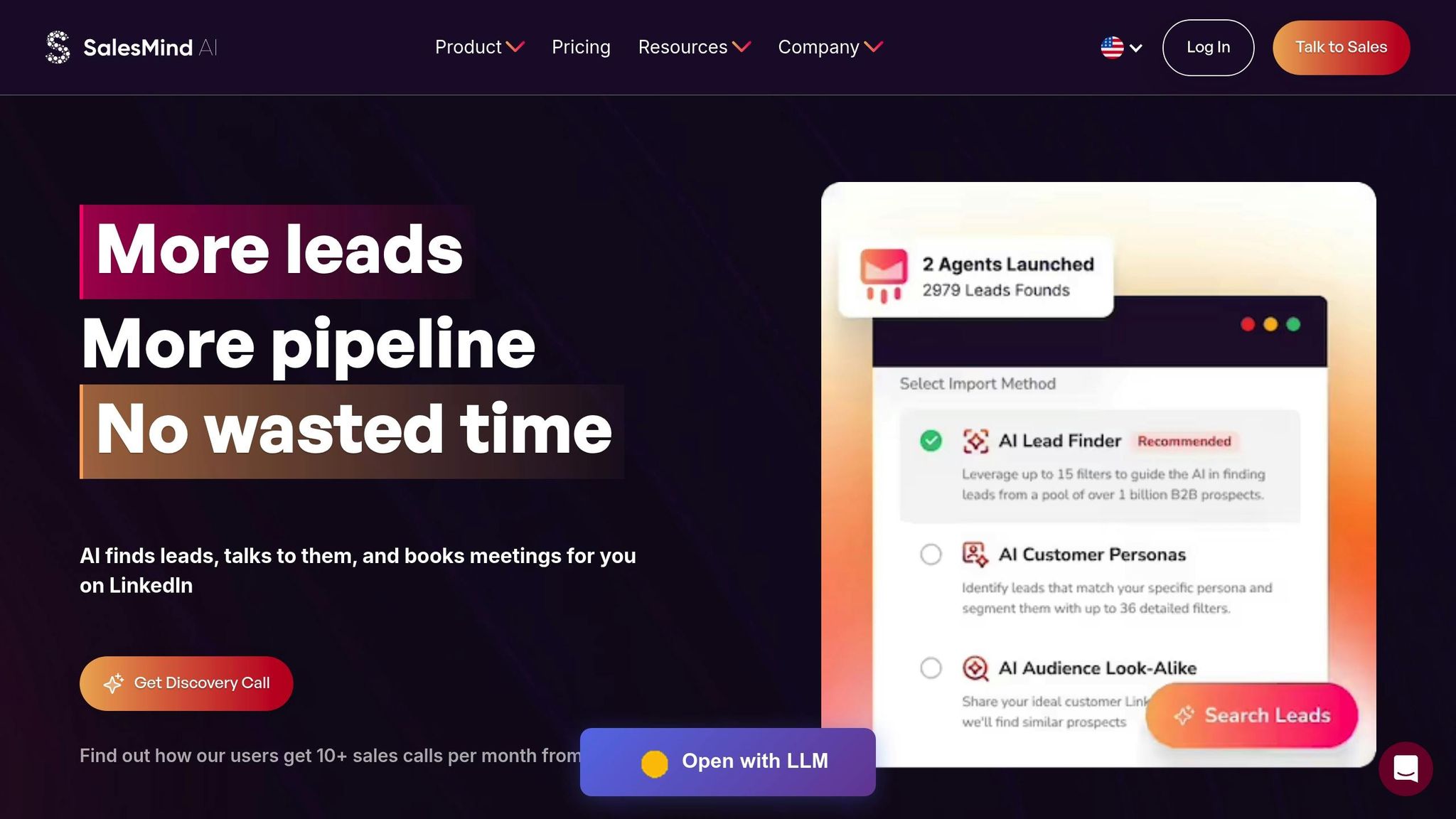
By integrating AI-driven segmentation, SalesMind AI transforms LinkedIn outreach into a highly targeted and efficient process. The tool identifies high-potential profiles by analyzing LinkedIn events, post interactions, and even competitor follower activity. Its personalization engine takes things further, using AI datasets and contextual clues to craft messages that feel tailor-made, significantly improving acceptance and conversation rates [22].
SalesMind AI also automates the entire outreach sequence, handling tasks like likes, follows, profile visits, and connection requests. This ensures consistent engagement without requiring constant manual input [22]. A centralized inbox with automatic tagging makes it easy to analyze responses and track the performance of outreach efforts [22]. To safeguard account integrity, the platform mimics human behavior by using local IP addresses and adhering to office-hour activity patterns [22].
The results speak for themselves: SalesMind AI achieves a 40% acceptance rate, a 45% reply rate, and generates a monthly pipeline worth $100,000 [22]. As Nick Heijman, CEO of ExtractTech, shared:
"The results were sometimes almost too good - connection rates and responses were way above what I expected" [22].
Better Engagement and ROI
AI-powered segmentation doesn't just enhance targeting - it also delivers measurable improvements in engagement and return on investment. Sales teams using AI for personalized messaging experience a 28% boost in response rates [18]. Tailored LinkedIn InMails, for instance, achieve 40% higher acceptance rates compared to generic messages [23]. While company-level personalization typically yields a 23% open rate, AI-driven individual-level optimization - based on engagement history - can achieve a staggering 67% meeting conversion rate [12].
Organizations adopting AI for lead management report up to a 50% increase in leads and appointments [3]. AI-optimized LinkedIn sequences have also slashed lead costs by 42% while increasing engaged accounts by 28% [12]. Over just three months, PTC used AI-driven insights to connect with over 2,000 new prospects, resulting in more than $4.5 million in closed deals [23]. Victoria Landsmann from monday.com summed it up perfectly:
"Your sales team's success no longer depends on how hard they work, but on how smart they work" [3].
Conclusion
Deciding between AI-powered segmentation and manual targeting isn’t just about choosing the more efficient option - it’s about staying ahead in a marketplace where 80% of B2B sales interactions now take place in digital channels [1]. Manual targeting, while manageable for smaller outreach efforts, struggles to keep up with the speed and complexity of today’s B2B sales environment. As businesses scale, manual methods often turn into a roadblock.
AI-powered segmentation, on the other hand, delivers results that manual strategies simply can’t replicate. Businesses leveraging AI for segmentation see 23% higher sales revenue, a 245% ROI, a 50% boost in leads and appointments, and 28% higher response rates [24][1][18]. These aren’t minor gains - they’re transformative shifts that redefine what’s possible.
The true strength of AI lies in its ability to interpret real-time behavioral signals and uncover insights that human teams might overlook. With the capacity to process over 1 trillion signals daily [2], AI identifies patterns that enable smarter decisions while freeing your team to focus on building relationships and closing deals. As Karin Kimbrough, Chief Economist at LinkedIn, puts it:
"Companies that embrace AI gain a crucial competitive advantage." [18]
For LinkedIn outreach specifically, AI takes scalability to new heights. Tools like SalesMind AI combine advanced segmentation with personalized LinkedIn connection requests, leading to 40% higher acceptance rates [23].
AI-powered segmentation doesn’t just outperform manual targeting - it redefines effectiveness entirely. With 56% of sales professionals already using AI daily [18] and top performers being 2.5 times more likely to adopt it [18], embracing AI-powered segmentation isn’t just a smart move; it’s a necessity for staying competitive and driving growth.
FAQs
How does AI-powered segmentation make marketing more personalized?
AI-driven segmentation is changing the game for marketing personalization. Instead of relying on static, generic lists, it uses dynamic, behavior-based profiles to target audiences more effectively. By analyzing real-time data - like browsing habits, purchase intent, and engagement patterns - AI creates precise audience segments that align with what prospects actually need at that moment. This means marketers can deliver messages that feel personal and relevant, not cookie-cutter.
What makes this even more powerful is AI’s ability to keep these segments updated in real time. Whether it’s a product recommendation, a tailored email, or a LinkedIn message, AI ensures the right content reaches the right person at the perfect time. For example, tools like SalesMind AI enhance this process by automating hyper-personalized LinkedIn messages, advanced lead scoring, and follow-ups. This not only saves time but also helps businesses build stronger connections with prospects. The payoff? More engagement, better relationships, and campaigns that deliver stronger results.
How does AI-powered segmentation save costs compared to manual targeting?
AI-powered segmentation helps cut costs by taking over time-intensive tasks like audience selection, bid adjustments, and A/B testing. By automating these processes, businesses can speed up campaign execution while reducing the need for manual work, which ultimately lowers personnel expenses. Plus, AI continuously processes data and fine-tunes targeting in real time, ensuring ad budgets are used more effectively.
For B2B teams, tools such as SalesMind AI take these savings even further. They automate tasks like lead qualification, personalized messaging, and follow-ups. Features like an AI-driven unified inbox and advanced lead scoring allow businesses to manage more prospects without increasing resources, reducing labor costs while improving ROI. By integrating AI, companies can achieve stronger outcomes while spending less on both staffing and advertising.
How does AI-powered segmentation adapt to real-time data changes?
AI-powered segmentation takes the guesswork out of managing customer data by analyzing real-time actions like clicks, login patterns, email engagement, and other behaviors. With machine learning models at the helm, segment definitions are constantly refined, ensuring contacts automatically shift between groups as their activity evolves.
This automated process removes the hassle of manual updates, enabling businesses to send tailored messages or initiate workflows instantly. By staying in sync with the latest customer behavior, AI-driven segmentation keeps campaigns relevant and allows businesses to respond quickly to changing user needs.
 JG
JG