Top Features of AI-Powered Lead Scoring Tools
How AI lead scoring boosts sales with real-time scoring, machine learning, multi-channel data, predictive forecasts and transparent scores to prioritize high-intent leads.
 Julien Gadea
How AI lead scoring boosts sales with real-time scoring, machine learning, multi-channel data, predictive forecasts and transparent scores to prioritize high-intent leads.
How AI lead scoring boosts sales with real-time scoring, machine learning, multi-channel data, predictive forecasts and transparent scores to prioritize high-intent leads.
Table of Contents
AI-powered lead scoring tools help sales teams focus on the right prospects by using data and machine learning to rank leads based on their likelihood to convert. These tools improve efficiency, shorten sales cycles, and increase conversion rates - by as much as 25% - all while reducing manual work.
Key Features:
- Real-Time Scoring: Updates scores instantly based on lead actions like website visits or email opens.
- Machine Learning: Learns from past data to predict which leads are most likely to convert.
- Multi-Channel Data Integration: Combines data from websites, emails, LinkedIn, and CRMs for a complete lead profile.
- Customizable Models: Tailors scoring to your specific business needs by weighing actions and attributes differently.
- Behavioral Analysis: Tracks engagement patterns to identify high-intent leads.
- Predictive Analytics: Forecasts conversion potential based on historical trends and live data.
- Automated Alerts: Notifies sales teams when a lead becomes sales-ready.
- Transparent Scoring: Shows exactly why a lead received its score, building trust in the system.
Why It Matters:
These tools eliminate guesswork, align sales and marketing teams, and ensure no high-value lead is missed. By automating scoring and providing actionable insights, they allow sales teams to focus on converting the best opportunities.
Using AI for Lead Scoring (AI for Business People Series)
1. Real-Time Scoring and Dynamic Updates
Traditional lead scoring often feels like looking at an old photograph - it’s static and outdated. Scores are updated in batches, sometimes only once a day or even less frequently. By the time your sales team sees a lead's score, the prospect’s interest might have already cooled off. Real-time scoring changes the game by monitoring prospect behavior continuously and updating scores instantly as actions happen, enabling your team to act while the lead is still engaged.
Let’s break it down with an example: A prospect from a target company visits your website and downloads a whitepaper, earning 25 points. Two days later, they attend a webinar and engage with your content, adding another 15 points. The next day, they visit your pricing page three times, which boosts their score by 30 points. A quick LinkedIn check confirms they’re a director-level decision-maker at a company that matches your ideal customer profile, earning them an additional 20 points. Within just three days, this lead has gone from cold to red-hot, ready for immediate sales outreach [1].
With real-time scoring, these signals are automatically detected, and your sales team is notified right away. The system integrates seamlessly with your CRM, instantly qualifying leads and routing them to the right sales development representative (SDR) using automation tools that sync with CRMs and chatbots. No delays, no guesswork - just actionable insights delivered when they matter most.
These systems pull data from multiple sources simultaneously. Website analytics track page visits, time spent on key pages, and content downloads. Email engagement metrics measure opens, clicks, and replies. Social media activity, particularly on LinkedIn, highlights job title changes, company updates, and content interactions. CRM data provides historical context, creating a fuller picture of each lead’s journey.
SalesMind AI takes this concept even further. It combines real-time lead tracking with LinkedIn integration, updating scores instantly as prospects interact with your outreach efforts. Whether they open a message, view your profile, or respond, the platform’s advanced scoring system ensures your sales team stays on top of active buying signals.
One of the standout benefits of real-time scoring is the transparency it brings. It eliminates the "black box" problem by showing exactly which actions caused a score to change. For example, if a lead’s score jumps from 45 to 85, your team can immediately see whether it was triggered by a visit to your pricing page, a case study download, or a LinkedIn connection acceptance. This clarity helps your team prioritize leads more effectively.
For sales teams, this means better focus and efficiency. What used to be a manual, subjective process is now automated and data-driven. Some platforms even simplify prioritization further by assigning letter grades (A, B, C, D) to leads, making it crystal clear who’s most likely to convert [1]. Signals like LinkedIn activity, pricing page visits, and email opens highlight prospects with active buying intent, while automation ensures these leads move through your pipeline without delay.
The results speak for themselves. Companies using AI-powered lead scoring tools report an average 25% increase in conversion rates [3]. Additionally, 81% of industry leaders agree that AI reduces manual work and improves conversion accuracy [3]. By removing lag and manual updates, real-time scoring keeps your team focused on leads when their interest is at its peak, leveraging advanced algorithms to drive better outcomes.
2. Machine Learning Algorithms
AI-powered lead scoring transforms how businesses predict conversions by learning from historical data and continuously improving its predictions. Unlike traditional systems that rely on fixed rules, machine learning dives deep into past sales data, uncovering patterns that drive success. Every closed deal, missed opportunity, and customer interaction feeds into this system, helping it refine its understanding of what works best for your business.
These algorithms analyze a wide range of data points to identify subtle patterns that signal conversion potential. They combine behavioral signals - like website visits, email clicks, content downloads, and LinkedIn activity - with firmographic data such as company size, industry, funding status, and job titles. This blend of behavioral and demographic insights creates a detailed profile of each lead, highlighting those who not only fit your ideal customer profile but also exhibit clear buying intent. This holistic approach enables businesses to consolidate diverse data into a single, actionable lead score.
Machine learning doesn’t stop there. It continuously updates lead scores in real time, ensuring they stay accurate as new interactions occur. Each closed deal or lost lead sharpens the algorithm’s ability to predict what drives conversions. Companies that use AI-powered lead scoring often see a 25% boost in conversion rates and a 15% shorter sales cycle [2].
Another standout feature is how machine learning handles incomplete data. When information like company size or job title is missing, the algorithms automatically fill in the gaps by pulling data from external sources [1]. This ensures that lead scores are based on accurate and complete information. Additionally, natural language processing (NLP) enhances the system by analyzing communication patterns across emails, chats, and other channels, uncovering subtle signals of buying intent that might otherwise be overlooked [1].
SalesMind AI takes this capability a step further. It refines its scoring system using real conversion patterns specific to your business. By analyzing prospect profiles, company data, and engagement metrics, it predicts which leads are most likely to convert, adjusting its model as your business evolves. As Svit Babarovic from MountainDrop remarked:
The lead scoring system is particularly impressive, providing clear insights into lead quality [4].
What sets machine learning apart is its ability to create custom models tailored to your business. For example, a SaaS company targeting enterprise clients will have vastly different conversion drivers compared to a consulting firm focused on mid-market businesses. The more historical data you feed into the system, the smarter and more precise your lead scoring becomes.
The advantages go beyond just better scoring. AI-powered conversational analytics, which learn from interactions with leads, have enabled some companies to boost sales productivity by as much as 50% [2]. By clearly identifying which leads to prioritize and why, your team can focus their efforts on engaging buyers who are ready to take the next step.
3. Multi-Channel Data Integration
Taking real-time scoring a step further, multi-channel integration refines prospect profiling by pulling together data from various sources. AI-powered lead scoring tools gather insights from places like LinkedIn activity, email interactions, website behavior, and CRM records to create a detailed profile for each prospect. This combined view uncovers patterns and signals that might be missed when data is analyzed in isolation, leading to more precise and timely lead assessments.
Imagine a prospect visiting your pricing page, downloading a whitepaper, interacting with your LinkedIn content, and opening multiple emails. Each of these actions provides valuable insights. By merging these signals, you can identify genuine buying interest that might otherwise go unnoticed.
Multi-channel integration works by consolidating data from websites, emails, LinkedIn, and CRM systems into a single scoring engine. Once these streams are combined, the algorithm can weigh each signal appropriately, creating a more accurate lead score.
To further enhance this process, data enrichment fills in gaps by automatically adding firmographic details such as company size, industry, revenue, or key decision-makers. This ensures that lead scores are based on complete and reliable data, reducing the risk of missing qualified prospects due to incomplete information.
Real-time updates play a crucial role here, allowing your team to engage prospects at the right moment when their buying signals are strongest. For example, visitor tracking enriched with firmographic data can turn anonymous website traffic into actionable CRM leads.
SalesMind AI takes this a step further by focusing on LinkedIn-based prospecting. It combines LinkedIn engagement data with behavioral signals from other channels, ensuring lead scores reflect both social selling activity and traditional engagement. Paired with dynamic scoring and adaptive algorithms, this approach provides a well-rounded view of each lead.
Integration with platforms like HubSpot, Marketo, and Segment streamlines the process even more. Qualified leads are automatically routed to the right sales representative as soon as they meet your criteria, while lower-priority leads continue to receive nurturing content to keep them engaged.
The method you choose for scoring - whether rule-based or AI-driven - can also impact how multi-channel data is utilized. Rule-based scoring assigns specific point values to actions, offering clear control. On the other hand, AI-based models analyze historical data to uncover patterns that predict conversions. Many B2B teams find success with a hybrid approach, combining the transparency of rule-based systems with the adaptability of machine learning. This aligns with the earlier focus on precise, data-driven lead scoring.
To get the most out of multi-channel integration, use custom filters to eliminate irrelevant traffic - like bots or non-target visitors - and consistently track both engagement metrics and firmographic details. This unified view of prospect behavior, combined with real-time updates, ensures your sales team can act quickly and effectively when strong buying signals appear.
4. Customizable Scoring Models
Customizable scoring models take the guesswork out of identifying high-intent leads by allowing businesses to tailor their approach based on their unique sales process. What signals interest for one company might not matter for another. For instance, a SaaS company targeting enterprise clients might focus on engagement with case studies or visits to pricing pages. Meanwhile, a B2B services firm might prioritize job title changes or indicators of company growth. These models let you zero in on what truly drives conversions for your specific market.
With customizable scoring, you can assign precise weights to behaviors that matter most in your sales funnel. For example, you can allocate higher scores to actions like downloading a whitepaper or adjust weightings based on firmographics, such as industry or company size. This ensures that your scoring reflects your actual customer journey rather than relying on generic benchmarks.
A particularly effective strategy combines AI-powered predictive scoring with custom rules. AI analyzes your historical data to identify patterns that predict conversions, learning from past successes. At the same time, custom rules allow you to emphasize or de-emphasize specific factors. For example, you might boost scores for director-level job titles or lower them for companies outside your target revenue range. This hybrid approach addresses the common concern that AI scoring can feel opaque, offering a balance between data-driven insights and human oversight.
Here’s a real-world example: a B2B software company increased its SQL rate by 45% in just 60 days after implementing a customized AI scoring model [1].
To get started, dig into your historical sales data to identify trends among your closed-won deals. What actions consistently led to conversions? For instance, if prospects who visit your pricing page are three times more likely to convert, that behavior should carry more weight. Similarly, if certain firmographic details - like industry or company size - are common among your best customers, those should be prioritized in your scoring model. This ensures your model evolves alongside your sales process, staying aligned with what works for your business.
SalesMind AI simplifies this process by letting you set target audience filters that align with your ideal customer profile. The system then evaluates leads based on these filters, assigning a clear suitability score. This filter-based approach makes it easy to adapt your scoring criteria as your business grows, without needing a full overhaul.
Keep your model straightforward. Focus on the five to ten most critical signals to avoid overcomplicating the process. Many platforms even offer easy-to-understand segmentation, like assigning letter grades (A, B, C, D), so your sales team can quickly identify high-priority leads without getting bogged down in complex calculations.
You can also customize thresholds for different teams or regions and refine your model regularly by tracking conversion rates and outcomes. Adding filters to block non-target traffic - like bots, ISPs, or competitors - further ensures your sales team spends time on genuine prospects with real potential.
5. Behavioral Analysis and Engagement Tracking
Behavioral analysis takes lead scoring to the next level by capturing real-time interactions and turning them into actionable insights. Instead of relying solely on static scores, it tracks how prospects engage with your brand - whether they’re viewing your LinkedIn profile, replying to messages, downloading a whitepaper, or browsing your pricing page. These live interactions paint a clearer picture of buying intent.
What makes behavioral tracking so effective is its ability to recognize patterns. For instance, a single website visit might not mean much, but if a prospect visits multiple times in a week, spends time on case studies, opens follow-up emails, and interacts with your LinkedIn posts, it signals genuine interest. Real-time updates ensure that lead scores are adjusted immediately, allowing your team to act when prospects are most engaged.
By analyzing which content prospects interact with, you can pinpoint their position in the buying journey. For example:
- Early-stage leads often focus on educational content like blog posts.
- Mid-stage leads might explore product details and customer testimonials.
- Late-stage prospects tend to request demos or compare pricing options.
This segmentation allows your sales team to tailor their approach, ensuring their outreach aligns with where the prospect is in their decision-making process. Advanced analytics further enhance this by identifying predictive patterns, using tools like natural language processing and historical data to recognize behaviors that often lead to conversions. Unlike traditional scoring, which might assign points based on isolated actions, these tools can detect reliable sequences - like visiting a pricing page, downloading a guide, and reviewing case studies - that indicate strong buying intent.
For example, one B2B software company saw a 45% increase in qualified leads within just 60 days by leveraging behavioral analysis [1]. Metrics now capture not just the frequency of interactions but also their depth, offering a more accurate measure of a prospect’s readiness to buy.
Take SalesMind AI as an example. It tracks engagement on LinkedIn by monitoring profile views, message responses, and connection activity. Its unified inbox consolidates these signals, making it easier to spot prospects who not only fit your ideal customer profile but are also actively engaging with your outreach.
To refine these insights further, multi-channel integration combines behavioral data with additional context, such as company size, industry, decision-maker roles, and budget indicators. Custom filters eliminate irrelevant data - like ISPs, bots, or competitors - while AI algorithms continuously learn which behaviors are most likely to lead to conversions. Over time, this makes lead scoring more precise and ensures your sales team focuses on the leads most likely to close.
sbb-itb-817c6a5
6. Predictive Analytics and Conversion Forecasting
Predictive analytics takes lead scoring to the next level by using historical data to forecast which leads are most likely to convert - even before they reach the bottom of your funnel. By combining behavioral and firmographic data, these models uncover subtle patterns that signal conversion potential.
Trained on the data from your closed deals, predictive models identify specific actions that consistently indicate a lead is ready to convert. This can increase lead conversion rates by an average of 25%, with some businesses seeing improvements of up to 30% [5]. It's no surprise that 75% of B2B marketers view AI-powered lead scoring as a critical factor in boosting sales efficiency [5].
One of the most compelling aspects of predictive analytics is its ability to spot high-potential prospects that may not fit your usual criteria. The AI learns from your historical data, enabling it to predict which leads are likely to close - even if they fall outside your traditional target profile.
Streamlining Resources with Conversion Forecasting
Conversion forecasting helps sales teams focus their efforts where they matter most. By identifying high-potential leads, sales teams can prioritize their outreach while lower-scoring leads are nurtured through automated workflows. This is especially important given that 61% of B2B marketers report challenges with lead qualification [5]. Predictive analytics automates much of this process, updating continuously as new data comes in. The models adapt over time, learning from new conversion data and adjusting to shifts in your market, product offerings, or customer base - no manual updates required.
SalesMind AI, for example, uses predictive insights to assign suitability scores to leads based on your specific filters, helping sales teams make faster, more informed decisions. As Svit Babarovic from MountainDrop shared:
The lead scoring system is particularly impressive, providing clear insights into lead quality [4].
Real-Time Adjustments for Maximum Impact
Predictive analytics doesn't just look ahead - it reacts in real time. When a lead performs a key action, their conversion likelihood is updated instantly. This triggers alerts for your sales team, ensuring they engage prospects while interest is at its highest. This combination of forward-looking predictions and immediate responsiveness provides both a strategic roadmap and the agility to act in the moment.
The results speak for themselves. AI-powered lead scoring tools deliver an average ROI of 300% [5], thanks to time savings and improved conversion rates. Sales professionals spend less time on unqualified leads and more time closing deals. As Henry F., an Enterprise Account Executive at Salesforce, put it:
I was able to automate something that would have taken me days or weeks of consistent manual work. This takes a load off and allows me to do more of the things I enjoy vs cold outreach [4].
Quality Data Is Key
For predictive analytics to work effectively, it needs robust historical data. Start by integrating all available sources, such as behavioral signals from your website and email campaigns, firmographic details from your CRM, technographic data, and intent signals from online activities. With a comprehensive data set, predictive models can refine their accuracy over time, enabling smarter, more strategic sales efforts.
7. Automated Alerts and Lead Segmentation
Building on predictive insights, automated alerts and segmentation ensure that your sales team receives actionable signals right when they matter most. AI-powered lead scoring tools don’t just calculate scores - they prompt action. These tools send automated alerts the moment a lead takes a high-intent action or reaches a critical threshold, ensuring no opportunity slips through the cracks. At the same time, automated segmentation organizes leads into groups, enabling targeted outreach based on their readiness to engage.
Real-Time Alerts for Immediate Engagement
When a lead hits a specific score threshold, the system instantly syncs that lead with your CRM [1]. This real-time update eliminates the need for manual handoffs, allowing your team to connect with prospects right when their interest is at its highest. High-intent leads are escalated automatically, and follow-ups are scheduled using predefined routing rules, keeping the process seamless and efficient.
Smarter Segmentation for Tailored Outreach
AI-driven segmentation automatically groups leads based on factors like score ranges, behavior patterns, engagement levels, and firmographic data [1]. For example, some tools use grading systems to help sales teams prioritize leads without needing to manually review numerical scores. Others evaluate website visitors against your ideal customer profile, monitoring their activity while filtering out irrelevant traffic. This kind of targeted segmentation allows for customized outreach strategies - high-priority leads might receive immediate personal attention, while mid-level leads can be nurtured through tailored workflows.
Customization to Fit Your Sales Strategy
The best segmentation systems allow you to define which actions and attributes are most relevant to your business [1]. For instance, you can assign specific point values to actions like visiting a pricing page or identifying decision-makers by their titles. This ensures that your segmentation aligns with your ideal customer profile and sales process. Sales teams can refine the results further with segment-specific workflows. For example, enterprise prospects might be routed to senior account executives, while mid-market leads are handled by sales development representatives (SDRs). These personalized methods pave the way for efficient execution.
SalesMind AI showcases this kind of targeted segmentation with its customizable audience filters. Louis-Alban B., CEO of Yindii, shared his experience:
Easy to set up, I choose my target audience filters, and the system will reach out for me. Propose a smart template based on profiles, companies, and very useful. [4]
Roberto K., Chief Product Officer at aCommerce, highlighted the scalability of this approach:
Completely automated our sales prospecting on LinkedIn. It means we can reach out to hundreds or thousands of prospects without losing control. [4]
Tangible Results from Smarter Routing and Segmentation
The benefits of automated routing and segmentation are clear. For instance, one B2B software company boosted its Sales Qualified Lead (SQL) rate by 45% within just 60 days - without increasing its marketing budget or traffic [1]. Companies using AI-powered lead scoring have also reported an average 25% increase in conversion rates. In fact, 81% of business leaders say AI reduces manual tasks and improves conversion accuracy. Personalized outreach plays a huge role here, with 95% of B2B decisions influenced by tailored messaging [3].
Tips for Effective Implementation
To make the most of these tools, it’s important to set clear score thresholds and define which leads require immediate follow-up versus nurturing. A hybrid approach - combining AI-driven scoring with custom rules for specific disqualifiers or boosters - can yield even better results. Regularly review and adjust alert thresholds based on your conversion data to keep the system running at peak efficiency.
Rahul P., Senior Advisor at Bounty Media, summed up the impact:
SalesMind AI has proven very useful to our sales team in reducing the massive pain points of manually tracking each and every lead interaction. [4]
8. Transparent Scoring Factors
For a sales team to fully embrace a lead scoring system, they need to know why each lead receives a particular score. If the reasoning behind the numbers remains hidden, even the smartest AI-driven systems can feel like mysterious black boxes. When reps can’t explain why one lead scores an 85 and another a 45, they’re more likely to rely on their instincts rather than trusting the system’s recommendations.
Transparent scoring factors make it clear which behaviors, traits, and engagement patterns contribute to a lead’s overall score. This visibility ensures that a high score isn’t random - it’s tied to specific actions like multiple visits to your pricing page, active email engagement, or a job title that matches your ideal customer profile. By understanding these connections, sales teams can see the logic behind the numbers, making them more confident in the system.
Understanding the "Why" Behind Lead Prioritization
When scoring factors are clearly displayed, your team gains a deeper understanding of what drives conversions. For instance, a lead’s score might break down as 40% website activity, 30% email engagement, 20% social media interactions, and 10% demographic alignment. With this information, sales reps can tailor their outreach. A lead with high website activity but little email engagement might respond better to a phone call or a LinkedIn message rather than another email.
The most effective systems present these factors in an easy-to-digest format. Visual tools, like color-coded signals - green for positive, yellow for neutral, and red for concerning - help reps quickly assess lead quality without having to analyze a complex numerical breakdown.
Building Trust Through Visibility
Svit Babarovic, from MountainDrop’s Food and Beverage Retail division, emphasized the importance of clear scoring insights:
The lead scoring system is particularly impressive, providing clear insights into lead quality. [4]
Similarly, Jure, CEO of Jure Design, praised the system’s transparency:
I like that it shows you a score on what the lead suitability with your filters is. [4]
When sales teams see that high scores are based on measurable actions, they’re more likely to trust the system’s recommendations. This trust leads to better adoption and more effective prioritization.
Enabling Strategic Adjustments and Spotting Bias
Transparency in scoring doesn’t just build trust - it also helps refine your strategy. By reviewing the factors behind lead scores, you can identify which actions and behaviors are most likely to result in conversions. For example, if leads who visit your pricing page multiple times tend to convert more often, you might assign 15 points to that action versus just 3 points for a general blog post view. This ensures your scoring model reflects actual buyer behavior.
A hybrid approach often delivers the best results. Combining AI-powered predictive scoring with customizable rules allows you to address specific disqualifiers or boosters. For instance, if certain industries or company sizes consistently receive lower scores despite strong conversion rates, you can adjust the scoring model to better align with your audience. This visibility helps you spot and correct any unintentional biases in the system.
Practical Implementation Tips
To get the most out of transparent scoring, consider these practices:
- Assign clear point values to key actions, such as pricing page visits, content downloads, or job title changes, to reflect their true importance in the sales process.
- Use automatic lead grading with letter grades (A, B, C, D) so sales reps can quickly prioritize leads without interpreting complex numbers.
- Regularly review and update your scoring criteria based on conversion data. What worked six months ago might need adjustments today.
A great example of this in action is SalesMind AI, which offers a transparent interface that breaks down how engagement metrics contribute to lead scores. This clarity empowers sales teams to adjust their strategies in real time and focus on what truly drives conversions.
When your team understands the logic behind lead scores, they’re more likely to trust the system. And when they trust the system, they follow its recommendations. The result? Data-driven decisions replace gut feelings, leading to better conversion rates. In fact, 81% of business leaders report that AI reduces manual tasks and improves conversion accuracy [3]. Transparency in scoring isn’t just a nice-to-have - it’s a game changer for your entire sales process.
Feature Comparison Table
When evaluating AI-powered lead scoring tools, it’s essential to understand how specific features influence sales performance. The table below highlights key capabilities and their impact on business outcomes.
| Feature | Business Impact | Response Time Improvement | Lead Prioritization Benefit | Conversion Rate Impact |
|---|---|---|---|---|
| Real-Time Scoring & Dynamic Updates | Speeds up lead routing, eliminating delays between qualification and contact | Cuts response time to mere seconds, eliminating manual delays | Instantly assigns leads to the right sales rep upon qualification | Faster follow-ups drive higher close rates |
| Machine Learning Algorithms | Detects conversion patterns beyond human analysis | Continuously improves without manual input | Ranks leads based on true conversion likelihood, not assumptions | Boosts conversion rates by an average of 25% [3] |
| Multi-Channel Data Integration | Combines CRM, website, email, and social data for complete lead profiles | Ensures real-time sync across platforms, avoiding data gaps | Provides a unified view of lead readiness | Improves targeting accuracy, leading to more effective conversations |
| Customizable Scoring Models | Tailors scoring to match your sales process and ideal customer profile | Configurable rules trigger alerts based on your priorities | Focuses on behaviors and actions most relevant to your business | B2B software firms report up to a 45% SQL increase within 60 days [1] |
| Behavioral Analysis & Engagement Tracking | Identifies buying signals and urgency in real-time interactions | Tracks every lead interaction across all channels | Escalates hot leads while nurturing colder ones | High-intent leads convert 50% more often [1] |
| Predictive Analytics & Conversion Forecasting | Predicts which leads are most likely to close based on historical trends | Flags high-probability prospects early | Directs sales efforts toward leads with the best conversion potential | Results in a 35% increase in conversions for high-value leads [3] |
| Automated Alerts & Lead Segmentation | Sends instant notifications when leads meet qualification criteria | Delivers alerts the moment a lead becomes sales-ready | Uses letter grades (A–D) for quick prioritization | Cuts manual review time by 60%, freeing reps for selling [1] |
| Transparent Scoring Factors | Displays clear scoring metrics for each lead | Simplifies understanding of scoring logic for sales teams | Enables reps to personalize outreach based on score-driving behaviors | 81% of leaders say AI reduces manual tasks and improves accuracy [3] |
How SalesMind AI Implements These Features
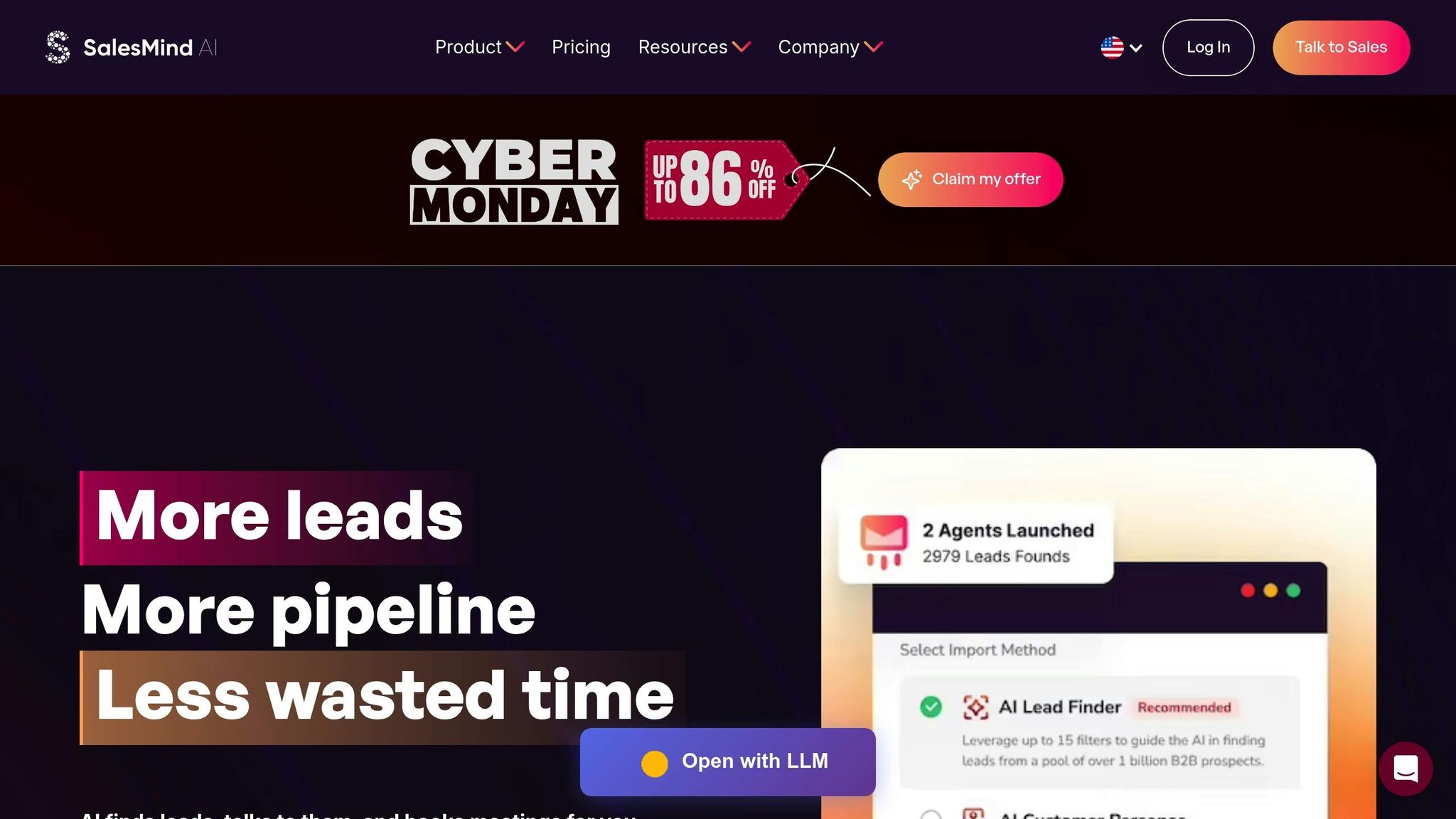
SalesMind AI takes lead scoring to the next level by integrating advanced scoring capabilities with LinkedIn outreach automation. When a prospect matches your ideal customer profile and demonstrates high engagement, the system assigns a score and routes them to the right sales rep automatically.
The scoring process updates in real time as prospects interact with your content. For example, if someone repeatedly visits your pricing page or engages with multiple resources in a short period, their score adjusts immediately. This triggers alerts for your sales team, ensuring no hot lead slips through the cracks.
With customizable scoring models, you can define what matters most for your business. Whether it’s giving higher scores to certain job titles or prioritizing companies within a specific revenue range, the system adapts to your sales strategy. This tailored approach ensures the scoring framework aligns with your actual sales process, not a one-size-fits-all model. Together, these features create a seamless system for accelerating sales.
The Power of Integration
When features like multi-channel data integration, machine learning, and real-time alerts work together, they create a powerful sales engine. Behavioral analysis identifies high-intent actions - like downloading a case study, attending a webinar, and visiting your pricing page within 48 hours. The system recognizes this pattern and elevates the lead’s priority, empowering your sales team to act while the prospect is still actively engaged.
Practical Tips for Choosing the Right Tool
When comparing lead scoring tools, think about your team’s specific challenges. If slow response times are an issue, prioritize tools with robust real-time scoring and automated alerts. If lead quality is inconsistent, focus on machine learning and data integration capabilities.
Make sure the tool integrates seamlessly with your CRM and enriches lead data automatically [1].
The impact is clear: 67% of B2B companies now use AI to analyze customer data [3]. Those leveraging AI-powered lead generation tools report a 35% increase in conversion rates [3]. These aren’t just theoretical benefits - they translate into measurable improvements in sales efficiency and revenue growth.
Conclusion
AI-powered lead scoring tools are reshaping the B2B sales landscape by combining multiple capabilities into one streamlined system. With real-time scoring, machine learning algorithms, multi-channel data integration, and predictive analytics working in harmony, these tools can pinpoint high-value prospects more quickly and accurately than traditional manual methods.
This shift has led to measurable improvements in sales efficiency. Companies using these tools report conversion and SQL rates increasing by 25–45% - all without additional spending[1][3].
To maximize the benefits, align the tool's features with your sales challenges. For instance, if slow response times are holding you back, opt for platforms offering real-time scoring and automated alerts. Struggling with inconsistent lead quality? Look for tools that use machine learning and behavioral analysis to identify genuine buying signals beyond surface-level demographics.
A hybrid approach - blending AI-driven predictive scoring with customizable rules - offers both precision and transparency[1]. Transparency is key: when sales reps understand why a lead received a high score - like frequent visits to pricing pages, a senior job title, or recent content engagement - they’re more likely to trust the system and adopt it into their workflow. This strategy not only optimizes processes but also adapts well to teams of varying sizes and sales models.
Choosing the right platform depends on your team’s needs. Smaller teams may prefer straightforward, rule-based systems that are quick to set up, while larger organizations with complex sales cycles might require advanced predictive models capable of analyzing thousands of interactions. The ideal tool should integrate seamlessly with your CRM, enrich lead data automatically, and provide clear segmentation to help your team focus on the most promising leads[1].
AI adoption in B2B sales is no longer a question of if but how. Most companies already use AI to analyze customer data, and many report a reduction in manual tasks[3]. The key is selecting a platform that aligns with your sales goals, enabling your team to spend less time on administrative work and more time building relationships and closing deals.
Take, for example, SalesMind AI. This platform combines cutting-edge lead scoring with smooth LinkedIn outreach integration, ensuring you never miss out on high-value prospects. It’s innovations like these that are driving the next generation of B2B sales success.
FAQs
How does AI-powered lead scoring help boost sales efficiency?
AI-powered lead scoring transforms how sales teams operate by streamlining the process of identifying and prioritizing the most promising leads. Instead of relying on manual analysis, which can be time-consuming and prone to errors, AI tools leverage sophisticated algorithms to assess factors like engagement, behavior, and demographic data - all in real time. This allows sales teams to zero in on prospects who are more likely to convert, maximizing their efforts where it matters most.
With tools offering predictive analytics and real-time updates, workflows become more efficient, cutting out the guesswork and saving precious time. For example, platforms like SalesMind AI integrate effortlessly with LinkedIn, enabling highly personalized outreach and follow-ups. This not only speeds up the sales process but also boosts the chances of sealing deals with precision and confidence.
How does integrating data from multiple channels improve lead scoring accuracy?
Integrating data from various channels improves lead scoring by offering a fuller picture of each prospect. When you combine insights from LinkedIn activity, email engagement, website visits, and CRM records, AI algorithms can spot patterns and better predict lead quality.
This approach helps businesses zero in on top prospects, focus their outreach where it matters most, and craft messages that align with individual needs and behaviors. The outcome? A smoother, more personalized sales process that delivers stronger results.
Can AI-powered lead scoring tools be tailored to meet the unique needs of different businesses or industries?
Yes, AI-driven lead scoring tools can usually be tailored to meet the unique needs of different businesses and industries. By leveraging advanced algorithms, these tools analyze data and detect patterns, making it possible to align them with the specific traits of your target audience or sales approach.
For instance, you can tweak the scoring criteria to account for factors like industry type, company size, or customer behavior. This adaptability helps ensure the tool delivers more precise and relevant insights, enabling businesses to prioritize leads effectively and boost sales productivity.
 JG
JG