AI-Powered Customer Journey Mapping Explained
AI turns static journey maps into real-time, predictive systems that unify customer data, personalize interactions, shorten sales cycles, and lift conversions.
 Julien Gadea
AI turns static journey maps into real-time, predictive systems that unify customer data, personalize interactions, shorten sales cycles, and lift conversions.
AI turns static journey maps into real-time, predictive systems that unify customer data, personalize interactions, shorten sales cycles, and lift conversions.
Table of Contents
AI is transforming customer journey mapping from static diagrams into real-time, data-driven tools. For B2B SaaS companies, this means shorter sales cycles, higher conversions, and personalized customer experiences. Here's why AI matters:
- Faster Insights: AI processes large datasets (e.g., CRM, web analytics) in hours, not weeks.
- Behavior Predictions: Machine learning and predictive analytics identify customer needs and next steps.
- Higher Efficiency: Sales teams save 10–15 hours weekly with automated sales outreach tasks.
- Improved Results: Companies using AI report 25% higher conversions and 30% shorter sales cycles.
AI-powered journey mapping integrates customer data across multiple channels, offering a unified view of behavior. This ensures businesses can act quickly to retain customers, improve satisfaction, and increase revenue. Tools like NLP and predictive models refine strategies, making every interaction count.
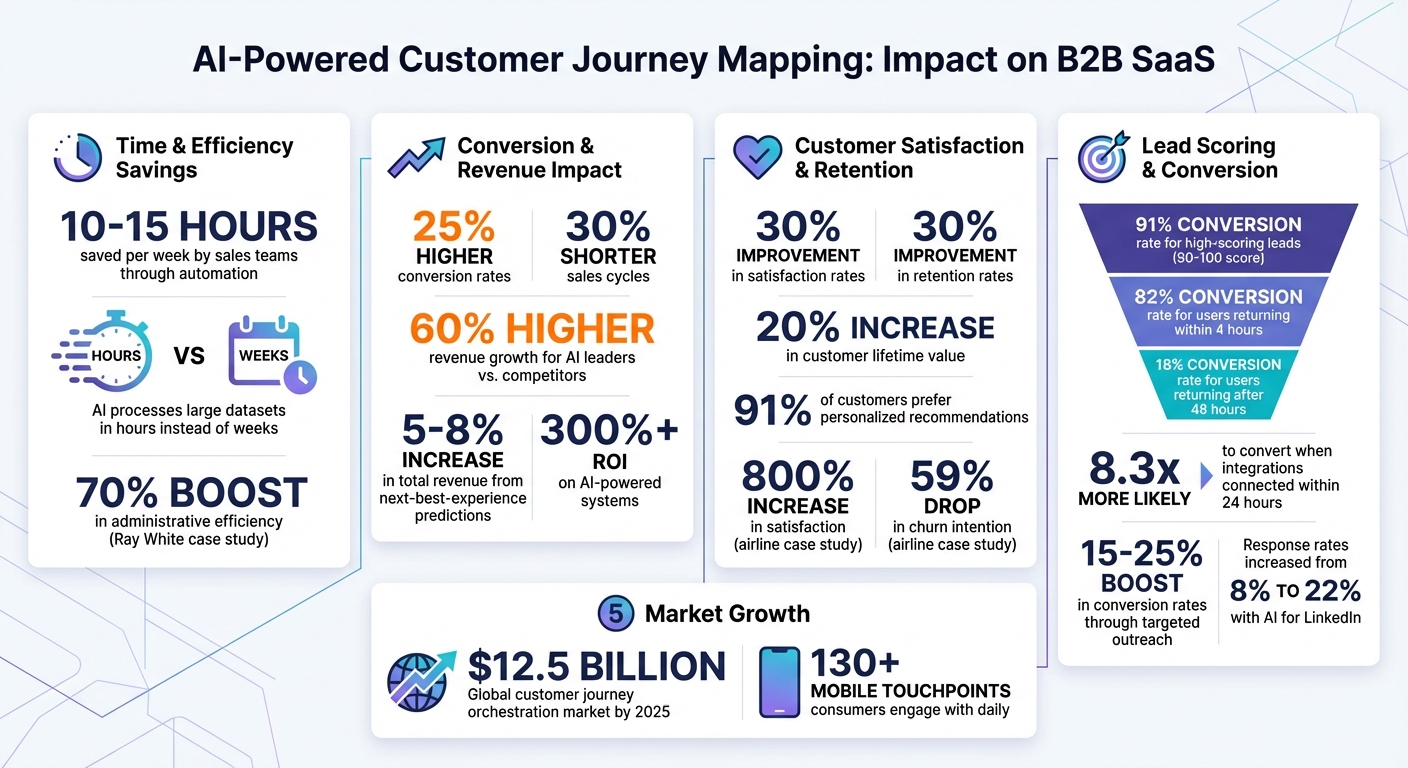
AI-Powered Customer Journey Mapping: Key Statistics and Benefits
A Deeper Dive Into AI-Powered Journey Mapping
To implement these strategies effectively, you can use AI prompts for lead generation to refine your outreach at every stage of the journey.
sbb-itb-817c6a5
AI Technologies That Power Customer Journey Mapping
AI has reshaped customer journey mapping by transforming raw data into actionable insights. The key technologies driving this evolution include machine learning to uncover patterns, natural language processing (NLP) to interpret sentiment, and predictive analytics to suggest next steps. Together, these tools enable businesses to better understand and respond to customer behavior.
Machine Learning for Journey Optimization
Machine learning (ML) excels at detecting patterns that humans might miss. For example, it can pinpoint specific micro-interactions that lead to a 73% higher likelihood of purchase [10]. Instead of relying on traditional segmentation like job titles or company size, ML uses clustering algorithms to group customers based on behavior, engagement speed, and intent [10][11].
ML also acts in real-time, flagging unusual shifts in customer behavior - like deviations from typical engagement paths - so teams can step in before churn occurs [10]. Additionally, it assigns health scores to accounts by analyzing historical data and live intent signals. Using Markov chain models, it predicts the best next step, whether that’s sending relevant case studies or scheduling a demo [10]. Once patterns are identified, NLP refines these insights by diving into customer communication.
Natural Language Processing (NLP) and Sentiment Analysis
NLP evaluates the tone and content of customer interactions across platforms like LinkedIn, email, support chats, and surveys to assess sentiment at every stage [4][2]. By clustering feedback into themes or keywords, NLP uncovers hidden friction points within large volumes of customer input [4][2].
Eric Karofsky, CEO of VectorHX, highlights a common pitfall:
AI can produce overly complex maps cluttered with unnecessary information or may generate overly simplistic, generic maps that fail to provide valuable insights [4].
NLP helps avoid these extremes by identifying specific gaps, such as analyzing recurring support ticket themes during onboarding to suggest new resources [4]. However, keeping data clean and having humans verify AI insights is crucial before taking action [4]. Building on these insights, predictive analytics takes it a step further by guiding real-time decisions.
Predictive Analytics for Next-Best Actions
Predictive analytics focuses on determining what customers need in the moment [12]. Three main models guide its recommendations:
- Propensity models estimate the likelihood of upgrades or churn.
- Channel models identify the best communication method.
- Value models calculate potential revenue opportunities [12].
For instance, a major US airline used predictive analytics to retain high-value frequent flyers who had experienced delays. Instead of offering generic vouchers, agents provided personalized compensation, leading to an 800% increase in satisfaction and a 59% drop in churn intention among this group [12]. Similarly, a European telecom company paused all marketing efforts for customers with unresolved complaints or a high likelihood of calling about service issues. This approach boosted their Net Promoter Score to market-leading levels while improving cross-sell rates and reducing churn [12].
Research Findings: How AI Affects the Customer Journey
Recent research highlights that using AI for journey mapping delivers measurable benefits, including higher customer satisfaction, increased revenue, and better data integration. In fact, companies have reported returns exceeding 300% on their investments in AI-powered systems [7].
Higher Customer Satisfaction and Retention
AI’s real-time monitoring of customer engagement is reshaping retention strategies. Businesses have seen a 30% improvement in both satisfaction and retention rates [7]. For example, AI can detect warning signs like declining email opens or fewer platform logins, triggering timely retention actions to prevent churn [5][8]. By analyzing historical data, AI also predicts customer needs and delivers tailored offers or support proactively [4][1].
Here’s a standout stat: 91% of customers prefer personalized, context-aware recommendations over generic messaging [7]. Companies leveraging these systems have experienced a 20% increase in customer lifetime value [7]. These gains in satisfaction and retention ultimately enhance the performance of the entire sales funnel.
Better Funnel Metrics and Revenue Growth
AI doesn’t just improve customer retention - it accelerates sales efficiency and drives revenue growth. Companies report a 25% boost in conversion rates after adopting AI-driven journey mapping [7][5]. Sales cycles have been shortened by 30% thanks to automated lead qualification and proactive engagement strategies [5]. Additionally, sales and customer success teams save 10 to 15 hours per week by automating repetitive tasks [5].
Organizations leading in AI adoption - those that integrate journey data across all customer touchpoints - achieve 60% higher revenue growth compared to their competitors [9]. Predictive tools offering the "next best experience" can further increase total revenue by 5% to 8%, ensuring customers receive the right interaction at the perfect time and channel [12]. These advancements not only streamline processes but also enable businesses to create a unified customer experience.
Cross-Channel Data Integration
AI’s ability to integrate data from various channels is a game-changer for customer journey mapping. By unifying data from CRMs, social media, email, website analytics, and support systems, AI creates a detailed, single view of each customer’s behavior - something traditional methods struggle to achieve [7][5]. This is especially crucial as today’s consumers engage with over 130 mobile touchpoints daily [9].
Natural Language Processing (NLP) plays a key role by combining qualitative inputs, like chat logs or support tickets, with quantitative data to assess customer sentiment across channels [6][4]. Experts often compare this dynamic mapping to a GPS system that updates in real time [5][1]. Moreover, platforms like Qualtrics and Medallia allow businesses to seamlessly integrate customer feedback into their journey maps, ensuring they stay aligned with evolving expectations [1].
With the global customer journey orchestration market projected to hit $12.5 billion by 2025, it’s clear that these integrated, AI-driven approaches are becoming the standard [7].
AI Use Cases for B2B SaaS Customer Journey Mapping
AI-powered journey mapping is no longer just an idea - B2B SaaS companies are actively using it to tackle specific sales and marketing challenges. These real-world applications show how AI can transform raw customer data into insights that directly impact revenue.
Real-Time Journey Monitoring and Anomaly Detection
AI turns static customer journey maps into dynamic systems that adapt based on real-time customer behavior, such as emails, calls, or product usage [5]. Machine learning processes thousands of data points at once, uncovering friction points and drop-offs that might go unnoticed by human teams [4][2].
For example, AI can identify behaviors that signal churn risk. If a trial user skips the research phase, fails to create a project within 24 hours, or ignores onboarding emails, the system flags these anomalies and sends automated alerts to sales teams, enabling them to act before losing the prospect [13].
Metrics like return velocity - a measure of how quickly users return to a product - are critical. Users who revisit a product within four hours of signing up convert at a rate of 82%, compared to just 18% for those who return after 48 hours [13]. AI monitors these patterns continuously, helping teams focus on high-intent prospects while their interest is still strong. Companies like Ray White have seen a 70% boost in administrative efficiency thanks to this kind of AI automation [5]. These insights underscore how AI can reshape customer journey mapping.
Dynamic Orchestration and Personalization
AI doesn’t just detect issues - it actively reshapes customer engagement by personalizing interactions in real time. Think of it as a GPS for customer journeys, constantly rerouting and adjusting touchpoints based on live data [5]. Instead of sending generic email sequences, AI analyzes individual behaviors to create tailored engagement paths, moving from broad personas to highly specific micro-segments using dynamic segmentation [2][5].
For instance, if a user repeatedly visits a pricing page, AI might trigger a demo invitation or notify a sales rep [13][5]. Trial users who connect key integrations like Slack or Teams within 24 hours of signing up are 8.3 times more likely to convert than those who don’t [13]. AI continuously tracks these engagement signals, identifying early signs of disengagement and triggering retention efforts before customers decide to leave [5][8].
Predictive Lead Scoring for LinkedIn Outreach
AI also enhances lead prioritization by analyzing multi-channel engagement data. It evaluates LinkedIn activity, firmographics, and behavioral signals to score and rank leads more precisely than traditional manual methods [5]. These scores, ranging from 0 to 100, are based on actual behavior rather than static demographic assumptions [13].
Leads with high scores (90–100) often have conversion rates as high as 91% [13]. These "Hot Leads" display high-intent behaviors like binge-watching tutorials or prioritizing integrations - actions that are better predictors of conversion than demographic data alone [13]. Tools like SalesMind AI integrate these behavioral signals directly from LinkedIn, enabling sales teams to focus on prospects with the strongest potential.
AI also identifies negative signals, such as ignoring onboarding emails or infrequent logins, helping teams avoid wasting time on low-potential leads [5][13]. By tracking micro-conversions - like viewing a pricing page or downloading resources - AI provides more accurate data for lead scoring. This approach has helped companies boost conversion rates by 15% to 25% through more targeted and timely outreach [5].
How to Implement AI-Powered Customer Journey Mapping
To effectively implement AI-powered customer journey mapping, you need a strong data foundation, the right tools, and a well-prepared team. Skipping these steps can result in AI systems that produce unhelpful outputs or fail to integrate seamlessly into your existing processes.
Data Integration and Governance Requirements
Before introducing any AI tool, start by creating a unified data foundation. This means auditing all customer interactions - whether it's website visits, LinkedIn views, sales calls, or support tickets - to identify gaps in your systems or missing data tracking [5]. Consolidate information from your CRM, LinkedIn, email platforms, and web analytics into one central source. AI relies on a complete and accurate dataset to generate reliable insights [5]. Take the time to clean your data by removing duplicates, filling in missing cells, and correcting inaccuracies, as poor data quality can severely impact AI performance [4].
Beyond basic metrics like "demo booked", define micro-conversions that signal customer engagement. For instance, track actions such as inviting additional team members, hitting usage milestones, viewing integration pages, or returning to your product within 24 hours of signing up [13]. Implement behavioral tracking to capture detailed events like scroll depth, feature usage patterns, and time spent on specific documentation [13].
For companies in the U.S., make sure your data governance practices are solid. Use enterprise licenses with built-in data protection features, such as the ability to disable model training. Additionally, implement encryption and access controls to safeguard sensitive information [4][14].
Using AI Tools to Apply Journey Insights
AI tools can help turn raw data into actionable insights. For example, SalesMind AI combines LinkedIn engagement signals, profile data, and connection status with CRM data to create a complete view of each prospect's journey [15][16]. It centralizes LinkedIn messages, emails, and call notes into one inbox, ensuring no context is lost [17].
This platform goes a step further by analyzing LinkedIn career paths, content engagement patterns, and communication styles to craft personalized outreach at scale [16][18]. When a prospect hits a specific predictive score, the system can automatically trigger a LinkedIn outreach sequence or send a tailored email [5][13]. SalesMind AI also uses predictive lead scoring to prioritize leads, categorizing them into "Hot" (90–100), "Warm" (70–89), and "Cold" (0–39) tiers based on engagement across multiple channels [13]. Companies using AI for LinkedIn lead generation have seen response rates increase from 8% to 22% [18].
For quick implementation, consider AI tools that integrate directly into your CRM. This avoids complicated data migrations and ensures real-time access to insights [5]. For instance, in 2024, Velv, a technology firm, adopted a CRM-native AI system. According to CIO Nuno Godinho, the team was fully onboarded and using the system's automation features within a few weeks [5].
Once the AI tools are up and running, the next step is aligning your team and processes to make the most of these insights.
Change Management and Team Training
Successfully integrating AI into your operations requires focusing on people and workflows, not just technology [2]. With a solid technical foundation in place, aligning teams and processes ensures that AI-driven insights lead to actionable results. Start with a pilot project to address a specific challenge - like reducing churn during onboarding - to gain stakeholder support before scaling up [2]. Document current performance metrics, such as lead response times and conversion rates, to measure the impact of AI accurately [5].
Train cross-functional teams, including product, marketing, sales, and support, to collaborate using a shared visual journey hub. This hub should merge AI-driven insights with team expertise [2][3]. While AI-generated journey maps provide valuable data, they often need human adjustments to fill in gaps or ensure accuracy.
For enterprise accounts, sales representatives should review AI-generated LinkedIn messages to maintain authenticity and align with your brand's voice [15][5]. This "human-in-the-loop" approach prevents generic outreach while still leveraging AI's efficiency. Sales professionals can save 10–15 hours per week through automation [5]. For example, in late 2024, Kyle Dorman, Department Manager of Operations at Ray White, reported a 70% boost in efficiency for administrative tasks after implementing automated workflows and AI-driven journey management [5].
Conclusion: The Future of AI in Customer Journey Mapping
AI is reshaping how B2B SaaS companies approach customer journey mapping. What used to be static, quickly outdated documents are now becoming dynamic systems that adjust in real time based on actual customer behavior [1][2]. This evolution allows CX teams to move from simply reacting to problems to proactively identifying potential friction points and churn risks before they even happen [1][8].
The future points to the rise of agentic AI - autonomous systems capable of handling tasks like lead qualification, scheduling, and personalized follow-ups [5]. Companies already leveraging AI at a high level report 60% faster revenue growth compared to their competitors [9]. These systems are also driving shorter sales cycles and improved conversion rates.
"2026 will be all about customer go-to-market teams going on the offense. Leaders who build customer-data-centric systems and move AI from productivity to revenue impact will distinguish themselves from the pack." – You Mon Tsang, CEO and co-founder, ChurnZero [19]
This forward-looking perspective is already being put into practice. Tools like SalesMind AI highlight this shift by integrating LinkedIn engagement data with CRM systems to create detailed prospect profiles. They also use advanced lead scoring to automate outreach, streamlining the sales process.
While tools like SalesMind AI showcase how far the technology has come, widespread adoption of AI-driven journey mapping still has room to grow. By late 2025, most B2B SaaS teams remain in the early stages of AI implementation, focusing on exploration or generative AI use cases [19]. This opens the door for early adopters to gain a competitive edge. Companies that prioritize strong data governance, implement agentic workflows for repetitive tasks, and embrace influence maps that reflect the nonlinear nature of modern buying journeys will set themselves apart. Success will come to those who treat AI as a strategic partner, combining automated insights with human expertise to deliver truly customer-focused experiences.
FAQs
How does AI enhance real-time customer journey mapping?
AI has revolutionized the way businesses map customer journeys in real time. By analyzing continuous streams of data from sources like website visits, chat interactions, social media activity, and purchase patterns, AI can turn raw information into meaningful insights. Through machine learning and natural language processing, it identifies trends, predicts customer behavior, and updates journey maps on the fly. This allows businesses to adapt quickly to changing customer actions and preferences.
SalesMind AI pushes this innovation even further. It automates critical tasks such as lead scoring, personalized messaging, and follow-ups. With its unified, AI-powered inbox, it adjusts to customer interactions as they happen, ensuring businesses can respond with timely and relevant communication. This real-time adaptability bridges the gap between sales and marketing, helping teams meet customer needs more effectively while driving stronger engagement and quicker outcomes.
How does NLP help businesses understand customer sentiment?
Natural Language Processing (NLP) is a game-changer for businesses looking to understand customer feedback on a deeper level. By analyzing text-based inputs like surveys, reviews, and social media posts, NLP can identify the tone, context, and meaning behind customer responses. It categorizes feedback as positive, negative, or neutral and can even gauge the intensity of emotions or pinpoint specific product or service features customers are talking about.
This ability to translate customer emotions into clear, actionable insights makes NLP a powerful tool in AI-driven customer journey mapping. It reveals pain points, highlights moments of satisfaction, and feeds into predictive models that help businesses tailor experiences and make smarter, data-informed decisions. Essentially, NLP transforms subjective feedback into measurable insights that guide meaningful improvements.
How does predictive analytics improve customer engagement?
Predictive analytics uses AI and machine learning to dig into past customer interactions - like browsing behavior, purchase history, and social media activity - to predict what they might do next. This shift from reacting to customer actions to anticipating their needs allows businesses to engage in a more proactive and data-driven way.
When paired with customer journey mapping, predictive analytics becomes even more powerful. It can highlight high-value customer segments and suggest the next best steps to keep them engaged. The result? Businesses can send the right message at just the right time, boosting conversion rates and cutting unnecessary costs. It also sharpens sales strategies by identifying prospects most likely to respond, ensuring teams focus their energy where it matters most, leading to more closed deals.
Tools like SalesMind AI make these insights actionable, integrating them directly into LinkedIn outreach and lead generation workflows. With features like advanced lead scoring and real-time updates, every interaction becomes more timely and personalized, driving stronger engagement and quicker results.
Additional Resources
Boost Your Sales with Smart Follow-Up Timing In the fast-paced world of sales, knowing when to reach out again can make or break a deal. A well-timed follow-up shows persistence without crossing into pushy territory, and it’s a skill that separates top performers from the rest. That’s where a strategic approach to scheduling outreach becomes invaluable. Why Timing Matters in Sales Outreach Picture this: you’ve had a great call with a prospect, but they’re not quite ready to commit.
Reach out too soon, and you risk seeming desperate; wait too long, and they might forget you entirely. Finding that sweet spot is tricky, especially when juggling multiple leads with different responses and timelines. A thoughtful follow-up planner can help by analyzing key details—like the nature of your last interaction and the length of your typical deal cycle—to suggest the perfect moment to reconnect. Tailored Strategies for Better Results Every prospect is unique, and so should your approach be.
Whether they’re showing interest or have gone quiet, having a system to guide your next step ensures you’re always moving the conversation forward. With the right tools, sales reps can focus less on guesswork and more on building relationships that convert. FAQs How does the tool decide the best follow-up timing? Our planner uses a mix of sales best practices and the inputs you provide. For instance, if a prospect didn’t respond to an email in a short sales cycle, it might suggest a follow-up in 3-5 days via email to keep the conversation warm without seeming overeager.
We factor in the type of interaction, their response, and cycle length to balance persistence with professionalism. It’s all about striking the right tone at the right time. Can I trust the tool to avoid being too pushy? We’ve built this tool with sales etiquette in mind. It won’t suggest bombarding a prospect with daily messages or following up too soon after a decline. Instead, it spaces out recommendations—like waiting a week after a ‘no response’ in a longer cycle—so you come across as thoughtful and respectful.
What if my sales cycle doesn’t fit the short or long options? We’ve designed the tool around common sales cycles—short (1-2 weeks) and long (1-2 months)—to cover most scenarios. If your cycle is unique, pick the closest option, and the tool will still provide a solid starting point. You can always tweak the suggested date based on your gut or specific industry norms. Think of it as a guide, not a strict rulebook. {"@context":"https://schema.org","@type":"FAQPage","mainEntity":[{"@type":"Question","name":"How does the tool decide the best follow-up timing?","acceptedAnswer":{"@type":"Answer","text":" Our planner uses a mix of sales best practices and the inputs you provide.
"}},{"@type":"Question","name":"Can I trust the tool to avoid being too pushy?","acceptedAnswer":{"@type":"Answer","text":" Absolutely. "}},{"@type":"Question","name":"What if my sales cycle doesn’t fit the short or long options?","acceptedAnswer":{"@type":"Answer","text":" We’ve designed the tool around common sales cycles—short (1-2 weeks) and long (1-2 months)—to cover most scenarios.
 JG
JG