How AI Personalizes Lead Nurturing at Scale
AI personalizes lead nurturing at scale by building dynamic profiles for each prospect and triggering the right message at the right moment across email, LinkedIn, and other channels. This article explains how scoring, sentiment analysis, and behavioral triggers work together so your follow-up feels personal even when it runs automatically.
 Julien Gadea
AI personalizes lead nurturing at scale by building dynamic profiles for each prospect and triggering the right message at the right moment across email, LinkedIn, and other channels. This article explains how scoring, sentiment analysis, and behavioral triggers work together so your follow-up feels personal even when it runs automatically.
AI personalizes lead nurturing at scale by building dynamic profiles for each prospect and triggering the right message at the right moment across email, LinkedIn, and other channels.
This article explains how scoring, sentiment analysis, and behavioral triggers work together so your follow-up feels personal even when it runs automatically.
Table of Contents
AI transforms lead nurturing by automating personalization, saving time, and boosting sales outcomes. Here's how:
- Personalized Outreach at Scale: AI tools analyze behavioral and firmographic data to craft tailored messages, ensuring relevance and timeliness.
- Dynamic Lead Profiles: Real-time updates keep lead data accurate, enabling smarter prioritization and faster responses.
- Behavioral Triggers: AI flags high-intent actions (e.g., multiple pricing page visits) and optimizes follow-up timing, increasing conversions by up to 9x.
- Multichannel Coordination: AI syncs outreach across email, LinkedIn, and ads, enhancing engagement and retention.
- Lead Scoring and Sentiment Analysis: AI prioritizes leads based on conversion likelihood and adjusts messaging based on emotional tone.
Results: Companies leveraging AI report up to 1.7x revenue growth, 40% higher lead quality, and faster sales cycles. Tools like SalesMind AI simplify this process, helping businesses scale personalized campaigns without sacrificing quality.
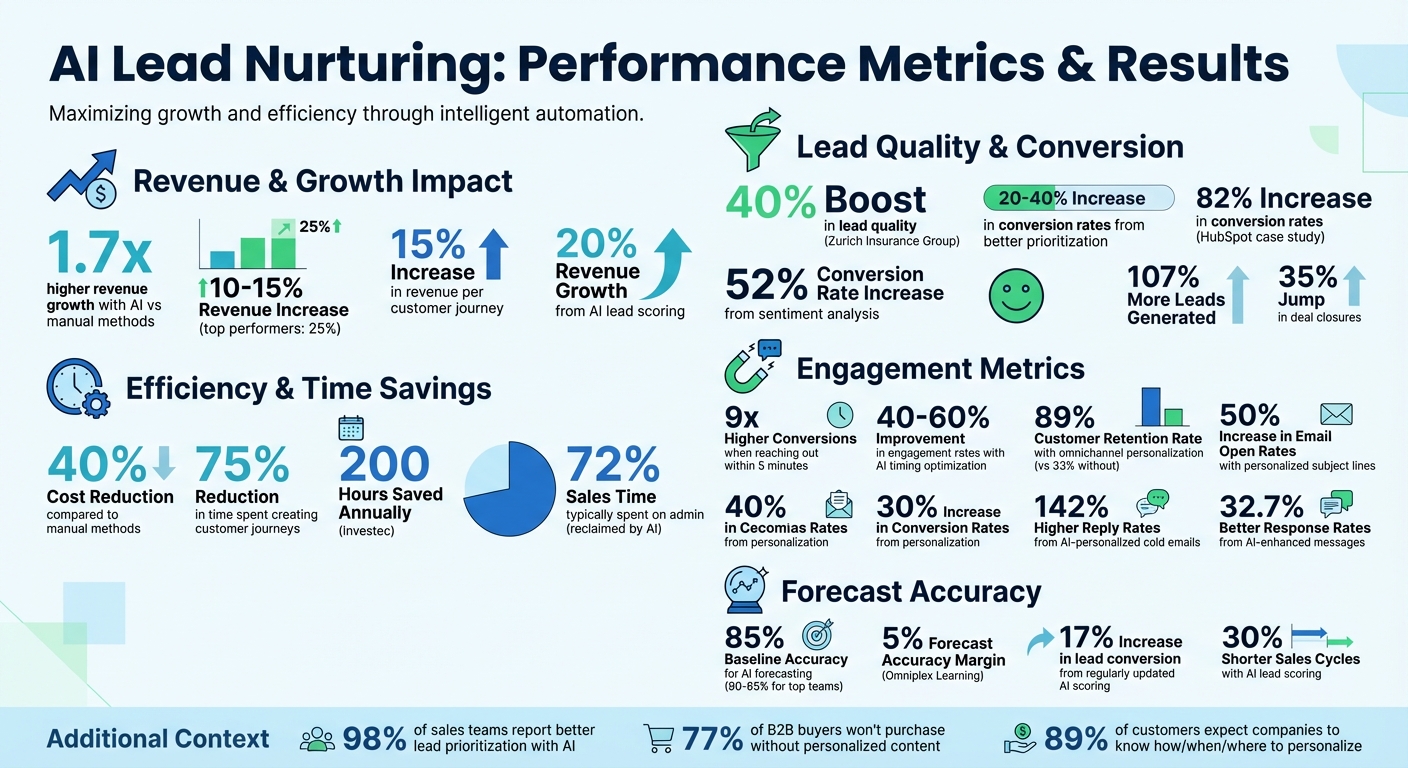
AI Lead Nurturing Impact: Key Performance Metrics and ROI Statistics
How AI Creates Dynamic Profiles for Each Lead
Using Behavioral Data and Firmographics
AI pulls data from multiple sources - CRM systems, marketing platforms, website analytics, and social media - to build a complete lead profile. It combines firmographic data (like company size, industry, revenue, and tech stack) to assess if a lead aligns with your Ideal Customer Profile (ICP) and behavioral data (such as website activity, content downloads, email engagement, and webinar participation) to gauge real-time interest and engagement levels [8][9][10].
Instead of leaving raw metrics like "time spent on site" as-is, AI converts these into engagement scores. These scores help prioritize leads by comparing their activity against historical patterns, assigning a conversion probability based on past outcomes [9][11].
Take Zurich Insurance Group, for example. By adopting Microsoft Dynamics 365 Customer Insights, they managed their growing data more effectively and improved customer journeys, resulting in a 40% boost in lead quality [5]. Similarly, Workforce Software achieved a 121% increase in account engagement within six months by using AI to target buyers at the right stage of their journey [9].
With these dynamic profiles, real-time updates ensure that a lead's data remains accurate and actionable.
Real-Time Profile Updates
Static profiles can quickly lose relevance, but AI's API connections allow for instant updates whenever a lead takes a new action [8][11]. If a lead visits your pricing page multiple times within 48 hours, downloads a case study, or joins a webinar, their profile is updated immediately - no delays.
This accuracy pays off. Businesses that regularly update AI-powered lead scoring models report a 17% increase in lead conversion rates [8]. Additionally, companies leveraging AI for lead scoring have seen sales cycles shorten by up to 30% and revenue growth climb by 20% [10]. For instance, Investec saved about 200 hours annually by automating routine data collection and preparation tasks with Microsoft 365 Copilot for Sales [5].
Platforms like SalesMind AI take full advantage of these dynamic profiling tools. By providing sales teams with current and actionable insights, they enable timely, personalized outreach. Acting on up-to-date information, rather than outdated data, can be the difference between closing a deal and losing it. This approach ensures sales teams maintain momentum and deliver outreach tailored to each lead's latest behavior.
Behavioral Triggers and Timing Optimization
Triggering Campaigns Based on Lead Actions
AI takes the guesswork out of follow-ups by monitoring lead behaviors to trigger timely, relevant outreach. Forget rigid schedules - AI reacts to real-time intent. For instance, if a lead visits your pricing page three times in 48 hours, it flags strong buying intent and sends the lead to sales with all the context they need [3]. By analyzing engagement speed, AI separates casual interest from serious intent.
To keep outreach sharp, AI applies decay logic, prioritizing recent actions over older ones. It also runs continuous A/B tests to refine subject lines and messaging sequences [2]. A lead who downloaded a whitepaper three months ago but recently returned to your site? AI treats them as a fresh opportunity, not a forgotten contact.
Behavioral triggers enable personalized responses. If a lead opens multiple emails without clicking any links, AI might pause the email sequence and switch tactics - like sending a LinkedIn connection request or restarting the sequence with fresh content after a 30- to 60-day break [13]. Similarly, when multiple stakeholders from one company engage, AI adjusts its strategy. It could send ROI data to the CFO while sharing technical specs with the IT Director [13]. This level of precision ensures that every interaction is relevant and impactful.
While these triggers get campaigns rolling, timing is what makes them hit the mark.
Predicting the Best Time to Reach Out
Timing can make or break engagement. Reaching out within 5 minutes of a lead’s activity can boost conversions by 9x compared to waiting 30 minutes [14]. AI takes it further by analyzing historical patterns - like when prospects open emails, visit websites, or engage on social media - to predict the perfect moment to connect [14]. This optimization can improve engagement rates by 40% to 60% compared to generic schedules [14].
Different leads require different timing strategies. Hot leads should be contacted within 5–30 minutes, warm leads benefit from weekly educational touchpoints, and cold leads do better with monthly check-ins [14]. For example, someone who visits your pricing page might get a follow-up within 4 to 6 hours to match their urgency, while someone downloading a whitepaper might be contacted 24 to 48 hours later [14].
A case in point: In 2025, Omniplex Learning used an AI revenue workflow platform to analyze deal signals and engagement trends across its operations. By letting AI pinpoint the best timing instead of relying on manual spreadsheet reviews, they improved forecast accuracy to within 5% [3]. This shift to signal-based engagement reflects what Swati Patil of RevNew aptly put:
"The days of blast emails and hope-for-the-best timing are long gone" [14].
The Future of AI-Driven Lead Nurture: Hyper-personalized Emails
Multichannel Coordination and Content Recommendations
AI takes personalization to the next level by enabling coordinated, omnichannel outreach through dynamic lead profiles.
Coordinating Campaigns Across Email, LinkedIn, and Ads
AI doesn't just send out messages - it creates a unified outreach strategy. By leveraging multi-agent processes, it ensures a seamless flow of communication. For instance, a Research Agent gathers key context, a Draft Agent crafts messages tailored to the recipient, and a QA Agent checks for brand consistency across platforms like email, LinkedIn, and ads [4][6]. This real-time, data-driven approach ensures that messaging aligns with the latest behavior of each lead.
Why does this matter? Companies that excel at omnichannel personalization enjoy an 89% customer retention rate, compared to just 33% for those that don’t [15]. The magic lies in programmatic personalization, often following the 80/20 rule: 80% of the message is built on a solid template, while the remaining 20% adapts dynamically to triggers like job changes or funding announcements [7].
As sales expert Jenny Romanchuk puts it:
"Outreach works best when it doesn't feel like outreach. Relevance beats volume every time." [15]
Tools like SalesMind AI simplify this process by delivering cohesive and timely messaging across all outreach channels.
Generating Personalized Content for Different Segments
In addition to coordinating campaigns, AI fine-tunes outreach by creating content tailored to specific roles and engagement levels. It analyzes factors like a lead’s job title, industry, and position in the sales funnel. For example, engineers might receive communications focused on technical specs, while purchasing managers get messaging centered on pricing and ROI [4]. AI doesn’t stop at static CRM data - it scans LinkedIn activity and company website updates to keep recommendations relevant and up to date [4].
The impact of personalization is hard to ignore. 77% of B2B buyers say they won’t make a purchase without personalized content [7]. AI-driven strategies often lead to a 10–15% revenue increase, with top-performing teams seeing gains as high as 25% [7]. Personalized subject lines alone can boost email open rates by 50% and conversion rates by 30% [15].
To manage personalization efficiently, many teams adopt a tiered strategy:
- Tier A accounts: Deeply customized approaches for high-value leads.
- Tier B leads: Programmatic AI-generated lines for mid-market prospects.
- Tier C prospects: Segment-based templates for broader outreach [7].
This approach allows teams to focus on high-priority opportunities while letting AI handle large-scale outreach with precision.
sbb-itb-817c6a5
Lead Scoring and Sentiment Analysis
AI isn't just about sending out messages - it’s about constantly analyzing which leads need immediate attention and understanding how they’re reacting to your outreach.
Calculating Lead Scores from Data
AI-powered lead scoring takes things up a notch from traditional points-based systems. Instead of relying on static criteria, it uses advanced models to analyze your entire lead database at once. It pulls from a huge range of data points, like website activity, content downloads, and even external factors like funding announcements, executive hires, or company news [3][16].
The real magic is in pattern recognition. AI studies past successful deals to find behaviors and traits tied to conversions. When a new lead shows similar patterns, it flags them instantly. Here’s the kicker: 98% of sales teams using AI report better lead prioritization [21], and smarter prioritization can boost conversion rates by 20–40% [11].
Take SolarWinds, for example. In December 2025, CMO Brian Goldfarb shared how their conversation intelligence, drawn from call transcripts, revealed key deal-closing metrics. The result? Their team achieved a 300% improvement in open and reply rates compared to emails written by humans [22].
Top AI systems don’t just stop at assigning scores - they keep them dynamic. If a lead visits your pricing page multiple times or downloads a competitor comparison guide, the system recalculates their score instantly. It might even trigger actions like routing the lead to a sales rep within minutes [16]. High-performing teams aim for a lightning-fast five-minute response time for top-priority leads, ensuring quick follow-ups. Tools like SalesMind AI make this real-time scoring possible, helping sales teams zero in on leads that are most likely to convert.
Once the lead scoring is handled, AI takes things a step further by analyzing the emotional tone of every interaction to fine-tune the next steps.
Adjusting Campaigns Based on Sentiment
AI doesn’t just track what leads do - it gauges how they feel. Using natural language processing (NLP), it evaluates the tone of emails, calls, and online interactions to pick up on buying signals, objections, or potential risks [20]. If it detects high intent, it might suggest scheduling a demo or following up right away. On the flip side, if hesitation or negative sentiment comes through, the system may recommend switching gears to provide educational content instead of pushing for a sale.
The numbers speak volumes: businesses using AI for lead management see 107% more leads and a 35% jump in deal closures [17]. Sentiment analysis alone can drive conversion rates up by 52%. Customers expect this level of understanding - 89% want companies to know how, when, and where to deliver personalized interactions [18]. But when businesses miss the mark, 76% of consumers report feeling frustrated [19]. AI bridges this gap by constantly monitoring sentiment and adapting outreach in real time, ensuring every message matches the lead’s mood and readiness to engage.
Research Results: AI vs. Manual Lead Nurturing
When examining lead nurturing, research consistently shows that AI-powered systems outperform manual methods. AI-driven approaches lead to 1.7x higher revenue growth while slashing costs by 40% compared to traditional practices [3].
Performance Metrics from AI Campaigns
Manual lead nurturing often bogs sales teams down with administrative work, consuming 72% of their time - time that could be spent selling [3]. AI changes the game, reclaiming countless hours and redirecting focus toward revenue-generating activities. For instance, companies leveraging AI for customer journey development report a 75% reduction in time spent creating journeys, alongside a 15% increase in revenue per journey [5].
The impact on lead quality is equally impressive. Zurich Insurance Group adopted Microsoft Dynamics 365 Customer Insights in March 2025, leading to a 40% improvement in lead quality [5]. Forecast accuracy also sees a dramatic boost with AI. High-performing teams using AI forecasting models achieve 85% accuracy as a baseline, with top-tier teams reaching 90-95% accuracy [3].
These numbers highlight why businesses increasingly turn to AI for scalable, personalized outreach.
Case Study Examples
The real-world results further illustrate how AI transforms lead nurturing into a precise, highly effective process.
Take HubSpot, for example. In January 2025, under the leadership of CMO Kipp Bodnar and VP of Marketing Emmy Jonassen, the company restructured its nurture flow using AI. By analyzing business URLs and content downloads, their AI system predicted each lead's specific "job-to-be-done", moving beyond generic segmentation. The outcome? An 82% increase in conversion rates, a 30% surge in open rates, and a 50% rise in click-through rates [23].
"AI's real power in marketing isn't just automation - it's understanding individual customer needs at scale." - Kipp Bodnar, CMO, HubSpot [23]
Omniplex Learning provides another compelling example. In January 2026, they integrated Outreach's AI Revenue Workflow Platform, replacing three separate tools and manual spreadsheet processes. AI analyzed deal signals across their operations, tightening sales forecast accuracy to within 5% of actual results [3]. Additionally, personalized cold emails crafted by AI achieved 142% higher reply rates, while AI-enhanced message bodies saw 32.7% better response rates [12].
These case studies showcase the measurable benefits AI brings to lead nurturing, from improved accuracy to enhanced engagement and revenue growth.
Conclusion
AI-powered nurturing doesn’t just streamline processes - it allows sales teams to dedicate more energy to high-impact activities like closing deals. By automating tasks such as data analysis, responding to behavioral triggers, and tailoring content, AI shifts the focus from tedious administrative work to meaningful customer interactions.
"AI should be the research assistant, not the closer. The reps who win are the ones who use AI to save time on research and targeting, then reinvest that saved time into thoughtful outreach." - Davidson Hang, HubSpot [1]
Adopting AI today provides a clear edge in a competitive market. Early adopters are positioned to stand out, but success hinges on smart strategies like prioritizing the right accounts and going beyond surface-level personalization.
With tools like SalesMind AI, businesses can take lead nurturing to the next level. Features like LinkedIn outreach automation, AI-driven messaging, and advanced lead scoring make it easier to run personalized campaigns at scale. Add real-time lead tracking through a unified inbox, and you have a platform that aligns seamlessly with modern buyer expectations. The result? Improved engagement, higher conversions, and a distinct advantage in today’s fast-paced sales environment [3].
FAQs
How does AI make lead scoring more accurate than traditional methods?
AI improves lead scoring by analyzing a wide range of data - like demographic details, behavior patterns, and firmographic insights - in real time. Traditional methods often depend on static or manually updated criteria, but AI takes it a step further with predictive modeling. This means lead scores are constantly updated using the latest information, making it easier to pinpoint high-potential leads. As a result, sales teams can focus their efforts on prospects most likely to convert.
What makes AI even more effective is its ability to adjust to shifting behaviors and market trends. It delivers sharper, more practical insights by offering faster and regularly updated assessments. This not only streamlines sales efforts but also helps drive higher conversion rates.
What are behavioral triggers, and how do they help convert leads?
Behavioral triggers are actions or signals that show what a potential customer is interested in or if they're ready to take the next step. Think of things like visiting a website, downloading a free resource, opening an email, or clicking on a link. These actions give businesses a peek into what a prospect is thinking or what they might want.
Here’s where AI steps in to make things smarter. AI-powered tools can take these triggers and use them to send personalized, timely messages that feel relevant to the prospect. For example, if someone checks out a product page, AI can automatically send them a follow-up email with details about that product or even a special offer. It’s like having a virtual assistant that knows exactly what to say and when to say it.
This dynamic way of responding to customer behavior helps businesses create a more tailored and efficient process for nurturing leads. The result? A better chance of turning those leads into paying customers, all while managing it on a larger scale.
How does AI keep lead profiles updated in real time for better personalization?
AI ensures lead profiles stay current by analyzing data from multiple sources, such as website visits, email interactions, and social media activity. Through predictive analytics and automated workflows, it constantly updates profiles with fresh information, reflecting a lead's latest behaviors and preferences.
This continuous updating allows businesses to adjust their nurturing strategies on the fly, offering personalized content and deals that align with a lead's interests. By spotting shifts in engagement or preferences, AI helps sales and marketing teams stay relevant, boosting the likelihood of turning leads into customers.
 JG
JG