AI Messaging Trends: NLP in Sales for 2025
NLP and AI are reshaping sales messaging with personalization at scale, intent detection, sentiment analysis, CRM integration, and measurable 2025 performance gains.
 Julien Gadea
NLP and AI are reshaping sales messaging with personalization at scale, intent detection, sentiment analysis, CRM integration, and measurable 2025 performance gains.
NLP and AI are reshaping sales messaging with personalization at scale, intent detection, sentiment analysis, CRM integration, and measurable 2025 performance gains.
Table of Contents
NLP (Natural Language Processing) is transforming B2B sales in 2025, making communication smarter, faster, and more effective. Here’s what you need to know:
- Personalized Messaging at Scale: AI tools craft unique, data-driven messages for platforms like LinkedIn and email, boosting reply rates by up to 31% and cutting customer acquisition costs by 18%.
- Intent Detection: Advanced models analyze language to identify high-priority leads, improving lead qualification accuracy by 40% and accelerating conversion rates.
- Sentiment Analysis: AI deciphers emotional cues in conversations, helping sales reps tailor responses and improve win rates by 19%.
- CRM Integration: AI seamlessly syncs messaging with platforms like Salesforce and HubSpot, automating tasks like lead scoring, follow-ups, and deal tracking.
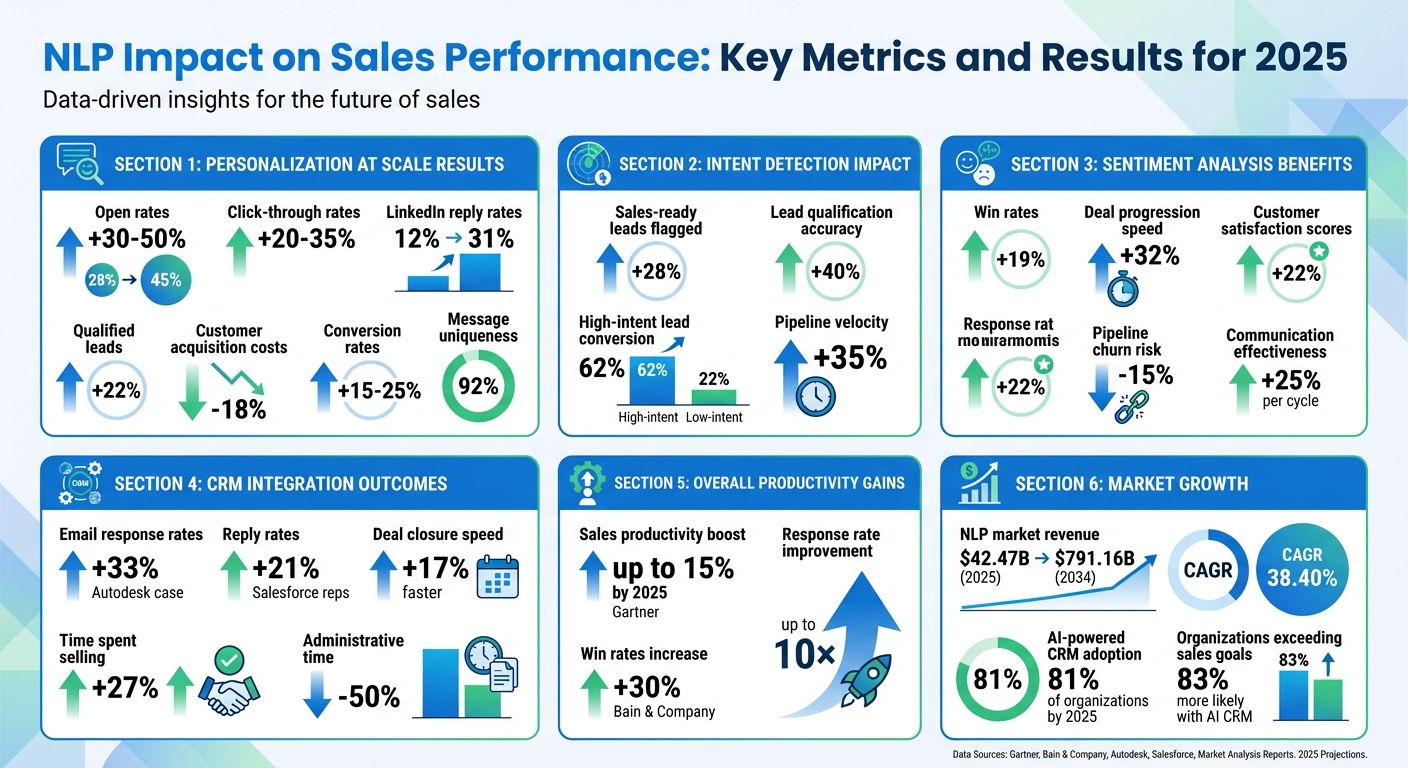
NLP Impact on Sales Performance: Key Metrics and Results for 2025
What Is NLP And How Does It Work In Sales Chatbot Integration? - Sales Pro Blueprint
Core NLP Features Changing Sales Messaging
In 2025, three key NLP capabilities are transforming how U.S. sales teams connect with prospects: personalization at scale, intent detection, and sentiment analysis. These features harness AI-powered models to analyze prospect data, recognize buying signals, and tailor communication in real time. Let’s dive into each capability and its impact on sales strategies.
Personalization at Scale in Sales Outreach
AI-driven personalization has taken sales outreach to a whole new level. Tools like GPT-4o and fine-tuned transformers allow sales teams to craft thousands of unique, targeted messages daily. By pulling data from sources such as LinkedIn profiles (e.g., recent promotions), company websites (e.g., product launches), and behavioral cues (e.g., content engagement), these systems create highly relevant subject lines and message content. With an impressive 92% uniqueness rate, these messages stand out and avoid spam filters.
The results speak for themselves:
- Open rates jump by 30–50%, with some campaigns improving from 28% to 45%.
- Click-through rates increase by 20–35% when messages align with prospect pain points.
- LinkedIn reply rates soar from 12% to 31% with personalized connection requests.
- Qualified leads grow by 22%, while customer acquisition costs drop by 18%.
For example:
Alex L., CTO at Slash Co, reported a 10× boost in lead prospecting productivity within the first week, with the system generating 5–10 new conversations weekly.
Henry F., an Enterprise Account Executive at Salesforce, shared that during an 8-day trial, he received 4–5 daily responses from AI-curated messages tailored using data from prospect profiles and his website.
Platforms like SalesMind AI make this possible by analyzing hundreds of prospect profiles simultaneously and recommending smart templates based on job titles, company size, and industry.
Louis-Alban B., CEO of Yindii, automated outreach to 100 potential leads using profile-based templates, while Roberto K., Chief Product Officer at aCommerce, scaled his team’s prospecting to thousands of leads without compromising message quality.
This combination of high volume and relevance has boosted conversion rates by 15–25%, outperforming generic messaging tactics.
Intent Detection for Better Lead Qualification
NLP models excel at analyzing linguistic patterns to gauge buying intent. Using techniques like keyword extraction, semantic similarity scoring, and sequence labeling, these systems identify both explicit interest signals (e.g., "interested in demo") and subtle urgency cues (e.g., "next quarter budget"). Advanced models like RoBERTa assign confidence scores - typically above 0.8 for high-intent leads - helping sales teams prioritize effectively.
The impact is clear:
- Gong.io’s analysis of over 1 million sales calls found that intent detection flagged 28% more sales-ready leads, improving qualification accuracy by 40%.
- For a fintech client, Outreach reported a 62% conversion rate for high-intent leads within 14 days, compared to 22% for low-intent prospects, accelerating pipeline velocity by 35%.
Svit Babarovic from MountainDrop noted, "The lead scoring system is particularly impressive, providing clear insights into lead quality."
Jure from Jure Design added, "I like that it shows you a score on what the lead suitability with your filters is."
When NLP detects buying intent, it can trigger automated follow-ups, update CRM deal stages, and alert sales reps to prioritize key conversations.
Sébastien D., a Freelance Insider, shared that automating conversations with "direct insights extracted from prospect profiles" resulted in "accurate and high-quality outputs that helped me secure more prospect meetings and close more deals!"
Sentiment Analysis for Better Communication
Understanding emotions in prospect interactions can significantly improve sales outcomes. NLP-powered sentiment analysis tools decode emotional cues - like hesitation, enthusiasm, or frustration - using lexicon-based models, LSTM networks, and transformer-based classifiers such as DistilBERT. These systems analyze tone, context (e.g., “love the idea” scoring +0.9), and even emoji usage to build detailed emotional profiles.
Here’s how sentiment insights improve outcomes:
- Win rates rise by 19% when negative sentiment prompts tailored objection-handling.
- Deal progression speeds up by 32% with sentiment monitoring.
- Customer satisfaction scores improve by 22%.
- Pipeline churn risk drops by 15% when hesitation is addressed early.
- Communication effectiveness increases by 25% per interaction cycle.
For instance, if a prospect’s response shows frustration, the system might recommend acknowledging their concerns before offering solutions. On the other hand, enthusiastic replies could prompt faster demo scheduling. This real-time guidance helps sales teams adjust their strategies and keep deals on track.
AI Integration with Sales Platforms and CRM Systems
The true potential of NLP in sales comes to life when messaging tools integrate smoothly with CRM systems and LinkedIn workflows. By 2025, it's projected that 81% of organizations will adopt AI-powered CRM systems capable of eliminating manual data entry, creating unified customer profiles, and enabling intelligent automated follow-ups [5]. This integration offers sales teams a central hub to access conversation histories, lead scores, and recommended next steps - all formatted to familiar U.S. standards, such as MM/DD/YYYY for dates and $ for currency [2]. The following sections explore how deeper CRM integrations and advanced automation drive greater efficiency in sales processes.
Connecting Outreach with CRM Integration
NLP-driven sales tools integrate seamlessly with platforms like Salesforce, HubSpot, and Microsoft Dynamics through APIs and built-in connectors. This ensures that all communications are automatically synced to corresponding contact records [3].
The results speak for themselves. For example, in 2023, Autodesk’s sales team incorporated Salesforce Einstein Email Insights into their workflow. By analyzing past interactions, they crafted more emotionally resonant follow-up messages, leading to a 33% increase in email response rates [6]. Similarly, Salesforce reps who used NLP-enhanced personalization experienced a 21% boost in reply rates and closed deals 17% faster [6].
SalesMind AI takes this a step further with a Chrome extension that allows users to add leads directly from LinkedIn into their CRM. This tool unifies outreach and CRM interactions while offering an AI-powered inbox that centralizes all prospect communications. By eliminating the hassle of switching between platforms, it ensures every interaction is captured and scored automatically.
SalesMind AI has transformed our lead generation process. The platform's intuitive interface and smart automation features have significantly boosted our sales efficiency. The lead scoring system is particularly impressive, providing clear insights into lead quality.
– Svit Babarovic, Food and Beverage Retail, MountainDrop
HubSpot sales teams using automated NLP summaries reported spending 27% more time selling and less than half the time on administrative tasks [6]. By enriching CRM profiles with sentiment scores, intent signals, and engagement patterns, NLP tools enable precise segmentation. This allows sales teams to focus on high-intent prospects with timely, personalized messaging while nurturing early-stage leads with educational content.
NLP systems don’t just sync data - they also orchestrate follow-ups and enable real-time lead tracking, ensuring engagement remains consistent and effective.
Automating Follow-Ups and Lead Tracking
Modern NLP systems go beyond logging interactions - they automate follow-ups by analyzing real-time engagement signals. These platforms monitor prospect responses to optimize the timing of follow-up messages and adjust sequences dynamically. This complements earlier personalization strategies, ensuring each interaction aligns with the prospect’s behavior.
SalesMind AI’s master dashboard offers real-time visibility into active conversations, empowering reps and teams to monitor lead lists and refine strategies on the fly.
Completely automated our sales prospecting on LinkedIn. Seamlessly integrated with LinkedIn, it was simple to configure the audience and set up the sequence of follow-up messages until the LinkedIn member reacts. It means we can reach out to hundreds or thousands of prospects without losing control.
– Roberto K., Chief Product Officer, aCommerce
This kind of automation reduces human error in prioritizing leads and facilitates proactive outreach. By analyzing engagement metrics and historical data, NLP systems can trigger follow-ups at the perfect moment. This ensures consistent communication without overwhelming prospects or requiring constant manual input [5].
SalesMind AI has proven very useful to our sales team in reducing the massive pain points of manually tracking each and every lead interaction. To have one master dashboard not just for yourself but for our entire team and try different lead lists, sequences, and track them all in real time is fantastic. Additionally, SalesMind works while you sleep, and you are exponentially increasing your productivity that way.
– Rahul P., Senior Advisor, Bounty Media
sbb-itb-817c6a5
Measuring NLP's Impact on Sales Performance
Quantifying the impact of NLP features and CRM integration is crucial for validating their value. Sales leaders need solid data to justify investments in technology. NLP-driven messaging has shown to improve key sales metrics significantly. For example, Gartner predicts that AI-powered sales tools could boost sales productivity by up to 15% by 2025, thanks to automation in outreach, qualification, and follow-ups [7]. Similarly, Bain & Company found that early AI implementations in sales have increased win rates by over 30% [9]. These improvements translate directly into higher revenue and efficiency, especially when teams use CRM data to track outcomes like replies, meetings, stage changes, and revenue generated by AI-assisted interactions [3][8][9]. These measurable benefits help establish clear performance benchmarks.
Performance Benchmarks for AI Messaging
The real-world benefits of NLP-powered personalization at scale are impressive. Early adopters have reported up to a 10× increase in response rates and prospecting productivity. One user noted achieving three times better results with NLP-powered LinkedIn outreach compared to other methods [1]. Generative AI-driven hyper-personalization has also been shown to significantly outperform generic email and LinkedIn blasts in terms of response rates [8]. Beyond boosting engagement, NLP models reduce inefficiencies by transforming unstructured text into actionable insights that lead to tangible business results [3]. To fully capture these benefits, it's essential to identify and track specific KPIs.
Key Metrics for Evaluating NLP Success
To gauge the effectiveness of NLP tools, sales teams should focus on a targeted set of KPIs. These include reply and response rates to measure engagement, connection rates on platforms like LinkedIn, the number of initiated conversations, booked meetings, and deals closed [1]. Lead qualification accuracy, often supported by AI-driven scoring systems, is another critical metric. Additionally, tracking time savings - such as reduced hours spent drafting messages, following up, and entering data - provides a clear link between efficiency gains and pipeline growth. For instance, one user reported that SalesMind AI generated over 10 LinkedIn sales calls per month [1]. The platform has also earned high ratings from users, including 4.4 on Trustpilot, 4.7 on G2, and 5 on the Chrome Store, with many praising its role in improving sales efficiency and connection rates.
To establish a clear ROI, start by setting a baseline. Capture current metrics like reply rates, meeting booking rates, win rates, average sales cycle length, and revenue per rep over a full sales cycle. Then, conduct controlled A/B tests comparing AI-assisted messages with rep-written ones within the same segment and channel. Track metrics such as open rates, reply rates, and meeting booking rates. Finally, tag each touchpoint in your CRM as AI-generated, AI-assisted, or human-only. This allows you to accurately attribute pipeline progression, win rates, and revenue to NLP-driven efforts [3][8][9].
Future Trends for NLP in Sales Messaging (2025 and Beyond)
The NLP market is set for explosive growth, with revenue expected to jump from $42.47 billion in 2025 to $791.16 billion by 2034, growing at an impressive 38.40% CAGR [10]. This surge is fueled by the increasing demand for real-time data processing in sales and e-commerce. Soon, sales teams will rely on advanced NLP tools that can analyze prospect behaviors, emotional cues, and responses in real time, enabling messaging that’s dynamic and tailored to the moment.
Multimodal AI is shaping up to be the next big leap. Instead of focusing solely on text, future NLP systems will combine voice, video, and visual data to deliver even deeper personalization. Consider this: 47.3 million U.S. adults already use smart speakers, and 11.5% of them make monthly purchases through these devices [11]. As voice commerce becomes more mainstream, sales platforms will integrate voice-first interfaces and even analyze video calls for sentiment, providing instant emotional insights. This evolution promises more responsive and adaptive sales interactions.
Real-Time Personalization Advances
Real-time personalization is set to become the norm. Advanced NLP systems will track prospect interactions - whether it's an email open or a LinkedIn profile view - and automatically adjust follow-up messages. Tools like IBM Watson already detect emotions with 95% accuracy [11], allowing chatbots to tweak their tone on the fly. By 2025, 81% of organizations are expected to adopt AI-powered CRM systems, making them 83% more likely to exceed their sales goals [5]. These platforms will likely include predictive intent recognition, helping sales teams focus on high-conversion prospects while maintaining personalized outreach at scale.
This push for personalization also aligns with the growing need for ethical AI practices in sales messaging.
Ethical AI Messaging Practices
As personalization becomes more advanced, ethical concerns are stepping into the spotlight. Behavioral tracking for tailored messaging raises critical data privacy issues, especially around obtaining clear consent. Regulations like GDPR and CCPA are pushing businesses to adopt stricter compliance measures. The U.S. NLP market, projected to hit $170.12 billion by 2034 with a 38.74% CAGR [10], will depend heavily on responsible and compliant AI implementations.
Sales teams will need to prioritize regular bias audits of their NLP models to avoid unintended discrimination. Best practices include anonymizing prospect data, offering clear opt-out options, and maintaining transparency in AI-driven decisions [5]. With 80% of businesses expected to transition to digital platforms and messaging apps for customer engagement by 2025 [4], ethical practices won’t just be about staying compliant - they’ll also build trust and enhance adoption.
Platforms like SalesMind AI are already leading the charge by combining cutting-edge NLP personalization with a firm commitment to ethical standards. This ensures businesses can scale their outreach while safeguarding trust and compliance, giving them a competitive edge in an increasingly AI-driven sales landscape.
Conclusion
By 2025, natural language processing (NLP)-driven AI will play a central role in U.S. sales teams, with the global NLP market projected to hit $40–50 billion [10]. Sales teams that weave NLP into their messaging, CRM workflows, and lead qualification processes consistently outperform those that don’t.
Take tools like SalesMind AI, for example. They empower sales teams to scale personalized LinkedIn and email outreach, classify prospect intent and sentiment in real time, and automate follow-ups that adjust dynamically based on responses. These capabilities translate directly into revenue gains - AI-powered personalization boosts response rates by 25%, while NLP-driven lead qualification delivers 30% more sales-qualified leads and drives 40% higher conversion rates [12].
To fully leverage these benefits, sales leaders need a structured approach. Start with a focused 30–60 day pilot on a single channel, integrate CRM data to capture all interactions, and fine-tune your strategy weekly based on insights.
But there’s more to long-term success than immediate metrics. Ethical AI practices are critical. Sales teams that combine advanced NLP tools with transparent data usage, regular bias checks, and respectful outreach strategies will foster trust and build lasting relationships. As voice commerce, multimodal AI, and real-time personalization become the norm, the real challenge lies in how quickly you can adopt NLP-driven tools to scale your outreach, strengthen your results, and maintain a competitive edge in this rapidly evolving market.
FAQs
How does natural language processing (NLP) improve personalized sales messaging?
Natural language processing (NLP) takes personalized sales messaging to the next level by analyzing customer data like preferences, behaviors, and past interactions. With this insight, AI can create messages that feel customized and relevant to each individual, making communication more engaging and impactful.
Using NLP, businesses can ensure their messages reach prospects at just the right moment, addressing specific needs or challenges. This approach doesn’t just improve the customer experience - it often leads to higher response rates and better conversions, making the sales process more efficient overall.
How does sentiment analysis help boost sales performance?
Sentiment analysis empowers sales teams to grasp the emotions behind customer messages by examining tone and intent. This insight enables tailored communication that connects more effectively with potential customers.
By picking up on emotional cues, teams can fine-tune their approach, making it easier to engage leads, boost conversion rates, and nurture trust-filled relationships. It’s a game-changer for fostering genuine connections that fuel sales growth.
What steps can sales teams take to use AI ethically in their strategies?
Sales teams play a key role in promoting responsible AI use by establishing clear guidelines that align with data privacy laws and ensuring openness about how AI is used in interactions with prospects. Instead of relying on manipulative tactics, the focus should be on fostering trust through straightforward and honest communication.
It’s equally important to routinely review AI-generated outputs to catch and correct any biases or inaccuracies. By emphasizing fairness and precision, businesses can uphold ethical standards while integrating AI to improve their sales strategies.
 JG
JG