AI vs. Manual Lead Qualification: Key Differences
Compare AI and manual lead qualification across speed, cost, accuracy, scalability, and when a hybrid approach improves conversions.
 JG
JGShare this article

- Speed: AI takes minutes; manual methods take hours or days.
- Cost: AI costs 50–75% less per lead.
- Accuracy: AI achieves 85–95%, compared to 70–80% for manual methods.
- Scalability: AI handles thousands of leads; manual systems struggle with high volumes.
AI-driven lead qualification is faster, cheaper, and more consistent than manual methods. While manual qualification relies on personal interactions and intuition, it’s slow and costly, taking 42 hours and $35–$100 per lead. AI, on the other hand, processes leads in 5 minutes for $5–$25 each, analyzing data 24/7 without bias.
Key Points:
- Speed: AI takes minutes; manual methods take hours or days.
- Cost: AI costs 50–75% less per lead.
- Accuracy: AI achieves 85–95%, compared to 70–80% for manual methods.
- Scalability: AI handles thousands of leads; manual systems struggle with high volumes.
- Best Fit: AI suits high-volume, short-cycle sales. Manual excels in complex, high-value deals.
Quick Comparison:
| Criteria | AI | Manual |
|---|---|---|
| Processing Time | 5 minutes per lead | 42 hours per lead |
| Cost | $5–$25 per lead | $35–$100 per lead |
| Accuracy | 85–95% | 70–80% |
| Scalability | Handles thousands easily | Limited by team size |
| Best Use Case | High-volume, short-cycle | Complex, relationship-driven |
A hybrid approach - AI for screening and manual for high-value follow-ups - combines the strengths of both, boosting efficiency and revenue.
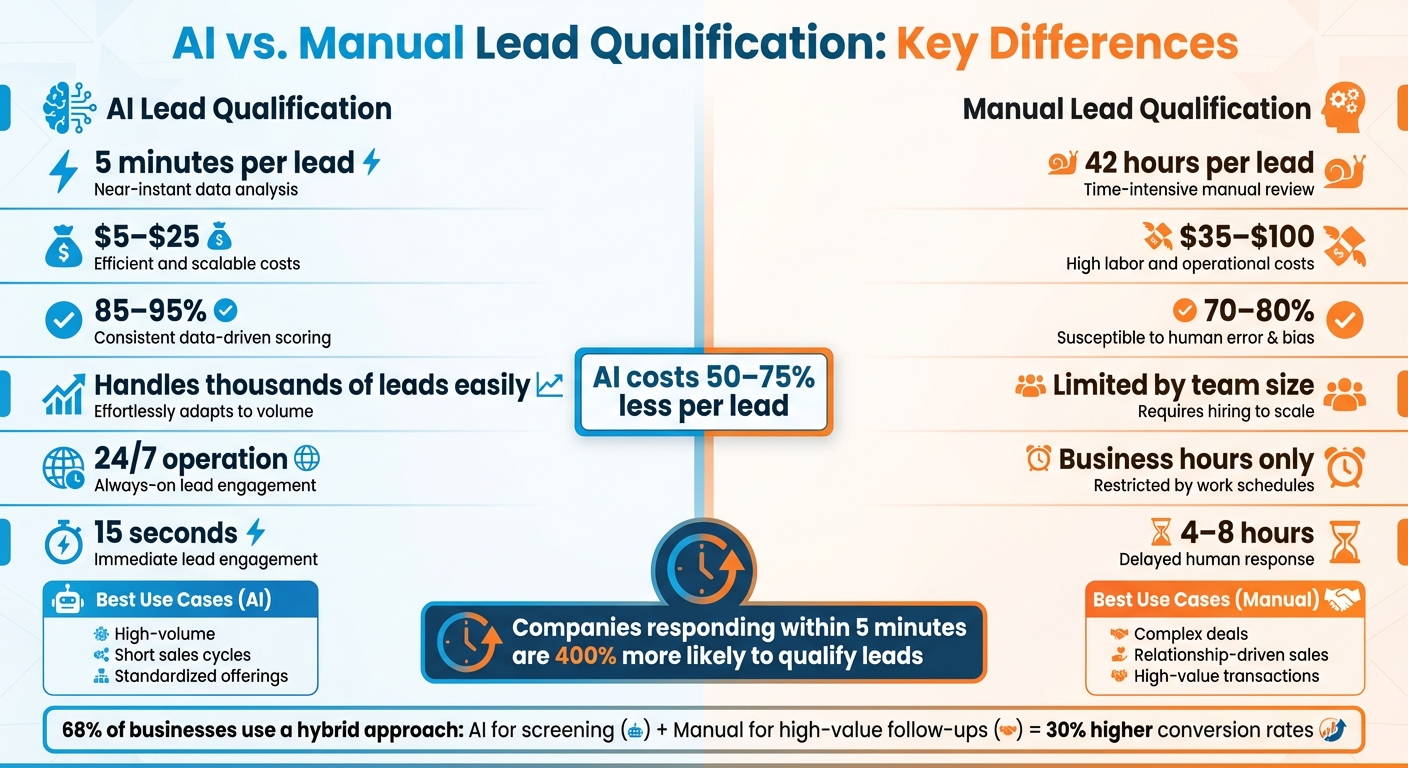
AI vs Manual Lead Qualification: Speed, Cost, and Accuracy Comparison
Make AI Agent Use Case – Automating Lead Qualification
Speed and Efficiency Comparison
The difference in speed between AI-driven and manual lead processing is dramatic. While manual qualification takes a staggering 42 hours per lead, AI systems can complete the same task in just 5 minutes [1]. This speed isn’t just a convenience - it’s a competitive edge. The numbers clearly show how each approach impacts overall sales efficiency.
AI: Instant Processing and Around-the-Clock Availability
AI systems operate 24/7, processing leads in as little as 15 seconds and immediately routing them to the appropriate workflows [2]. This speed is critical because companies that respond to leads within 5 minutes are 400% more likely to qualify them than those who take just 10 minutes longer [2]. For instance, if a prospect submits an inquiry at 11:00 PM on a Saturday, an AI system is already analyzing the data and initiating the next steps - long before a human team would even see the request.
Manual teams simply can’t keep up. For a team managing 100 daily leads, manual qualification might take up to 6 hours of work. AI slashes that down to just 1 hour, saving 83% of the time [2]. This rapid processing translates directly into higher conversion rates. Tools like SalesMind AI take advantage of this speed by automating tasks such as LinkedIn outreach and lead scoring, ensuring that high-priority prospects receive immediate attention - even when your team is off the clock.
While AI delivers consistent and lightning-fast results, manual methods struggle to match its pace due to natural human limitations.
Manual: Slower Processing and Restricted Hours
Manual lead qualification faces significant hurdles, including limited working hours and slower response times. With average response times ranging from 4 to 8 hours, leads can quickly lose interest [2]. This delay is costly, as 35 to 50% of sales go to the vendor that responds first [1]. If your team only checks emails or forms a few times a day, you’re already falling behind.
The administrative workload adds another layer of inefficiency. Sales reps dedicate less than 30% of their time to actual selling, with the rest consumed by tasks like lead qualification [5]. Imagine a rep managing 40 leads when a high-priority inquiry comes in at 4:30 PM on a Friday. That lead might not get a response until Monday, by which point they may have already chosen a competitor who replied within minutes. These delays not only hurt conversion rates but also emphasize how slower processes can put businesses at a disadvantage.
Accuracy and Consistency
When it comes to lead qualification, the difference between AI-powered systems and manual methods is striking. Studies reveal that AI systems boast an accuracy rate of 85–95% in assessing sales readiness, whereas manual methods typically achieve only 70–80%[1]. That 15% gap can mean lost opportunities and wasted effort chasing leads that are unlikely to convert. This disparity underscores how accuracy directly impacts overall sales performance.
AI: Precision Through Data
AI systems excel by evaluating a wide range of data points, such as website activity, email interactions, and technographics. In contrast, human sales reps often rely on just a handful of factors like job title, company size, and budget[2]. This deeper analysis allows AI to make distinctions that humans might miss - like recognizing that a CFO browsing a pricing page signals high intent, while an intern doing the same likely doesn’t[2].
AI also ensures consistency by applying standardized criteria, which eliminates the subjective errors common in manual evaluations[2][3]. Hybrid models, which combine automated scoring with human oversight, significantly improve conversion rates and revenue. Plus, AI systems continuously adjust their scoring models based on new data, keeping pace with shifts in buyer behavior[2][9].
The benefits of AI extend to lead routing as well. While manual methods result in a 15–20% error rate in routing leads, AI reduces these errors to under 2% - a dramatic improvement of over 90%[2]. For a company handling 1,000 leads each month, this means manual processes could misroute 150–200 leads, whereas AI would misroute fewer than 20.
Manual: Prone to Human Error
Manual lead qualification often falters due to its reliance on individual judgment, which can vary widely. As Raquel Magalhães, Editorial Writer at Landbot, points out:
"Qualifying leads manually is subjective and prone to human bias. Different salespeople may have varying criteria for what constitutes a qualified lead, leading to inconsistencies in the qualification process"[7].
One salesperson might focus on company size, while another prioritizes engagement metrics, resulting in an uneven pipeline[2][7]. These inconsistencies can weaken the entire sales process.
The administrative workload adds another layer of inefficiency. Manual methods lead to 20–25% duplicate follow-ups and 10–15% rule noncompliance[2]. Sales reps often spend as much as six hours a day on lead qualification, leaving less time for actual selling. When teams are overwhelmed - especially with volumes exceeding 500 leads per month - their performance tends to decline[2]. Stan Rymkiewicz, Head of Growth at Default, highlights the advantage of AI in this regard:
"AI lead scoring models are consistent. They apply the same standards to every lead that comes to them. So you're not going to miss opportunities due to human error and bias"[9].
Tools like SalesMind AI (https://sales-mind.ai) take this a step further, combining real-time data analysis with automated follow-ups. This automation not only reduces human error but also streamlines the entire qualification process, enabling businesses to work more efficiently and effectively. These differences in accuracy and consistency set the stage for exploring how AI impacts cost, scalability, and workflow efficiency in the next section.
Cost Structure and Financial Impact
AI comes with a higher upfront cost but offers lower ongoing expenses, while manual methods tend to rack up costs as lead volume increases. Understanding these cost patterns is essential for businesses looking to make smart investment decisions. Let’s break down how each approach affects your bottom line.
AI: Higher Initial Investment, Lower Ongoing Costs
Implementing AI for lead qualification involves a significant initial investment. Software subscriptions can range from $50 to $10,000 annually, depending on your business size and specific needs. If custom AI development is required, costs might fall between $25 and $250 per hour. On top of that, businesses often need to invest in data infrastructure or upgrade cloud storage systems to support AI solutions[10]. By 2025, the average monthly cost for AI tools and ongoing management is expected to range between $100 and $5,000[10].
Despite the upfront expense, the financial benefits of AI become apparent quickly. AI can slash the cost per qualified lead from $150–$300 (the typical cost for Sales Development Representatives) to just $40–$80, potentially reducing expenses by up to 50%[2][11]. For instance, a Legal Tech firm used AI to filter out non-target audiences, cutting its cost per qualified lead by 40% and saving over $120,000 annually by eliminating wasted outreach efforts[11].
Another advantage is scalability. AI can handle ten times more leads without requiring additional staff[2]. This makes it a cost-effective solution for growing businesses. Tools like SalesMind AI demonstrate how automating lead qualification can help companies reduce costs while driving growth.
Manual: Lower Initial Investment, Higher Ongoing Costs
Manual lead qualification, on the other hand, starts with a lower upfront investment. Costs are limited to hiring, onboarding, and basic CRM training, with no need for expensive software or infrastructure upgrades[1]. This makes it an appealing option for businesses just starting out.
However, as lead volumes increase, the expenses pile up. Manual qualification costs range between $35 and $100 per lead, compared to $5 to $25 for AI-driven systems[1]. Additionally, inefficiencies in manual processes can waste up to 400 hours per year per sales rep[11]. Scaling a manual approach often means hiring more staff, which drives up salaries and benefits. For every 100 new leads, manual processes require an additional 6 hours of labor, compared to just 1 hour with AI - a staggering 83% time savings[2].
Bad data further amplifies these costs. According to Gartner, poor data quality in lead pipelines costs businesses $3.1 trillion annually[11]. For example, a B2B Fintech firm struggled with an 80% ineligibility rate in its web form leads. After adopting AI-driven qualification, unqualified lead intake dropped by 70%, freeing up over 200 sales hours per month[11]. Unlike manual methods, AI costs remain relatively stable as lead volumes grow, making it the more scalable option for businesses aiming for long-term growth.
Scalability and Volume Handling
Scalability is where AI truly sets itself apart from manual methods, especially as lead volumes grow. Whether you're handling 50 leads or scaling up to 500 per month, AI and manual processes diverge significantly. While AI systems adapt seamlessly to increased demand, manual methods often hit a breaking point. This difference can make or break your sales team's ability to focus on selling instead of getting bogged down in administrative tasks.
AI: Handling Growth Without Limits
AI systems can process thousands of leads with the same speed and consistency as they handle just a handful. Compare that to a sales rep who might manually qualify between 20 and 50 leads per day - AI can handle thousands in the same timeframe. This means your pipeline can expand tenfold without requiring additional staff.
For example, processing 100 daily responses manually might take about six hours. With AI, that workload shrinks to just one hour - a massive 83% reduction in time spent. And since AI operates 24/7, it captures leads even outside of regular business hours. This is crucial because companies that respond within five minutes are 400% more likely to qualify leads than those that take just ten minutes. With AI response times as fast as 15 seconds (compared to the typical 4–8 hours with manual review), tools like SalesMind AI ensure your sales funnel keeps flowing smoothly, even during high-volume periods.
PointClickCare offers a great example of this in action. By integrating AI-driven scoring to identify high-intent website visitors in real time, they generated over $1 million in additional revenue and saw a 400% increase in their chat pipeline within just 90 days[4].
Manual: Struggling to Keep Up
Unlike AI, manual processes are inherently limited by the size and capacity of your team. As lead volumes increase, sales reps often find themselves overwhelmed, spending up to 60% of their time on qualification tasks instead of selling. This creates bottlenecks that slow down the entire sales cycle.
"Manual qualification works at 50 leads monthly; at 500 leads, teams drown in administrative work instead of having sales conversations." – Smartlead.ai[2]
Scaling manually means hiring more staff, which increases costs. And during periods of high volume, manual routing often leads to errors - team assignments can have a 15–20% error rate, while duplicate follow-ups occur in 20–25% of cases. These mistakes not only waste time but also frustrate potential customers. On top of that, sales reps handling large volumes manually often miss 60–70% of urgent or high-priority requests simply because they don’t have the bandwidth.
The challenges don’t stop there. Sales Development Representatives (SDRs) in manual setups tend to burn out quickly, with an average turnover rate of just 14 months. This constant churn adds to recruitment and training costs, while new hires require time to get up to speed. All of this creates gaps in your team’s ability to handle leads effectively - right when you need it most.
Integration and Workflow Automation
How your lead qualification system interacts with other sales tools can make or break your team’s efficiency. Whether you rely on AI or manual methods, the approach you choose impacts everything - from the accuracy of your data to how quickly your team can respond to promising leads. These differences in integration directly influence how smoothly your sales workflows operate.
AI: Automated CRM Integration and Follow-Ups
AI-powered systems connect seamlessly with CRMs like Salesforce, HubSpot, or Dynamics through two-way API integration, enabling automatic data exchange. The AI pulls historical deal data to refine its models and pushes up-to-the-minute updates on lead scores and routing assignments back into your CRM - all without requiring any manual effort.
The real magic lies in what happens after the integration. Using natural language processing (NLP), AI systems can instantly categorize prospect responses into actionable groups like "Interested", "Meeting Request", "Out of Office", or "Wrong Person." Each category triggers a tailored workflow. For example:
- An interested lead receives a calendar link within seconds.
- An out-of-office reply pauses follow-ups until the prospect is back.
- A meeting request is routed to the most suitable rep based on territory, expertise, and availability.
"The most effective qualification systems operate within unified platforms where data, scoring, routing, and outreach happen in a single workflow without requiring exports, imports, or manual data transfer." – Smartlead.ai [2]
This level of automation translates into lightning-fast response times - as low as 15 seconds - which can improve lead qualification rates by 400% compared to delays of just a few minutes [2]. Tools like SalesMind AI take it a step further by integrating with LinkedIn, automatically updating lead scores, and triggering follow-ups the moment a prospect engages.
A real-world example? In 2022, Typeform implemented a hybrid system that scored leads based on website activity and form submissions. Leads with scores over 80 were flagged for immediate personalized outreach. The results were impressive: a 45% increase in qualified leads, a 28% boost in conversion rates, and an additional $1.2 million in quarterly revenue within six months [1].
AI also uses webhooks to sync data in real time, enriching incomplete records with firmographic details. This ensures that sales reps always have the latest insights, eliminating the need to manually research prospects on LinkedIn or company websites.
Manual: Separate Tools and Manual Data Entry
On the other hand, manual systems rely on disconnected tools and processes, creating inefficiencies at every step. Sales reps often spend time juggling inboxes, researching leads on LinkedIn, updating spreadsheets, and manually entering data into the CRM. Each lead can take anywhere from 15 to 60 minutes of research and data entry [1].
Every step of the process - reviewing emails, drafting follow-ups, updating the CRM, setting calendar reminders, and notifying team members - requires manual effort. Territory assignments are often handled through round-robin systems or ad hoc decisions, which can lead to a 15–20% error rate, including assigning leads to the wrong rep or duplicating follow-ups [2].
This fragmented approach affects data quality. Information often remains siloed - what marketing knows doesn’t always reach sales, and insights from one rep rarely get shared across the team. Updates are delayed or happen in batches, meaning everyone is working with outdated information. This lack of coordination can waste up to 40% of a sales team’s time on administrative tasks rather than selling [8].
The contrast is clear. While AI can process thousands of leads in seconds with high accuracy, manual methods introduce bottlenecks that slow your entire sales cycle. The difference isn’t just about speed - it’s about whether your team spends their time on tedious data entry or closing deals. This automated integration paves the way for even greater efficiency, as we’ll explore in the next section.
Best Use Cases by Business Type
Deciding between AI and manual lead qualification comes down to understanding your business model and priorities. Factors like lead volume, sales cycle speed, and deal complexity play a key role. For companies managing more than 100 leads monthly with standardized offerings, AI is often a game-changer. On the other hand, businesses focused on high-value, relationship-driven deals usually benefit from the human touch.
AI: High-Volume and Short Sales Cycles
AI shines in scenarios where businesses handle large volumes of leads with predictable customer journeys. If your company processes hundreds - or even thousands - of leads monthly, relying on manual qualification can create bottlenecks. This is where AI steps in to streamline the process. Industries like e-commerce, SaaS, digital marketing, and B2C companies with deals under $10,000 often see the most benefit from full automation.
One major advantage of AI is its speed. Operating 24/7, AI ensures instant engagement, even for global traffic or leads that come in after hours. Businesses using AI have reported significant gains, including more qualified leads, higher conversion rates, and shorter sales cycles.
AI also excels at identifying anonymous website visitors by analyzing behavioral patterns, such as visits to pricing pages or content downloads. For example:
- PointClickCare implemented machine-learning models to detect high-intent visitors in real time, generating over $1 million in additional revenue and boosting their chat pipeline by 400% [4].
- Formstack used AI-driven scoring to direct low-intent leads to chatbots while connecting high-intent leads to live reps, resulting in a 420% increase in chat conversions [4].
Another example is SalesMind AI, which automates LinkedIn outreach by scoring leads and sending immediate, personalized follow-ups. This automation saves sales reps 83% of their time, freeing up as much as 5 hours per day for more valuable activities [2].
Manual: Complex and Relationship-Driven Sales
For industries where trust, personalization, and nuance are critical, manual lead qualification remains essential. This approach is especially important for complex, high-value deals. Sectors like wealth management, luxury real estate, specialized consulting, and regulated industries such as healthcare and finance often require the kind of deep understanding and judgment that AI cannot replicate.
In enterprise B2B sales, for instance, navigating the "Paper Process" (legal and procurement steps) and identifying key decision-makers relies heavily on human insight. These deals frequently involve multiple stakeholders, extended sales cycles, and a need to establish trust over time. Similarly, industries with strict regulatory requirements demand thorough, individualized assessments that only skilled professionals can provide.
However, manual qualification comes with limitations. Teams typically handle 20-50 leads per rep per day, with each lead requiring 15 to 60 minutes of research and data entry [1]. Despite the higher cost - ranging from $35 to $100 per lead [1] - the investment often pays off for businesses where a single deal can yield significant revenue.
Interestingly, 68% of businesses now use a hybrid approach [1]. This strategy combines AI's efficiency for high-volume initial screening with manual efforts for high-value, late-stage interactions. By leveraging AI for speed and scalability while maintaining a personal touch for complex deals, businesses can align their lead qualification process with their unique needs, ensuring the best outcomes for both scale and complexity.
Conclusion: Choosing the Right Method
Deciding between AI and manual lead qualification comes down to what fits your business needs. If you're dealing with standardized, high-volume lead processes, AI offers unmatched speed and consistency. On the other hand, manual qualification shines when handling complex, high-value deals that require a human touch and nuanced judgment.
As mentioned earlier, AI significantly cuts down time and costs compared to manual methods. For instance, AI can reduce lead processing time from 42 hours to just 5 minutes and lower costs from $35–$100 per lead to as little as $5–$25 [1]. Speed matters too - companies that respond to leads within 5 minutes are 400% more likely to qualify them than those that take just 10 minutes longer [2][6].
A hybrid approach, combining AI and manual efforts, has proven to be highly effective. This method, already adopted by 68% of companies, uses AI for initial screening and manual follow-ups for high-value prospects, boosting conversion rates by 30% [1]. These numbers highlight the strategic edge automation provides in managing leads.
Take SalesMind AI as an example. It simplifies LinkedIn outreach and lead qualification at scale. Its advanced lead scoring system identifies prospects and triggers personalized follow-ups automatically. This can save sales reps up to 83% of the time they’d normally spend on manual lead research - freeing up about 5 hours daily to focus on closing deals [2]. With 24/7 operation and seamless CRM integration, SalesMind AI handles large volumes while your team nurtures meaningful client relationships.
For businesses managing high lead volumes and short sales cycles, adopting AI immediately offers a clear advantage. For more intricate B2B sales, a hybrid strategy - leveraging AI for initial qualification and routing high-priority leads to your team - provides the best balance of efficiency and personalization.
FAQs
How does AI enhance lead qualification accuracy compared to traditional methods?
AI takes lead qualification to the next level by leveraging real-time data and predictive models to assess potential customers. Unlike traditional methods that depend on static criteria and subjective judgment, AI dynamically adjusts to fresh behavioral signals, making it easier to pinpoint high-intent leads with precision.
This shift doesn’t just save time - it ensures consistency across the board. Sales teams can concentrate their efforts on engaging with leads that are most likely to convert, while automation handles the heavy lifting. With AI, businesses can simplify lead qualification and confidently base decisions on solid data.
How does using AI for lead qualification impact costs?
AI-powered lead qualification can dramatically cut the costs associated with finding sales-ready prospects. On average, businesses report a 50% drop in cost per qualified lead compared to traditional manual processes. Take, for instance, a mid-sized company that spends $100,000 monthly on lead generation. By using AI, they managed to reduce unqualified leads by 70%, saving over $60,000 in wasted efforts and freeing up valuable time for their sales team.
Typically, manual lead qualification costs between $35 and $100 per lead. In contrast, AI-based solutions can bring that down to just $5–$25 per lead. Most of the cost for these tools comes from subscription fees, which can range from $100 to $5,000 per month, depending on the features and scale of usage. Tools like SalesMind AI provide a cost-effective and scalable way to handle tasks like lead scoring, personalized messaging, and follow-ups. These solutions not only reduce expenses but also boost efficiency and improve conversion rates.
When should you combine AI and manual lead qualification?
A hybrid approach shines when you need to combine AI's speed and scalability with the human element for handling complex or high-stakes leads. AI excels at sorting through and qualifying large numbers of prospects quickly, while humans are better suited for assessing situations that demand nuanced understanding or personalized decision-making.
This approach works particularly well for businesses juggling a high volume of leads alongside intricate sales processes. It ensures that no promising opportunities slip through the cracks, all while keeping operations efficient and streamlined.
Additional Resources
Maximize Sales with a Lead Scoring Calculator In today’s fast-paced sales environment, not every prospect deserves equal attention. That’s where a tool for ranking leads can make all the difference. By assigning numerical values to your prospects based on key indicators like engagement and company size, you can zero in on those most likely to close, saving time and boosting efficiency. Why Prioritizing Leads Matters Sales and marketing teams often juggle dozens, if not hundreds, of contacts.
Without a clear system, it’s easy to waste effort on low-potential prospects while missing out on golden opportunities. A structured approach to lead qualification helps you cut through the clutter. It’s not just about working harder—it’s about working smarter. Imagine having a clear roadmap that highlights which conversations to start today and which can wait until tomorrow. Benefits Beyond the Numbers Using a system to evaluate prospects doesn’t just organize your pipeline; it aligns your team on shared goals.
Plus, it builds consistency across campaigns. Whether you’re a small business or a growing enterprise, refining your focus with data-driven insights can transform your outreach. Start streamlining your process today and watch your conversion rates climb. FAQs How does the Lead Scoring Calculator determine scores? Our tool uses a weighted system to evaluate leads based on four factors: engagement level (like email opens or website visits) at 40%, company size at 30%, budget readiness at 20%, and lead source at 10%.
Each input you provide gets a value, and we crunch the numbers to give you a final score out of 100. It’s a straightforward formula, no guesswork or AI—just clear math to help you prioritize. What do the lead categories mean for my sales strategy? The categories—Cold (0-30), Warm (31-60), and Hot (61-100)—give you a quick snapshot of a lead’s potential. Hot leads are your top priority; they’re likely ready to buy and worth immediate follow-up. Warm leads need nurturing, maybe a few more touchpoints, while Cold leads can sit on the back burner until they show more interest.
This helps you allocate your time and resources smarter. Can I trust the scores to reflect real lead quality? Absolutely, as long as you’re honest with the data you input. The scoring is based on tried-and-true sales metrics, with heavier weight on factors like engagement that often predict buying intent. It’s not a crystal ball, but it’s a reliable way to cut through the noise and focus on leads most likely to convert. Think of it as a guide, not gospel—your gut still matters!
{"@context":"https://schema.org","@type":"FAQPage","mainEntity":[{"@type":"Question","name":"How does the Lead Scoring Calculator determine scores?","acceptedAnswer":{"@type":"Answer","text":" Our tool uses a weighted system to evaluate leads based on four factors: engagement level (like email opens or website visits) at 40%, company size at 30%, budget readiness at 20%, and lead source at 10%. "}},{"@type":"Question","name":"What do the lead categories mean for my sales strategy?","acceptedAnswer":{"@type":"Answer","text":" The categories—Cold (0-30), Warm (31-60), and Hot (61-100)—give you a quick snapshot of a lead’s potential.
"}},{"@type":"Question","name":"Can I trust the scores to reflect real lead quality?","acceptedAnswer":{"@type":"Answer","text":" Absolutely, as long as you’re honest with the data you input.
JGGet AI Sales Insights Weekly