

.avif)




Find out how our users get 10+ sales calls per month from LinkedIn.
B2B sales teams often struggle with dormant LinkedIn leads - contacts who showed initial interest but then went silent. Instead of letting these leads go to waste, AI tools can now re-engage them effectively. Here's how:
- AI Personalization: Tailors LinkedIn messages based on past interactions, job changes, or activity.
- Predictive Lead Scoring: Identifies the most promising leads by analyzing behavior and engagement.
- Automated Follow-Ups: Sends timely, context-aware follow-ups over weeks or months without manual effort.
The results? Companies report up to a 3x increase in response rates, while cutting manual tasks by 60%. Tools like SalesMind AI integrate LinkedIn data, automate messaging, and prioritize leads, making outreach more efficient and results-driven.
Key Takeaway: AI ensures no lead is forgotten, turning dormant contacts into revenue opportunities with smarter, scalable re-engagement strategies.

AI-Powered LinkedIn Lead Re-Engagement: Key Statistics and ROI Metrics
How to Automate your LinkedIn with AI (Full Tutorial with Prompts)
Core Elements of AI-Driven LinkedIn Lead Re-Engagement
To make the most of AI for LinkedIn lead re-engagement, it’s essential to start with a solid foundation. This means integrating reliable data sources, choosing the right tools, and setting clear segmentation criteria. These steps are the backbone of AI strategies that have already improved response rates and simplified follow-up efforts.
Data and Tools for AI-Powered Re-Engagement
AI thrives on good data. For LinkedIn lead re-engagement, focus on gathering a comprehensive set of information, such as:
- LinkedIn profile details (e.g., job titles, company info, career history)
- Connection history and message exchanges
- Engagement metrics like profile views, likes, comments, and shares
- CRM records, including past opportunities, deal stages, and reasons for stalled or lost deals
The more detailed your data, the smarter your AI becomes. For instance, if your CRM shows a lead went silent after receiving a high-value proposal and LinkedIn reveals they’ve recently been promoted, AI can craft a follow-up that acknowledges both events. This level of personalization often leads to better responses.
To streamline the process, consider tools like AI-powered messaging engines, predictive lead scoring, and workflow automation. Platforms like SalesMind AI simplify re-engagement by combining LinkedIn data, intelligent messaging, and advanced lead scoring in one place. For example:
- LinkedIn integration automatically pulls profile and activity data.
- The AI messaging engine generates personalized follow-ups based on context.
- Advanced lead scoring ranks dormant leads by their likelihood to convert.
- A unified inbox consolidates replies, allowing your team to respond quickly.
Henry F., an Enterprise Account Executive at Salesforce, notes: "I've been impressed with some of the AI-recommended messaging. They pulled information from my website and other sources to curate recommended responses."
Accuracy is just as important as volume when it comes to data. Before feeding leads into an AI system, clean your CRM by removing duplicates, updating job titles, and flagging accounts that shouldn’t be contacted. AI lead scoring works best when it’s comparing accurate, up-to-date information against your target filters. Outdated or incorrect data can lead to irrelevant messaging and missed opportunities.
Once your data and tools are in place, the next step is to segment dormant leads effectively for targeted outreach.
How to Segment Dormant Leads
Using your integrated data, segmenting leads by their activity and deal stage ensures your outreach is focused and relevant. Not all dormant leads are alike - a prospect who went quiet 45 days after a product demo is very different from one who hasn’t responded in over a year.
Break down dormant leads into categories like:
- Inactivity duration: Short-term gaps (e.g., 45 days) might call for a light check-in, while longer gaps (e.g., 10 months) may need a more compelling update.
- Deal stage: Leads who’ve completed a demo but didn’t schedule the next step require a different approach than those who only had an initial discovery call.
- LinkedIn engagement: AI can analyze activity levels (e.g., highly active, moderately active, or low-activity) and interests based on the content they interact with.
For example, if a dormant lead starts engaging with posts about supply chain automation - a topic your company specializes in - AI can flag this behavior, reprioritize the lead, and suggest a message tailored to their interests. Research shows that using behavioral triggers and segmentation can increase response rates by about 25% compared to traditional time-based outreach [3].
AI also excels at spotting relationship signals, such as mutual connections or recent interactions. If a dormant lead liked your CEO’s post or commented on your company’s product announcement, these signals can serve as a natural opening for re-engagement. In some cases, AI might even recommend asking a shared connection to make an introduction.
While AI is excellent at crunching numbers and identifying patterns, balance automation with human oversight. For high-value accounts - especially those tied to enterprise deals over $50,000 - your sales team should review AI-generated priority lists. This ensures that outreach is tailored appropriately, combining the speed and precision of AI with the nuanced judgment of your sales professionals.
AI-Powered Messaging and Follow-Up Strategies
Once you've identified dormant leads, the next step is crafting personalized and timely messages to re-engage them. This is where AI shines. It can create outreach messages that reference specific details - like a prospect's recent job change, a post they interacted with, or a previous challenge they faced. What used to take hours per lead can now be done quickly and at scale.
AI-Generated Messaging Templates
Using your segmented leads, AI can generate messages tailored to each group's context. For instance, it can analyze LinkedIn data or past conversations to create highly personalized templates. Say a lead went quiet after a deal stalled and recently changed jobs. AI might suggest something like:
"Hi [Name], I noticed our conversation about [topic] paused after your role change at [Company]. Congratulations on the promotion! How has that impacted your [pain point] goals?"
For leads who’ve engaged with your LinkedIn content, AI can generate follow-ups like:
"Hi [Name], I appreciated your comment on my post about [topic]. Since you're addressing similar challenges at [Company], I wanted to share how we helped [similar company] achieve 30% efficiency gains."
AI also adjusts the tone and intensity of messages based on the situation. For example, if someone viewed your profile but didn’t connect, AI might suggest:
"Hi [Name], I noticed you checked out my profile and saw your post on [topic]. Here’s a quick tip on [related solution] that might help."
For long-dormant leads, AI can create softer re-introductions, such as sharing a new case study or industry insight, without immediately pushing for a meeting. The goal is to align the message with the lead's activity level and position in the sales funnel.
Automated LinkedIn Follow-Up Workflows
AI can also automate follow-ups, creating multi-step workflows that nurture leads without requiring constant manual input. A typical sequence might include:
- Day 0: Send a personalized connection request mentioning a mutual connection or shared interest.
- Day 2–3: If accepted, follow up with a welcome message and share a relevant article or case study.
- Day 5–7: Ask a question about their role or industry challenges.
- Day 10–14: Share a helpful resource or post and tag them if appropriate.
For long-term engagement, AI can schedule monthly or quarterly touchpoints that offer insights or updates rather than repetitive sales pitches.
Tools like SalesMind AI make this process seamless by integrating with LinkedIn, crafting personalized messages, and using advanced lead scoring. It even consolidates responses into a unified inbox, so your team can reply quickly. For example, one user reported receiving 4–5 responses per day within the first week, leading to valuable new connections.
Behavioral triggers add another layer of precision. If a lead views your profile or likes a post, AI can send a timely follow-up. Research shows that 75% of buyers prefer brands that respond quickly, and AI-driven follow-ups can boost response rates by 25% compared to rigid, time-based sequences [3]. By tracking engagement signals like profile views and content interactions, AI ensures your outreach feels timely and relevant.
The next step is to integrate human oversight to maintain quality and compliance.
Balancing Automation with Human Oversight
While automation can scale your outreach, human oversight ensures it stays effective and compliant. LinkedIn limits activities like pending connection requests to 100 at a time, and its algorithm penalizes spammy behavior. AI tools can monitor these limits and adjust accordingly, but your team should review high-value accounts before sending messages [3].
For enterprise deals over $50,000 or accounts on targeted marketing lists, adding a human review step is essential. AI might draft a great message, but a sales rep can fine-tune it to match your brand's voice or add a personal touch.
Henry F., an Enterprise Account Executive at Salesforce, shared: "I've been impressed with some of the AI-recommended messaging. They pulled information from my website and other sources to curate recommended responses."
This combination of AI efficiency and human input keeps your outreach authentic and impactful. Plus, human oversight helps improve AI over time. By analyzing which templates and workflows perform best, your team can refine strategies, promoting what works and discarding what doesn’t. This approach reduces time spent on repetitive tasks, giving your team more bandwidth to focus on meaningful conversations and closing deals.
sbb-itb-817c6a5
Measuring and Improving AI-Driven Re-Engagement
AI-powered messaging has proven to be a game-changer, but tracking results is just as important as executing the strategy. To fine-tune your AI-driven LinkedIn re-engagement efforts, focus on key performance indicators (KPIs) like reply rate (percentage of leads responding), positive response rate (responses showing genuine interest), and meeting-booked rate (percentage of leads scheduling a call). Another critical metric is the pipeline influenced by re-engaged leads, measured in dollars, which ties your LinkedIn outreach directly to revenue. For instance, if an AI campaign reaches 500 dormant leads and generates $125,000 in new pipeline opportunities, you have strong ROI data to present to leadership.
Key Metrics to Track
While reply rates are a starting point, US-based B2B teams should dig deeper. Metrics like conversion rate to SQL or opportunity help determine if AI is surfacing sales-ready accounts or just creating noise. Additionally, time-to-reply and touches-to-reply (the number of interactions needed to get a response) offer insights into how well AI optimizes timing and cadence. Companies using AI-enhanced LinkedIn strategies have reported 67% increases in profile views from target accounts and 3.1X more qualified leads compared to simply posting content [6].
Platforms like SalesMind AI provide a unified inbox where responses are consolidated and key metrics - such as reply rates, positive reply rates, and meetings booked - are automatically calculated. Its advanced lead scoring system highlights which dormant leads need immediate attention, offering actionable insights for US-based B2B teams.
Rahul P., Senior Advisor at Bounty Media, noted: "To have one master dashboard not just for yourself but for our entire team and try different lead lists, sequences, and track them all in real time is fantastic" [1].
This centralized approach allows you to quickly identify the most effective re-engagement strategies and refine your approach on the fly. With these metrics in hand, you can take the next step: leveraging AI's feedback loops to continuously improve your outreach.
Using AI Feedback Loops for Continuous Improvement
AI doesn't just execute your strategy - it evolves with every interaction. The feedback loop begins by collecting and categorizing data: every message, step, and outcome (viewed, replied, meeting booked, opportunity created) is logged and tagged based on reply type and downstream CRM results. Tools like SalesMind AI automatically classify responses as interested, not now, or not a fit, feeding this data back into the system for analysis.
From there, AI identifies patterns to determine which subject lines, value propositions, and calls-to-action resonate best with specific segments - like mid-market SaaS CMOs versus enterprise CISOs. It then generates new message variations, emphasizing successful elements while tweaking one or two variables at a time. This constant learning cycle sharpens the re-engagement tactics discussed earlier. Teams that implement this process weekly or monthly report 20–30% increases in response rates after incorporating AI-driven personalization and behavioral triggers [2] [3]. By refining both messaging and workflows - such as spacing LinkedIn touches 3–5 business days apart for US audiences - AI ensures your re-engagement strategies stay effective and relevant [2] [3].
Implementation Tips for US-Based B2B Teams
3-Phase Rollout for AI-Powered Re-Engagement
To effectively adopt AI-driven messaging, a phased approach helps US-based B2B teams achieve steady progress while delivering measurable results. Start small, refine your strategy, and gradually expand.
Phase 1 (4–6 weeks): Begin with one or two sales reps focusing on 200–300 dormant SaaS VP leads in the US who have been inactive for 90–180 days. Sync your LinkedIn account, CRM, and AI outreach tool, and develop 3–5 AI-assisted message sequences. Set clear goals, such as improving reply rates and securing more meetings - aim for a 20–25% increase [2] [3]. Assign a small team comprising one sales or SDR rep, one RevOps member, and one marketing partner to track progress and analyze results.
Phase 2 (6–8 weeks): Scale up by involving three to five reps and targeting multiple ideal customer profile (ICP) segments, covering 1,000–2,000 dormant leads. Expand your messaging options, use AI for lead scoring to prioritize outreach, and adjust timing based on engagement data. Conduct weekly reviews to monitor performance metrics and address any LinkedIn account warnings [3].
Phase 3 – Full Operationalization: Roll out optimized AI messaging sequences across all SDR and AE teams. Integrate the process with your CRM for detailed reporting and set up AI feedback loops to refine the system based on replies and outcomes. Define benchmarks like the percentage of re-engaged leads contributing to the pipeline and cost per reactivated opportunity. Review and optimize quarterly to ensure continued success [2] [4].
Best Practices for the US Market
Timing matters when engaging US-based prospects. Schedule LinkedIn messages during local business hours - typically 9:00 a.m. to 11:30 a.m. or 1:30 p.m. to 4:30 p.m., Tuesday through Thursday. Avoid sending messages during major US holidays or long weekends [2]. Leverage AI to pinpoint each lead's most active hours for better message timing.
Keep your communication straightforward, concise, and focused on delivering value. US buyers appreciate messages that highlight time savings and offer clear next steps. Avoid overly formal or pushy tones, as they can deter engagement.
Space out LinkedIn interactions by two to four days. Frequent daily follow-ups can come across as overly aggressive in the US B2B environment [3]. Be transparent about using AI by including a note like, "I use an assistant to stay organized, but I personally read and reply to all messages." Tailor your content to address decision-makers, budget holders, and compliance considerations. Stay within LinkedIn's limits - keep pending invitations under 100 and use AI to identify language that might trigger spam filters [3]. Focus on sparking meaningful conversations rather than pushing for a sale right away. LinkedIn’s algorithm rewards authentic, context-driven interactions [5].
These strategies ensure a smooth transition to AI-powered outreach, made even easier with SalesMind AI.
How SalesMind AI Simplifies Implementation
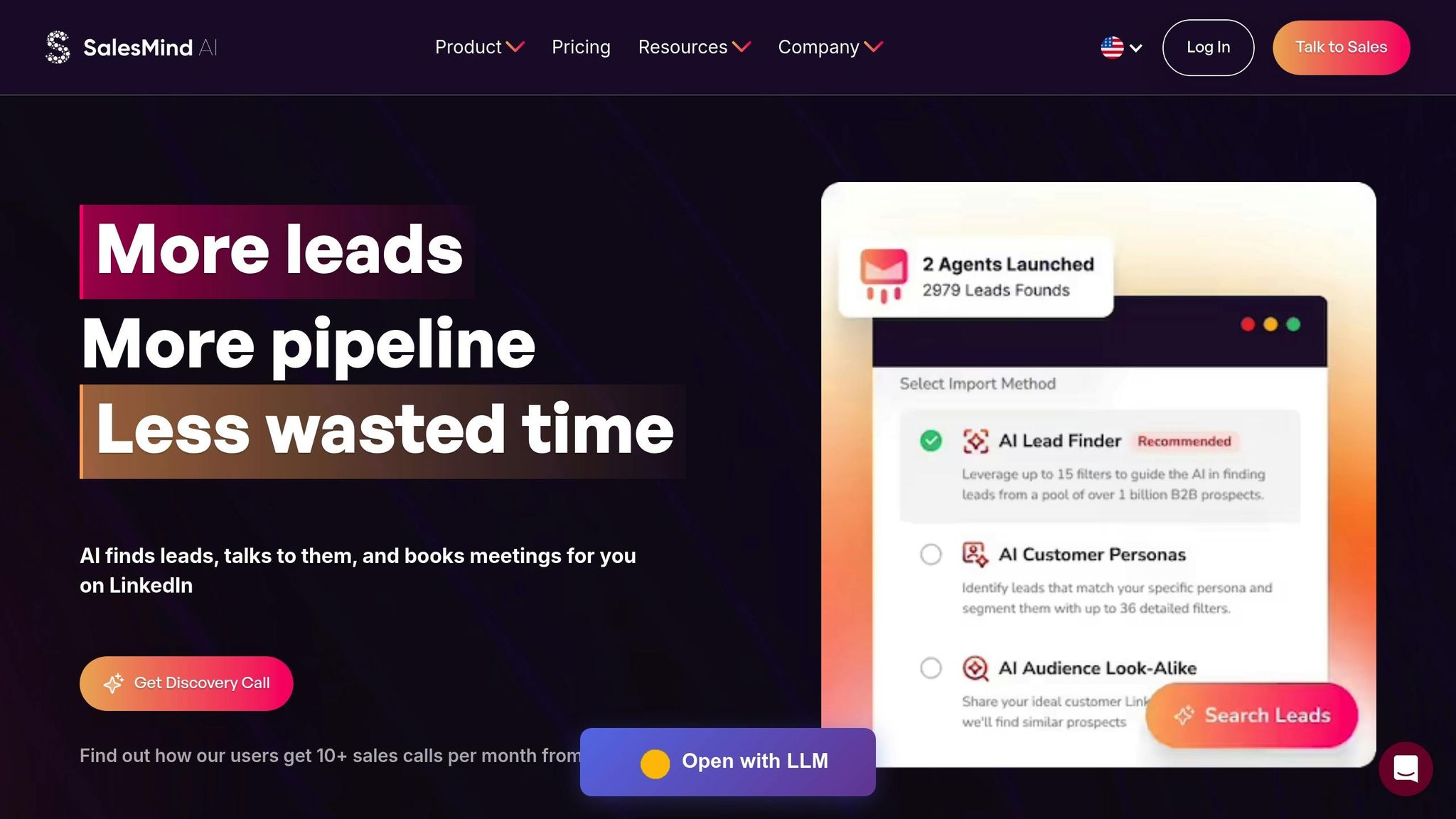
SalesMind AI takes the complexity out of AI-driven LinkedIn outreach by automating personalized messaging, lead qualification, and follow-ups at scale. Its unified inbox consolidates all LinkedIn replies, complete with AI-suggested responses, tags, and reminders. Advanced lead scoring identifies which dormant leads need immediate attention, allowing your team to focus on closing deals rather than chasing prospects.
The platform also pulls insights from prospect profiles and company websites to craft messages that feel personal and relevant, steering clear of the generic, automated tone [1].
"From the very first week, SalesMind AI boosted my productivity in lead prospecting by 10×. At full capacity, the AI managed to get 5 to 10 new conversations started per week."
Seamless integration with LinkedIn and CRM systems ensures every interaction is automatically logged as activities or opportunities. Qualified replies can even trigger automatic meeting scheduling. The master dashboard provides real-time visibility into lead lists, sequences, and interactions, helping your team identify successful strategies and make adjustments on the go [1].
Conclusion
AI-powered LinkedIn lead re-engagement is changing how US-based B2B teams reconnect with inactive leads. Instead of manually managing countless cold leads, AI steps in to handle personalization at scale, analyze behavioral cues, and automate follow-up sequences - while still preserving the personal touch that fosters trust. The payoff? 2–3x higher response rates, more meaningful conversations, and sales teams spending their time closing deals instead of chasing unresponsive leads [2][3].
This approach moves away from impersonal mass outreach and embraces intelligent, context-aware messaging, perfectly aligning with LinkedIn's focus on meaningful connections. By referencing details like recent role changes, company achievements, and engagement with shared content, AI ensures every message feels timely and relevant - even when reaching thousands of leads at once [2][3][5]. It’s a strategy that respects LinkedIn’s guidelines and meets the expectations of US buyers, who prefer clear, results-oriented communication.
The key to success lies in combining AI’s efficiency with human expertise. AI takes care of tasks like segmentation, lead scoring, message timing, and routine follow-ups, freeing your team to concentrate on strategic decisions and relationship building [2][3][4]. With continuous optimization through A/B testing and feedback, re-engagement campaigns can improve significantly - some teams report 20–30% higher conversion rates within just a few months [2][3][4]. These results are even stronger when managed through an all-in-one platform.
SalesMind AI brings it all together, offering a single solution for automated outreach, personalized messaging, lead qualification, and follow-ups - making scalable, personal lead re-engagement a reality.
FAQs
How can AI help personalize LinkedIn lead re-engagement?
AI transforms LinkedIn lead re-engagement by crafting personalized messages that resonate with a prospect's specific interests, behaviors, and preferences. This customized touch boosts the likelihood of meaningful conversations and improved response rates.
By automating tasks such as creating follow-up messages and analyzing engagement trends, AI ensures your outreach stays relevant and well-timed. The result? Stronger relationships and a more effective LinkedIn strategy that fosters trust with potential leads.
How does predictive lead scoring help identify high-potential leads?
Predictive lead scoring leverages data analysis and AI to determine which leads are most likely to turn into customers. By examining patterns, behaviors, and various metrics, it generates a score that pinpoints the leads with the highest potential.
This method allows businesses to streamline their efforts by prioritizing follow-ups with top prospects, concentrating on opportunities that offer the most value, and distributing resources more strategically. The result? A more efficient and effective sales process.
Why is human oversight important in AI-powered LinkedIn outreach?
Human involvement plays a crucial role in AI-powered LinkedIn outreach. It ensures that messages are not only tailored and relevant to the recipient but also free from mistakes. While AI excels at handling tasks on a large scale, human input refines the messaging, aligning it with specific organizational and social expectations to make interactions feel genuine.
By actively monitoring and tweaking campaigns based on immediate feedback, humans can enhance response rates and foster trust with potential connections. The blend of AI’s speed and human insight leads to a more impactful and engaging outreach approach.
Have You Ever Experienced Sales Done by AI?