How AI Uses LinkedIn Behavior for Engagement
AI analyzes LinkedIn actions—profile views, post interactions, and messages—to score leads, personalize outreach, and boost engagement while noting risks.
 Julien Gadea
AI analyzes LinkedIn actions—profile views, post interactions, and messages—to score leads, personalize outreach, and boost engagement while noting risks.
AI analyzes LinkedIn actions—profile views, post interactions, and messages—to score leads, personalize outreach, and boost engagement while noting risks.
Table of Contents
AI is transforming how businesses engage on LinkedIn by analyzing user behavior to improve outreach and lead conversions. By tracking actions like profile views, post interactions, and messaging patterns, AI identifies prospects' intent and prioritizes follow-ups. For example:
- Behavior tracking: AI monitors profile visits, likes, comments, and message responses to gauge interest.
- Predictive scoring: Assigns scores to actions (e.g., +5 for a profile view) to prioritize leads.
- Tailored outreach: Uses natural language processing (NLP) and sentiment analysis to craft personalized messages.
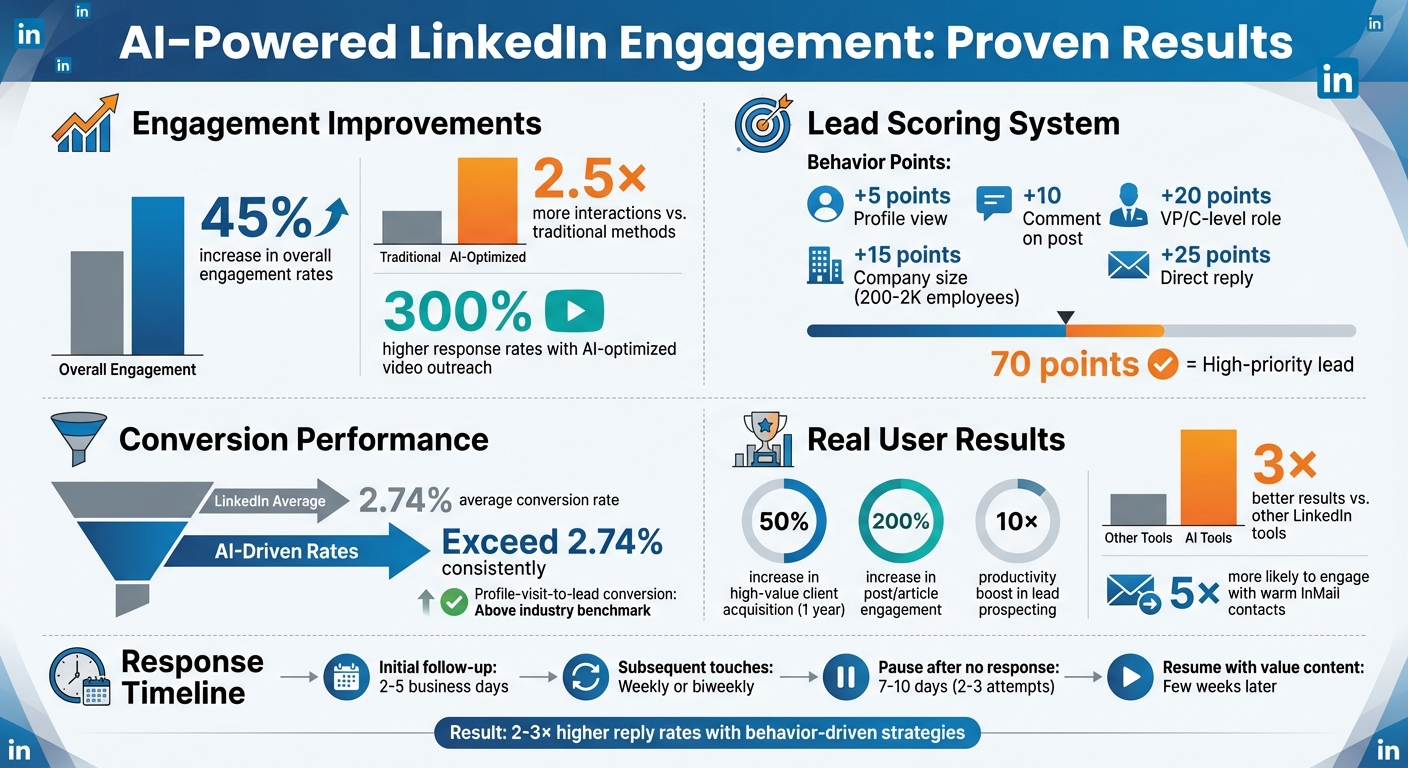
- Improved metrics: Companies report up to 45% higher engagement and 2.5× more interactions with AI-driven strategies.
AI tools like SalesMind AI automate follow-ups, refine messaging based on real-time data, and help sales teams focus on high-priority leads. However, challenges like incomplete data, algorithm bias, and compliance risks require careful oversight to avoid spammy or ineffective interactions.
Key takeaway: AI-powered LinkedIn strategies enhance engagement and streamline sales processes, but balancing automation with thoughtful human input is crucial for success.
AI-Driven LinkedIn Engagement: Key Performance Metrics and Results
How AI Captures and Models LinkedIn Behavior
LinkedIn Behavior Signals AI Tracks
AI systems keep a close eye on both obvious actions and subtle cues to figure out where prospects stand in their buying journey. For instance, repeated visits to a profile - especially when multiple people from the same company are involved - often indicate early interest [2].
Quickly accepted connection requests and frequent interactions with profiles can highlight high-priority prospects [3]. Similarly, engagement levels, ranging from simple likes to detailed comments or shares, provide a clearer picture of a prospect's growing interest [2][4]. Actions like clicking "see more", watching videos, or consistently engaging with content on a specific topic suggest a deeper level of intent [2][5].
Even messaging behavior offers insights. How quickly someone responds, the tone they use, and the length of their replies can signal how ready they are for a sales conversation [3]. Broader network signals, such as mutual connections or interactions with a company page, help AI gauge a prospect’s influence and the potential value of a deal [5].
How Machine Learning Analyzes LinkedIn Data
Machine learning takes all this activity and turns it into actionable insights. Using natural language processing (NLP), it can analyze posts and comments, categorizing them into themes like "budget concerns" or "pipeline challenges." This allows for tailored follow-ups that address specific pain points [2]. Sentiment analysis adds another layer, distinguishing positive feedback (e.g., "this is helpful") that might indicate readiness for a direct pitch, from more skeptical or negative comments that call for a softer, educational approach [2].
Predictive analytics assigns scores to specific behaviors - like +5 for a profile view or +10 for leaving a comment. These scores help prioritize follow-ups, whether it’s sending another message, sharing relevant content, inviting someone to an event, or even pausing outreach for a while [4].
Machine learning also groups prospects based on their engagement patterns. For example, it might classify them as "silent observers", "active engagers", or "fast responders", enabling more personalized strategies for each group [2].
Even with all these tools, AI still faces challenges when it comes to fully understanding LinkedIn behavior.
Limitations in Modeling LinkedIn Behavior
While AI provides detailed insights, its capabilities are not without limits. A major obstacle is incomplete visibility: not all profile viewers can be identified, and some engagement data is only available in aggregate form. This creates gaps in understanding the customer journey [6]. Additionally, infrequent LinkedIn users generate weaker signals, making scoring and segmentation less reliable until more data is collected [2].
Another challenge lies in attribution. Prospects often interact across multiple channels - like email, ads, or in-person events - making it tricky for AI to accurately credit LinkedIn activity alone [6]. Plus, sudden changes in behavior caused by algorithm updates, market disruptions, or viral trends can throw off previously reliable patterns if models aren’t updated regularly [6].
Bias also plays a role. For example, highly active LinkedIn users, often from industries like tech, marketing, or sales, might receive more attention, while quieter decision-makers in other fields could be overlooked [2]. Similarly, models that rely heavily on mutual connections may unintentionally favor specific regions or social networks, potentially hindering efforts to expand into new markets [6].
Ultimately, AI-generated scores are best viewed as probabilistic tools that need validation through real-world interactions.
Behavior-Based Triggers for LinkedIn Engagement
Profile and Content Interaction Triggers
AI leverages specific LinkedIn behaviors as cues to initiate tailored outreach. For instance, a single profile view might lead to a cautious action like adding the viewer to a watchlist or sending a tentative connection request. However, when someone views your profile multiple times over a few days, it signals stronger interest, prompting a personalized message - often including a resource or case study. A simple "like" on a post suggests moderate curiosity, while comments addressing challenges, pricing, or implementation are flagged as high-intent signals. Sharing your content or tagging colleagues triggers a broader outreach, engaging both the sharer and their tagged connections. According to LinkedIn’s own data, members are 5× more likely to engage with InMail when they’re identified as "warm" contacts [6].
Messaging and Conversation Triggers
Interactions through LinkedIn messages further refine how outreach evolves. For example, if an InMail is opened but unanswered within 3–5 business days, it prompts a follow-up message - shorter and with a fresh subject or a low-pressure call-to-action. When someone clicks a link to explore a case study or pricing page but doesn’t reply, it’s treated as a signal of warm interest, often leading to a more direct message suggesting a meeting during typical U.S. business hours. Natural language processing tools identify phrases like "this looks interesting" or "can you share more details?" as signs of high interest. These responses trigger workflows that share additional information or even calendar links to book a meeting. Positive or curious replies are flagged for immediate human follow-up, while neutral responses keep the conversation in a nurturing sequence. Negative replies or explicit opt-outs stop further outreach immediately.
Time-Based and Multi-Step Nurturing Triggers
Timing and sequencing play a critical role in keeping engagement effective without overwhelming prospects. Initial follow-ups are typically sent 2–5 business days after the first message, while subsequent touches are spaced weekly or biweekly to remain visible without being intrusive. If there’s no response after 7–10 days and 2–3 attempts, the sequence pauses for a few weeks before resuming with content that provides value - such as industry benchmark reports relevant to U.S. market trends. AI-driven workflows adapt based on real-time behavior. For instance, if a prospect engages with educational content but ignores meeting requests, the focus shifts to delivering more value rather than pushing for a meeting. On the other hand, multiple high-intent signals within a short period - like repeated post interactions, profile visits, or link clicks - fast-track the outreach to a direct call. Companies using these adaptive, behavior-driven strategies report 2–3× higher reply rates compared to manual, non-personalized campaigns [5][4]. These triggers form the backbone of an AI-powered approach that continuously fine-tunes LinkedIn outreach for better results.
Measured Results of AI-Driven LinkedIn Engagement
Improvements in Engagement Metrics
AI-powered tools are reshaping how professionals engage on LinkedIn, delivering measurable improvements across the board. By leveraging tailored engagement strategies, businesses are seeing engagement rates soar - AI trend analysis, for instance, has been shown to increase interaction rates by 2.5× and boost overall engagement by up to 45% compared to traditional approaches [2]. Connection requests crafted with AI, using profile data and shared interests, lead to higher acceptance rates.
One standout example is personalized video outreach. When optimized with AI, these videos achieve response rates up to 300% higher than generic text messages, as reported by consultants who embraced this approach [5]. Additionally, B2B teams using AI to fine-tune posting schedules, personalize messaging, and improve targeting have seen their profile-visit-to-lead conversion rates surpass LinkedIn's average benchmark of 2.74% [2].
Impact on Lead Nurturing and Sales Performance
AI is also proving invaluable in lead nurturing and sales. By analyzing behavioral signals, AI-powered lead scoring helps sales teams zero in on high-intent prospects, boosting conversion rates at every stage of the funnel. For example, one professional who utilized AI-driven network analysis and targeted content reported a 50% increase in acquiring high-value clients within a year [5]. Another saw a 200% increase in post and article engagement after implementing AI-based content recommendations [5].
User testimonials further highlight these successes. Henry F., an Enterprise Account Executive at Salesforce, shared:
"Having used the free trial for only 8 days, I am already getting 4-5 responses per day and am confident they will start converting to booked meetings and new business." [1]
Alex L., CTO of Slash Co, noted:
"From the very first week, SalesMind AI boosted my productivity in lead prospecting by 10×. At full capacity, the AI managed to get 5 to 10 new conversations started per week." [1]
Similarly, Steven Huibers, COO of Policereports.ai, remarked:
"I've used a couple of other tools for LinkedIn outbound, but this has gotten me 3× the results." [1]
These results are a testament to AI's ability to identify high-intent signals, automate timely follow-ups, and keep prospects engaged with relevant content. The outcome? Shorter sales cycles and a stronger sales pipeline, with conversion rates consistently exceeding the 2.74% benchmark [2].
Risks and Ethical Considerations
Despite these impressive gains, the use of AI on LinkedIn isn't without potential pitfalls. Over-automation can lead to generic or spammy messages, which may harm your brand's reputation, reduce response rates, or even trigger account restrictions under LinkedIn's policies [3] [6] [7]. Misconfigured AI tools that ignore context or send messages at odd hours - outside typical U.S. business times - can also reduce message visibility and effectiveness [3] [6].
Another concern is algorithmic bias. If AI models rely solely on historical data without oversight, they could unintentionally favor certain roles, industries, or demographics, creating unfair targeting patterns [7]. Additionally, privacy issues arise when tools scrape or misuse data in ways that violate LinkedIn's terms of service, exposing organizations to potential legal and reputational risks [6].
To navigate these challenges, human oversight is critical. Teams should review and refine first-touch messages, set conservative daily limits, regularly audit AI outputs for bias, and ensure all tools comply with LinkedIn’s policies [3] [6] [7].
Here’s a quick breakdown of the benefits and risks:
| Pros | Cons |
|---|---|
| Scalable personalization and higher engagement rates [2] [5] | Risk of spammy or inauthentic interactions if overused [3] [6] |
| Improved lead scoring, prioritization, and time efficiency [3] [5] | Dependency on third-party tools and algorithms [3] |
| Data-driven content and outreach optimization [2] [4] | Privacy and compliance concerns [6] [7] |
| Higher response rates and better conversion metrics [5] | Potential bias in targeting and scoring [7] |
| Shortened sales cycles and better pipeline quality [3] [5] | Risk of violating LinkedIn policies if misconfigured [3] [6] |
Striking the right balance between automation and authenticity, while staying compliant, is key to achieving sustainable success with AI on LinkedIn.
sbb-itb-817c6a5
Using Behavior-Based Triggers with SalesMind AI
How SalesMind AI Uses Behavioral Signals
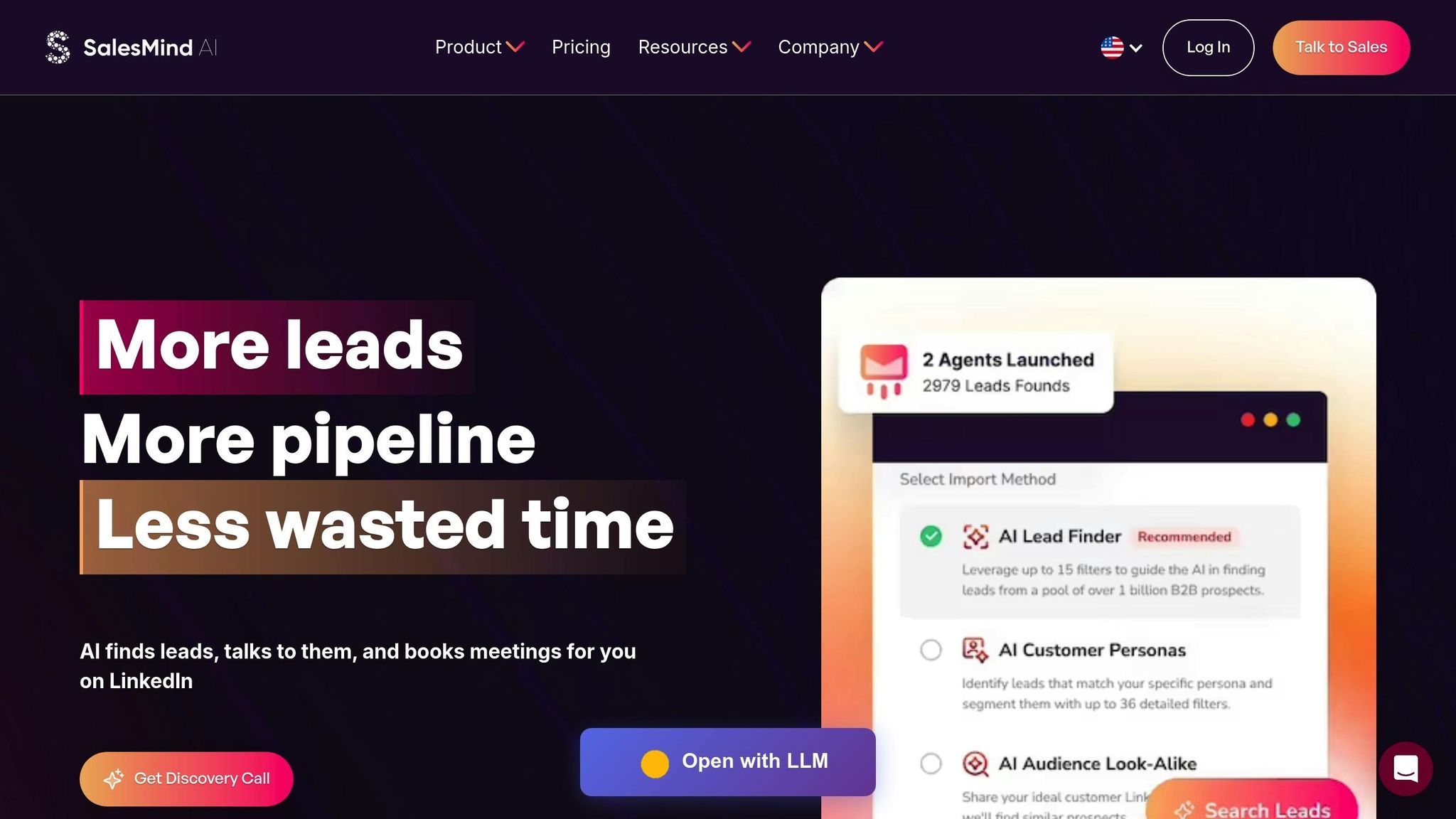
SalesMind AI takes behavior analysis to the next level by monitoring key actions such as profile views, connection requests, replies, post reactions, comments, shares, link clicks, and even the timing of activities. These behaviors are transformed into actionable metrics like 30-day reply rates and engagement frequency, allowing the platform to prioritize prospects effectively.
Here’s how it works: Imagine a U.S.-based VP of Sales who frequently engages with posts about pipeline forecasting. SalesMind AI identifies this pattern, prioritizes outreach centered on revenue predictability, references the prospect's recent interactions, and schedules communication during times when they are most likely to respond.
"Completely automated our sales prospecting on LinkedIn. Ready integrated with LinkedIn, it was easy to set up in terms of selecting the audience and setting up the sequence of follow-up messages until the LinkedIn member reacts."
– Roberto K., Chief Product Officer at aCommerce
By quantifying engagement, SalesMind AI powers its automated outreach features, making it easier to connect with high-priority leads.
Features for Automated LinkedIn Outreach
SalesMind AI offers a suite of features designed to run behavior-based campaigns seamlessly. Its AI-powered unified inbox organizes LinkedIn interactions into a prioritized queue, highlighting high-intent signals like clicked pricing links or unanswered messages after 48 hours. The system provides tailored reply suggestions and automatically tags conversations by their stage, ensuring they reach the right team member.
The platform also uses advanced lead scoring to rank prospects. Points are assigned based on criteria such as:
- Role fit: +20 points for VP or C-level executives.
- Company size: +15 points for companies with 200–2,000 employees.
- Engagement intensity: +5 points per profile visit, +10 per comment, and +25 per direct reply.
When a prospect’s score hits a certain threshold - say, 70 points - they trigger alerts or are handed over to senior representatives. Lower-scoring prospects remain in automated nurturing tracks, ensuring no lead is overlooked. Additionally, SalesMind AI adapts follow-ups based on behavior, such as delaying post-connection messages by a few days or sending an ROI summary after a case-study link is clicked.
Continuous Optimization Through Data Feedback
SalesMind AI doesn’t just automate - it improves. By tracking performance metrics like open rates, reply rates, positive responses, and meetings booked, the platform continuously refines its strategies. It tweaks subject lines, connection hooks, and messaging while adjusting send times based on historical engagement trends. This feedback loop ensures trigger thresholds are always aligned with current LinkedIn behaviors, directing highly engaged prospects to sales teams while nurturing others over the long term.
"SalesMind AI has proven very useful to our sales team in reducing the massive pain points of manually tracking each and every lead interaction. To have one master dashboard not just for yourself but for our entire team and try different lead lists, sequences, and track them all in real time is fantastic."
– Rahul P., Senior Advisor at Bounty Media
How To Automate Engagement On Linkedin With AI
Conclusion: The Future of AI-Driven LinkedIn Engagement
AI is reshaping how B2B companies connect and engage on LinkedIn. By analyzing behavior signals - like profile views, content interactions, and messaging trends - AI makes it possible to deliver outreach that's both scalable and personalized without losing that human touch.
The results speak for themselves: AI-driven strategies can increase engagement by up to 45% and generate 2.5× more interactions compared to manual efforts, far outperforming LinkedIn's average conversion rate of 2.74% [2].
Looking ahead, exciting trends are emerging. Real-time video customization is showing potential to boost response rates by 300% [5]. Features like linguistic mirroring, which adapts communication to match a prospect's tone, and network dynamics analysis, which leverages mutual connections, are expected to redefine outreach. AI chatbots and interactive tools like quizzes are also set to encourage more meaningful two-way interactions, while emotion analysis could help sales teams better understand the sentiment of their prospects. These advancements promise a future where automation and genuine human connection work hand in hand.
The key to success in this evolving space lies in striking the right balance between automation and authenticity. While AI excels at processing data, optimizing timing, and scoring leads, the most effective strategies combine these strengths with a personal touch. Tools like SalesMind AI, which uses behavioral signal tracking and offers a unified inbox, illustrate how technology can enhance, rather than replace, human connection.
As LinkedIn behaviors continue to shift, companies can stay ahead by using AI feedback loops to refine their strategies. By analyzing response rates, engagement patterns, and conversion data, businesses can fine-tune their messaging, adjust timing, and update triggers to ensure their outreach remains effective. This approach transforms LinkedIn into a reliable revenue channel, delivering the right message to the right audience in a way that resonates.
FAQs
How does AI use LinkedIn activity to prioritize leads?
AI reviews LinkedIn activity by studying behavioral signals such as how users engage, their interaction history, and overall activity levels. It assigns scores to leads based on actions like replying to messages, viewing profiles, or interacting with posts, pinpointing those most likely to convert.
By prioritizing these high-potential leads, this approach streamlines outreach efforts, saving time and boosting the success rate of engagement strategies.
What challenges come with using AI for LinkedIn engagement?
Using AI to enhance LinkedIn engagement comes with its own set of hurdles. A major concern is making sure AI can correctly identify and qualify leads without misreading user actions or intentions. Misinterpretations here can lead to missed opportunities or awkward interactions.
Another tricky area is steering clear of generic or spammy messages. These not only hurt your credibility but also discourage genuine engagement. Striking the right tone is key to building trust and fostering meaningful connections.
Then there’s the issue of data privacy. Businesses need to navigate regulatory requirements carefully while ensuring users feel their information is handled responsibly. On top of that, AI-driven interactions must feel authentic and tailored. If the communication comes across as too robotic, it risks alienating potential connections instead of bringing them closer.
How can businesses use AI on LinkedIn ethically?
To use AI responsibly on LinkedIn, businesses need to focus on transparency and privacy. This means being upfront about how data is gathered and utilized, ensuring users are aware of these practices, and providing clear opt-out options whenever possible.
It's also essential for companies to conduct regular audits of their AI systems to reduce bias and uphold fairness. Adhering to LinkedIn's guidelines and steering clear of manipulative tactics are crucial steps in maintaining trust and credibility in AI-powered interactions.
 JG
JG