Top 5 AI Algorithms for Lead Scoring
Five AI lead-scoring models explained — their accuracy, interpretability, and best B2B use cases to help prioritize high‑value leads.
 Julien Gadea
Five AI lead-scoring models explained — their accuracy, interpretability, and best B2B use cases to help prioritize high‑value leads.
Five AI lead-scoring models explained — their accuracy, interpretability, and best B2B use cases to help prioritize high‑value leads.
Table of Contents
Lead scoring helps businesses prioritize potential customers by assigning scores based on their likelihood to convert. With AI, this process becomes faster and more accurate by analyzing large datasets like CRM records, website activity, and social media interactions. The article highlights five popular AI algorithms for lead scoring:
- Logistic Regression: Simple and transparent, ideal for small datasets. It predicts conversion probabilities but struggles with imbalanced data without adjustments.
- Random Forest: Combines decision trees for reliable scoring. Handles complex data well and reduces overfitting.
- Gradient Boosting Machines (GBM): Builds models iteratively for high accuracy, especially with large datasets. Great for nuanced lead scoring.
- Neural Networks: Processes massive structured and unstructured data but lacks interpretability. Best for advanced, large-scale applications.
- Support Vector Machines (SVM): Focuses on critical data points for precise scoring in high-dimensional datasets. Requires more computational resources.
Each algorithm has strengths and trade-offs depending on your data, sales pipeline complexity, and need for transparency. For beginners, Logistic Regression is a good starting point, while GBM or Neural Networks work well for enterprises with complex pipelines.
| Algorithm | Accuracy | Interpretability | Computational Cost | Best Use Case |
|---|---|---|---|---|
| Logistic Regression | Moderate | High | Low | Small datasets, simple lead qualification |
| Random Forest | High | Moderate | Moderate | Mixed data types, general lead scoring |
| Gradient Boosting (GBM) | Very High | Low to Moderate | High | Enterprise pipelines, precise scoring |
| Neural Networks | Very High | Very Low | Very High | Large datasets, behavioral patterns |
| Support Vector Machines | High | Low | Moderate to High | High-dimensional datasets |
AI-powered lead scoring can increase conversion rates by 20–30% and shorten sales cycles by 20–40%. Start with a data audit and pilot program to see measurable results.
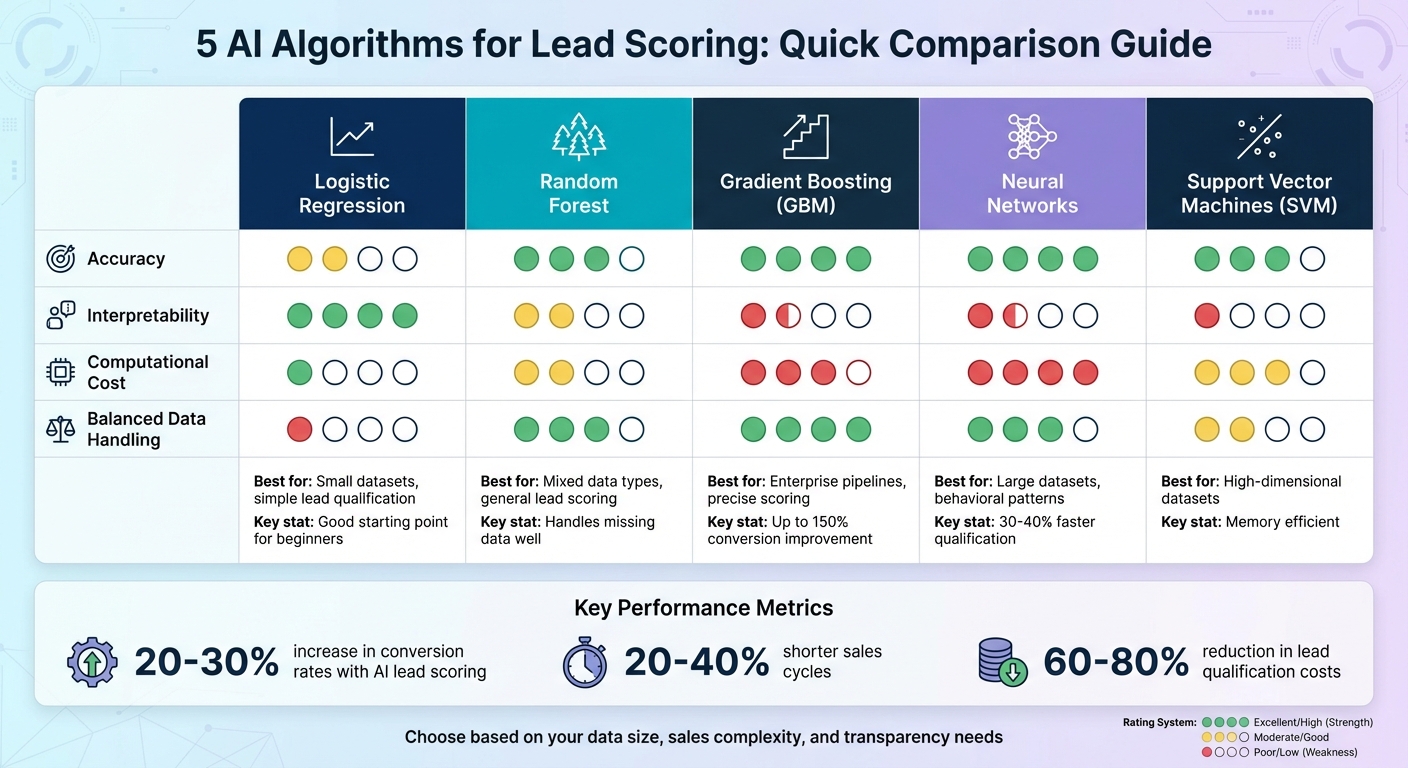
AI Lead Scoring Algorithms Comparison: Accuracy, Interpretability, and Use Cases
Using AI for Lead Scoring (AI for Business People Series)
1. Logistic Regression
Logistic regression is a supervised machine learning algorithm designed to predict the probability of a binary outcome - essentially answering the question of whether a lead will convert or not. By analyzing historical CRM data, such as firmographic details, technographic insights, and intent signals, it identifies patterns that correlate with conversion events [3]. The result? A probability score ranging from 0 to 100, which helps sales teams prioritize high-potential leads [3][7].
This algorithm is widely used for predictive lead scoring and often paired with decision trees as one of the most effective methods [8]. It’s especially useful for B2B organizations with complex sales cycles and ample historical data on both closed-won and closed-lost deals [3]. It also serves as a foundation for more advanced models discussed later.
Interpretability for Sales Teams
One of the key strengths of logistic regression is its transparency. It assigns clear weights to different lead characteristics - like job title or number of website visits - based on their influence on conversion likelihood [5]. This level of clarity builds trust among sales and marketing teams, as they can easily understand what factors are driving a lead’s prioritization.
"Focus on platforms that allow for 'explainable AI,' meaning the AI model provides transparency on how it derives lead scores. This transparency helps build trust in the system, particularly when sales and marketing teams need to justify lead prioritization." - Marc Perramond, VP Product, Account Intelligence Platform, Demandbase [5]
Handling Imbalanced Datasets
A common challenge with logistic regression is its tendency to favor the majority class - in this case, non-conversions [9]. To address this, Balanced Logistic Regression adjusts by assigning higher weights to the minority class, significantly improving recall rates for conversions - from 0.19 to 0.78 [9].
Why It Works for B2B Sales
Logistic regression is particularly well-suited for B2B sales because it converts raw behavioral data into actionable insights that sales teams can immediately use [5]. However, its effectiveness depends on having enough historical conversion data in your CRM for training the model [3]. Regular audits are also essential to ensure the algorithm stays accurate, especially if your market or product offerings evolve [3][7].
Next, we’ll dive into another powerful model for lead scoring.
2. Random Forest
Random Forest is an ensemble learning algorithm that combines the outputs of multiple decision trees through majority voting. This approach reduces overfitting and improves the reliability of lead scores by training on diverse random subsets of CRM data [10][11].
"An ensemble model called Random Forest aggregates several decision trees to increase the expected accuracy." - Vasanta Kumar Tarra, Lead Engineer, Guidewire Software [11]
Accuracy in Predicting Lead Conversion
Random Forest stands out for its ability to handle high-dimensional data, making it a perfect fit for the complex nature of B2B sales. It processes a wide range of variables - like firmographics and behavioral signals - without sacrificing accuracy [10][4]. By using random subsets of both data and features for each tree, the algorithm introduces diversity into its predictions, leading to more reliable and precise lead scores [10]. Research from 2024 shows that companies adopting AI-driven lead scoring have seen a 20–30% increase in conversion rates [1]. This capability to detect subtle patterns within intricate datasets makes Random Forest especially valuable in B2B sales, where the buying process often involves multiple stakeholders and extended sales cycles [1].
Interpretability for Sales Teams
One of the standout features of Random Forest is its Feature Importance functionality. This allows the algorithm to rank variables - such as job titles, company revenue, or specific web behaviors - based on their impact on conversion predictions [10]. These insights can be used to guide sales teams in identifying behaviors that indicate genuine buying intent. For example, if the model highlights "pricing page visits" as a key predictor, sales reps can focus their efforts on leads exhibiting this behavior [10][6]. Many modern platforms now integrate "Explainable AI" features directly into CRMs, enabling sales teams to differentiate between casual inquiries and serious prospects [1][4].
Ability to Handle Imbalanced Datasets
Random Forest effectively tackles the challenge of imbalanced datasets, where non-conversions often far outnumber conversions. Using bootstrap aggregating (bagging), it trains multiple deep decision trees on various random samples of data [12]. Additionally, feature bagging - selecting random subsets of features at each decision point - ensures that less obvious but critical predictors of conversion are not overshadowed by more dominant variables [12]. These capabilities make Random Forest highly adaptable to the complexities of B2B lead scoring.
Suitability for B2B Sales Applications
Random Forest shines in B2B sales scenarios due to its ability to handle missing data and outliers seamlessly, maintaining accuracy even when CRM data is incomplete [10]. It doesn’t require normalization or standardization, simplifying its integration with real-world datasets [10]. Unlike algorithms that focus solely on the most recent lead activity, Random Forest evaluates the entire journey of a lead. This is essential in B2B sales, where the process is lengthy and involves multiple decision-makers [1]. By feeding the algorithm both explicit CRM data and implicit marketing signals, businesses can automate alerts or outreach when a lead's score crosses a high-intent threshold [1][4]. This makes Random Forest not just a technically reliable choice but also an effective tool for navigating the complexities of B2B sales environments.
3. Gradient Boosting Machines (GBM)
Gradient Boosting Machines (GBM) work by building decision trees one after another, with each tree aiming to correct the errors made by its predecessor. This step-by-step process helps the model identify subtle patterns, which is particularly useful for B2B lead scoring [14].
Accuracy in Predicting Lead Conversion
Between January 2020 and April 2024, researchers Laura González-Flores, Jessica Rubiano-Moreno, and Guillermo Sosa-Gómez analyzed 15 classification algorithms using real CRM data from a B2B software company focused on product design and manufacturing. Their findings revealed that the Gradient Boosting Classifier outperformed all other algorithms in terms of accuracy and ROC AUC. The study highlighted "source" and "lead status" as the most influential factors in predicting lead conversion [6].
"The potency of using AI for predictive lead scoring lies in its ability to detect subtle correlations that are almost indiscernible for humans." - Sushma Shetty, LeadSquared [1]
GBM’s iterative learning method continuously improves its predictions by refining earlier outputs. This makes it particularly effective at identifying patterns that differentiate high-potential leads from those less likely to convert [6]. Its ability to handle these nuanced patterns also allows GBM to excel in addressing imbalanced datasets, a frequent issue in B2B lead scoring.
Ability to Handle Imbalanced Datasets
Beyond its accuracy, GBM is also adept at managing imbalanced datasets, a common challenge in B2B scenarios where conversion rates are typically just 3–5% [7]. This imbalance means there are far more non-converting leads than actual deals, which can cause many algorithms to prioritize the majority class. GBM tackles this issue by adjusting weights and focusing on the loss gradients of misclassified examples. Each iteration of the model hones in on these harder-to-classify cases [13].
"Boosting is an iterative technique that adjusts the weights of incorrectly classified instances, focusing more on hard-to-classify examples." - AnantheshJShet, Data Science Author [13]
This capability is a game-changer for sales teams. With sales reps often spending up to 40% of their time pursuing leads that don't convert [7], using AI-driven lead prioritization powered by GBM can improve conversion rates by as much as 150% [4].
Suitability for B2B Sales Applications
GBM is particularly well-suited for B2B environments due to its step-by-step learning approach, which aligns with the multi-touch decision-making process often seen in these sales cycles. It thrives on structured, tabular data typically found in CRM systems [14]. Unlike deep learning models that specialize in unstructured data like images or text, GBM is designed to process firmographics, engagement metrics, and behavioral data efficiently. Its feature importance analysis not only helps sales teams prioritize leads but also provides insights into why certain leads are more promising [6].
To ensure reliable performance, GBM includes mechanisms like shrinkage and subsampling to prevent overfitting [14]. This makes it a dependable tool for handling the complex datasets that characterize B2B sales, with multiple digital touchpoints and interactions [6]. Companies that adopt AI-driven lead scoring often report a 10–20% increase in revenue within the first year, and GBM’s ability to adapt to consultative, multi-touch sales processes makes it an ideal choice for these scenarios [1] [6].
sbb-itb-817c6a5
4. Neural Networks
Neural networks are exceptional at spotting intricate, non-linear patterns within massive datasets. They work across both structured data - like CRM records - and unstructured data, such as email exchanges, social media activity, and customer reviews. This capability helps create detailed lead profiles, serving as a strong base for accurate lead scoring in complex B2B scenarios [11].
Accuracy in Predicting Lead Conversion
One of the standout features of neural networks is their ability to process thousands of data points at once. This makes them particularly effective for large-scale B2B applications. By learning from historical data, these models can evaluate new, unseen lead profiles - even if they don’t perfectly align with past successful conversions [4]. In fact, AI-driven lead scoring has been shown to improve conversion rates by 20–30% and increase revenue by 10–20% [1].
"Deep learning models, particularly neural networks, identify complex patterns and correlations that traditional scoring mechanisms might overlook." - Vasanta Kumar Tarra, Lead Engineer, Guidewire Software [11]
Neural networks also stand out because they continuously update predictions as fresh data comes in. This real-time adaptability helps them keep pace with shifting B2B buyer behaviors [11][6]. These dynamic capabilities make them a clear step up from simpler models discussed earlier.
Interpretability for Sales Teams
Despite their impressive accuracy, neural networks often face criticism for their "black box" nature, which can make their decision-making process harder to understand. To address this, many modern CRM platforms now integrate explainable AI features. These tools provide insights into lead scores by highlighting key factors - like website activity or firmographic details - rather than just showing a raw score [1].
To maintain reliability, it’s essential to retrain neural network models regularly and ensure they are built on robust datasets. Ideally, this includes at least 100 converted leads and 100 non-converted leads to prevent issues like model drift [7].
Suitability for B2B Sales Applications
Neural networks are particularly effective in B2B environments characterized by lengthy sales cycles, multiple stakeholders, and numerous touchpoints [1][11]. They excel at handling imbalanced datasets, where conversion rates often range between 3–5%. By identifying subtle patterns and sequences of actions, these models can distinguish high-value leads from casual browsers [7]. As a result, AI-driven lead scoring with neural networks can cut the time sales teams spend on initial lead qualification by 30–40% and reduce overall lead qualification costs by 60–80% [1].
5. Support Vector Machines (SVM)
Support Vector Machines (SVM) take a unique approach by focusing on the most relevant data points, known as support vectors. These models emphasize the decision boundary, relying only on these critical points, which helps them handle noisy B2B lead data effectively. Like other models, SVMs bring their own strengths to an AI-powered lead scoring strategy.
Handling Imbalanced Datasets
SVMs are particularly adept at managing imbalanced datasets. They achieve this by using a soft margin, which allows for some misclassifications, and by leveraging a technique called the kernel trick. A common kernel, the Radial Basis Function (RBF), helps SVMs separate complex, non-linear lead profiles. The regularization parameter (C) can be adjusted to control the softness of the margin, striking a balance between overfitting and tolerating errors.
Challenges in Interpretability
Despite their mathematical sophistication, SVMs can be harder for sales teams to interpret compared to models like logistic regression or decision trees. The hyperplane they generate exists in a high-dimensional space, making it difficult to visualize or explain. This lack of transparency can make it challenging to justify why a specific lead received a particular score.
Fit for B2B Sales Applications
SVMs shine in B2B settings with high-dimensional data, where attributes like firmographics, demographics, and behavioral patterns come into play. They are also memory-efficient, as they retain only the support vectors instead of the full training dataset. However, training SVMs on very large datasets can be slower compared to simpler models. Despite this, organizations using AI-driven lead scoring have reported impressive results, including up to a 30% increase in conversion rates and a 60–80% reduction in lead qualification costs [1]. These benefits highlight the value of SVMs as part of a broader range of AI tools, which will be explored further in the algorithm comparison table.
Algorithm Comparison Table
The table below offers a quick side-by-side look at the strengths and trade-offs of various AI algorithms for lead scoring, helping you navigate which might work best for your B2B sales strategy.
Selecting the right algorithm depends on factors like your data size, the complexity of your sales pipeline, and team priorities. For instance, Logistic Regression is highly transparent but struggles with intricate patterns. Meanwhile, Random Forest and Gradient Boosting Machines (GBM) shine with imbalanced datasets, offering strong accuracy. Neural Networks excel at processing massive datasets but function as a "black box", making them less interpretable. Finally, Support Vector Machines (SVM) are effective in high-dimensional spaces but come with significant computational demands.
| Algorithm | Accuracy | Interpretability | Computational Cost | Balanced Data Handling | Best B2B Use Case |
|---|---|---|---|---|---|
| Logistic Regression | Moderate | High | Low | Poor (requires tuning) | Simple binary qualification; small/medium datasets. |
| Random Forest | High | Moderate | Moderate | Good | General lead scoring with mixed data types. |
| Gradient Boosting (GBM) | Very High | Low to Moderate | High | Excellent | High-precision scoring for large enterprise pipelines. |
| Neural Networks | Very High | Very Low | Very High | Good | Analyzing complex behavioral patterns in massive datasets. |
| Support Vector Machines (SVM) | High | Low | Moderate to High | Moderate | High-dimensional data (e.g., text-based signals). |
For example, a recent case study highlighted that the Gradient Boosting Classifier outperformed traditional methods in both accuracy and ROC AUC metrics [6]. This makes it a strong contender for enterprises managing extensive and complex lead pipelines.
If you're new to AI-powered lead scoring, Logistic Regression is a reliable starting point. It provides clear, easy-to-understand results, which can be crucial for sales teams. As your data grows and your needs evolve, transitioning to Random Forest or GBM can offer a significant accuracy boost, justifying the additional computational effort [16]. Businesses using AI lead scoring have reported a 25% increase in conversion rates and a 30% reduction in manual qualification time [15].
This comparison equips you with the insights needed to choose the best algorithm to enhance your lead scoring strategy.
Conclusion
Selecting the best AI algorithm for lead scoring boils down to your business's unique needs. Different models shine under different conditions, offering a variety of options for modern lead scoring. For instance, Logistic Regression is ideal when transparency and smaller datasets are priorities. Random Forest and Gradient Boosting Machines (GBM) provide excellent accuracy, especially for intricate B2B pipelines with mixed data types. Meanwhile, Neural Networks handle large-scale data exceptionally well, even if their "black box" nature makes interpretation challenging. On the other hand, Support Vector Machines (SVM) work effectively with high-dimensional data, though they demand more computing power.
The choice ultimately depends on two key factors: the size of your data and the need for explainability. Transparent models are especially valuable when your sales team needs a clear understanding of why a lead received a particular score. Research indicates that conversion rates can improve by 20–30% when using AI-driven scoring, while some organizations report sales cycle reductions of 20–40% as a result of improved lead prioritization[1].
Before diving in, it’s crucial to conduct a data audit. This helps ensure your CRM data is clean and identifies any gaps in behavioral or firmographic information[5]. A 30-day pilot program can also be a game-changer - it allows you to test whether high-scoring leads are converting at better rates than your baseline[2]. Involving your sales team during this phase ensures the algorithm’s definition of an "ideal customer" aligns with what actually works in practice[5].
Tools like SalesMind AI simplify this process by combining advanced lead scoring with LinkedIn outreach automation. Features like a unified inbox and CRM integration can reduce manual qualification time by 30–40%[1], giving your sales team more time to focus on meaningful, high-value interactions. With the right algorithm and tools, lead scoring becomes a precise, data-driven strategy that drives results. Stay agile - retrain your models as buyer behaviors shift, and integrate scoring seamlessly into your sales process to maximize your ROI.
FAQs
What’s the best way to choose an AI algorithm for lead scoring?
To pick the best AI algorithm for lead scoring, start by identifying your business objectives. Are you focusing on prioritizing high-value leads, boosting conversion rates, or speeding up the sales cycle? Once your goals are clear, take a close look at the data you have - this could include demographic information, website interactions, or CRM updates. If your dataset is large and contains intricate patterns, advanced models like gradient-boosted trees or neural networks might be the way to go. On the other hand, for smaller datasets or when transparency is a priority, simpler models like logistic regression or decision trees are often a better fit.
It’s a good idea to run a short pilot test with multiple algorithms to determine which one performs best for your specific needs. Popular options include logistic regression, Random Forest, XGBoost, and shallow neural networks. Evaluate their performance using metrics such as AUC-ROC or lift. Beyond raw performance, think about practical considerations like scalability, how well the algorithm integrates with your CRM, and how easy it will be to maintain. Tools like SalesMind AI can make this process easier by providing advanced lead-scoring algorithms, LinkedIn integration, and automation features that streamline your workflow. These tools can help you zero in on the most effective solution for your sales strategy.
What are the key benefits of using AI for lead scoring compared to traditional methods?
AI-powered lead scoring brings precision and speed to the table by processing massive datasets from various sources. Unlike manual methods, AI can uncover intricate patterns that might go unnoticed, ensuring leads are prioritized with greater reliability.
What’s more, AI evolves as it learns from new data, keeping up with shifting market trends. By removing human bias and static scoring rules, it offers a more impartial and flexible way to qualify leads.
How can I make AI-based lead scoring models more understandable for my sales team?
To make your AI-driven lead scoring model more accessible and understandable for your sales team, start with interpretable algorithms like logistic regression or decision trees. These models break down how specific factors - like company size or recent website activity - affect a lead's score. This clarity makes it easier to explain and trust the results.
For more advanced models, such as gradient-boosted trees, tools like SHAP or LIME can help. These tools offer clear, visual explanations of how predictions are made. Integrating these visual insights into your SalesMind AI dashboard allows your team to quickly grasp why a lead received a particular score and tailor their outreach accordingly.
To build trust and encourage adoption, make it a habit to review model outputs with your team. Document feature definitions and keep a leaderboard of key features visible. This transparency ensures your AI tool is viewed as a reliable assistant rather than an opaque "black box", leading to better engagement and stronger sales results.
 JG
JG